
Modern Berlin along the Spree: a walk from Hauptbahnhof
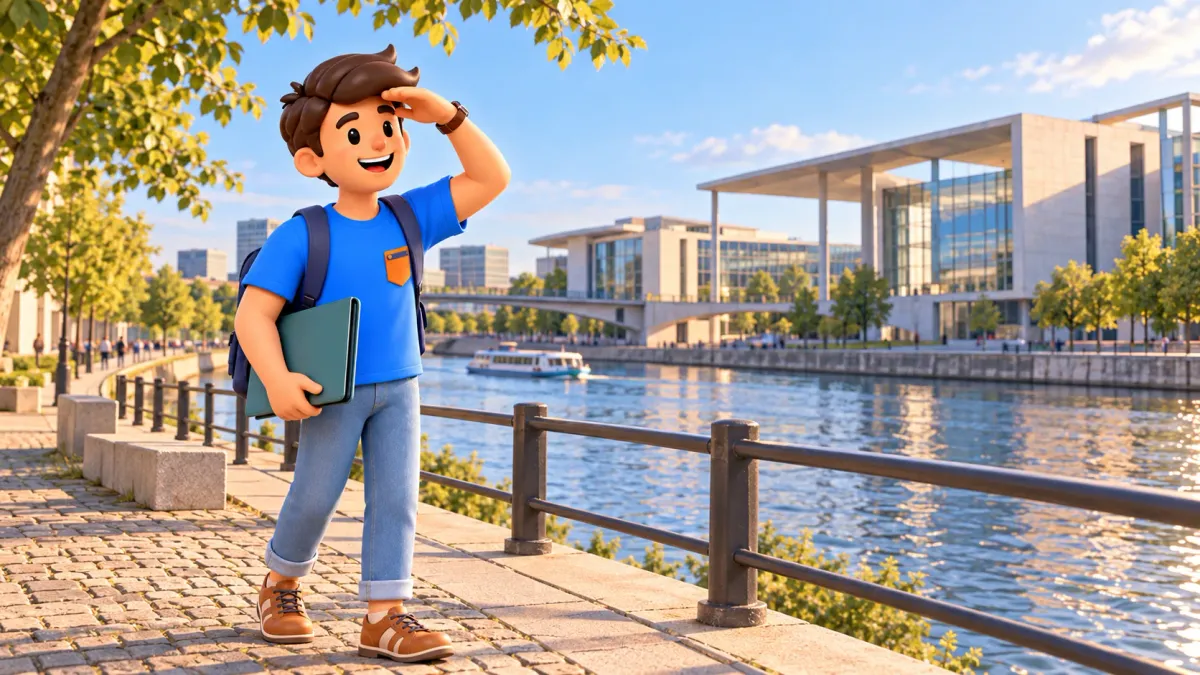
For a walk through contemporary Berlin, start at Hauptbahnhof’s southern exit on Washingtonplatz, cross the Spree into Spreebogenpark and explore the public spaces around the Chancellery and parliamentary buildings. Finish across the river near the Marie-Elisabeth-Lüders-Haus, using Marschallbrücke as your ordinary street crossing. Allow about two and a half hours for looking, walking and resting.
This is an outdoor architecture walk, with a brief look inside the station if convenient. A Reichstag dome appointment, guided visit or exhibition needs additional time. The return to Hauptbahnhof is also separate. The pleasure lies in seeing buildings respond to water, open ground and one another, rather than collecting the maximum number of entrances.
How to give the walk a comfortable rhythm
Begin on Washingtonplatz after you have found the southern station exit. Cross Gustav-Heinemann-Brücke into the park, look towards the Federal Chancellery, then continue through public spaces towards the Paul-Löbe-Haus and the Reichstag exterior. Head east to Marschallbrücke, cross to the northern bank and turn back towards the Marie-Elisabeth-Lüders-Haus. Finish wherever public access and your energy allow.
Try RoadMe to develop this idea into a personal plan for your whole Berlin trip, based on your dates, interests and pace. The app makes it more convenient to give architecture proper time alongside the visits and breaks you actually want.
As an editorial guide, allow fifteen minutes for the station and square, fifteen for the river approach and bridge, twenty-five for the park and Chancellery views, twenty-five for the Paul-Löbe-Haus, twenty for the Reichstag exterior, twenty-five for the crossing and opposite bank, and twenty-five for rest and unhurried looking. These total 150 minutes, with connections included within the sections.
The timings are estimates, not a measured walking track. You can shorten the outing by spending less time comparing façades, but keep the necessary public crossings. If a train departure limits your day, add a separate return and boarding allowance. The architectural sequence is not a guarantee that a particular gap between trains will be sufficient.
Hauptbahnhof: look at movement before leaving
Berlin’s central station opened in 2006 and was designed by gmp. Its crossing railway directions and different levels become part of the architecture. Look at the glass roof and the openings that draw daylight into the interior. You do not need a tour of every floor to appreciate how a transport interchange becomes a large, connected space.
Choose a place away from busy passenger flows before pausing. Watch how a walkway crosses the view and how a train on another level changes your sense of scale. A building you first understood as a departure point can become the first architectural subject of the day. Keep clear of platform edges and ordinary working routes.
On Washingtonplatz, look back once. From outside, the same station appears as a substantial glass volume beside an open square. That shift is a useful preparation for the river walk: the most revealing view is sometimes a little farther away. Buy water or use station facilities before starting the estimated route time, rather than silently squeezing those tasks into it.
Across the river into Spreebogenpark
From the southern square, head towards Gustav-Heinemann-Brücke and cross the Spree into Spreebogenpark. Pause only where you leave room for other people. Look back towards the station, then ahead towards the park. The river creates enough distance to compare an intricate glass structure with the broader forms of the government district.
Spreebogenpark was completed in 2005. Open lawns and more closely planted paths offer different ways of seeing the surroundings. Rather than heading immediately towards the next building, choose a wide view, then move closer to one detail. The change between these distances can make contemporary architecture easier to understand than a list of dimensions would.
The site also recalls the former Alsenviertel, an embassy quarter whose gardens inform aspects of the planting. Today’s park is a contemporary landscape, rather than an old garden preserved intact. That distinction gives a little historical depth to what might otherwise appear to be a simple green interval between the station and the government buildings.

Take a short pause without photographing. Follow the curve of the river with your eyes and notice where a long façade seems to end or continue. In this part of Berlin, open ground contributes to the composition. It gives the surrounding buildings room to be seen and visitors room to choose their own viewing distance.
The Chancellery: read the outline from public space
The Federal Chancellery, or Bundeskanzleramt, was designed by Axel Schultes and Charlotte Frank and first occupied in 2001. From accessible public spaces, compare its substantial central volume with its longer side sections. You will soon encounter parliamentary buildings with different rhythms, making this a useful first reference rather than an isolated famous façade.
Glass and long views can suggest openness, but they do not establish unrestricted visitor access. This walk concerns the exterior. There is no need to approach a working entrance or search for an ordinary sightseeing queue. One clear general view can be enough to understand the building’s relationship with the surrounding space.
Ask a companion how the scale feels: formal, welcoming, distant or unexpectedly sculptural. Different answers make a better conversation than a competition to remember architectural measurements. Then look for the part of the building that prompted your reaction. A personal observation gives the next comparison something concrete to build on.
Paul-Löbe-Haus: follow a long façade
Continue by the available public paths towards the Paul-Löbe-Haus. Designed by Stephan Braunfels, it accommodates parliamentary work, including Bundestag committees. Repeated wings, glass surfaces and exposed concrete help organise a building whose purpose is very different from the station’s. Here the architectural rhythm belongs to offices, meetings and the daily activity of an institution.
Look from a reasonable distance, then walk a short stretch alongside the building where access permits. Compare the new angle with the first. A long façade is often understood through movement: some parts open up while others overlap. You do not need to approach windows to notice how repeated forms give a large structure coherence.
The name Band des Bundes, often rendered as Federal Ribbon, describes the architectural ensemble extending across the river. Think of it as a relationship between buildings, rather than the name of a marked walking trail. Our route uses Marschallbrücke to reach the other bank; it does not depend on access to the bridges connecting parliamentary premises.

Before moving on, choose one repeated feature and remember its shape. Later, from the opposite bank, see whether it still dominates the view. This small exercise helps the two sides of the river become one composition. There is no need to count every wing or reproduce an architectural plan to enjoy the connection.
The Reichstag as a point of contrast
Give the Reichstag exterior a separate moment from the surrounding public streets and spaces. The historic building with its contemporary glass dome provides a different kind of architectural layering. Here a modern intervention sits within an older building, while the parliamentary neighbours express their purpose through newer structures. The comparison works without entering any of them.
A dome or roof-terrace visit requires separate registration and security procedures and is not included in the 150-minute estimate. If you already have a confirmed appointment, organise the day around it. Looking at the exterior and attending a booked visit are different activities with different demands on your time.
At the check on 17 October 2026, the Bundestag lists a dome closure for cleaning and maintenance from 19 to 30 October 2026. The roof terrace can still be visited under the applicable visitor arrangements. A dome closure therefore does not automatically mean the whole roof is closed; check the arrangements for your own date before planning an interior visit.
Marschallbrücke and the view from the other bank
Continue east to Marschallbrücke using open public streets and crossings, then cross to the northern bank and head back towards the Marie-Elisabeth-Lüders-Haus. Follow signed diversions if a riverside section is restricted. The purpose of changing banks is to gain another view, rather than to preserve an uninterrupted line beside the water at any cost.
The Marie-Elisabeth-Lüders-Haus was inaugurated in 2003 and accommodates the parliamentary library and scientific services, among other functions. Its name recalls a social politician and advocate for women’s rights. Compare its heavier and glazed sections with the Paul-Löbe-Haus across the river. Their shared architect, Stephan Braunfels, conceived them as related parts of the ensemble.
The parliamentary library is not an ordinary tourist reading room. Our finish is an available public place near the northern riverside, without a promise of access to offices, courtyards or library spaces. Let the final view bring the buildings together. A bench or a comfortable standing place can matter more than reaching a particular photograph position.

Choose a continuation that suits the day
If you want an exhibition or a different neighbourhood afterwards, RoadMe makes it easier to work out the complete personal trip plan around your interests and available days. Give this architectural walk the space it deserves, then let the app help organise the rest at your preferred pace.
For a different mood, use our first-visit guide to choosing Berlin by interest. A smaller street or one museum may be a better next chapter than more monumental architecture. Returning to the station is also a complete choice; the walk does not need another famous landmark to justify itself.
Much of this route is exposed. In wind or rain, shorten outdoor pauses; in heat, carry water and allow more rest. We do not claim an entirely step-free route: individual approaches, surfaces and temporary barriers need checking for your requirements. Leave time for a suitable crossing or diversion. The most useful result is a clearer understanding of how the river, public space and buildings belong together.


