
Art on Milan’s Streets: A Walk among Unusual Sculptures
For a short walk through Milan’s public art, connect three works: Ago, filo e nodo at Cadorna, Maurizio Cattelan’s L.O.V.E. in Piazza degli Affari and Arnaldo Pomodoro’s Grande disco in Piazza Meda. Allow about two and a half hours, including a coffee break. The sculptures can be viewed from public space without a museum ticket, and each changes how its surroundings look. This is a compact selection for looking closely, rather than a citywide inventory of monuments, murals and outdoor installations.
Plan a walk of contrasts, not a race between photographs
A workable daylight version starts at Cadorna at 10:00: give the needle and knot 25 minutes, then allow 25 minutes to reach Piazza degli Affari. Spend 25 minutes with L.O.V.E., followed by a 20-minute coffee break. Allow another 25 minutes towards Piazza Meda, then 20 minutes for the disc and a final 10-minute reserve. That makes 150 minutes, finishing around 12:30. Expect approximately 2–2.5 kilometres outdoors, including movement around the squares. These are planning estimates, not a measured track; arrival at Cadorna and travel away from the final square are additional.
If contemporary art, architecture and unusual city details are your interests, try RoadMe for a personal trip plan shaped around your dates, pace and budget. Organising the stay in the app makes it more convenient to fit this walk into the days that suit you, alongside the other parts of Milan you want to explore.
The main route stays outdoors, so it does not depend on a museum’s weekly closing day or include a timed gallery visit. Choose a day with suitable weather and daylight. Temporary works, events or barriers can still affect a view: public space is not a promise of unrestricted access at every hour. At Cadorna, use pavements and designated crossings to look at the two parts. You do not need to stand in a road, enter a fountain or approach an installation across a restricted area to understand it.
Cadorna: an ordinary object at an extraordinary scale
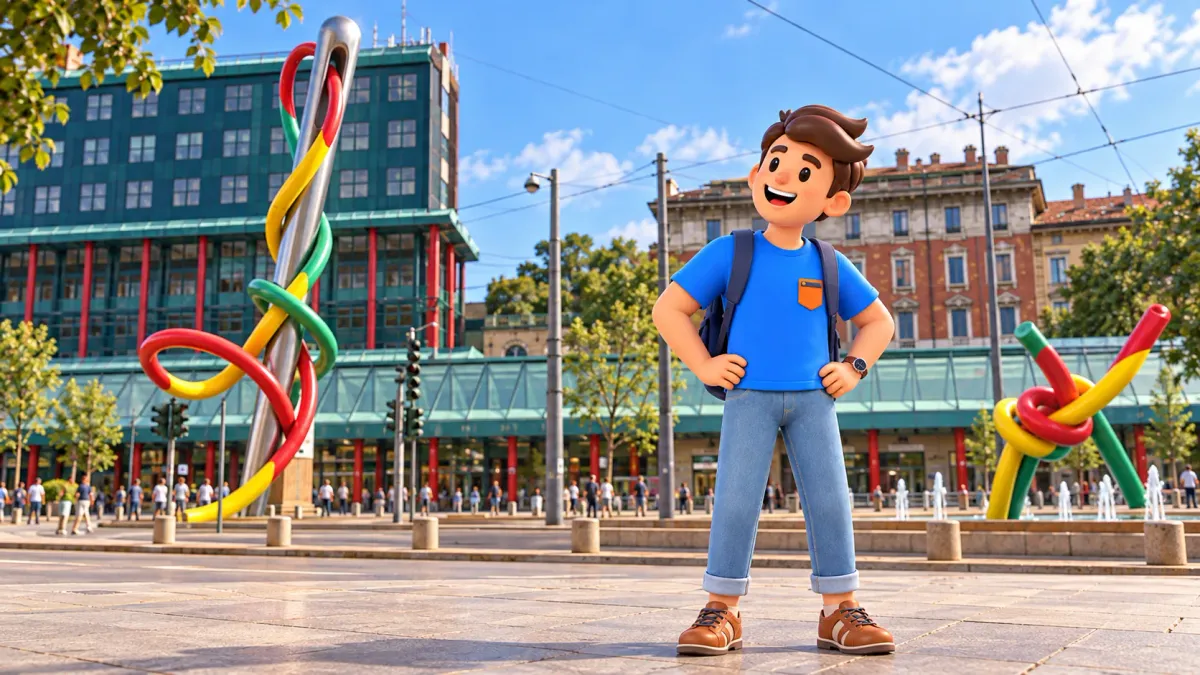
Ago, filo e nodo, or Needle, Thread and Knot, is by Claes Oldenburg and Coosje van Bruggen. Installed in 2000 in Piazzale Luigi Cadorna, it belongs to the redevelopment of the station area coordinated by architect Gae Aulenti. Keep those roles distinct: Aulenti shaped the urban setting, while the two artists created the sculpture. Cadorna, served by M1 and M2 as well as trains, makes a practical starting point, but leave time to emerge from the station and find a comfortable observation position.
The first surprise is scale. A small tool associated with precise handwork becomes something that competes with the buildings and movement of a transport interchange. Look for the needle’s eye and follow the coloured thread with your gaze. Then locate the separate knot, some distance away in a basin. These are two parts of one work, imagined as connecting beneath the ground. The underground connection is an artistic idea, not a visible tunnel to visit. Seeing only the tall needle misses the second part of the composition.
The red, green and yellow colours refer to Milan’s historical three-line metro network, while the sewing imagery evokes the city’s fashion and work. They do not mean that Milan has only three metro lines today. This combination makes the place matter: a work about connection occupies a point where journeys meet. Rather than treating the surrounding movement as a distraction, notice how the sculpture remains legible among station entrances, overhead wires and traffic. Its playful subject does not require the square to become an isolated gallery.
Spend part of your 25 minutes on the overall outline, then change your viewing angle from a suitable public pavement. Ask which part feels most like an ordinary needle and which depends on the enlarged scale. A photograph can record the form, but it may not communicate the distance to the knot or the movement around it. There is no need to touch or climb the work, and the reading does not depend on fountain jets operating. The important relationship is between the two visible parts and the intervening city space.
Walk towards Piazza degli Affari
Allow about 25 minutes for the connection towards the Corso Magenta and Santa Maria alla Porta area, continuing to Piazza degli Affari. Use current pedestrian navigation for precise turns and crossings. This is a walk through working streets, not a guaranteed pedestrian-only corridor. Keep the planned museum-free rhythm: a church entrance, shop or attractive courtyard can easily turn a connection into another visit. You can note an address for later without assuming every interesting doorway is open to the public.
If you would rather begin with the castle and park near Cadorna, our Sforza Castle and Sempione Park walk gives that landscape its own outing. It is a different use of the morning, not a complete extra route hidden inside these 150 minutes. For the sculpture walk, the change from a transport interchange to a more enclosed square is part of the experience. Notice what happens to scale and attention when the first work disappears and the next setting comes into view.
L.O.V.E.: the square is part of the work
Maurizio Cattelan’s L.O.V.E., created and placed here in 2010, stands in Piazza degli Affari in front of Palazzo Mezzanotte, the stock-exchange building. It is made of Carrara marble. The hand itself is about 4.6 metres high; the roughly 11-metre figure often quoted for the work includes its pedestal. That distinction helps make sense of the scale. Do not mistake the building behind it for a museum entrance included in this route: the proposed stop concerns the public square and the sculpture outside.
Look carefully at the hand before deciding what gesture it makes. The other fingers are truncated rather than simply folded into a conventional fist, leaving the middle finger extended. The familiar outline is therefore also a damaged-looking form. Its title is an acronym for Libertà, Odio, Vendetta, Eternità: freedom, hate, revenge and eternity. Those words complicate the first impression of a title resembling “love”. You do not need to settle on one definitive explanation to notice the tension between the title, the gesture and the material.
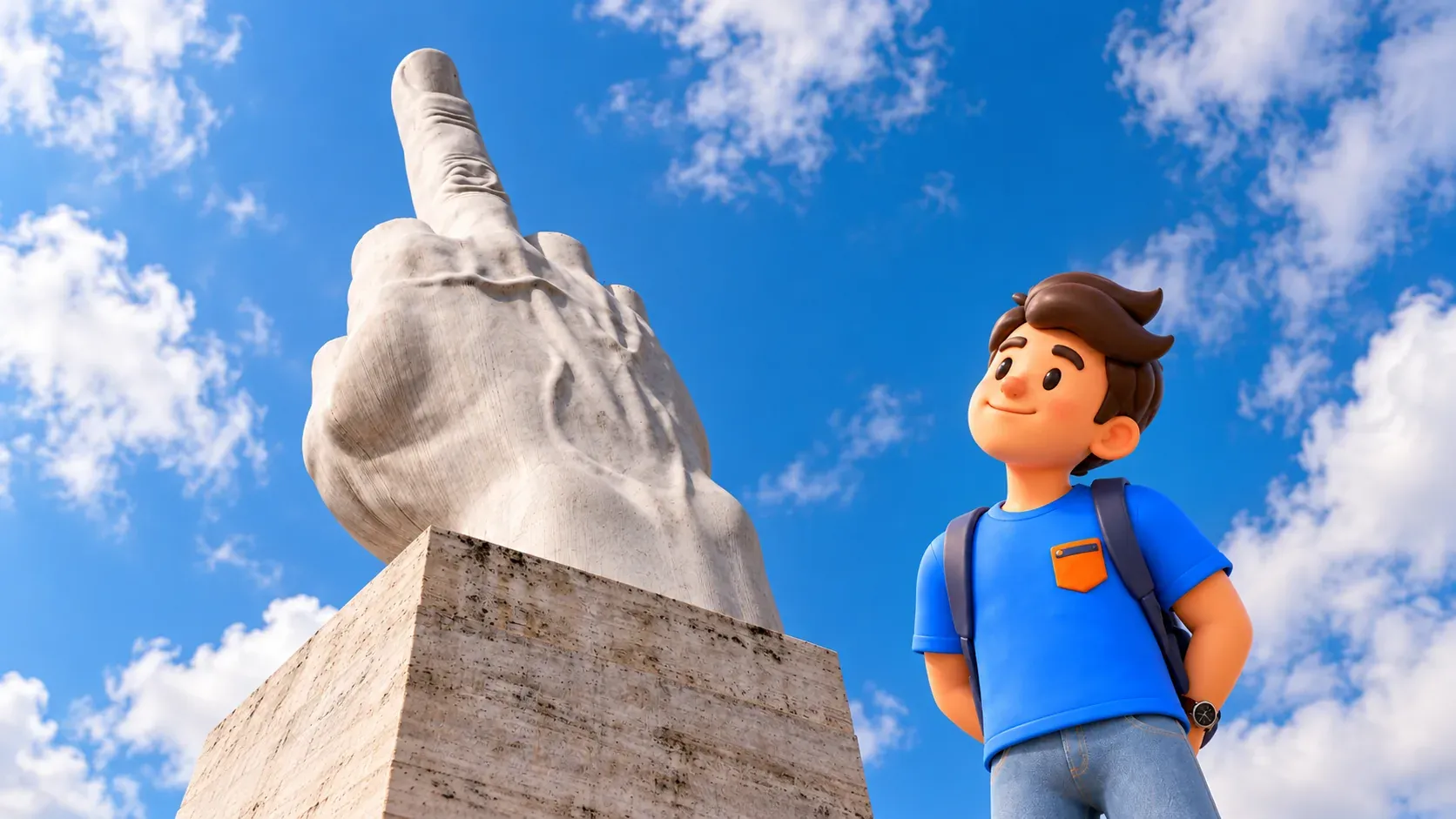
The setting gives that tension a particular direction. A monumental marble hand faces the environment of finance and the imposing stock-exchange architecture; the Ministry of Culture’s description reads it critically in relation to this context. Treat that as an interpretation anchored in the site, rather than a universal answer that every viewer must share. Compare the work’s outline with the lines of the building and the height of its base. Moving your gaze between them reveals more than isolating the finger against the sky for a quick photograph.
The 25-minute allowance gives you room to look, read the title and discuss a reaction. If travelling with children, you can explain the difference between describing a provocative artwork and copying its gesture at other people. There is no need to turn the stop into a performance. A useful question for any age is whether this same hand would feel different in a garden, a station or an indoor room. The question makes the square an active part of the visit without requiring a long lecture on contemporary art.
Pause, then continue towards Piazza Meda
Take approximately 20 minutes for coffee or another short rest, choosing a place that fits your needs and its actual opening. Consumption is the optional expense here; viewing the three outdoor works does not require museum admission. Keep the pause separate from the next 25-minute walking estimate. Continue towards Cordusio, then the Piazza della Scala area and Piazza Meda, following current pedestrian directions. The walk changes the visual rhythm again, from the white marble hand to a bronze disc whose surface rewards a different kind of attention.
During the pause, compare just one feature from each stop: scale at Cadorna and the relationship with a building at Piazza degli Affari, for example. This keeps the third sculpture from becoming another name to tick off. You can sketch a simple outline in your own notebook without making a navigational map or an exact copy. A short break also leaves a practical margin before the final stop, particularly if a street crossing or a crowded pavement has made the walk slower than expected.
Grande disco: read the surface, not just the circle
Arnaldo Pomodoro’s Grande disco stands in Piazza Filippo Meda. The bronze work was created in 1972 and installed in this Milan square in 1980: creation and placement are different dates. Its golden appearance comes from the bronze surface and reflected light, not from being a disc made of solid gold. Start with the circular outline, then let your eye travel towards the disrupted centre. The contrast between polished exterior and intricate openings is more revealing than the shorthand idea of a large shining circle.
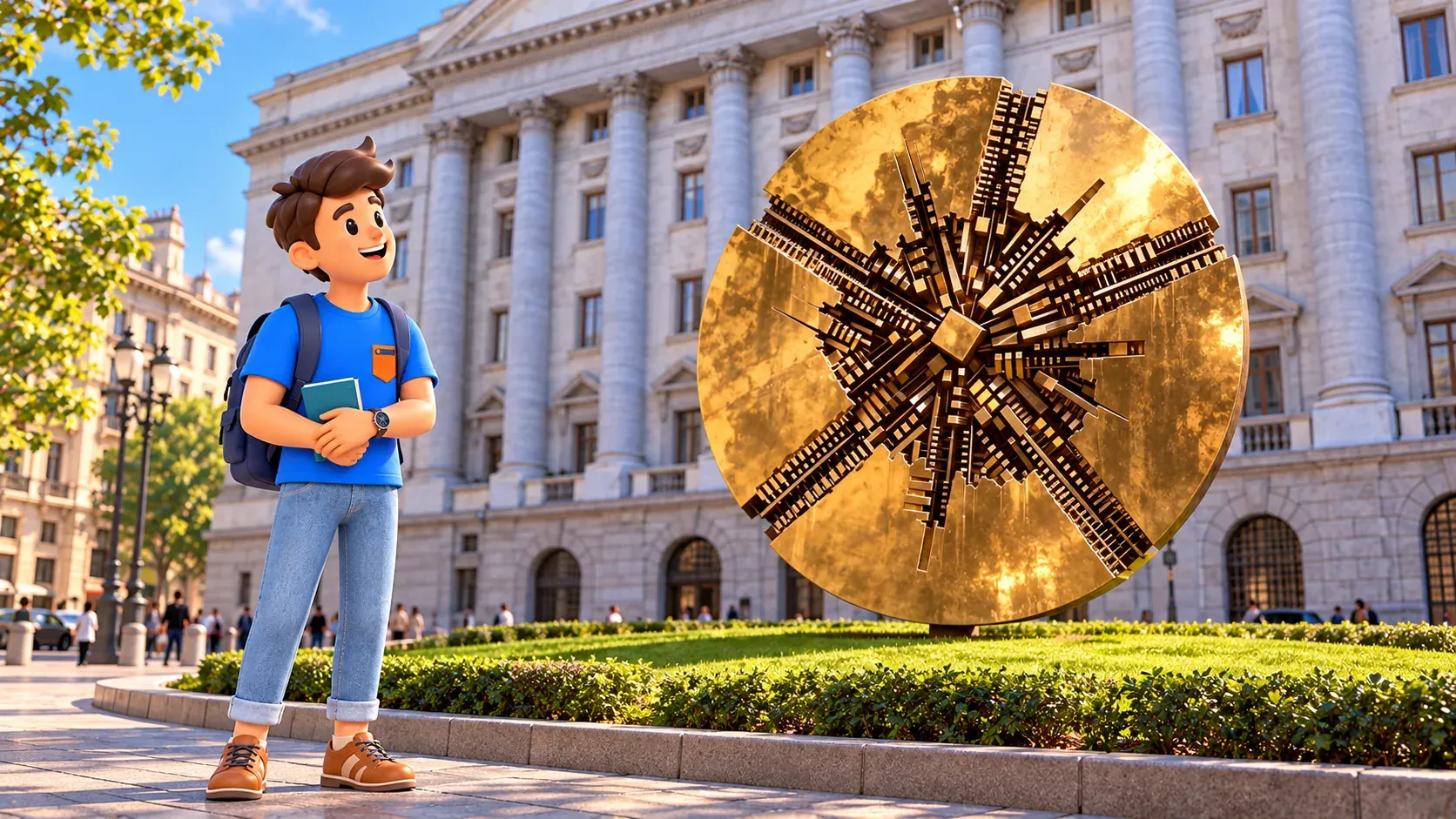
The cuts spread out from the centre along five main directions, exposing a geometric inner world that can suggest machinery without becoming a working machine. Look at how smooth and interrupted areas meet. Changing your position along the public edge can alter reflections and bring the thickness or second face into view, where the layout allows. Stay outside planting and any barriers. The purpose is observation, not testing whether a sculpture can move, pushing its surface or stepping onto the grass to obtain a closer photograph.
The circle has been associated with the sun and with Leonardo’s Vitruvian figure, but your first useful comparison can be simpler: an intact outline surrounding an unsettled interior. Unlike the recognisable sewing tool or hand, this work does not begin with an everyday object you can immediately name. Give it the planned 20 minutes. First notice a detail for yourself, then read any available identification. The different approach makes a satisfying final stop after two works whose subjects appear more immediately familiar.
Keep the outing flexible without losing its focus
Public works need maintenance. A municipal sponsorship notice issued in December 2025 included conservation of Grande disco; it does not by itself establish that the sculpture is screened off on your date. Check local notices and respect the arrangements you encounter. If a work is obscured, shorten the route or give the other stops more time. An announcement is not proof of either a current closure or completed restoration. The same practical care applies to station lifts, crossings and uneven surfaces if access without steps is important.
Use RoadMe to build the rest of the trip around the mix of public art, museums and neighbourhoods that interests you. A personal day-by-day plan makes the whole stay easier and more efficient to organise, while keeping enough time for observation rather than filling every gap with another stop.
Finish in Piazza Meda, with an additional walk to M3 Montenapoleone or M1/M3 Duomo for onward travel. For a shorter version, choose two works and recalculate the connection rather than retaining a two-and-a-half-hour label automatically. For another approach to visual culture, our fashion without shopping itinerary explores museums and streets on a separate day. Here, three sculptures are enough to make familiar city spaces look less automatic.


