
Masdar City in two hours: a walk through climate design

Two hours in Masdar City can make a rewarding change from Abu Dhabi's palaces, museums and waterfronts. The interest here lies in ordinary urban questions: where shade falls, how air moves and what a place offers someone walking through it. Build a short outing around the wind tower, Solar Tree at Eco Plaza and a proper pause.
This plan uses two hours on site, after arrival and before your onward journey. It does not include the ride from your hotel or airport. The allocation is an editorial estimate rather than a measured walking tour; your actual arrival point, public access and weather determine the final version.
Start with a compact walk, then add depth
Choose Masdar because you want to look at climate-conscious architecture, rather than because the name sounds like a promise of a completely different world. It is a place where people study, work and live. The useful discoveries are often a shaded passage, a change in building scale or a public seat that makes stopping feel natural.
For an easier way to fit this outing into your trip, try RoadMe: the app creates a complete personalised itinerary around your interests, dates, pace and budget. It can give a short architecture walk its proper place within a wider holiday.
Keep the main idea small enough to remember without constantly checking a list: streets, wind, solar shade, rest. You do not need every building or every park to understand the appeal. A shorter route with time to notice design can be more satisfying than a large loop of exterior photographs.
Agree the arrival and the finish before you begin
Save the actual place where you will be dropped off and a sensible location for collection afterwards. Masdar is a district, so a general location pin is less useful than a clear arrival arrangement. If using public transport, include the walk from the relevant stop in the wider journey plan.
On arrival, spend a few minutes orienting yourself using the current visitor information and permitted public paths. Identify the wind tower and Eco Plaza, then choose the simplest connection between them. A map can suggest a direct line across a block without showing whether that particular passage is available to visitors.
Think of the walk as a small loop or a clear outward route with a planned finish. Which works better depends on where you arrive. Do not promise yourself a perfect circuit before seeing the actual access. Leave a little time at the end for finding the agreed pickup point.
Read the streets through their shade
Begin with the spaces between buildings. Notice whether the walkway feels enclosed or open, whether a facade shades its neighbour and how a corner changes the view. These are accessible architectural questions: you can enjoy them without identifying every material or knowing a building's technical rating.
A comfortable public space is made from several decisions working together. Look at the position of a seat, the surface beneath it and the nearby buildings. Ask where you would choose to pause at that moment. This turns the walk into an observation of how a neighbourhood supports daily life.
Shade is part of the subject, rather than a guarantee about your own comfort. On a hot day, keep outdoor sections shorter and use an appropriate indoor break. Choose the time of the visit for the actual forecast and the people travelling with you.
The wind tower: an old principle in a modern structure
The Masdar wind tower is a useful first anchor. Its design reinterprets the regional idea of a windcatcher: taking air from higher up and directing it towards the space below. The exposed contemporary structure makes an environmental idea visible as part of the cityscape.
Look upward from a permitted public position and then look back at the plaza. The interesting relationship is between the tower and people at ground level. This is not a viewpoint to climb; the design is best understood through the public space it serves.
Allow roughly twenty minutes to look, take a few photographs and sit briefly if a suitable seat is available. You need not feel a dramatic breeze to make the visit worthwhile. A building's design intention and the conditions during a particular visit are different things.

Solar Tree: a reason to stop at Eco Plaza
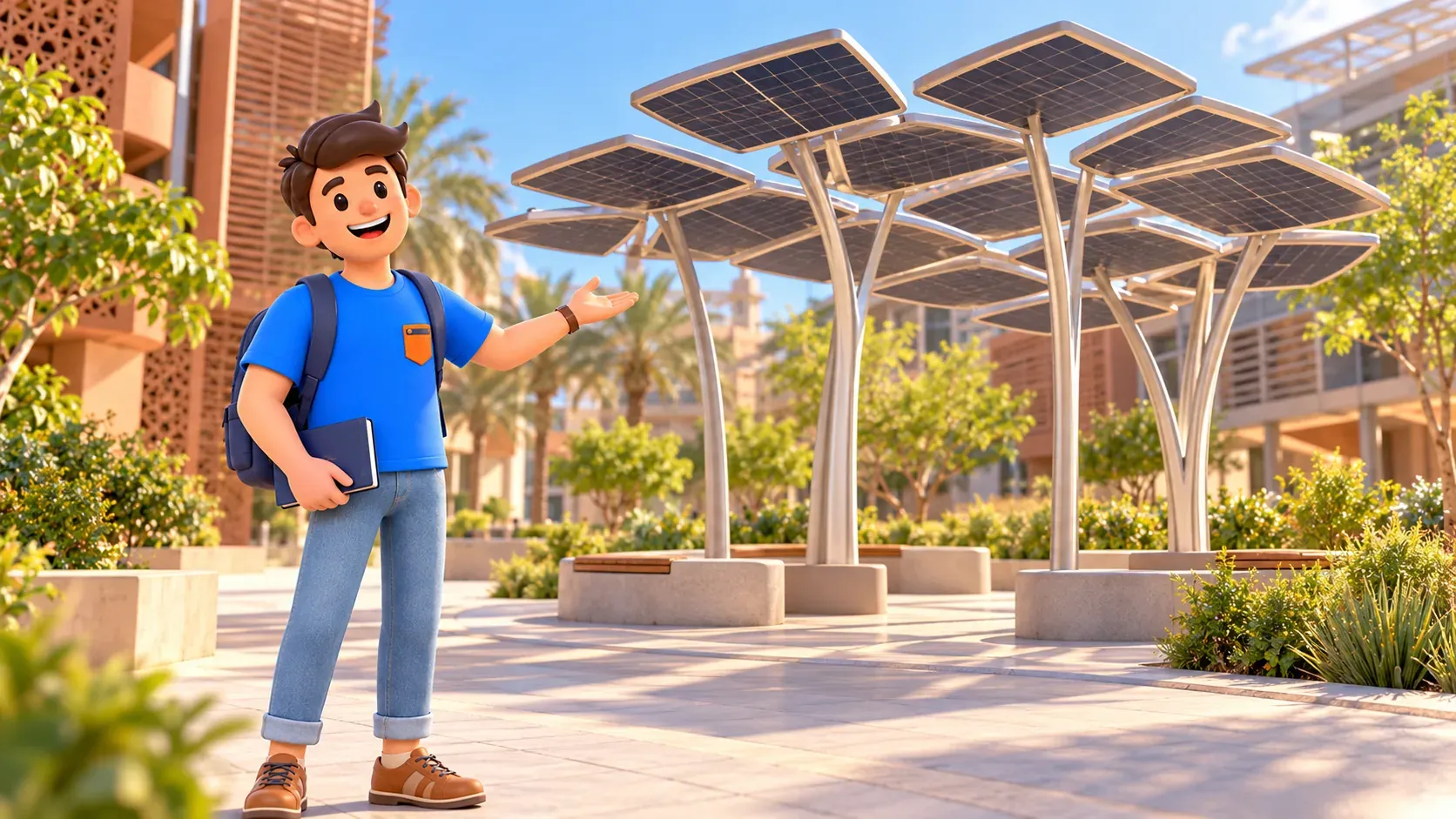
Continue to Solar Tree at Eco Plaza using the available public route. The installation combines solar panels with a canopy and seating, bringing an energy idea into a familiar everyday activity: finding somewhere to rest. It offers a different scale from the wind tower, closer to the experience of a person on foot.
Notice the slender supports and the curved panel shapes above them. Compare the shade below with the open area nearby from a comfortable position, without turning the visit into an informal temperature experiment. The useful question is how one piece of urban furniture can perform more than one job.
Do not confuse Solar Tree with the wind tower or another artwork whose name includes a tree. They tell related environmental stories through different forms. For this short route, one carefully observed solar structure is enough; there is no need to turn the stop into a search for every installation in the district.
Give the two hours a simple rhythm
As an illustrative allocation, keep fifteen minutes for arrival and orientation, twenty-five for the shaded streets, twenty at the wind tower, twenty around Solar Tree, twenty for a pause and twenty for the final connection to your finish. The total is two hours; the parts are flexible.
If the first connection takes longer, shorten the later wandering rather than remove the rest stop. If a particular building detail catches your attention, spend longer there and make the next stop briefer. The purpose of the allocation is to protect the shape of the outing, not to create six deadlines.
A cafe break can be part of the experience, but choose somewhere convenient to the route that is actually open. A long meal or a shopping visit belongs outside this two-hour version. Carry water so that the whole walk does not depend on finding a specific business at exactly the right moment.

When the Visitor Center is the better choice
If you prefer explanation and interactive displays, consider the Masdar City Visitor Center. Its official visitor experience uses locations at North Car Park and Building 1A, connected by Personal Rapid Transit vehicles. Check the current arrangements before building your outing around that experience.
The operator suggests allowing about an hour for the centre itself. Treat it as a substantial activity, with its own arrival and movement between spaces. It can replace much of the outdoor walk, or you can give the overall visit extra time. Adding it to every street, tower and plaza stop changes the scope.
For a first visit, decide what you most want to leave understanding: the feel of the neighbourhood or the explanation of its ideas. Both are valid. This choice is especially useful when travelling with companions who have different levels of interest in architecture.
Make a small photographic story
For photographs, choose three scales rather than twenty similar views: the whole space, a building detail and an everyday moment such as resting beneath the canopy. These can record what interested you without turning the visit into a search for a famous postcard angle. Keep the camera away during part of the walk so that you notice the place directly.
At the wind tower, a wide composition can show the relationship between structure and plaza. Around Solar Tree, look for the contrast between its canopy and the space below. In the passages, a pattern of shadow may be the subject itself. You can make a coherent sequence without entering a building or standing in a vehicle access.
Masdar remains a working neighbourhood. Let people use entrances and paths, and avoid making a private office or residential threshold part of your photo session. If someone would be the main subject of a close photograph, ask first. A good short walk gives residents and workers room to continue their day while you enjoy yours.
This approach also suits a group: each person can choose one detail to show the others at the rest stop. It creates a shared conversation about the visit without requiring everyone to take the same pictures.
Adapt the outing to the people travelling
With children, give the walk one or two small observation games: find a pattern of shade, choose the most inviting seat or compare a narrow passage with an open square. Keep the conversation tied to things they can see. A short successful visit can encourage more curiosity than a long technical explanation.
For an architecture enthusiast, use the same small route more slowly. Sketch one facade, compare the way two buildings meet the ground or watch how people use a plaza. Depth does not require adding destinations. The time saved by limiting the route can be spent looking.
RoadMe makes it more convenient to turn those different interests into a personal trip programme, with the right balance of architecture, culture and rest. Use the app to shape the whole stay around your priorities, rather than forcing everyone through the same checklist.
Finish at the agreed collection point while the outing still feels complete. Masdar can work as a distinct short visit within a longer Abu Dhabi stay. If you are considering it during an airport connection, first establish your entry eligibility and flight requirements; being on the airport side of the city does not make the journey or return automatic.


