
Binoculars, an Ocean Liner and Space-Age LAX: Los Angeles Architecture
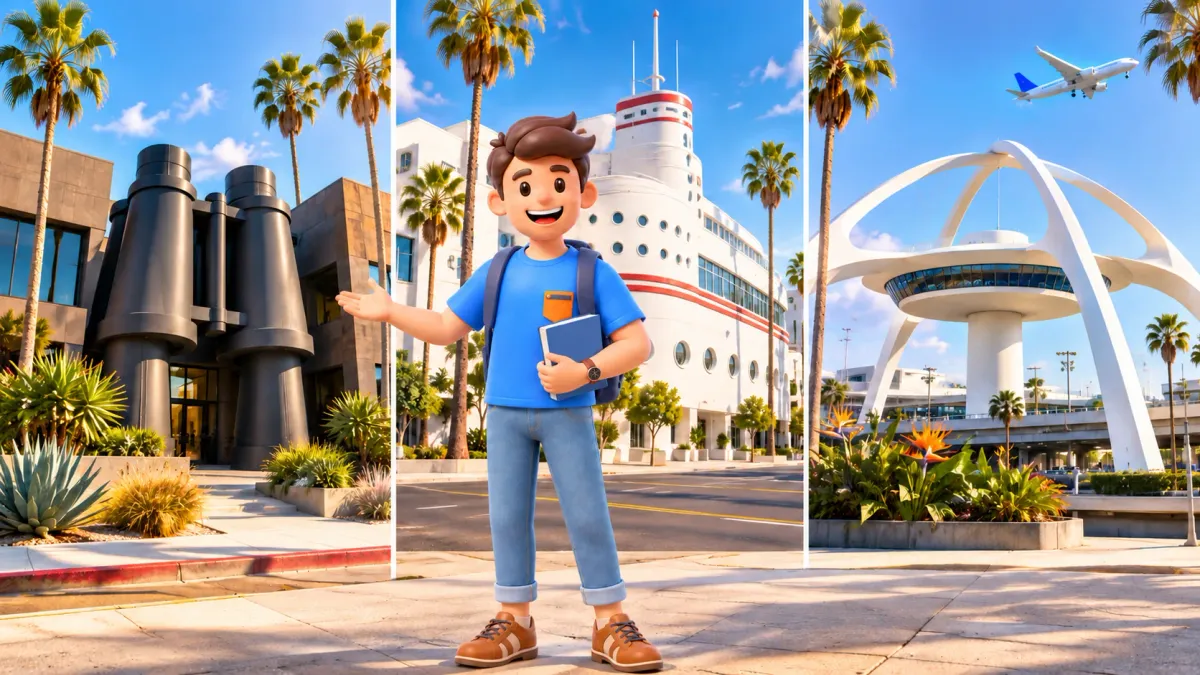
Sometimes the easiest way to remember Los Angeles architecture is through objects: enormous binoculars, an ocean liner among city streets, a space-age shape at the airport. The Binoculars Building in Venice, the Coca-Cola building on South Central Avenue and LAX's Theme Building offer three reasons to look up from everyday navigation. Behind each recognisable image are a working purpose, authors and ideas of modernity. An unusual form does not cancel a building's real life.
This selection belongs to different parts of a trip, rather than a walking route. Venice, the industrial city setting around South Central Avenue and the central airport area are separate places. Do not combine them into a short stroll or expect interior visits everywhere. LAX requires particular care: airport access is restricted and the Theme Building observation deck is closed. Notice its architecture during an authorised airport visit connected with flying, without planning an unrestricted sightseeing excursion.
How to look at a building shaped like something else
Begin with a simple game: what makes the image recognisable? For the binoculars, two large cylindrical forms; for the liner, horizontal lines and nautical details; for the airport symbol, a raised central shape and crossing arches. Follow that first impression with a second question: how does the image relate to an ordinary working purpose? This helps reveal architecture beyond an amusing large object, without requiring specialist training or an entire vocabulary of styles.
Let RoadMe develop a complete personal trip plan around your interests, dates, budget and pace. The app makes it much more convenient to connect architectural discoveries, walks, main visits, travel, meals and rest into one journey than to assemble each day from individual places.
Unusual appearance does not place all three buildings in one style. The binoculars connect art and office architecture; Coca-Cola uses the streamlined language of Streamline Moderne; the Theme Building evokes a futuristic aviation age. These are different visual languages. For a traveler, the distinction is more useful than memorising a lengthy classification. A familiar object opens the story without becoming the final explanation of a building or its place in the city.
Choose one observation for each place you actually encounter: the silhouette, a repeated window or the relationship between a large form and a person. A modest focus gives a stop substance. Perfect symmetry or a famous photograph is unnecessary. Your own view can be more interesting than a borrowed angle, especially when taken from an accessible pavement without obstructing people. A photograph can preserve the observation without interfering with the setting's working life.
The Binoculars Building: art at office scale
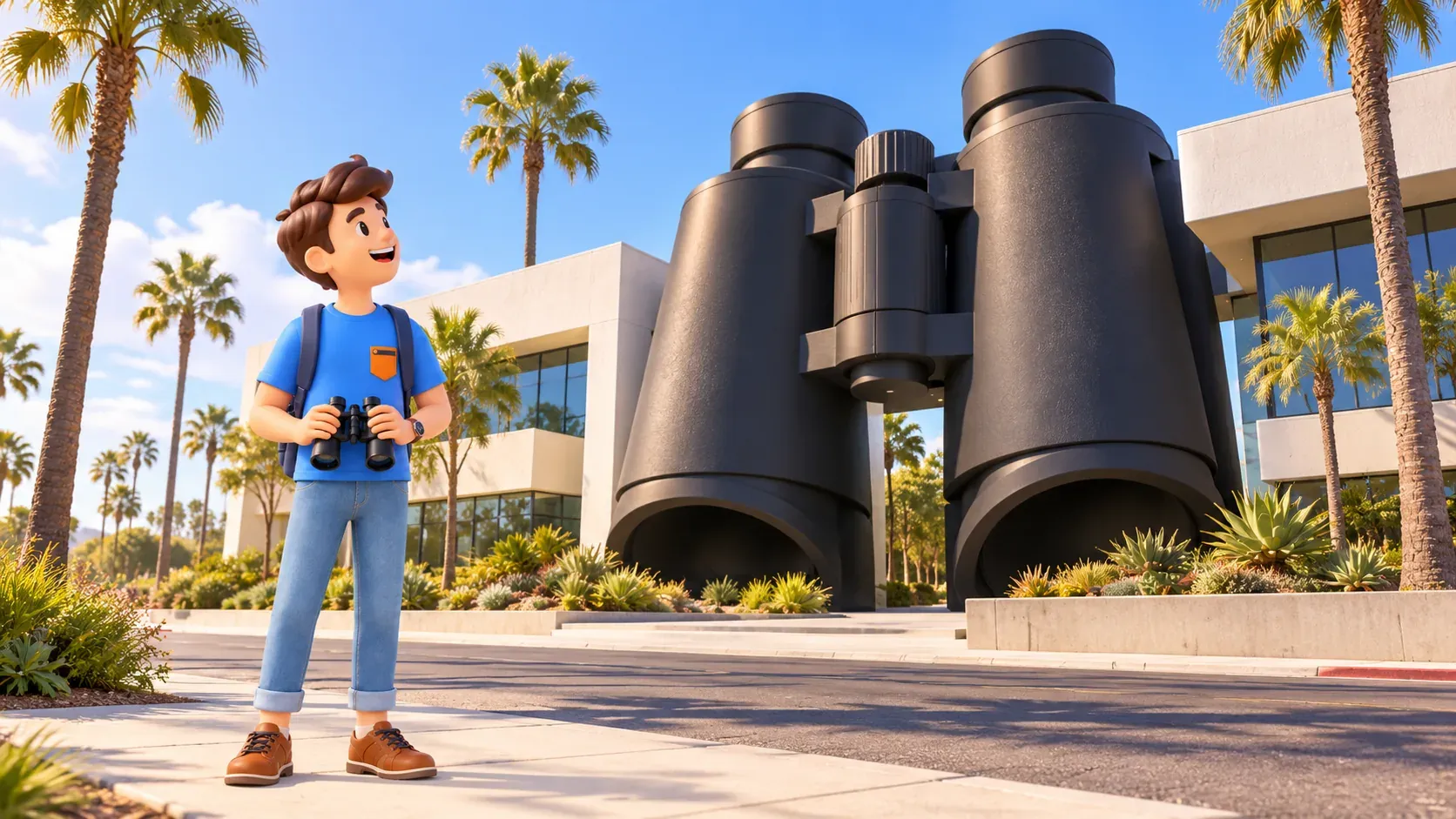
In Venice, a recognisable object grows to architectural size. The enormous binoculars are associated with the office complex developed for advertising agency Chiat/Day. Distinguish the authors' roles: architectural work by Frank Gehry and his practice, alongside artists Claes Oldenburg and Coosje van Bruggen. Giving the entire image to one famous architect would be inaccurate. Collaboration makes this story stronger than a simplified account of a single surprising gesture by one designer.
Look at the relationship between the binoculars and the adjoining parts of the complex. The object is not simply a monument placed on a distant platform; it participates in how the building is perceived. That invites a question about where sculpture ends and architecture begins. Asking is enough for an introduction, without immediately finding the correct category. The city shows that an office environment can prompt a smile and conversation while remaining a workplace.
A large form does not make this a real public pair of binoculars through which visitors observe the ocean. Do not expect an optical viewing platform or admission inside the eyepieces simply from the name. The building is a private office setting; its familiar image can be appreciated from Main Street within accessible boundaries. An openly visible facade and permission to use interior rooms are different things. Clear expectations preserve a pleasant encounter.
If your day already involves Venice, an architectural look can become a short episode of its own. It does not require entering offices or studying every facade. Stand without blocking an entrance or pavement traffic, notice the scale, then continue your day. Interest in a building need not become an attempt to enter a working driveway for a closer picture. A respectful distance is enough to understand the central idea.
Coca-Cola: an ocean liner going nowhere
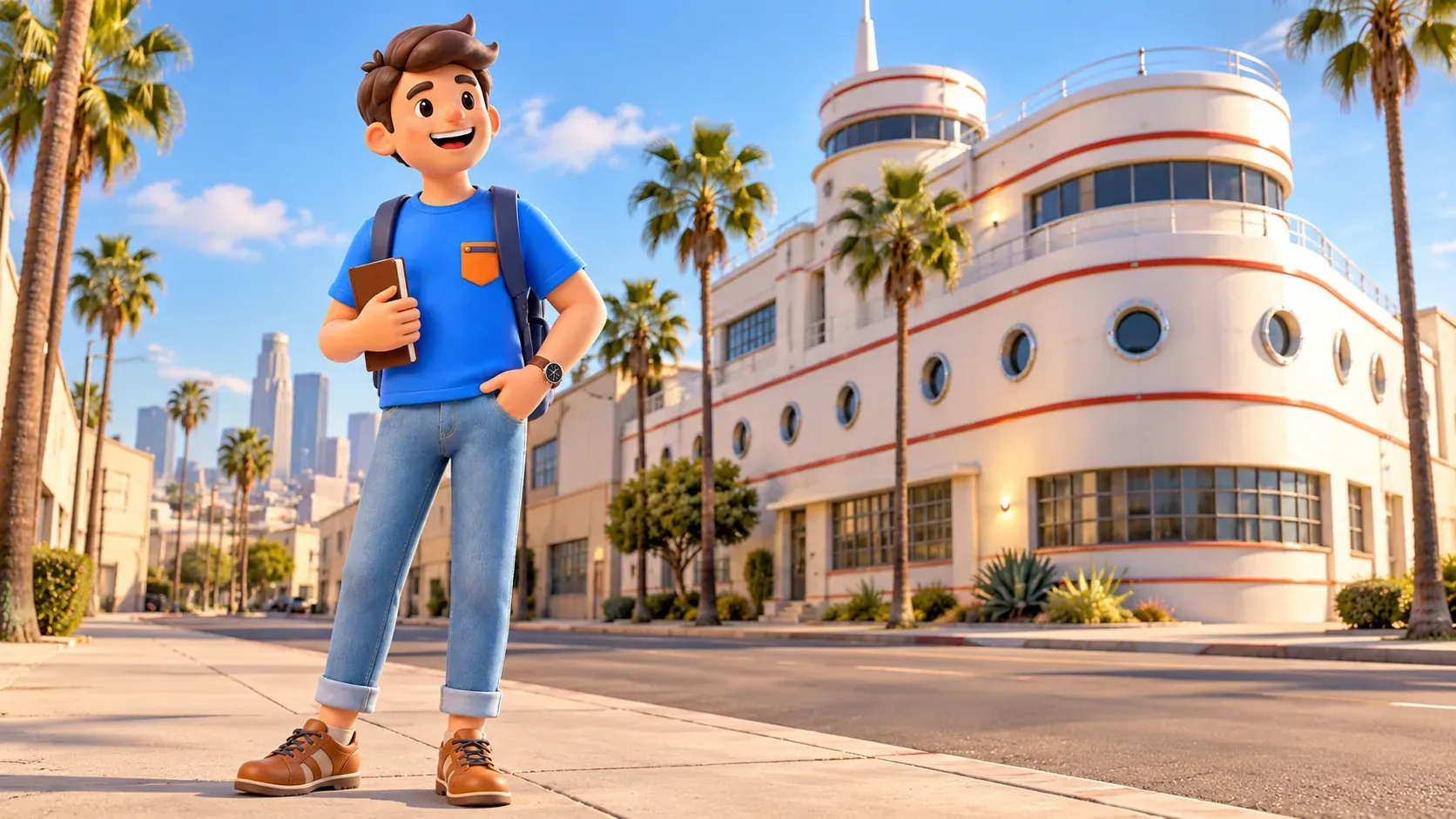
On South Central Avenue, a nautical image appears in an industrial city setting. The Coca-Cola building is associated with architect Robert Derrah and the aesthetics of the 1930s. Rounded lines, portholes and elements recalling decks and a bridge create an ocean-liner resemblance. This is an architectural metaphor rather than an actual ship placed on land. The initial smile becomes more interesting when you distinguish imagined movement from the ordinary stationary work of a building.
Streamline Moderne is a useful name to remember here. Streamlined forms and extended horizontal lines help explain the image without requiring every distinction in interwar architecture. Notice repeated circular windows and the outline suggesting a vessel. The history involves unifying earlier industrial premises with an overall exterior treatment. The appearance therefore gives a working complex a common identity, rather than providing an unusual decoration detached from its purpose. That is a small but valuable architectural idea.
Do not confuse resemblance with function. A deck motif does not promise a rooftop promenade, and the Coca-Cola name does not automatically provide a drinks museum, tasting or bottling tour. This selection concerns the exterior architectural image. Interiors and any special visits require separate confirmed arrangements. Without them, the outside details still communicate the story. You do not need to invent an additional programme to justify looking at an interesting building.
Observe horizontal lines and rounded features from an ordinary permitted public position. A working street does not become a quiet visitor square because its facade is expressive. Do not stop a car in an unsuitable place or enter the carriageway to obtain the liner's full profile. If conditions are awkward, a brief look is enough. An encounter is not measured by reproducing an architectural-album photograph at any cost or seeing every side.
The Theme Building: a jet-age idea of tomorrow
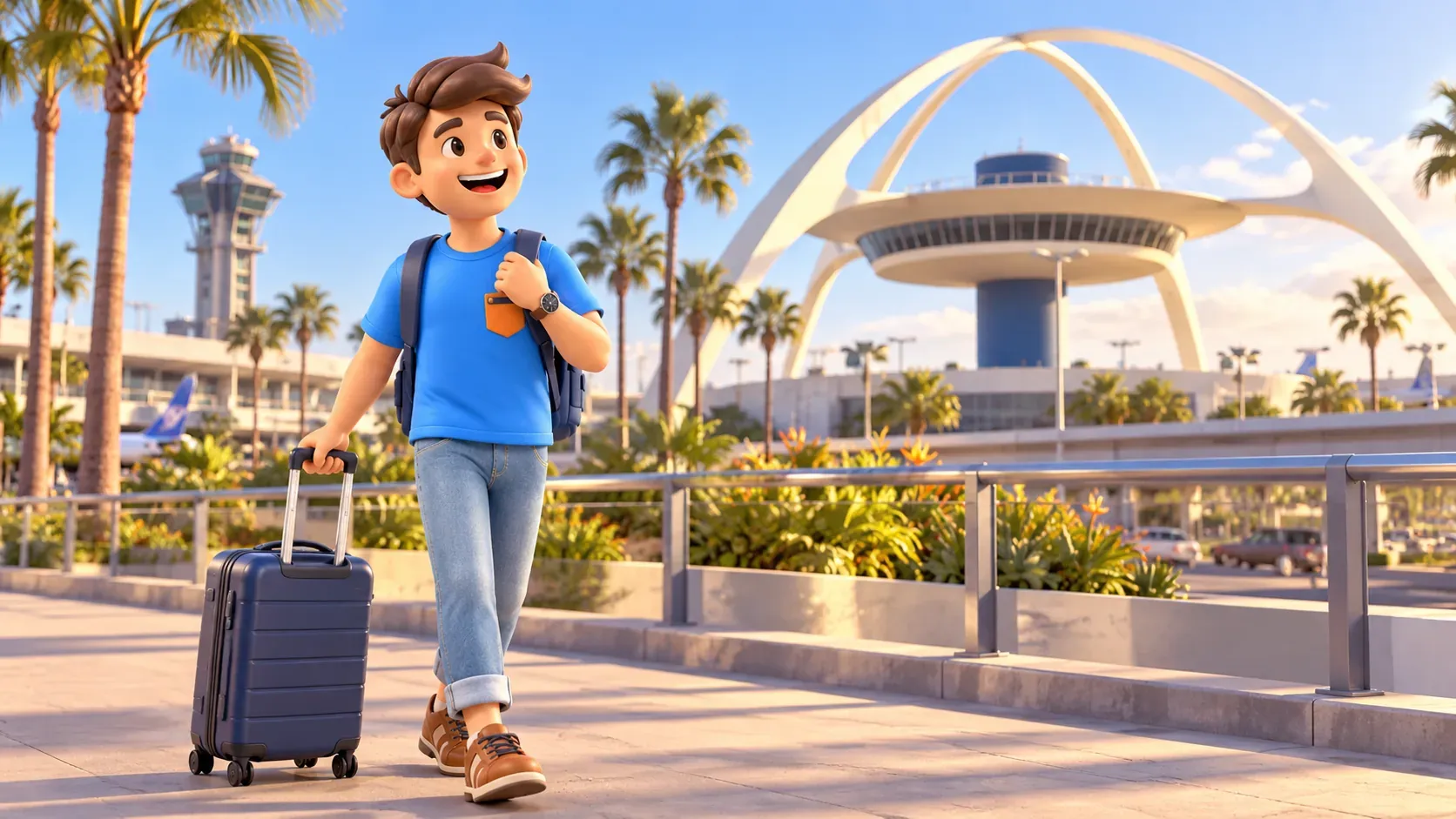
The Theme Building appeared in 1961 as part of LAX's new aviation identity. Its raised circular form and large crossing arches recall an imaginary craft. The resemblance suggests how architecture could express expectations of a technological future. This is neither a real spacecraft nor a passenger terminal nicknamed for its shape. It is a distinct architectural airport symbol, separate from check-in, boarding gates and air-traffic-control infrastructure. Understanding the role keeps the metaphor useful.
Authorship is collaborative here too. The project involves Pereira & Luckman, Welton Becket and Paul R. Williams. A brief history should not reduce that team to one name. It is enough to know that this expressive shape grew from architectural cooperation in the aviation era. Exact engineering measurements of the arches are unnecessary for a first encounter: silhouette and date already provide context, revealing cultural history within a setting usually considered mainly through transport.
The relationship between weight and lightness is particularly interesting. Large supports hold an image that visually seems eager to leave the ground. That describes an impression, rather than movement of the building. Expect no rotating construction or flying platform. Architecture addresses the imagination while remaining a structure. Explain the difference to a child: the spacecraft comparison helps reveal form, without promising an attraction, launch or special interactive programme inside.
Why LAX is not an ordinary sightseeing stop
Current LAX access rules allow airline passengers, people meeting, accompanying or assisting them, and personnel whose work requires their presence. It is not a freely open park for a separate architectural outing. Consider seeing the Theme Building only during an authorised visit. An attractive structure within the airport creates no additional right of entry and removes no instruction from staff or boundary of accessible areas. The architectural story must respect the airport's actual operation.
The Theme Building observation deck is currently closed because of construction. Older pictures of people upstairs or accounts of a restaurant do not establish a present opportunity to ascend or dine inside. No such visit is promised here. If you fly through LAX and can see the shape from your permitted route, it may add an impression to arrival or departure. If not, the flight and necessary procedures matter more than securing a particular angle.
Do not turn the time allowed before a flight into an unaccounted excursion. Travel, bags, check-in and screening remain the airport day's foundation. Architectural observation is a possible addition, rather than a reason to rush towards boarding. Do not cross traffic lanes or enter restricted zones for a photograph. A suitable moment exists only where your presence is allowed and the observation does not obstruct the main purpose of visiting the airport.
Place the three images within your own trip
Start with the area and activity that already interest you. A Venice day may suit an exterior look at the Binoculars Building. An interest in industrial city architecture may justify separately considering the Coca-Cola exterior. Leave the Theme Building to an appropriate airport context. These are three possibilities, without a compulsory order. Seeing one attentively can be more useful than crossing the city for three ticks with little energy for impressions or rest.
Afterwards, name what held your attention. Was it the binoculars' familiar object at an unfamiliar scale, the liner's suggestion of movement, or LAX's imagined future? Such questions help compare impressions without competing over correct taste. Companions can share one observation and continue the day. Architecture becomes part of a personal journey when connected to curiosity, rather than becoming a compulsory list of titles and designers. Different responses can enrich the same encounter.
It is also fine to notice a building without making a long stop. Some settings offer a comfortable moment, others do not. Keep the distinction between seeing a memorable exterior and completing a formal visit. Neither needs to imitate a museum session. A small detail can remain with you during the next walk, changing how you look at less famous structures. That continuing attention is a useful result even without an extensive photo collection.
In RoadMe, getting a fully developed personal itinerary or whole-trip plan around your interests and pace is much more convenient. The app connects architecture, main visits, travel, meals and pauses into one journey, so unusual city discoveries do not require constant organising along the way.
Remembering Los Angeles through binoculars, a liner and a space-age silhouette is a good beginning. Then authors, working purpose and the history of an era appear behind the metaphor. Choose suitable encounters, distinguish an exterior image from interior access, and respect airport rules. Unusual architecture can give a trip character without turning the whole city into a long and tiring circuit merely to complete one themed list.


