
Jebel Ali’s religious quarter: meeting different traditions in Dubai
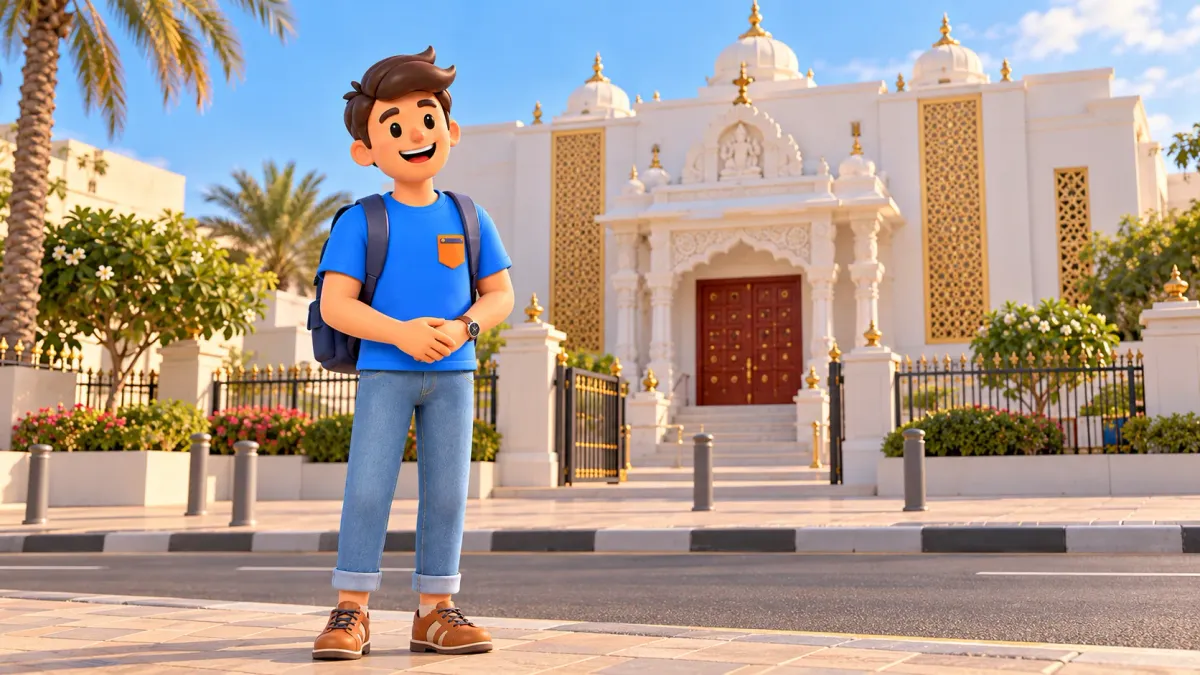
Jebel Ali offers a different way to understand Dubai: through the buildings created for communities who live and work in the city. The Hindu Temple, Guru Nanak Darbar and St Francis of Assisi Catholic Church belong to distinct traditions, yet their presence in the same wider area gives a cultural outing a clear focus.
Allow roughly two to three hours as an initial planning estimate, with the actual length depending on confirmed visitor arrangements and the places you choose. Begin with one main institution and keep additional stops flexible. This is a plan for attentive observation, not a promise of unrestricted access to several worship spaces.
Choose one main visit before linking the area
Start with your interest: contemporary religious architecture, craft, community history or a particular tradition. Then check the current visiting arrangements of the institution that matters most. Each place has its own purpose, programme and conditions; sharing an area does not make them one attraction with a single entrance.
RoadMe can develop a personal Dubai trip plan around your interests, dates and preferred pace, making it easier to give this cultural outing the right place in the journey. The app connects individual ideas into a coherent itinerary instead of leaving you to assemble a day from separate lists.
Once the main visit is clear, consider one or two other observations according to current access, practical connections and your group’s attention. The order should follow confirmed arrangements and permitted routes, rather than an invented continuous walking circuit.
Keep the arrival and departure points distinct and save the correct one for each place you intend to use. A modest visit can be complete even when part of your understanding comes from the exterior and only one building offers an appropriate opportunity to enter.
Read the area as part of the city’s community history
These buildings tell a story of permanent community infrastructure in modern Dubai. Their significance is not only a distinctive facade or decorated room. They provide places for gathering, worship, learning and service connected with the lives of residents.
Their dates also show different stages of development. St Francis of Assisi was consecrated in 2001, Guru Nanak Darbar opened in 2012 and the Hindu Temple opened in 2022. These are contemporary institutions whose architectural languages refer to traditions much older than the present buildings.
That relationship is worth noticing. A carved motif or domed form can carry a familiar religious reference into a new urban setting, while the building’s organisation responds to a living community. The result is more than a decorative borrowing of historical shapes.
You do not need to compare the traditions by a single measure. Instead, ask what each building makes visible about its own community: a gathering space, a craft language, an educational role or a form of shared service. The differences give the visit its substance.
The Hindu Temple: light, carving and a contemporary building
The Hindu Temple in Jebel Ali opened in October 2022. Its pale architectural volume and detailed craftsmanship bring traditional forms into a modern religious complex. The exterior’s carved elements and screens give you material to observe before considering any interior visit.
The building combines lattice-like screening with Hindu decorative references. Plant, elephant and bell motifs form part of its craft language. Look at the relationship between a larger facade surface and the smaller work that becomes visible at close range, while remaining in areas available to you.
Inside the main prayer hall, a large pink lotus beneath a skylight is an important part of the design. This is useful context for understanding the building, not a guarantee that you may enter or photograph that space on your date. Confirm any visitor opportunity separately.
The lotus theme links different details rather than acting only as one large object. That is a helpful way to read the architecture: a recognisable symbol gives coherence to several scales of work, from the main space to small surfaces and fittings.
Give the building attention as an active religious institution. Its value includes the continuity of community practice as well as the appearance that attracts a visitor’s eye. A respectful exterior observation remains meaningful when that is the appropriate form of visit.

Guru Nanak Darbar: gathering and service
Guru Nanak Darbar opened in January 2012 as a permanent home for Dubai’s Sikh community. Its architecture and organisation connect prayer, gathering and service. The gurdwara is centred on the Guru Granth Sahib, the sacred scripture of Sikhism.
The building’s exterior gives a different architectural impression from its neighbour. Domed references, decorative surfaces and the rhythm of its openings belong to its own design language. Compare the way a large volume and smaller details work together without treating similar shapes as evidence of identical religious meaning.
Langar, the community kitchen and shared meal, is important to understanding the institution. It expresses equality and selfless service through practice. The kitchen therefore has a religious and communal significance beyond a practical support function.
For a visitor, this is context for appreciating the place rather than a meal stop to insert automatically into an itinerary. Any participation should follow the hosts’ current guidance and the actual arrangements available. The meaning of the practice deserves attention in its own right.
Check the current visitor process before arriving and follow the guidance given for the different spaces. An architectural walk should fit around the community’s use, not expect that every activity can be paused for observation.
St Francis of Assisi: a parish in southern Dubai
St Francis of Assisi Catholic Church was created for the growing community in the southern part of Dubai. Its foundation stone was laid in October 2000, and the church was consecrated in November 2001. The history reflects the need for a parish connected with where people lived and worked.
The complex combines the main church with spaces for parish gathering, religious education and community activity. That organisation is part of its cultural value. A building can tell a story through the functions it brings together as much as through one striking architectural feature.
Its dedication to Francis of Assisi gives the interior its own religious references. Understanding that identity is more useful than viewing the church as a generic example of another tradition. Every institution on this outing has a particular history and purpose.
Confirm the current visitor arrangements and respect services and parish life. If an interior visit is not appropriate at that moment, an exterior observation and a little historical understanding can still belong to the route. There is no obligation to enter every place for the outing to be worthwhile.

Build a modest route with room between visits
For a first version, make one confirmed visit the anchor, add a short exterior observation where permitted and leave a pause before deciding on more. This gives each tradition its own attention instead of turning different institutions into rapidly collected stops.
Use current maps, entrances and permitted pedestrian connections for the actual movement. Do not infer access through a compound or continuity between sites simply because their map points look close. Arrange the transport you need for the full outing, including the return.
Keep the pause separate from an assumed facility inside a religious institution. Choose a place you can actually use, with current conditions checked if necessary. A short period to sit and discuss what you noticed can connect the visit without adding another destination.
If you have less time, one institution and its context can be enough. If you have more, deepen the observation rather than automatically expanding to every building in the area. A focused cultural outing benefits from space between impressions.
With children, choose one concrete theme such as light, pattern or the way a community gathers. There is no need to ask them to remember every name. Let questions remain open when an answer needs more understanding than the moment allows.
Let each host define the practical visit
Before entering any premises, establish the current expectations for clothing, footwear, head covering where applicable, photography and visitor access. The requirements belong to each institution. A rule from one place should not be transferred to all the others.
Follow the hosts’ guidance in the spaces you use and keep circulation clear. Treat worship and community activities as the purpose of the place. If a photograph would interrupt someone’s practice or include people without their agreement, choose another way to remember the detail.
RoadMe makes the wider trip more convenient through a personal day-by-day plan based on your interests and pace. Use the app to balance this thoughtful cultural visit with the other sides of Dubai you want to explore, while leaving room for rest.
A small group can keep the outing simple by agreeing on one shared interest and allowing different reactions. Someone may notice craft, another community history or the role of a shared room. Nobody needs to become a guide responsible for explaining an entire tradition.
Keep practical decisions proportionate. If current arrangements do not support the intended visit, adjust the route rather than trying to complete the original list. The institutions remain meaningful even when the suitable way to encounter them is more limited.

Leave with a clearer sense of the city
Before departing, gather your belongings and follow the correct exit and return arrangement. There is no need to append a shopping centre or another distant attraction to justify the journey. The religious quarter already has a subject of its own.
Think about the connection between modern buildings and continuing traditions. A carved screen, a gathering hall or the idea of service may remain more clearly than a sequence of facades. Those details help make the area part of your understanding of Dubai as a lived city.
The visit works best when each institution is allowed its own identity and the route stays attentive to real community life. Choose a clear focus, confirm the practical arrangements and give a small number of places enough time.


