
İstiklal Through Its Passages: A Short Beyoğlu Walk
On İstiklal, the main flow can encourage you to keep looking straight ahead. The passages suggest another way to explore Beyoğlu: turn away from the main line, notice an entrance, look up at the covering and return outside. This walk connects Çiçek, Avrupa and Suriye passages. They share a neighbourhood setting but reveal different ways of arranging space. The result is a short architectural outing with room for curiosity, rather than an inventory of shops to complete.
Allow about two and a half to three hours after arriving in Taksim. Begin with a stretch of İstiklal, visit Çiçek and nearby Avrupa, pause, then continue towards Suriye. Finish around Tünel Square in upper Beyoğlu. This is distinct from the lower Karaköy station: a subsequent descent or ride belongs to the next part of your day. All timings are editorial estimates and exclude travel from your accommodation.
Keep a route through the windows
The sequence is Taksim, Çiçek Pasajı, Avrupa Pasajı, coffee, Suriye Pasajı and upper Tünel. Avrupa sits close to the Çiçek section, so visit the pair together before moving towards the southern part of İstiklal. Turkish names help when locating entrances: translated versions can vary between maps and signs. Use the sequence for orientation, then respond to the public access and the actual street conditions you find.
Turning this walk into a complete personal trip is much more convenient in RoadMe, which develops an itinerary around your interests, available days and comfortable pace. Choose more architecture, shopping or cultural stops so İstiklal becomes part of your own Istanbul.
Allow twenty to twenty-five minutes for the first stretch from Taksim with short pauses, fifteen to twenty for Çiçek and twenty to twenty-five for Avrupa. Coffee suits around half an hour. Later transitions and the approach to Suriye take an allowance of twenty to thirty minutes, with fifteen to twenty for its introduction. The remaining time provides reserve and a calm finish. Shopping and a long meal enlarge the programme.
Agree on the main purpose before starting. One option concentrates on architecture with little shopping; another gives one passage a purchasing block and treats the others briefly. A third extends the outing for food. Each works when everyone understands the choice. Someone absorbed in a window and the companions waiting nearby then share expectations for the next ten minutes.
From Taksim: find a rhythm on İstiklal
Use the first minutes for straightforward orientation towards the Çiçek section. On a busy street, choose somewhere suitable for the whole group to pause instead of discussing the next step in the middle of the flow. Look beyond displays at entrances and upper storeys. These suggest a more complex urban setting behind the commercial line and prepare your attention for the passages that follow.
Try a small exercise: find three kinds of entrance. One might be broad and formal, another almost lost between neighbouring premises, and a third lead deep into a building. You do not have to enter each one. The task makes the street itself interesting while training your eye for the route's main subject. A single clear focus can give a short transition more content than adding another named stop.
Before taking photographs, move to the side and leave space for others. Complete crossings and clear the tracks before choosing a frame. If someone lingers at a window, a previously agreed meeting point is easier than repeatedly redirecting the entire group. There is no need to match the speed of everyone moving along the avenue.
Çiçek Passage: begin with the facade, then look deeper
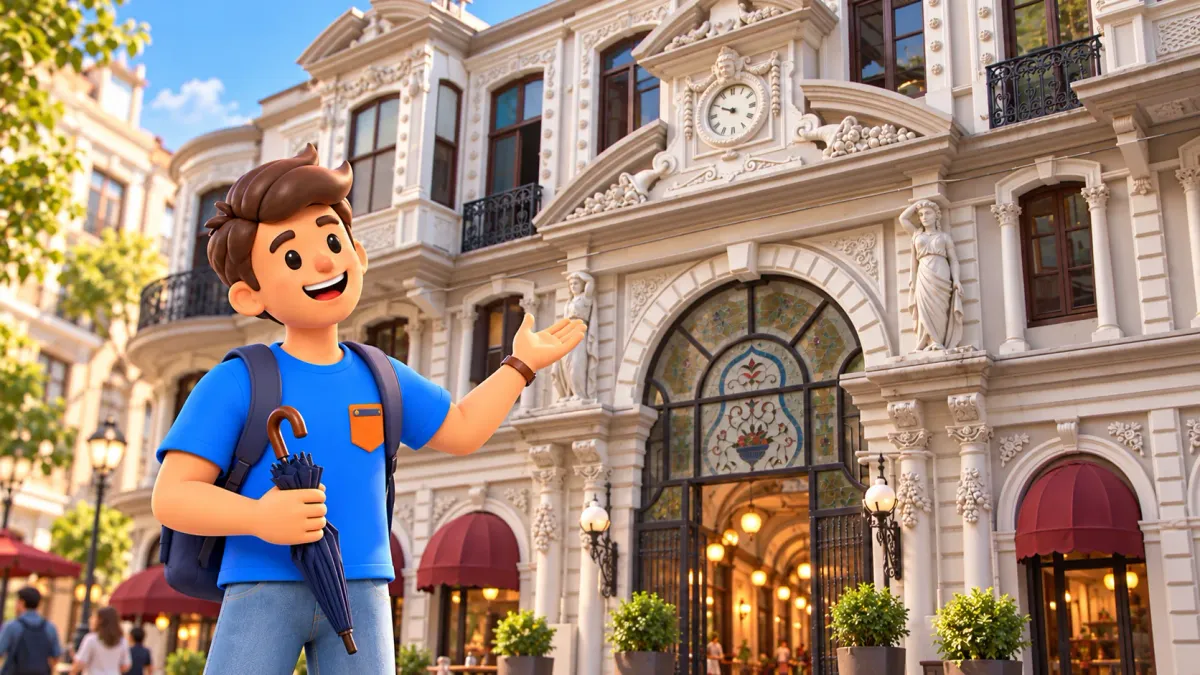
Çiçek belongs to Beyoğlu's nineteenth-century commercial architecture; the municipal historical list dates it to 1876. On the walk, connect that brief context with what is visible. An ornate frontage introduces a space leading inward. Notice its central composition, clock, sculptural figures and arched treatment. You can appreciate the entrance's expressive character without identifying every decorative motif or turning the stop into a formal architectural lesson.
Start far enough away to read the overall arrangement, then choose one detail. If visitor access is open, step into the permitted part and compare it with the street. Light, width and the direction of your gaze change. That transition is the useful experience of a passage. A few minutes can leave a clear impression even when you do not intend to sit at a table or make a purchase.
The translated name, Flower Passage, need not make you expect a present-day flower market. Observe how the place is being used during your visit rather than building expectations from a word alone. If eating inside appeals, check menus, prices and available seating first. A served meal is a different format from a fifteen-minute architecture stop. Choose it deliberately, then adjust the day's timing instead of trying to preserve the original schedule unchanged.
For photographs, one broad entrance view and one upper detail from a comfortable position are enough. Inside, consider visitors and staff: people at tables are spending their own time. Ask before making close portraits. A few deliberate images usually fit the outing better than a long attempt to produce a completely empty passage in a functioning city space. Let the view contain some of the ordinary life that gives it context.
Avrupa Passage: a street under a covering
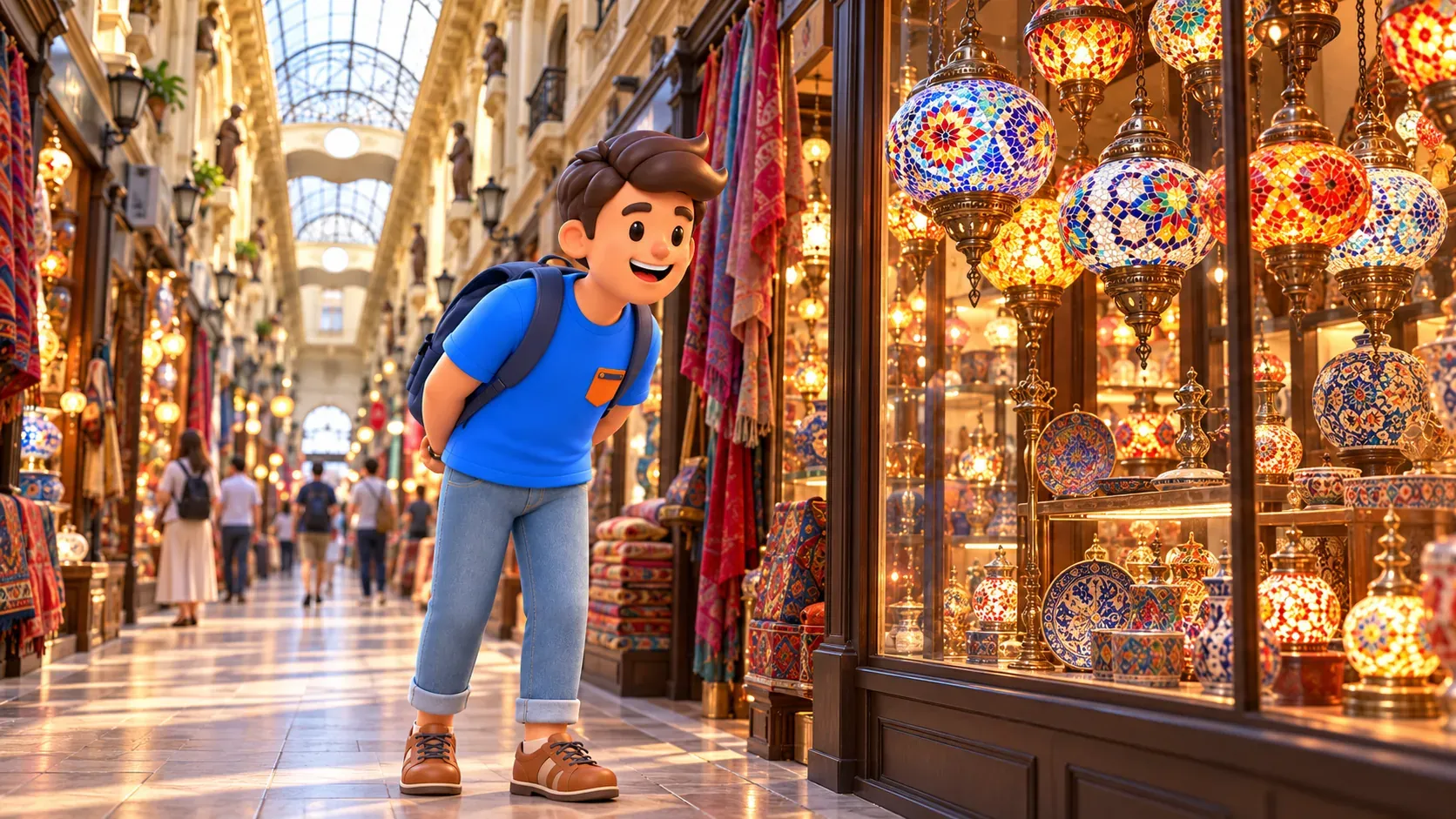
Avrupa belongs to the same period: the municipal list gives 1874 and the alternative name Aynalı Pasaj. Use the stop to compare two neighbouring spaces rather than rank their beauty. Look along the passage, where shopfront rhythm, upper decoration and light through the covering form an elongated composition. Your gaze moves differently here from the central frontage at Çiçek.
Walk through the accessible section first without a buying task. Notice how depth feels when looking ahead, then changes when you turn to a window. Afterwards, choose one stop if an object interests you. This order gives the passage itself some attention before the shop. Otherwise, the first few displays can absorb the whole block and leave little time to understand the space that brought you inside.
Choose a souvenir for your own interest rather than an obligation to take something home. Compare size, material and ease of carrying it, and ask the final price beforehand. For a fragile object, discuss packing before payment. Even a small purchase adds time: examining, choosing and paying remain part of the walk. Give them a real allowance so a pleasant moment does not become a reason to hurry everyone through the next section.
Without shopping, choose a combination of light and colour to remember: a reflection, a decorative fragment or a row of displays. You do not need to enter every business. Children can look for repeated patterns or matching shapes above eye level. One shared subject helps people with different interests enjoy this stretch together. It also provides something specific to compare later instead of only saying that both passages were attractive.

Pause and choose one continuation
After the two passages, allow roughly half an hour to stop. Choose somewhere by actual seating, menu and your onward direction. A panorama is optional; the purpose is to leave the flow, rest and decide what you want next. Order for the short-stop format. A substantial lunch deserves its own extension, especially if an appointment later in the day has a fixed time and cannot simply move with the walk.
At the table, compare impressions. Çiçek may stand out for its facade, Avrupa for the length of its interior, while someone else prefers ordinary upper storeys on İstiklal. That is a useful clue for another day. An interiors enthusiast might enjoy a longer cultural visit; someone who likes small discoveries may prefer another neighbourhood's streets and shops. All these ideas can be retained without having to realise them immediately this afternoon.
If time has become short, choose the reduced version here. Two passages already make a coherent subject, so you can finish after coffee and continue with the day. To include Suriye, proceed without adding new major stops. Make the decision once, allowing the remaining section to feel settled. There are several good endings to a walk, and the appropriate one depends on your actual plans and energy.
Suriye Passage: another part of the same story
Suriye dates to the early twentieth century, adding a further layer after the two nineteenth-century passages. The shared subject remains Beyoğlu's commercial spaces. Begin again with the entrance and the building's relationship to İstiklal. Do not expect an exact repeat of the earlier interiors. Difference is part of the route's interest: one neighbourhood can hold several answers to the idea of a street continuing behind its frontage.
If access is open, explore the permitted section; otherwise, keep the introduction external. The word passage does not guarantee every business is open or that you can walk through from end to end. Follow indications on site in this working urban environment. Fifteen to twenty minutes suits the basic stop: compare entrance, depth and overall impression, then move calmly towards the finish rather than trying to inspect every available room.
Complete your small observation series here. What mattered most in each place: facade, length, light or displays? An answer links three names into a personal comparison. It needs no specialist knowledge and remains useful on a later city walk. Looking at another unfamiliar area becomes easier when you can choose one question to ask of its spaces. The afternoon then offers a way of noticing places as well as a set of locations.
In rain, passages provide individual sheltered stops, but the whole route remains an outdoor walk between entrances. Do not expect a continuous covered corridor from Taksim to Tünel. Bring a suitable layer and reduce optional loops. If conditions make walking unpleasant, the nearby pair and a longer pause are a sensible version. Completing all three is less important than keeping the outing comfortable for the people taking it.

Finish at upper Tünel and fit the walk into the trip
End towards Tünel Square in Beyoğlu, then choose walking or suitable transport for the next address. If continuing to Karaköy, count the descent or ride separately. The word Tünel also appears around the lower station, so specify upper or lower when arranging a meeting. A clear finish prevents a small place-name misunderstanding from becoming an unnecessary extra journey at the end of a short outing.
Another day, the Galata walk from the tower through Bankalar to Karaköy offers a different theme. Combine the outings only with enough time and a willingness to walk longer: shops, coffee, interiors and transport quickly increase the total. Separate blocks preserve each neighbourhood's character and let you choose visits according to your own interests. Sharing an area does not mean every nearby programme has to be completed together.
The whole personal plan is more convenient to use in RoadMe, where chosen places, interests and days form a coherent trip that stays easy to consult. Download Istanbul beforehand with an internet connection to use maps and navigation offline afterwards.
This outing leaves a simple habit: on a large street, occasionally look inward. Three passages answer the same question in different ways, showing how the city continues behind its facades. Leave room between them and a few hours become a distinct encounter with Beyoğlu, with enough curiosity remaining for another visit and a different focus.


