
Iron Inside Paris Churches: Two Unusual Interiors
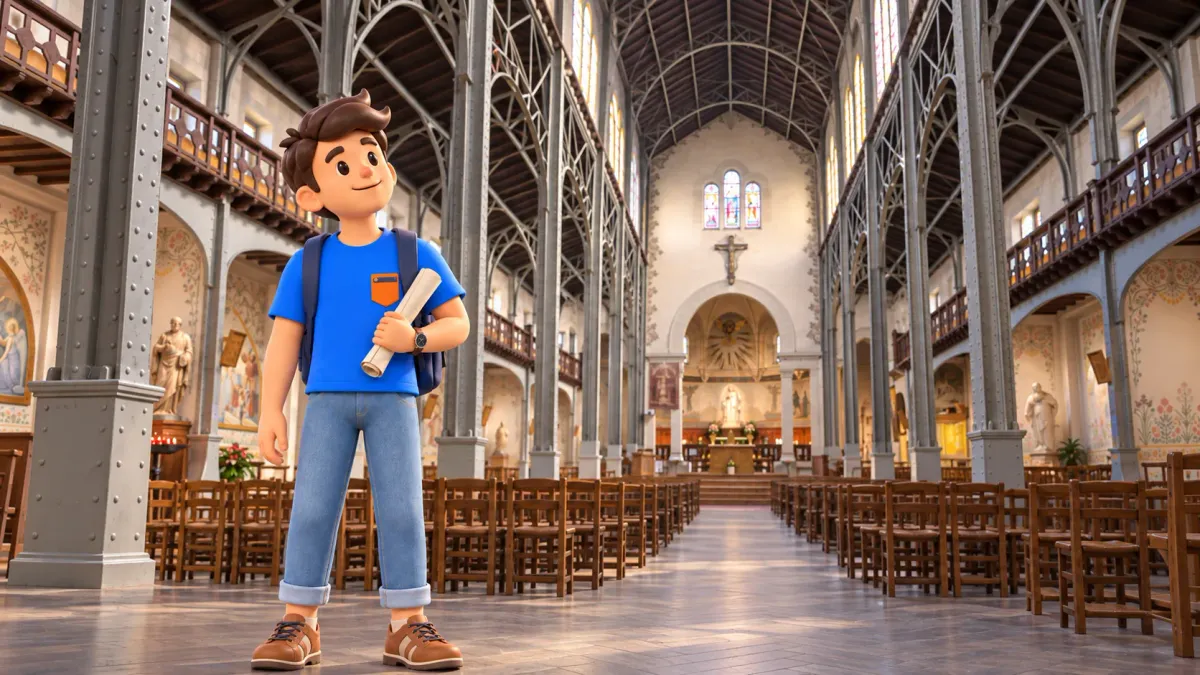
A Paris church can look traditional from the pavement and reveal a surprisingly modern structure inside. At Notre-Dame-du-Travail, a visible metal framework gives the nave something of a workshop’s character. At Saint-Eugène-Sainte-Cécile, slender supports and coloured ribs bring iron into a Gothic-looking interior. These buildings make a useful distinction: architectural appearance and construction method do not necessarily belong to the same historical world.
Choose one church for a quiet visit with a short neighbourhood walk. The two are in different parts of Paris, and comparing their ideas does not require visiting both on one afternoon. Their metal interiors are the main subject; an exterior-only visit offers context, but cannot show the structure hidden beyond the door.
Look at the structure before the decoration
Begin with one question: what seems to hold the space together? Follow a support upwards with your eyes, notice where an arch or diagonal member meets it, then look across the room. Repetition can make the building understandable without a technical drawing. You are observing from the visitor area, without touching the structure or searching for access to galleries.
RoadMe prepares a complete personal trip plan around your interests, travel dates, pace and budget, helping you place an architectural visit within your Paris stay. Using the app makes planning and organising the whole trip more convenient and efficient.
The word “metal” covers different materials here. Saint-Eugène uses cast iron for its pillars and iron for its ribs; Notre-Dame-du-Travail’s parish describes an iron-and-steel framework. You do not need to identify every component. The useful comparison is how a visible supporting system shapes your impression of a room, and how colour, timber and masonry work around it.
These are also working churches. Confirm that a quiet architectural visit is appropriate for your chosen time, check services and follow instructions on arrival. Ordinary opening hours describe access to a place of worship; they do not reserve a sightseeing appointment. If the interior is the reason for coming, settle that practical point before building the afternoon around it.
Notre-Dame-du-Travail: an industrial nave behind a traditional face
Approach Notre-Dame-du-Travail at 59 rue Vercingétorix, on the pedestrian forecourt opposite Square Cardinal-Wyszynski. This is the main church frontage in the 14th arrondissement. The exterior’s traditional forms give little warning of the exposed metal nave beyond. Pause outside first so that, if entry is permitted, you can compare expectation with the space you actually encounter.
Jules Astruc designed the church around the turn of the nineteenth and twentieth centuries. The parish’s account links its construction to the working population of Plaisance and the ambitions of Abbé Soulange-Bodin. Familiar materials were part of the intention: people accustomed to factories and workshops could recognise iron and wood within a religious building. The design gave their daily working world a place in the church’s architectural language.
Inside, start with the repeated grey uprights and arches. Diagonal members and lattice-like infill make the supporting framework conspicuous beneath the dark timber roof. The visual effect differs from a room where the structure disappears behind a smooth decorative surface. Here, the pattern of construction becomes one of the things you came to see.
Look across the nave before following individual details. The lines form a rhythm along the main space, while the timber of the side galleries introduces another material and scale. You can understand their relationship from the permitted floor area. The presence of an upper gallery does not establish visitor access to it.
The industrial character does not remove the building’s religious composition. The porch and the more traditional apse give another direction to the experience, and painted wall decoration softens the framework’s geometric repetition. Choose one contrast: a thin upright against a painted surface, or the dark roof above a lighter wall. A few sustained observations explain more than trying to identify every image.
Notice the difference between following one arch and seeing the whole repeated sequence. A closer view shows how separate members meet; a wider one reveals their rhythm beneath the roof. If you can sit quietly in an appropriate place, let your eyes move between those two scales. There is no need to keep walking around the building to make the comparison.
The historical value lies partly in that combination. The church presents work, religious life and modern construction within one setting. Calling it simply a factory misses the purpose of the comparison. Its materials were intended to feel familiar, while the building remained a place for worship, consolation and community.
Saint-Eugène: Gothic forms carried by metal
Saint-Eugène-Sainte-Cécile offers a different answer in the 9th arrondissement. Use the main porch at 4 bis rue Sainte-Cécile. The address on rue du Conservatoire belongs to the same church complex, but the Sainte-Cécile frontage provides the architectural starting point. The parish is near the Grands Boulevards, so this choice fits a different part of a Paris stay from the Plaisance visit.
Louis-Auguste Boileau built the church in 1854–55. Its Gothic-looking forms refer to an earlier architectural world, while the self-supporting metal framework belongs to nineteenth-century construction. The heritage description emphasises the lightness and brightness made possible by that system, with masonry serving as infill. Appearance and structural method tell related but distinct stories.
The dates make the comparison more interesting. Saint-Eugène’s metal structure precedes Notre-Dame-du-Travail by several decades. The coloured Gothic-looking church therefore does not represent a later decorative disguise for the industrial nave. They are separate projects, made at different moments, using metal to answer different architectural questions. Let each building explain its own choice of forms.
Follow a slender painted support towards the point where several coloured ribs spread above it. Then look at the star patterns across the vaulting. Colour makes the structural lines part of the decorative scheme: the eye moves between the column, the branching ribs and the fields between them. This is a close detail to study from an allowed position, rather than a reason to move through worshippers.
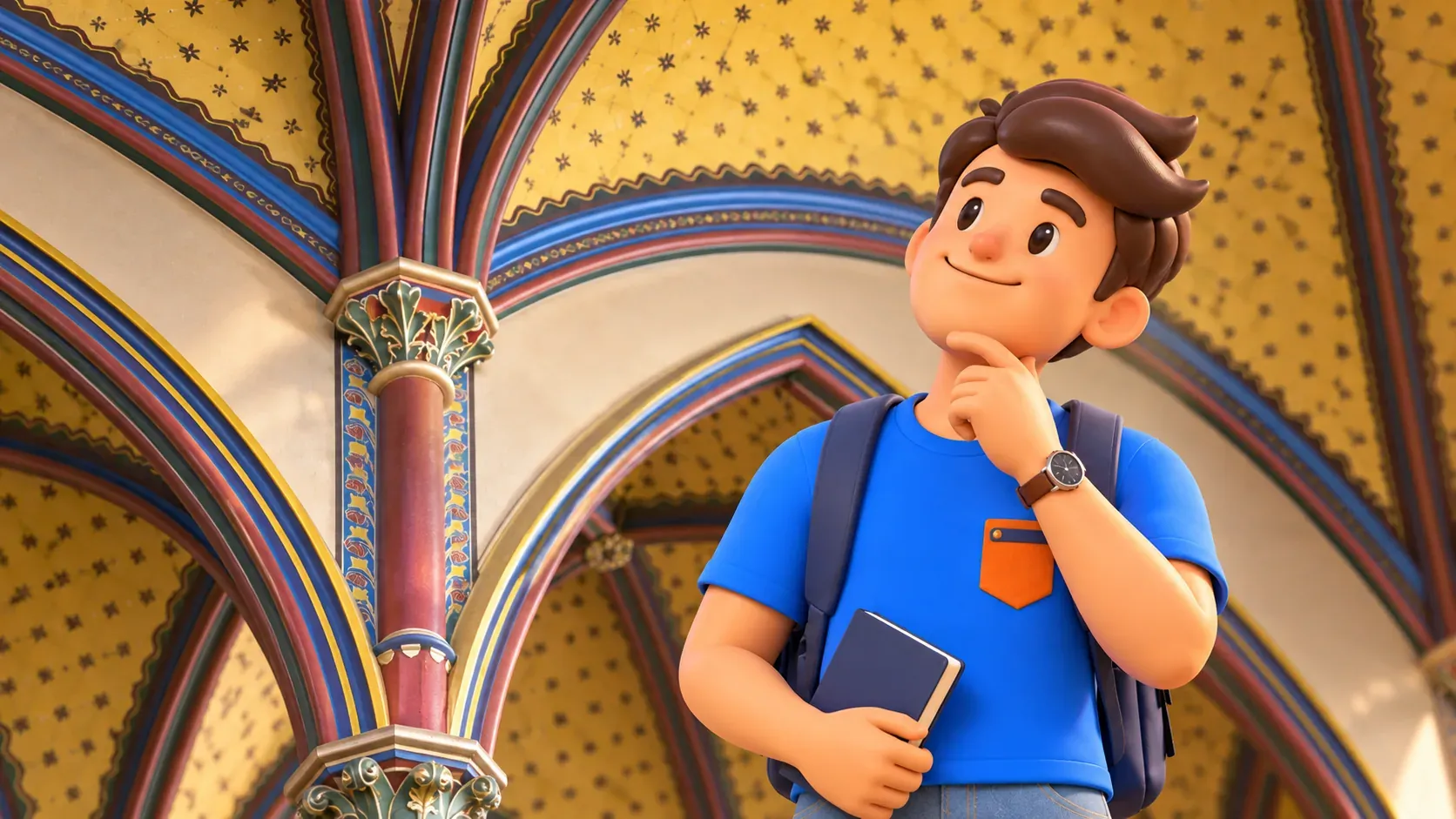
Compare this with the more openly industrial impression described at Notre-Dame-du-Travail. At Saint-Eugène, the supporting system participates in an abundant coloured interior. Painted metal, stained glass and the Gothic vocabulary belong to one visual composition. Recognising metal does not require the building to look like a bare engineering hall.
Take a second, wider look from where you are permitted to stand or sit. Notice how the slim supports let your eye move between parts of the interior. The point is not to count every column or window, but to recognise the relationship between a small structural element and the larger volume. One support and one overhead pattern can be enough for a first visit.
This church also rewards a distinction between historical reference and historical age. A pointed arch does not automatically make a building medieval. Here, an older architectural language was reworked through different materials in the middle of the nineteenth century. That is the unusual feature worth remembering when you return to the street.
Make one local visit fit into ninety minutes
Choose Notre-Dame-du-Travail if you are most interested in the relationship between industrial materials and a working neighbourhood. Choose Saint-Eugène if painted structure and Gothic forms appeal more. Confirm suitable interior access with the chosen parish, then use the same ninety-minute outline for either visit. Travel from your accommodation and a full meal require separate time.
| Part of the outing | Time | Purpose |
|---|---|---|
| Local arrival | 10 minutes | Find the correct frontage and check access |
| Exterior | 10 minutes | Form an impression before entry |
| Quiet interior, if permitted | 30 minutes | Study a few structural details |
| Neighbourhood streets | 20 minutes | Walk the selected local connection |
| Outside pause | 15 minutes | Rest and compare what you noticed |
| Finish | 5 minutes | Orient yourself for the next journey |
After Notre-Dame-du-Travail, follow public rue Vercingétorix southwest to rue Pernety, then continue generally southeast along Pernety’s pavements to a street-level finish nearby. The selected local connection is about 450 metres. Allow the full twenty minutes for walking, crossings and looking at the neighbourhood; this is not a return loop to the church.
After Saint-Eugène, go west along rue Sainte-Cécile to rue du Conservatoire, south to rue Bergère, west to rue du Faubourg Montmartre and south towards boulevard Poissonnière. Finish on the open boulevard pavement, without entering the Métro. This selected street route is about 600 metres, with the same twenty-minute allowance. Keep the pause near the end so the afternoon remains local and unhurried.
The street sequences offer a transition back to everyday Paris. You do not need another monument to complete them. Compare the scale of the church interior with the street outside, then use your pause to recall one support, one roof pattern and one contrast between materials. The walk gives those observations time to settle.
Build your full personal trip plan with RoadMe around your dates, interests, pace and budget, including the journeys and pauses around your chosen church. Keeping that complete plan in the app makes organising the whole stay more convenient and efficient.
Check the day and keep the interior visit quiet
Notre-Dame-du-Travail lists ordinary opening Monday to Saturday from 8 am to 7:45 pm, and Sunday from 8:45 am to 7:45 pm, with changes during school holidays. Saint-Eugène’s parish lists daily opening from 7:15 am to 9 pm. Check the current parish arrangements and services for your date; those broad opening periods are not uninterrupted architectural visiting sessions.
Keep doorways clear, speak quietly and ask before photographing. Worship and ceremonies take priority, including when they begin during a planned visit. For an adapted entrance at Saint-Eugène, contact the church in advance: the municipality describes a removable ramp at the main façade on request. Ask separately about the interior areas you need rather than assuming every part of a historic church is equally accessible.
If entry is unavailable, remove the thirty-minute interior block and keep a sixty-minute exterior outing with the street walk, pause and finish. That version cannot reveal the hidden metal framework. Postpone the interior if it is your main interest; the outside walk remains a different experience. For another day, our southern Paris church architecture walk has its own exterior route and longer timing.


