
Ibn Battuta Mall without shopping: a walk through themed worlds
Ibn Battuta Mall can be interesting even when you have nothing to buy. Its interiors use a traveller’s story to turn a large commercial building into a sequence of different settings. A dome, a gateway or a large display can become the reason to stop, rather than something passed on the way to a shop.
For a first visit, choose a few contrasting courts, leave time to look closely and take a proper pause. Roughly one and a half to two and a half hours can work as an initial estimate, depending on your entrance and interests. This is an interpretive walk, not a measured route through every gallery.
Give the walk a purpose beyond covering the building
The simplest idea is to compare three kinds of space: a richly ornamented dome, a themed street-like court and a large display inside a hall. Persia, Tunisia and China provide useful points of reference. Their order should follow the current mall map and where you arrive, not an invented promise that they sit next to one another.
RoadMe can develop a personal Dubai trip plan around your interests, dates and pace, making it much easier to fit an architectural walk into the whole journey. Use the app to connect the day into a coherent itinerary instead of assembling separate lists of things to see.
Choose a clear stopping point before you begin. You might decide that three contrasts and a drink are enough, while keeping the other courts optional. A large interior does not need to be completed for the visit to feel satisfying.
Check current access arrangements and the parts of the complex you intend to use. Save the correct arrival and return points. The building has a real commercial function, so a walk should respect ordinary circulation, current rules and people who are there for other reasons.
A traveller’s story becomes an interior
The mall opened in April 2005 as a Nakheel project, with themed interiors developed by MTE Studios. Its concept draws on regions associated with the journeys of Ibn Battuta, the Moroccan traveller of the fourteenth century. That gives the building a narrative structure beyond a sequence of similar retail corridors.
The six themes are Andalusia, Tunisia, Egypt, Persia, India and China. They are cultural and geographical references used in a modern design. The courts are not historic buildings transported to Dubai or a precise reconstruction of one moment in the traveller’s life.
This distinction makes the walk more interesting. Instead of asking whether you are seeing an authentic old street, look at how a contemporary designer makes an area recognisable: through colour, scale, ceilings, arches and repeated detail. A broad cultural image becomes a way to organise a large public interior.
You do not need a complete biography before visiting. Begin with the idea that travel connects places, then notice how the building turns a change of region into a change of visual language. The historical inspiration and the modern commercial setting can both remain visible.
Persia Court: look up, then return to the details
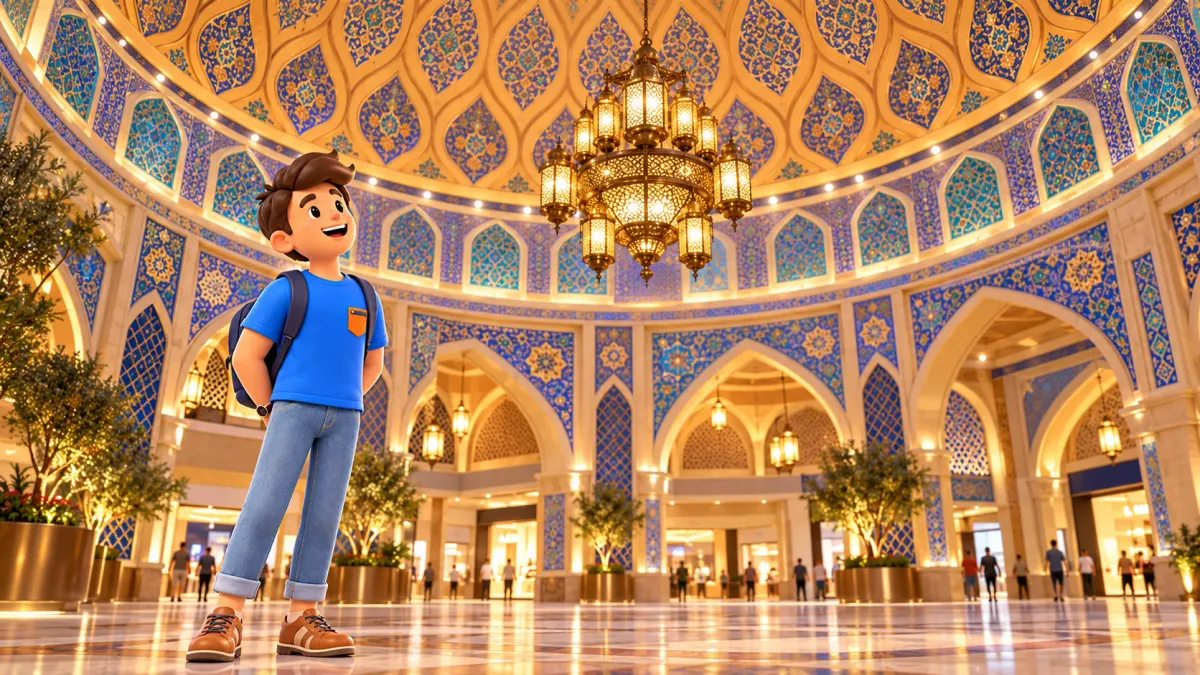
Persia Court is a strong place to think about scale. Its large ornamented dome draws attention upward, while blue and turquoise decorative surfaces and arched passages give the surrounding space a different level of detail. The whole composition works through the relationship between a broad overhead form and smaller repeating patterns.
Start far enough away to read the dome as a single shape. Then look at how a motif repeats and changes as it follows a curve. You do not have to identify the origin of every ornament to appreciate how many small elements create a coherent surface.
Return your gaze to eye level as well. A themed interior is still used by people walking, meeting and shopping. That contrast between a grand ceiling and ordinary activity is part of the place’s character, not something that needs to be removed from every photograph.
For a family, one simple observation works: what makes the space feel larger, the height, the pattern or the light? Different answers are welcome. The point is to notice the setting rather than test anyone’s architectural knowledge.

Tunisia Court: notice how a street is suggested indoors
Tunisia Court uses pale facades, blue accents and details associated with North African urban imagery. The effect differs from the grand dome: it suggests a sequence of fronts, openings and smaller features that can be read more like a street.
Look at the edge between architecture and decoration. An arch, lantern or mosaic border helps create a sense of place, while the controlled interior remains a contemporary mall. The design does not have to reproduce a single town at a single date to establish a recognisable atmosphere.
Compare it with the court you have already seen. Does your attention stay at eye level or travel upward? Do repeated doorways or one large form guide the view? These questions turn the transition into the substance of the walk.
Keep the pace light. You can stop for a detail that interests you without examining every shopfront. Respect entrances and circulation, and avoid turning a photograph into a prolonged obstruction. A short, attentive passage can be enough.
China Court: a display changes the size of the room
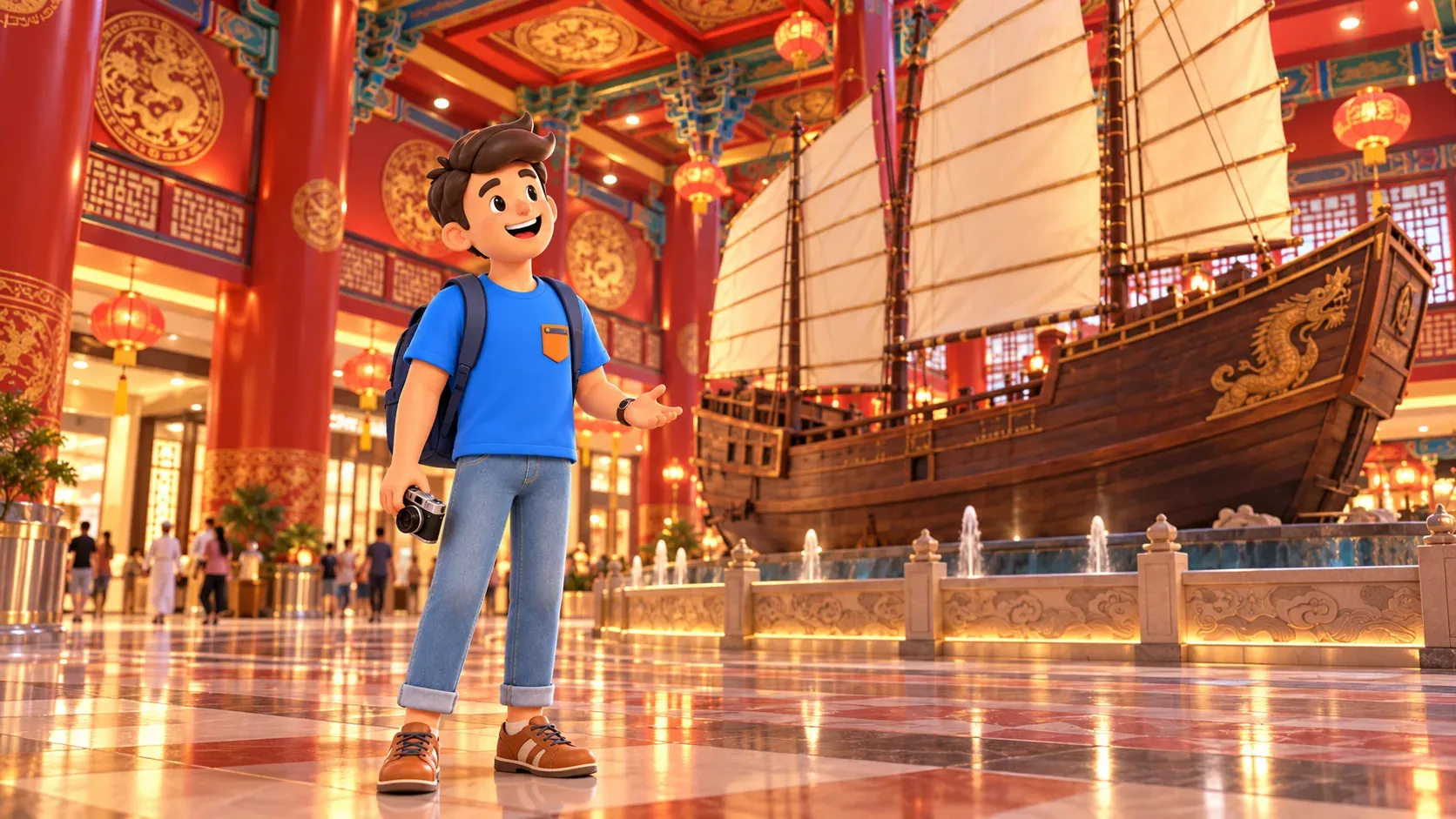
China Court offers a different contrast through its large display and colonnaded interior. A Chinese junk representation is part of its design story. The important visiting idea is the way an object associated with travel becomes an organising element inside a modern hall.
Notice how a large object changes your sense of the surrounding space. You may first see a silhouette, then materials and smaller components. The room is read in relation to the display, rather than only as a corridor connecting stores.
Treat the setting as interpretation. A model or reconstruction can help tell a story about movement, making and distant places without being an original historical object. Looking at how the display is presented is more useful than assuming every element belongs to the traveller’s exact period.
Confirm current accessibility and do not depend on an event or demonstration unless it is specifically listed for your visit. The court can be part of an architectural walk without a performance taking place. Its main role here is to provide another scale and another visual rhythm.
Leave the remaining courts as choices, not obligations
Andalusia, Egypt and India add further architectural references. You can continue if the group remains interested, but there is no need to turn the six names into a checklist. Repeating the same hurried method in every area would remove the contrast that made the first sections enjoyable.
If you do continue, choose a new question rather than simply another place. Look for a ceiling pattern, compare two openings or notice how a display relates to the surrounding architecture. This keeps the walk connected even when the visual themes change.
Some visitors will prefer a compact route with one favourite court revisited. Others will want to explore more widely. Both versions make sense, provided the amount of walking and the return point remain practical for the group.
For children, a simple comparison often works better than collecting all the names. Ask which space they would recognise again and why. A colour, shape or remembered object can be a more meaningful answer than a memorised list of regions.
Use a pause to connect the impressions
Place a real break after the main contrasts. Choose a current option you can actually use rather than assuming a particular café, view or table is available. The purpose is to sit comfortably and let the spaces become distinct in memory.
You can use the pause for a small observation: what changed between a dome, a street-like area and a hall with a large display? A quick sketch of one simple pattern can also help, if that is enjoyable. Nobody needs to produce a drawing or an account of every court.
RoadMe makes the wider trip more convenient through a personal day-by-day plan based on your interests and preferred pace. Use the app to balance this indoor architectural visit with the other parts of Dubai you want to explore, while leaving room to rest.
If the walk has already filled your attention, stop after the pause. Extra time need not become a shopping session or a second district. A visit without purchases still has a clear purpose when the interiors themselves are what you came to see.
Keep bags and practical needs simple. A comfortable walk is easier when you are not continually reorganising belongings. If members of the group separate, agree on a recognisable meeting point rather than relying on a broad description such as “near the main hall.”

Photograph a few ideas and leave comfortably
For pictures, choose a small set of different views: one wide scene, one close pattern and one human-scale moment. You do not need the same portrait in every court. Follow the current photography rules and keep other visitors out of your composition unless they agree to be included.
Before leaving, check the return route and collect belongings without rushing. A large mall can feel different when you are tired, so do not leave the departure entirely to memory. The correct entrance matters more than one final detour.
Ibn Battuta Mall rewards a change in the way you look at a commercial building. A few hours can become a walk about travel, storytelling and the translation of cultural images into space. Choose the contrasts that interest you, give them attention and let the building be more than a place to buy things.


