
Hyde Park in Half a Day: Campus Gothic, Wright and One Museum

A half-day around the University of Chicago can connect Gothic courtyards, Frank Lloyd Wright’s Robie House and a museum of ancient cultures without turning into an endurance test. The useful decision comes before you arrive: choose one substantial indoor visit. Make that either a booked Robie House tour or a focused visit to the Institute for the Study of Ancient Cultures, known as ISAC.
The other places give the walk shape rather than competing for equal time. Henry Moore’s Nuclear Energy provides an outdoor starting point; Bond Chapel and Rockefeller Memorial Chapel introduce different scales of campus architecture. This is a neighbourhood outing, with time to observe buildings and sit down, rather than a complete university tour.
Choose the main visit before assigning four hours
Set aside roughly four hours on campus, separately from the journey from downtown. Give the main interior about ninety minutes including arrival arrangements, then distribute the remaining time between short exterior stops, walking and a break. This is a planning allowance, not a measured promise: your booked tour, walking speed and actual access determine the final sequence.
RoadMe helps plan a complete personal trip around your dates, interests and preferred pace. Try making architecture or ancient cultures the focus of this half-day, then balance it with the other experiences you want across your Chicago stay.
Choose Robie House if you want to understand a domestic building from inside. Choose ISAC if archaeological collections hold your attention. Keeping both interiors would leave less time for the campus itself; give them a longer day if both are priorities. Check the chosen venue’s calendar first, because neighbouring institutions do not share one opening schedule.
Use a flexible route through real streets and entrances
A workable sequence begins at Nuclear Energy on Ellis Avenue between 56th and 57th Streets. Continue south towards the campus quadrangles and Bond Chapel, then reach ISAC on East 58th Street. Robie House is on Woodlawn just north of 58th; Rockefeller Chapel stands farther south along Woodlawn. You can reverse or rearrange this order around a ticket.
For a four-hour budget, allow twenty minutes at the sculpture, thirty-five around the quadrangles and Bond, ninety for the selected interior, fifteen for the other main venue’s exterior, twenty at Rockefeller, thirty for movement and thirty for a break or delays. These allocations express priorities rather than require you to spend every minute at every stop.
Use public streets and paths currently open to visitors. An attractive archway is not a guarantee of a through route, and a closed gate is a reason to use the street alternative. The day’s destination addresses are more useful than trying to remember a chain of unnamed shortcuts through academic buildings.
Begin with Nuclear Energy and its setting
Henry Moore’s bronze Nuclear Energy was unveiled in 1967 to commemorate the first controlled, self-sustaining nuclear chain reaction achieved here in 1942. It marks a historic site rather than offering a visit to a surviving reactor. Knowing that distinction changes expectations: the stop is about a sculpture, a place and the event remembered there.
Look at it from more than one permitted viewpoint. Rounded mass, openings and the relationship between solid form and surrounding space give you something concrete to compare as you move. You do not need to settle on a single interpretation or turn the encounter into a lengthy physics lesson to make it worthwhile.
Pause without blocking people crossing the area. A photograph from a sensible distance can preserve the form and its setting better than squeezing everyone against the work. Then continue south with the contrast in mind: a modern outdoor sculpture leads into the older architectural language that shapes much of the university walk.
Read the quadrangles slowly and treat Bond as optional indoors
On the approach to Bond Chapel, concentrate on the transition between streets, enclosed courts and smaller pedestrian spaces. The campus rewards looking at proportions: the width of a passage, the depth of an arch and the way a quiet green area sits against substantial stone walls. You can appreciate these relationships without entering classrooms or libraries.
For orientation, the chapel’s visitor directions use the Classics archway near 1010 East 59th Street. Follow current access arrangements rather than assuming every courtyard entrance is open. If the approach is unavailable, stay with the surrounding public streets and spend the time on an exterior comparison elsewhere in the route.
Bond is a quiet place with its own activities. Enter only when visitor access actually permits, and leave any session undisturbed. A short look inside is a possibility, not the main indoor block you selected earlier. The exterior and its intimate setting already offer a useful contrast with the scale of Rockefeller Chapel later.
Choose Robie House for a concentrated architecture experience
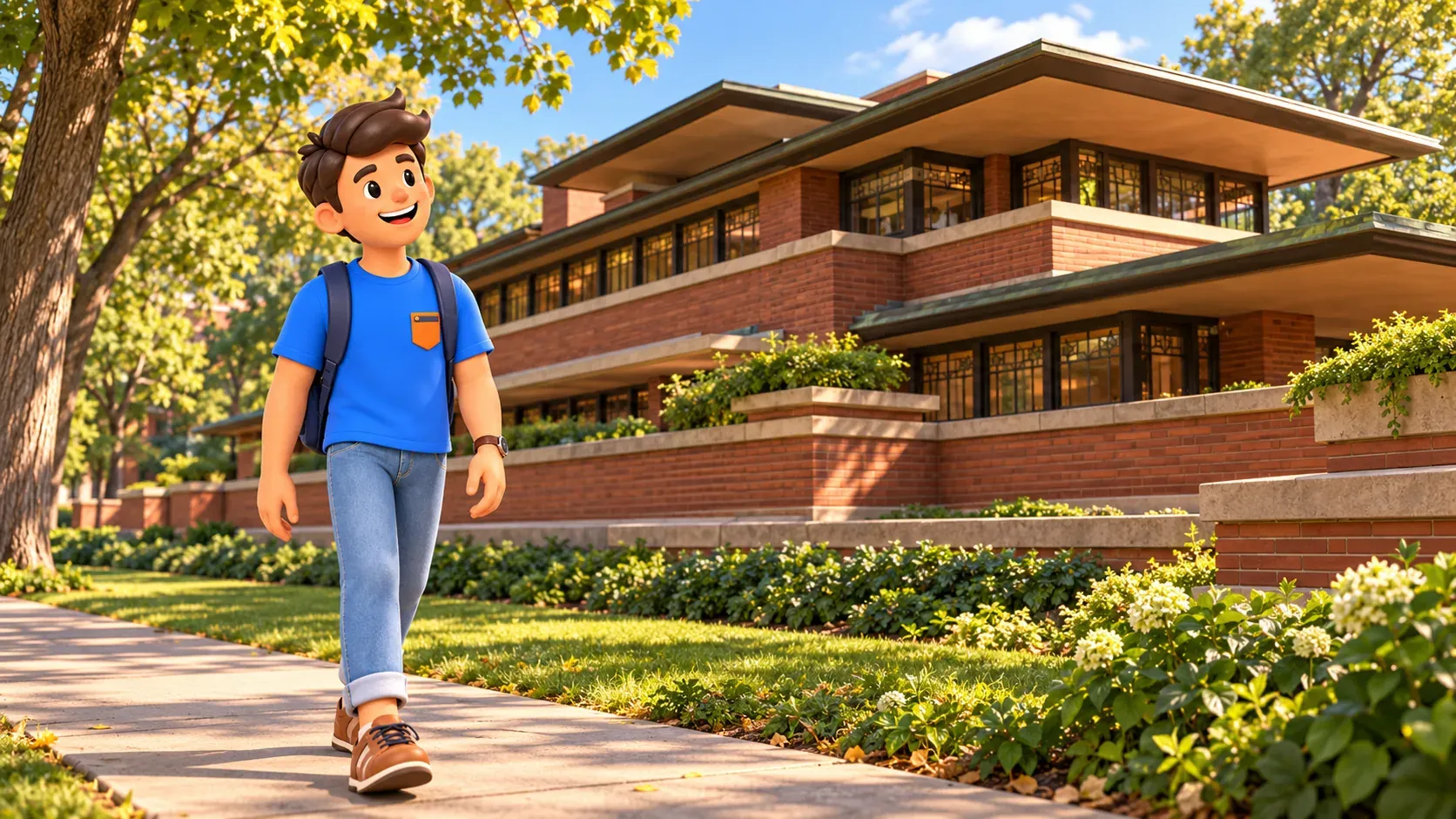
Robie House at 5757 South Woodlawn Avenue brings a deliberately different rhythm to the campus. Before looking for individual details, notice the long rooflines, projecting eaves and strong horizontal arrangement. From the public sidewalk, let your eye follow the building across its width. The contrast with nearby Gothic forms is the central architectural comparison of this outing.
Entry is by guided tour. The standard interior option currently lasts about sixty minutes; check the specific product you book, since longer and combined options use a different amount of time. Advance booking is advisable, and the Trust asks visitors to check in at the museum shop before joining their tour. Allow arrival time separately.
During the visit, use one question to connect what you see: how does the building organise movement, privacy and shared living? Follow the guide’s explanation rather than racing ahead to assemble a complete photographic record. A house tour has a sequence and a limited group capacity; it works differently from wandering freely through an art museum.
If Robie is your main visit, keep ISAC to an exterior stop today. If tickets are unavailable, choose the museum before you travel, subject to its opening calendar. An exterior view of the house remains worthwhile, but it should never be described as having completed the interior tour.
Choose ISAC for one focused encounter with ancient cultures
The Institute for the Study of Ancient Cultures Museum is at 1155 East 58th Street. Its galleries introduce ancient societies of West Asia and North Africa. Plan around what is actually open on your date, and choose a manageable focus when you arrive rather than assuming that the whole research collection is displayed in the galleries.
A useful ninety-minute visit might begin with orientation, spend most of the time in one area, then finish with a brief comparison elsewhere. You could follow objects connected with writing, material, everyday use or ceremonial life according to your interests. Read the labels for the individual objects; visual resemblance alone cannot establish their origin or purpose.
Allow enough space between objects to think about what you have seen. The aim is to leave with a few connected observations, not to photograph every case. If several people are visiting together, agreeing on one shared focus often produces a better conversation afterwards than separating immediately to pursue every room.
If ISAC is your main interior, the Robie stop becomes an architectural exterior comparison. Keep an eye on the time without treating the museum as a checkpoint. Should the collection become the highlight of the day, use the flexible margin there and shorten the optional chapel stops instead of hurrying through the galleries.

Finish the architectural comparison at Rockefeller Chapel
Rockefeller Memorial Chapel at 5850 South Woodlawn Avenue gives the walk a larger vertical presence after Robie’s long horizontals and Bond’s smaller setting. From outside, compare the tower, pointed openings and overall mass rather than trying to collect every decorative feature. A view from a little farther away can make these relationships easier to understand.
Public visiting hours depend on the academic calendar, services and events. Check the actual day, especially during university breaks; an open campus does not imply an open chapel. A tower tour or scheduled performance would be a separate activity with its own arrangements, not an automatic part of this four-hour plan.
If the building is open for visitors, enter quietly and keep the stop proportionate to your chosen main visit. If it is closed, the exterior is a natural finish. You have still compared public sculpture, university courts, a small chapel and two strikingly different approaches to architectural scale.
Keep the practical decisions proportionate to the outing
Check transport for your actual starting point and final stop. The journey from central Chicago belongs outside the four-hour campus budget, and your return need not begin where you arrived. Use current journey information rather than assuming a single bus or train works equally well for every hotel, date and finishing location.
For a wet or cold day, protect the main indoor visit and reduce the outdoor comparisons. In comfortable weather, give the courts and streets more breathing room. If steps, standing time or surfaces matter to your group, ask each chosen venue about its actual arrangements before booking; a short distance on a map does not describe the whole visit.
RoadMe can build your wider trip around the pace and interests that work for you here. Try giving a second museum or a longer architecture tour its own place on another day, with time for meals and travel across the city.
To place this outing within a first visit, use the three-day Chicago plan linking downtown, Lincoln Park and Hyde Park. This campus half-day supplies one concentrated chapter: choose a real main visit, let the outdoor stops connect it, and finish at the place where your attention naturally lands.


