
How Rome Brought Water: Aqueducts, Gates and Display Fountains
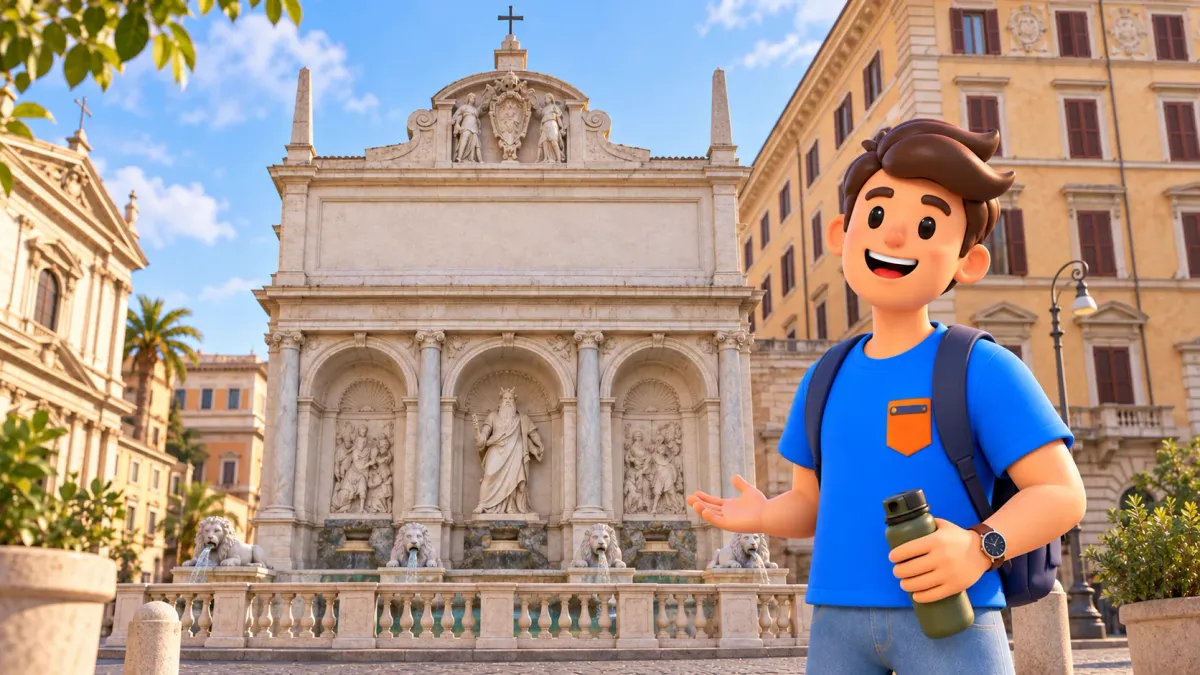
Rome’s fountains become easier to understand if you briefly look past the statues and ask where the water came from. Behind a beautiful stream lies a practical task: find a source, carry a channel across uneven terrain, preserve a suitable height and distribute the supply within the city. Aqueducts and fountains reveal different sides of that work, engineering and public display.
You do not need to travel from the aqueduct park to Porta Maggiore, then to the Moses Fountain and the Janiculum in one day. Choose one section: arches in a landscape, an urban crossing or a monumental fountain. The wider story becomes understandable without trying to follow an entire water network, whose parts also belong to different periods.
The principle is to carry water while managing height
Water moved through an ancient channel because of its gradient. The builders’ task was not simply to make everything as high as possible, but to maintain a suitable route with a slight, sustained descent. Sometimes that required a detour around terrain; sometimes it required tall supports over a low area. The straightest line on a map was not necessarily the best engineering solution.
The famous arches support a channel above them. Water did not flow through the large open spaces beneath the vaults as though they were a stone riverbed. Nor did an aqueduct need to stand on arcades throughout its length: substantial stretches ran underground. The part that makes the greatest impression on a walk is only one component of a much larger conduit.
To give discoveries like these a place in a personal plan for your whole trip, try RoadMe, which considers interests, dates, pace and budget. The app makes it more convenient to distribute engineering history, walks and rest across days that suit you.
Remember three stages: where water is collected, how it reaches the city and how its arrival is presented to the public. You need not find all three at one site. A high arch explains a problem of terrain; a large fountain suggests why water provision could become an opportunity for a public statement and an artistic commission.
The aqueduct park reveals the scale of the task
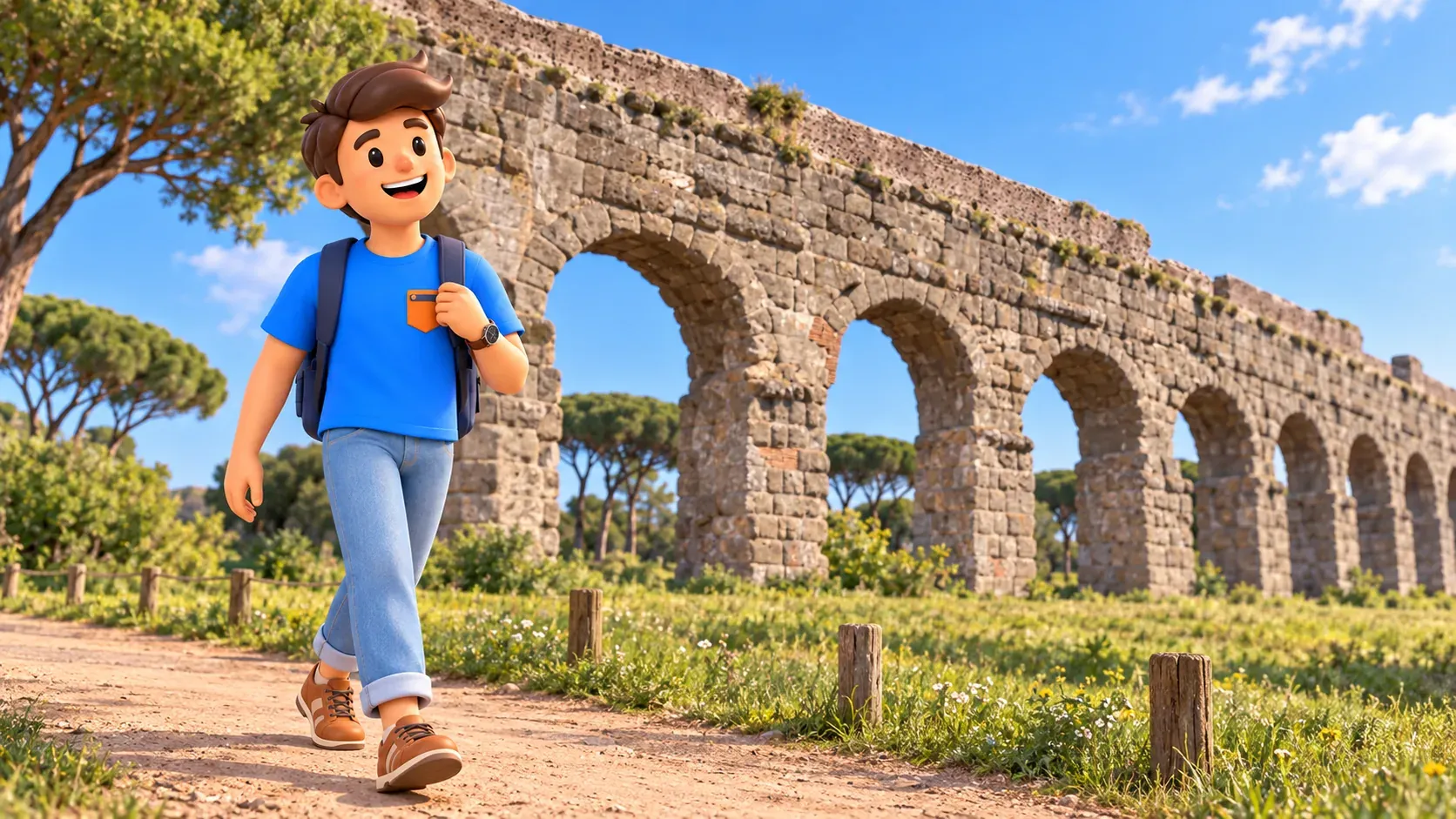
In the Park of the Aqueducts in southeast Rome, the high arches of the Aqua Claudia are particularly striking. Work on the Claudia and Anio Novus began under Caligula in AD 38 and was completed under Claudius. Two channels could share one supporting structure, positioned one above the other. Two supplies therefore did not necessarily require two separate rows of supports.
Look beyond an individual opening to the repeated arches extending into the distance. The builders were solving a continuous transport problem, rather than making a single impressive façade. The channel needed to continue beyond the visible stretch. A surviving fragment explains the principle without proving that the whole ancient system has remained continuously operational ever since.
The park also contains the lower Acquedotto Felice, associated with papal construction in the sixteenth century. Do not automatically assign it the same ancient date as the Claudia. The regional park describes the Felice as still used for irrigation. That is a specific function of a specific supply, not evidence that water in every old arcade is currently drinking water.
Repairs, secondary arches and blocked openings belong to the engineering story too. A conduit required maintenance and alteration rather than surviving for centuries without intervention. Choose one clearly visible stretch and compare its broad structural pattern with later masonry. You need not confidently date every patch from the colour of its stones to recognise that maintenance has changed its appearance.
This option suits visitors who want space, sky and unhurried walking. Paths are unpaved, so consider conditions after rain and your own mobility requirements separately. On a sunny day, do not assume the whole selected stretch will have shade. Bring water and choose a duration that suits the weather and your energy, rather than trying to identify every aqueduct.
Porta Maggiore brings water into the urban picture
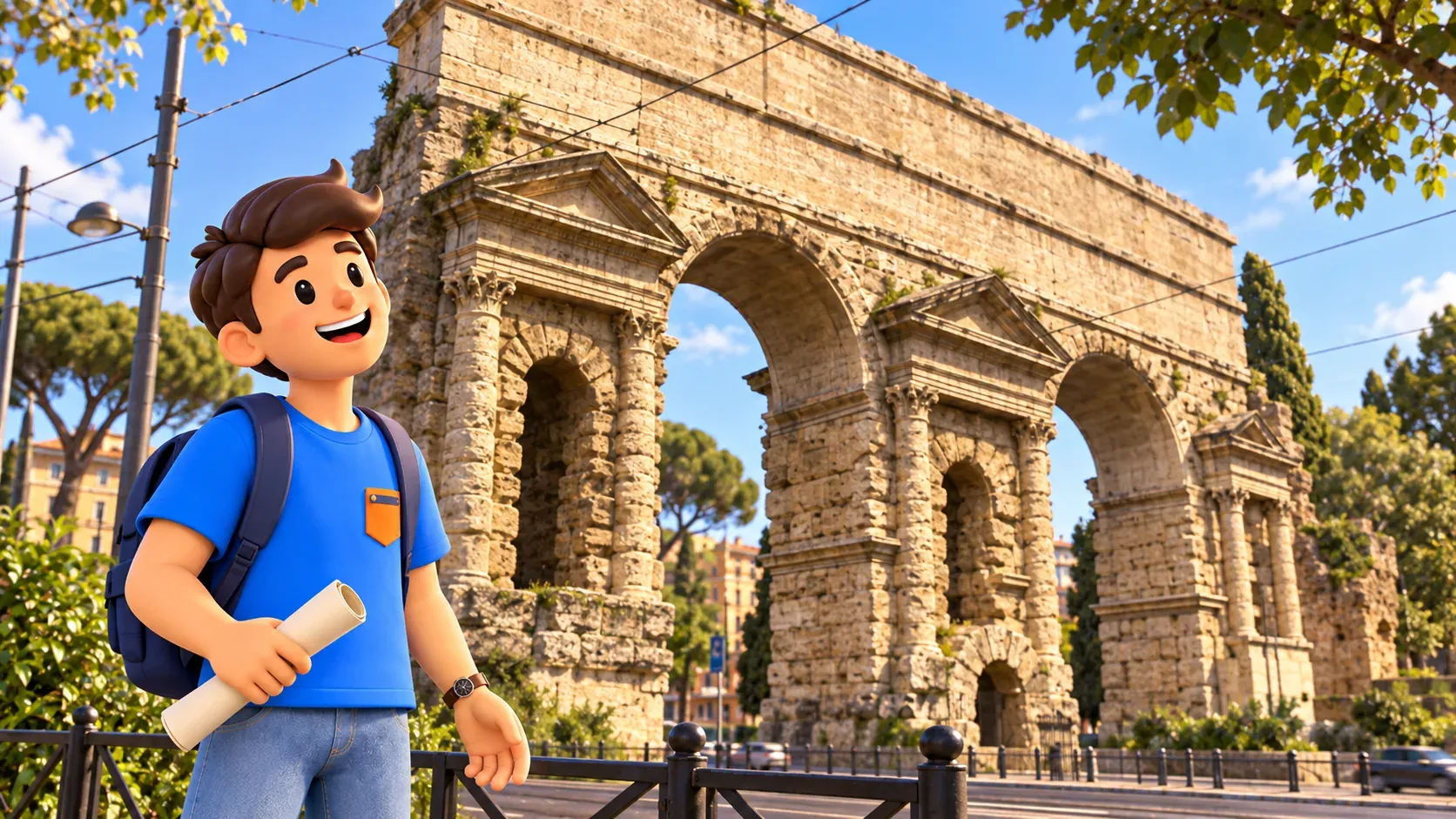
Porta Maggiore presents the subject within a much denser urban setting. Built under Claudius in AD 52 at a road crossing, it originally monumentalised a section supporting the Aqua Claudia and Anio Novus channels. Its role as a gate in the city’s defences came later, when it was incorporated into the Aurelian Walls in the third century.
That difference matters: a monument with two large passages was not necessarily conceived as a defensive gateway. Here roads and water occupied different levels of the same architecture. The high attic above the arches stops looking like heavy decoration once you remember the practical task of carrying a water supply onward across the city.
Inscriptions also commemorate construction and subsequent imperial restoration. You need not translate every line of Latin during a brief stop. Simply notice that maintaining a water supply was considered an achievement worth announcing. Urban infrastructure gave rulers a way to associate their names with something useful to the people who depended upon it.
Today the surroundings are a transport setting rather than a quiet park. Choose an authorised public pavement viewpoint and use normal crossings. Understanding the principle does not require stepping onto tram tracks, approaching traffic or finding a way into the water channels. Ancient paving and modern movement do not imply unrestricted access to every part that catches your eye.
Treat Porta Maggiore as an independent introduction. It explains a meeting of aqueduct and city without obliging you to walk from here to the park along a supposed conduit route. Ancient fragments, later rebuilding and modern streets do not form a continuous public path along the water channel. That would require a separately checked walking itinerary.
The Moses Fountain made arriving water a public event
The Moses Fountain, also called the Acqua Felice Fountain, stands by Piazza San Bernardo. Built between 1585 and 1589, it marked the monumental end of the Felice aqueduct commissioned by Pope Sixtus V. The name refers to his birth name, Felice Peretti. This is a late sixteenth century story, rather than an unchanged imperial fountain surviving from antiquity.
The supply reused elements of an earlier system associated with the Aqua Alexandrina. Its development should not be imagined as simply reopening an old tap. Restoration, changes and distribution arrangements were required. A display fountain made the otherwise partly hidden achievement conspicuous in the city, while providing a lasting public reminder of its patron.
Look at the three tall niches, the central standing figure of Moses and the large inscription panel above. The biblical theme connects the appearance of water with a recognisable story. The central sculpture is associated with Prospero Antichi and Leonardo Sormani. It is not Michelangelo’s Moses in San Pietro in Vincoli, despite sharing a subject and a city.
For this theme, the relationship between practical provision and ceremonial presentation matters more than an argument about the statue’s beauty. You do not need unverified stories about the sculptor’s fate or a contest between artists. Ask instead why a working supply acquired niches, heraldry and a commemorative inscription, rather than remaining an unobtrusive technical installation.
This makes a useful short urban stop. The idea of a monumental aqueduct terminus is understandable from outside, without arranging another museum visit. Yet the fountain does not reveal the entire journey from the sources. It presents the result. Nor should arches seen elsewhere automatically be labelled the one direct channel supplying this particular basin today.
Acqua Paola belongs to another supply and period
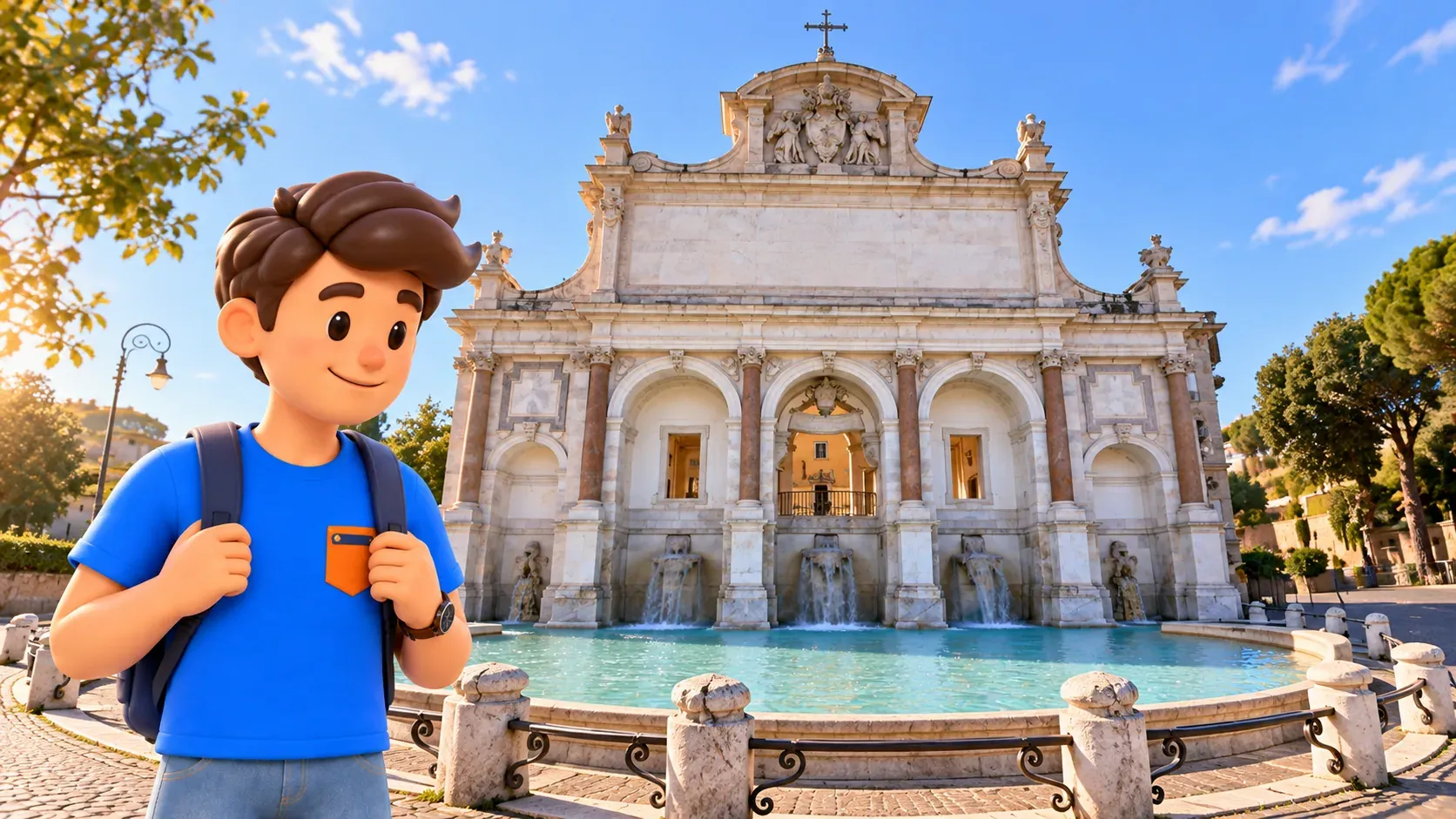
The great Acqua Paola Fountain on the Janiculum is connected with Pope Paul V and his restoration of the Trajan aqueduct, initiated in 1608. Giovanni Fontana and Flaminio Ponzio created the monumental fountain between 1610 and 1614. This was a different supply reaching the western city, rather than the continuation of the same Claudia channel seen in the park.
The architecture resembles a ceremonial arch with five openings and a large upper inscription. The wide shared basin in front resulted from a later change by Carlo Fontana at the end of the seventeenth century, replacing the original separate basins. Even a famous fountain did not stand still within a single construction year; its present effect developed in stages.
There is a small historical surprise as well. The commemorative inscription names the restored Alsietine aqueduct, whereas the municipal heritage account explains the fountain’s connection with the Aqua Traiana. An inscription on a monument also needs historical interpretation, rather than always providing the final answer. It is a compact example of material evidence being compared with research.
An ordinary exterior look concerns the front of the fountain. The small garden behind has separate reservation and access conditions; it is not automatically part of an unrestricted walk. Do not confuse the hilltop monument with the other Acqua Paola fountain in Piazza Trilussa. A shared water history does not turn two different monuments into one address.
Choose one section and give it a clear time limit
Choose the park for landscape. Choose Porta Maggiore for a short story about intersecting infrastructure in the city. If the artistic message of a new water supply appeals most, select one large fountain: Moses or Acqua Paola. These are alternatives for different days and interests, rather than four compulsory stops on one route across Rome.
For the park, consider an hour once you have reached a permitted view of the arches: five minutes to orient yourself, fifteen along a suitable path, fifteen to observe, ten to rest and fifteen to return the same way. A 10:00 start gives an approximate 11:00 finish. This is an illustrative pace without a fixed distance, not a measured tour of the whole park.
Travel to the park, the approach from transport, the journey back to your accommodation and lunch are additional. Walking time does not oblige you to reach a distant landmark: turn back earlier if the path or weather does not suit you. For one urban monument, allow twenty minutes instead: five to orient yourself, ten to observe and five to pause, already at an authorised viewpoint.
To connect the chosen section with museums, walks and rest on your other days, prepare a personal itinerary in RoadMe. The app makes it more convenient to work out the whole trip around your interests and pace than to reconcile every separate idea with the rest of your plans again.
Finally, distinguish a historical principle from current operation. Explaining gravity does not mean every modern fountain lacks pumps, water treatment or other equipment. A decorative basin is not automatically a bottle refill point either. Use designated drinking fountains and follow the current instructions at the particular location, rather than judging water by the beauty of its setting.
The central observation is simple: water had to make a real journey, and the city wanted that achievement to be seen. Arches reveal height and distance, Porta Maggiore a meeting of infrastructures, and fountains the relationship between usefulness, memory and artistic patronage. One chosen fragment can change the way you hear the next Roman fountain.


