
How the 1992 Olympics Changed Barcelona: What to Notice on a Walk
Barcelona’s Olympic legacy is not confined to a stadium or a commemorative symbol. You can notice it where a street meets the sea, where former athletes’ accommodation functions as a neighbourhood, or where a large sculpture gives part of the coast a memorable outline. The story of the 1992 Games continues through ordinary urban life.
You do not need to collect every sporting address to explore it. Choose one part of Barcelona and look at the relationships between housing, public space and leisure. The ideas below offer a way to read those relationships. They are not a complete Olympic directory or a promise that the waterfront, Montjuïc and a museum fit into one short walk.
A major turning point, rather than the birth of the city
The phrase “the Olympics opened Barcelona to the sea” is memorable, but needs some explanation. Barcelona had a maritime history long before 1992. The change concerned particular sections of the waterfront and their relationship with everyday city life. It was not the sudden arrival of the Mediterranean or the first time residents had encountered a beach.
Industry and railway infrastructure had shaped access to parts of the coast and the character of the surrounding districts. Preparing for the Games provided a powerful opportunity to transform housing, connections and public space. Ideas for improvement existed before the Olympic preparations, while construction and new decisions continued after the event had ended.
A better question is therefore not “what did the Olympics create entirely on their own?” but “which changes did the event help bring together and accelerate?” That leaves room for the earlier city and its later development. Barcelona becomes more than the stage set for one summer, and the Games take their place in a longer process.
Try RoadMe to turn your interest in the city’s history into a personal trip plan shaped around your dates, pace and budget. The app makes it more convenient and effective to combine walking, culture and rest than manually squeezing every Olympic address into one tiring day.
At the waterfront, look beyond the water
Around Port Olímpic, the transition from residential streets towards the shore is part of the story. Notice how the width of the space, the reach of your view and the balance between buildings and open sky change. Even without a historical photograph, you can recognise that the waterfront participates in the urban walk rather than existing separately from it.
Port Olímpic is connected with the sailing competitions of the 1992 Games. That helps show why Barcelona’s sporting history does not fit entirely onto Montjuïc. Walking through public coastal space does not, however, mean unrestricted access to every pontoon, boat or working port building. A public promenade and operational infrastructure have different boundaries.
Do not expect the area to remain a frozen picture of the early 1990s. The port and adjacent spaces continued to change. Today’s restaurant arrangements, passages and resting areas should not automatically receive a 1992 date. History explains a direction of transformation without making every present-day element an untouched Olympic original.
For a relaxed encounter, choose a manageable stretch instead of trying to cover the entire coastline. Look towards the water, then back towards the residential streets. That turn of the head can be more revealing than a long building list: it shows the relationship between ordinary life and the open space that draws people to the sea.
The athletes’ village became a neighbourhood
Vila Olímpica was created to house participants in the Games and subsequently became a residential district. This is one of the clearest ways to think about the life of a large project after an event. The interesting question is not only who once stayed in the buildings, but how temporary requirements became a continuing urban use.
Look at ordinary features: streets between homes, places to pause, the direction of the shore and the relationship between buildings and open areas. They may not look like individual attractions. That is precisely why they help you move beyond the sporting postcard and recognise a district intended for everyday living.
The area had an industrial past; the new development did not arrive on historically empty ground. A short walk cannot explain every social and economic consequence of the transformation. There is no need to turn a general impression into a claim of complete research. Remembering that a change of use happens within an existing city is a useful starting point.
Respect the district’s ordinary purpose. Entrances, courtyards and windows do not become museum exhibits because of Olympic history. Public streets provide enough opportunity to notice the scale of the neighbourhood and its coastal connections. A meaningful encounter does not require access to residential interiors or a separate stop at every door.
Gehry’s Fish: a memorable sign of its moment
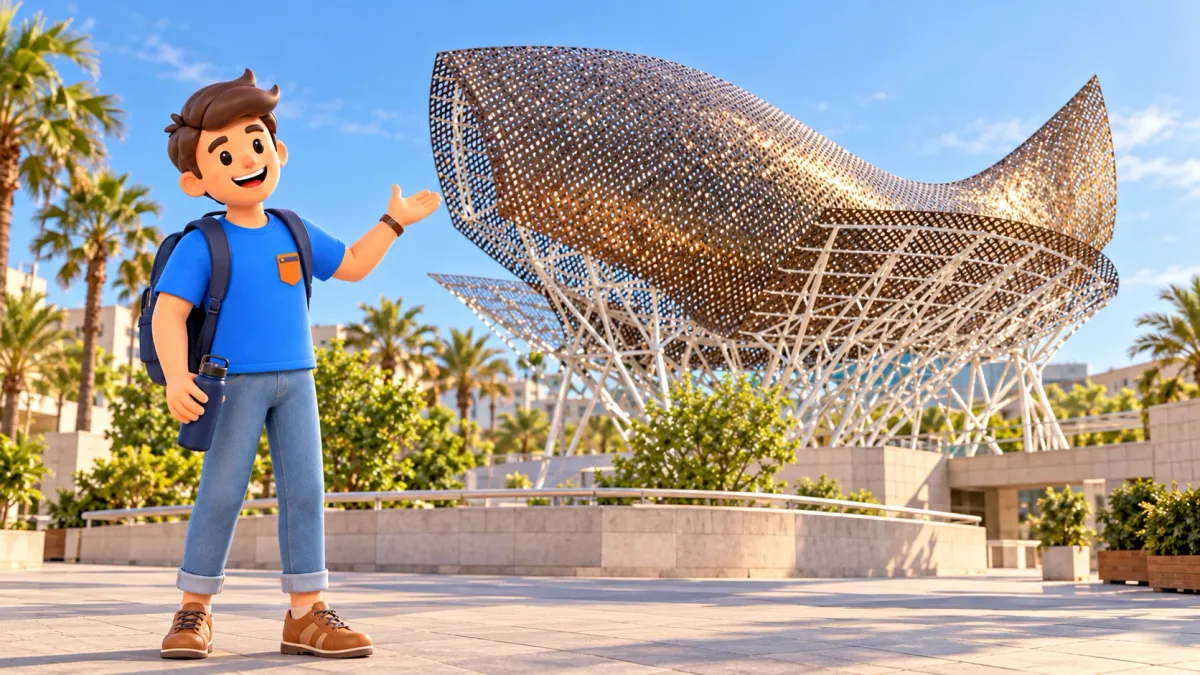
Frank Gehry’s Peix appeared beside the Olympic Port in 1992. Its large curved mesh form and warm reflections make it easy to remember. Separate the visual effect from the material: this is stainless steel, rather than a fish made from gold or bronze. Light changes how its surface appears.
Start with the silhouette, then notice the lattice and supports. A recognisable animal image emerges through architectural scale and an open metal structure. You do not have to find literal eyes, a mouth and fins as if you were examining a naturalistic statue. The more general shape does much of the work.
Here, the Fish is useful as a visual marker of a particular period and a transformed stretch of waterfront. It does not prove that everything nearby belongs to one project or one year. A memorable object can begin a story without replacing the history of an entire neighbourhood with a single attractive landmark.
A first encounter needs only an ordinary permitted viewing position. There is no reason to climb the structure, enter closed areas or stand directly beneath every part. The illustration introduces the character of the form; it is not an access diagram or a guarantee of particular light on your travel date.
On Montjuïc, notice the stadium’s two historical layers
The Estadi Olímpic Lluís Companys did not first appear in 1992. The original stadium opened in 1929 for the International Exposition. It was extensively remodelled before the Games and reopened in 1989. The façade was retained while the facility behind it received a substantial rebuilding.
This is a helpful example of Olympic preparation working with an existing place rather than always beginning from nothing. Different moments in Barcelona’s history meet in one building. The classical character of the exterior and the later sporting purpose are not contradictory: they show how an earlier structure was adapted to another major task.
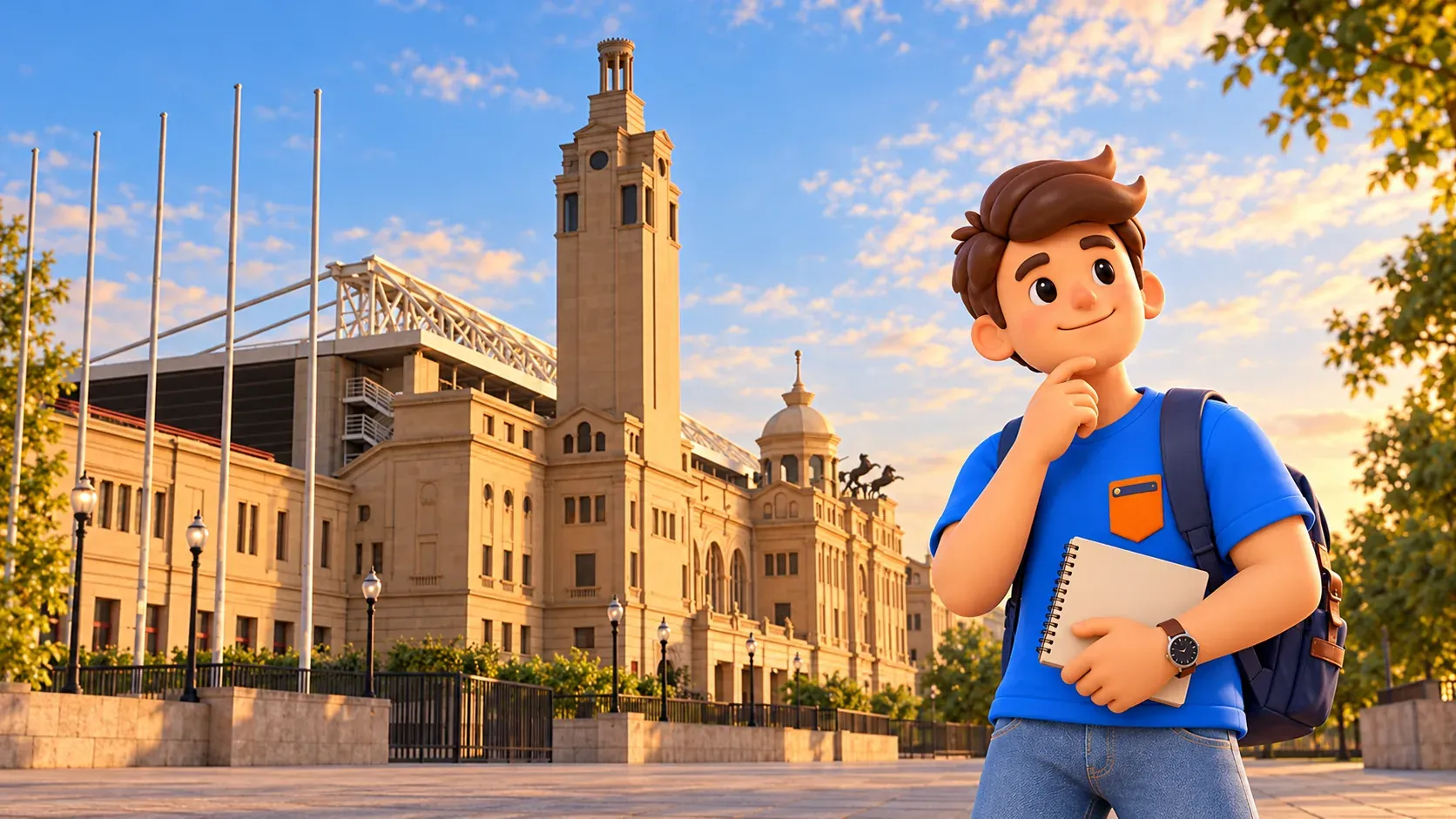
In 1992 the stadium hosted ceremonies and competition during the Olympic and Paralympic Games. Today it remains an active venue with its own programme. Historical importance does not guarantee unrestricted access to the field, track or stands at any hour. Treat an interior visit and an exterior encounter as separate options.
Montjuïc also differs from the coast in terrain and distance. Spacious photographs can conceal uphill sections and tiring connections. Do not automatically attach the stadium to a seaside walk because both stories involve 1992. A thematic relationship does not mean the locations are close or involve the same physical effort.
When the Olympic and Sports Museum adds something
If your curiosity goes beyond urban form, the Joan Antoni Samaranch Olympic and Sports Museum on Montjuïc can provide a separate continuation. It offers a museum context for sporting history. The street reveals scale and use; a museum allows a move towards objects, documentation and a more detailed account.
The museum does not have to become a compulsory part of every Olympic-themed outing. Some visitors care most about the city and coast; others want sporting stories. Let the decision follow your own interests. Check the particular programme, tickets and available areas before a visit instead of treating an old exterior photograph as a promise of everything inside.
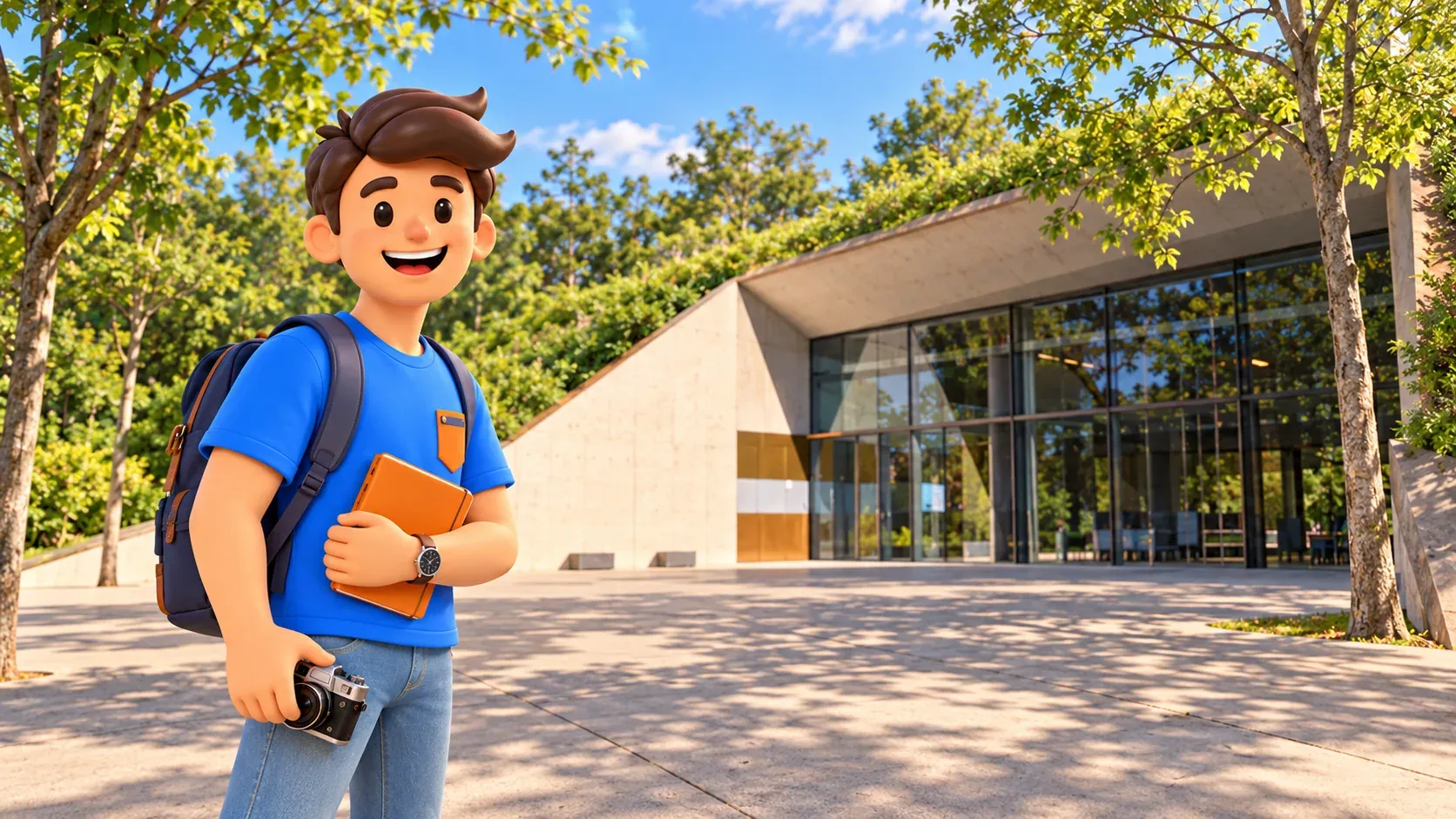
Being near the stadium also does not mean the museum building was created for the 1992 Games. Institutions and structures can tell the story of the same event while having different histories of their own. Keeping that distinction prevents the whole map from being coloured with one date.
What not to attribute automatically to the Olympics
Barcelona continued changing after 1992. Later parks, museums, façades and public-space projects cannot all be labelled Olympic. If you do not know a particular date, describe the visible relationship with the city without assigning an unsupported historical caption. That is more honest, and often more interesting, than forcing every modern object into one story.
Nor should the earlier coast become a completely lifeless blank in your imagination. Industrial areas had work, transport and histories of their own. You can notice a change in urban function without erasing what preceded it. The account becomes richer when it leaves room for more than the celebratory final result.

A useful walking habit is to distinguish an object, a connection and a use. The object might be a stadium or sculpture; the connection, a route from streets towards the water; the use, residential life after the athletes. This reveals more than searching for a commemorative marker at every corner, without requiring a study of every redevelopment project.
Choose the part of the story that suits your trip
For an easy outing, choose the coastal theme and leave time simply to sit near the sea. If sporting memory and architecture matter most, give Montjuïc a separate part of a day or a day of its own. With limited time, you do not have to connect both territories: one clear story can be more satisfying than a long transfer made mainly to finish a list.
Think about weather, exposed sunny areas, slopes and your available energy. If you plan to enter the stadium or museum, check that venue’s arrangements. Olympic history provides a theme, not a shared ticket, common opening hours or automatically accessible passages through every related place.
Let RoadMe prepare a complete personal plan around your interests and preferred pace, distributing city walks, cultural visits and rest across your days. It is a more convenient way to use the trip well and experience the Barcelona that suits you without turning Olympic history into an exhausting race.
For a more focused Montjuïc visit, continue with our guide to the Olympic Ring. On your next ordinary walk, notice not only the recognisable building but also how people use the space around it. That is where the long life of a major event becomes especially visible.


