
Time balls and the Noonday Gun: how Hong Kong shared the time

Checking the time in Hong Kong is now easier than noticing the city’s old time signals. A phone supplies the answer without ceremony. A small tower beside expensive shops or a brick structure among trees can seem like decoration. Yet these places recall a period when accurate time had to be made visible to people around the harbour. One shared signal helped observers compare many separate clocks.
You can explore that story through three places: the Time Ball Tower associated with the former Marine Police Headquarters, the Signal Tower at Blackhead Point and Jardine’s Noonday Gun. The towers are in Tsim Sha Tsui; the gun is across the harbour in Causeway Bay. Their connection is thematic, not a promise of one continuous walk. Choose the part that fits your day rather than treating all three as compulsory.
Why a port needed time everyone could share
For a visitor, time often means when to meet for lunch. In maritime navigation, accurate clocks had a different value: they were working instruments. A public signal was useful as a means of supplying a common reference, not merely an attractive ceremony. Keeping a reliable clock inside an institution was only half the task. Its information also had to reach observers outside.
RoadMe makes it easier to turn an interest in history into a personal trip plan, connecting themed stops with suitable walks, available time and your preferred pace.
A visual signal did this through movement. A ball was raised on a mast and dropped at an agreed moment. Observers did not have to read small numbers on a distant clock face; they had to know the arrangement and see the event. A tower starts to look different when you consider it as a place for transmitting information rather than simply an attractive architectural object.
Providing accurate time, particularly for mariners, was among the original duties of the Hong Kong Observatory, established in 1883. The interesting connection for a traveller is between scientific observation, a civic service and practical harbour life. You do not need a detailed account of the instruments to recognise the chain of work behind a signal that was deliberately simple for its users.
Ask three questions while walking: who supplied the signal, who needed to see it and why was this particular position chosen? These questions turn a list of dates into a practical problem. Even when later buildings interrupt an old view, imagining the line of sight helps reveal architecture as part of a working system rather than a statement about institutional status alone.
The former Marine Police site: making time visible
Begin, if it suits your plans, at today’s 1881 Heritage in Tsim Sha Tsui. Its Time Ball Tower is associated with the former Marine Police Headquarters. Larger buildings and the present commercial setting easily draw attention away from a smaller technical object. For this story, reverse that hierarchy temporarily and allow the tower to become your main point of interest.
The first time ball at the Marine Police site was dropped on 1 January 1885. In the original arrangement, the signal marked one o’clock in the afternoon. Raising it prepared observers; the drop identified the precise moment. This was not a continuous display like an ordinary clock. Someone who looked later could see the apparatus but had already missed its message.

That distinction makes a short stop more engaging. You can ask a clock what time it is, but a time ball requires anticipation of a known event. Time was communicated through an agreement between a service and an observer. With a child, imagine a shared gesture that everyone waits for before checking their own watch. The example explains the principle without turning the visit into a technical lecture.
Today, approach the tower as heritage from a former system rather than automatically expecting a historical demonstration at a particular hour. Current access to different parts of the site requires its own check. The name 1881 Heritage should not become the assumed date of the first time-ball signal: the complex’s name and the device’s history answer different questions.
Instead of taking only a general photograph, look at the mast’s relationship with the building and how a technical purpose distinguishes the structure from a simple pavilion. Then return your attention to the surrounding district. The contrast between a modest old signal and the dense contemporary setting becomes part of the harbour story without requiring a complete tour of every building.
Blackhead Point: greater visibility for the same task
The next chapter is the Signal Tower in Signal Hill Garden at Blackhead Point. Built in 1907, it began its time-ball service in January 1908. This continues the story of the earlier Marine Police location. The towers are therefore more interesting as connected stages of a service than as two unrelated curiosities to collect during a sightseeing day.
Red brick and contrasting pale stone provide a reason to look closely at the architecture. The central question, however, is how the building performed its job. An additional storey was added in 1927 to improve visibility. Height had practical value: the message needed to reach its observers through urban space. The form of a building can record a problem that its designers had to solve.

The historical timetable changed too. Initially the ball dropped once daily at one in the afternoon; from 1920 it signalled at ten in the morning and four in the afternoon. Avoid applying one time to every period of the service. For a walk, the useful idea is that this was an evolving urban system, not an unchanging ritual repeated identically through all its decades.
The service ended in 1933 as radio time signals reduced the need for the earlier method. The tower remained while its role changed. This is a revealing kind of heritage: a place can retain value after it stops doing the work for which it was built. Visitors now encounter a spatial memory of infrastructure rather than an instrument still delivering its original service.
Distinguish garden access from access to the tower itself. Interior opening is limited and should be checked before a visit. Assess the garden approach and any climbing against your group’s energy as well. Seeing the exterior already supplies a useful basis for the story; a closed door does not have to make the stop a failure.
The Noonday Gun: hearing a time signal
Jardine’s Noonday Gun stands on the Gloucester Road waterfront in Causeway Bay, on Hong Kong Island. It introduces another kind of signal: sound. Instead of watching a ball move, visitors anticipate a short report. This is a separate tradition connected with the city’s trading history, not another tower in the same service or a continuous performance throughout the day.
The regular tradition is a single firing at noon. If witnessing it is important, check current arrangements and arrive with time to spare. Walking to the installation after midday and observing the signal itself are different visits. Do not expect the sound to be equally audible from every point around the harbour; the modern soundscape and your position both influence the experience.
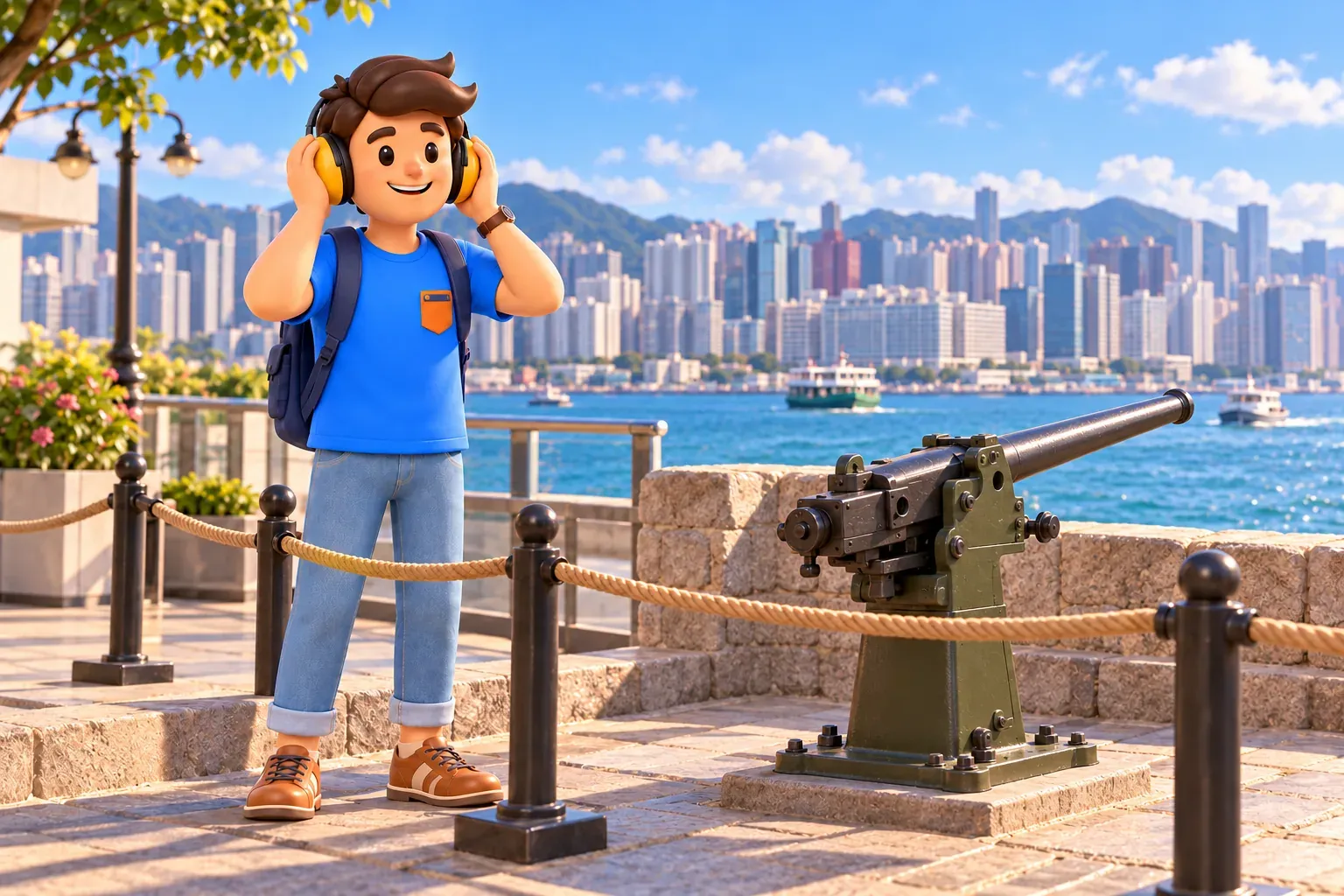
The event is brief and loud. Explain what will happen to children beforehand and consider anyone sensitive to sudden noise. Follow on-site instructions, remain in the permitted visitor area and use appropriate hearing protection if needed. Historical interest does not require approaching more closely than allowed or placing someone in front of the installation for a photograph.
Try not to organise the entire stop around recording the instant. A camera can take attention away from the anticipation and the shared experience. You might agree that one person records while the others simply watch, or leave the phone in a pocket. Understanding the tradition depends more on noticing the relationship between place, people and signal than on obtaining a perfect video.
Two manageable ways to fit the story into a day
The first option follows the two towers in Tsim Sha Tsui as meaningful pauses within an ordinary neighbourhood walk. Allow roughly one and a half to two and a half hours with walking and a break. That is an editorial planning estimate, not the time required to inspect every surrounding attraction. You do not need to fill each remaining minute with another museum.
RoadMe helps shape a personal itinerary for the whole journey around your interests. Balancing a historical theme, waterfront walks and rest in the app is more convenient than manually assembling separate tips about each stop.
Our Tsim Sha Tsui walk provides wider neighbourhood context after the towers. Choose its extent according to your energy. These places do not require turning a whole day into a specialist technical excursion. They can simply change how you look at a familiar visitor district by adding one question: how did information travel through this space before the methods we now take for granted?
The second option is a short Causeway Bay episode built around the noon signal. Keep the rest of the day on that side of the harbour if you prefer fewer transfers. Combining gun and towers is possible when the theme especially interests you, but they occupy different districts and require transport between them. Proximity on an overview map does not make them neighbouring courtyards.
What these stops can change about your view
The main discovery is not a collection of old devices. It is that familiar accuracy once required visible work in the city. A scientific service, someone operating a mechanism, an observer around the harbour and a clearly understood moment formed a connected system. The towers make that system imaginable, while a surviving sound tradition shows that a city can retain history through an action as well as a building.
Check access for your date and do not expect the long-ended time-ball service to repeat. Then leave time to look around normally: vessels, modern buildings and passing people provide the living background. These stops work without demanding complete knowledge of Hong Kong’s past. They offer one understandable question that can make the harbour look a little different.


