
What is the tiny triangle in a Greenwich Village sidewalk?
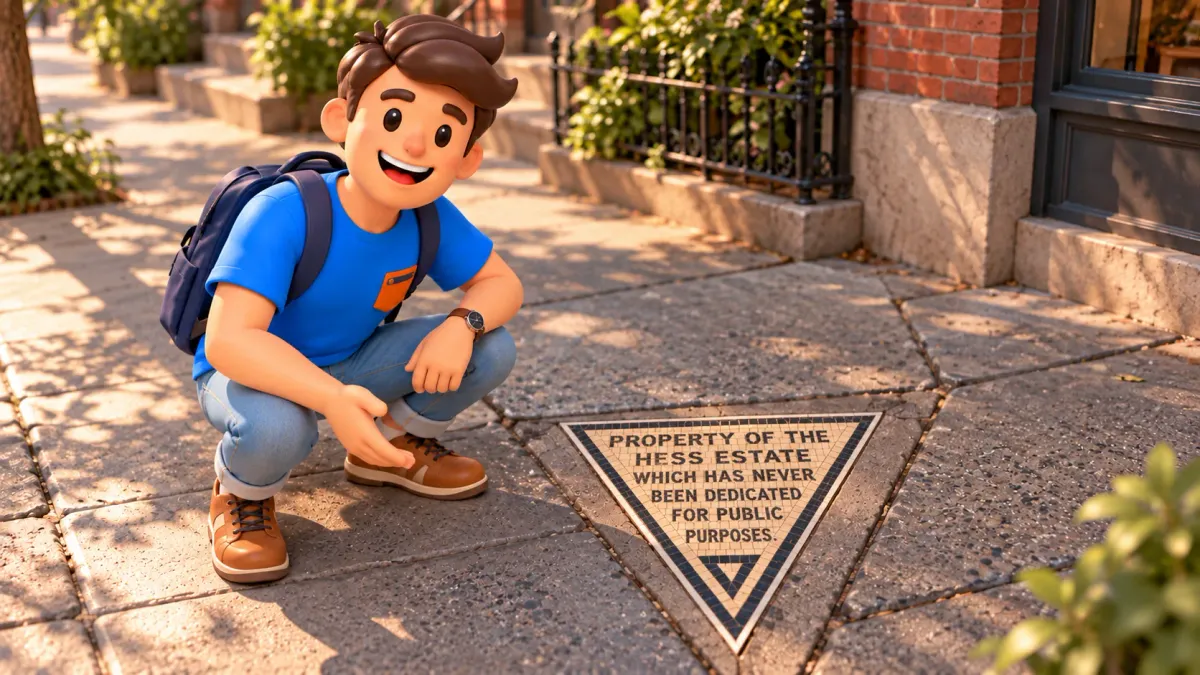
Some New York stories make you look up. This one asks you to look down. At the corner of Christopher Street and Seventh Avenue South, a small triangular mosaic interrupts the pavement with an unexpectedly firm statement about ownership. It is easy to miss, and its size is part of the attraction: a piece of city history that can disappear beneath the position of a single passer-by.
The Hess Triangle is not a miniature park or a room to enter. It is a surviving message connected with a much larger change to Greenwich Village. A brief stop can become the beginning of a thoughtful local walk, especially when paired with the nearby Jefferson Market Library. The reward is a different way of noticing New York, where a pavement detail and a conspicuous tower can both reveal how the city remembers its past.
Find a small story without making a large expedition
RoadMe makes it much more convenient to build a personal New York plan around unusual stories, architecture and your own walking pace. The application can give a small discovery its right place in the day, alongside the experiences that interest you most.
Look for the triangle at the southwest corner of Christopher Street and Seventh Avenue South, by the historic Village Cigars location around 110 Seventh Avenue South. The former shop name remains useful in historical descriptions, but do not treat it as a promise of an operating shop. The mosaic is the subject of this visit. There is no need to enter adjoining premises or invent an interior experience to make the stop worthwhile.
Allow a few unhurried minutes to notice it and understand the story. If you continue towards Jefferson Market Library at Sixth Avenue and West 10th Street, roughly forty-five to seventy-five minutes can give the local sequence room for photographs and a pause. That is an editorial allowance, not a measured walking duration. Your journey to the area and your next transfer are additional; the triangle itself does not require an hour of standing over it.
Choose daylight when the pavement is easier to examine, and wait for a clear moment without blocking pedestrians or a doorway. A small feature calls for a small footprint. You can step aside after looking and read the rest of the story away from the busiest part of the corner. Treat the surrounding street as a place where people live and work, not a viewing area reserved for visitors.
Before the triangle, there was a building
The story begins with property belonging to the Hess family and an apartment building known as the Voorhis. The little mosaic was not an eccentric owner’s decision to buy a tiny patch of pavement for amusement. It followed the removal of a much larger building during the early twentieth-century extension of Seventh Avenue southwards through Greenwich Village, associated with subway development.
That project brought a broad transport corridor into an area with an older, less regular street pattern. On a plan, a new route can look like a clean line. At street level it passes through places already occupied by homes, businesses and familiar paths. The Hess story makes that difference visible through an unusually small remainder. What survives is not the demolished building, but a trace of the boundary left behind.
Local preservation histories describe a sliver of the Hess property remaining outside the land taken for the new avenue. The family did not agree to donate that leftover piece to the city. The contrast explains the appeal of the story: the scale of the public works was enormous compared with the fragment over which the family continued to assert a claim.
It is tempting to make the whole episode a simple contest with a neatly triumphant ending. The more interesting version keeps both scales in view. The original building was gone. The little remnant could not restore it. Yet a visible statement on that remnant ensured that the loss and the family’s objection would not disappear entirely into an ordinary stretch of pavement.

A mosaic that answered back
In July 1922, the family’s heirs placed the mosaic that made the fragment famous. Its message asserted that the property belonged to the Hess estate and had not been dedicated to public purposes. You can understand the point without memorising the inscription word for word. It speaks with the formality of a property notice while occupying a place that most people would simply read as sidewalk.
That mismatch gives it much of its personality. The claim is emphatic; the area carrying it is tiny. A visitor who expects a grand monument instead finds a sentence close to their shoes. It turns a question of urban change into something immediate and slightly surprising. The triangle asks for attention through insistence rather than height, grandeur or an elaborate display.
Look at how the triangular outline differs from the surrounding pavement. Then consider the message as a historical voice, not a contemporary instruction addressed to you personally. The mosaic records an assertion made at a particular moment. Seeing old wording in place does not establish that every ownership condition described by it remains unchanged today.
This distinction matters because the story continued. In 1938, the heirs sold the triangle to the neighbouring Village Cigars business, and it was joined with the adjacent property. The familiar claim of a separate little Hess holding therefore belongs to its history. It should not be repeated as an unqualified statement about a current independent parcel or the present legal status of the corner.
Smallest is less useful than memorable
The triangle is often introduced through a superlative about tiny New York property. That is a convenient invitation to look, but it is not the most useful thing to carry away. Current ownership records and precise area rankings are different subjects from a traveller’s encounter with an old mosaic. You do not need a present-day record claim to appreciate why this fragment became a memorable part of Greenwich Village.
Think of it instead as a detail that connects a broad event with an individual response. Avenue construction and subway expansion can feel abstract until they are related to a particular lost building. The mosaic supplies a human scale. It does not tell the whole history of the neighbourhood, but it gives you a reason to notice that today’s street arrangement was made through changes to an earlier city.
A good photograph can show the triangle’s position within ordinary pavement rather than cropping away every sign of scale. Another can focus on the pattern itself. Make either image quickly when the space is clear, without stepping into traffic, touching the surface or keeping others waiting. A respectful brief look is enough; physical contact does not make the historical connection stronger.

Continue to a very different survivor
For a short continuation, head generally northeast towards Jefferson Market Library at 425 Avenue of the Americas, also called Sixth Avenue, by West 10th Street. Use the actual pedestrian crossings and check your route on a working map if needed. This is a local extension of the story, not a complete Greenwich Village itinerary or a promise that every interesting street will lie along one straight line.
The former courthouse is a striking contrast with the pavement triangle. Its nineteenth-century Gothic architecture, brick and stone, steep roof forms and clock tower are designed to be seen. Where the mosaic can be missed underfoot, the library invites you to raise your eyes. Putting both into one small walk changes the scale without losing the theme of what a city chooses to retain.
The courthouse survived a threat of demolition through neighbourhood preservation efforts, associated prominently with Margot Gayle. Restoring the clock became an early focus of the campaign, followed by a wider effort to find a useful future for the building. Its adaptation as a library offers another kind of survival: a substantial structure kept in urban life through a new purpose, rather than only as a historical shell.
The connection with the Hess Triangle is an interpretation for your walk, not a claim that both arose from the same dispute. One is a remnant and a message; the other is an adapted building. They show different relationships with the past. Neither requires you to regard Greenwich Village as unchanged, or to imagine that preserving one feature prevents every other change around it.

Let a library remain a library
Make the library exterior your reliable architectural stop. If you want to enter, confirm the branch’s actual public opening and any relevant conditions for your date. Ordinary library access does not establish a clock-tower tour, unrestricted access to every room or an automatically open adjoining garden. Those would be separate arrangements. The basic walk remains coherent without adding an interior you have not confirmed.
If a normal visit is available, consider how the building’s present use changes the story. It is a place for reading and public library activity, not simply an old courthouse preserved for photography. Be considerate of people using it for that purpose. A quiet visit with attention to the working space can be more rewarding than treating every interior as a series of backgrounds for personal photographs.
You can also finish outside with a simple comparison. What made you pause at the triangle, and what made you pause at the tower? One may have prompted a smile at its disproportionate statement; the other may have attracted you through colour, height or the idea of reuse. Your own answer gives the walk a more personal shape than another list of things to collect.
Give small discoveries room in the trip
This pairing works best as part of a comfortable neighbourhood visit. Avoid making a long special journey solely to photograph a small triangle if that does not match your interests. Combine it with time you already want to spend in the area, and leave a proper pause between looking at details. The point is attention, not the highest possible number of stops before the next booking.
RoadMe can work these small historical discoveries into a personal trip plan, balancing neighbourhood walks, major visits and rest across your available days. Planning the whole journey in the application is more convenient and effective than trying to connect an expanding collection of saved curiosities yourself.
Leave the corner with a new habit rather than only a photograph. A pavement, a building’s edge or an unexpected angle in a street can hold the trace of an earlier city. The Hess Triangle makes that possibility visible in a very small space. Once you have noticed it, ordinary walking through New York can become a little more attentive, with room for stories that do not announce themselves from the skyline.


