
Hapjeong: a quiet walk to Yanghwajin and Jeoldusan
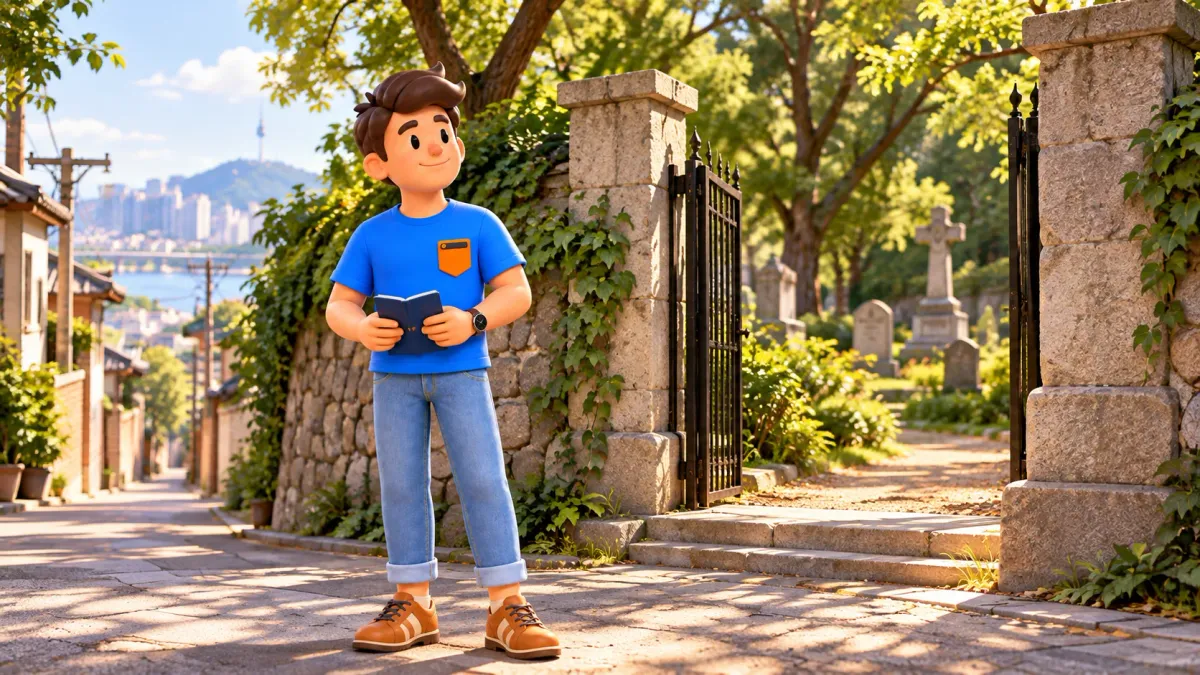
Set aside three to four hours for a quieter side of Hapjeong: visit Yanghwajin Foreign Missionary Cemetery, pause in the public historical park and continue to Jeoldusan’s memorial museum. Tuesday to Friday provides the simplest calendar for the complete version. Start and finish at Hapjeong station on Lines 2 and 6, adding travel from your accommodation separately. A few stories deserve more attention here than a long list of stops.
This walk suits an interest in Korea’s connections with people from other countries, the development of education and medicine, and the history of religious communities. Leafy spaces establish a gentler rhythm near busy western neighbourhoods. Cemetery and Catholic shrine nevertheless remain active places of remembrance. Their histories and visitor arrangements differ. Understanding those distinctions makes the outing richer than treating every nearby memorial as part of a single old church complex.
A half-day with room between the visits
From Hapjeong Exit 7, use public streets towards Yanghwajin. Begin with the cemetery, take a short break in the historical park outside its boundary, then continue south to Jeoldusan. The museum and permitted exterior areas provide the second main visit before returning towards the same transport hub. This sequence allows reflection without requiring a Han River crossing or a comprehensive Hongdae walk afterwards.
Develop this day much more conveniently with RoadMe: the app prepares a complete personal route or trip around your interests, dates and pace. Memorial places, museums, neighbourhood walks and rest receive suitable space in a programme that is easier and more effective to follow.
| Part | Suggested allowance | Purpose |
|---|---|---|
| Approach from Hapjeong | 20–30 minutes | Find the current visitor entrance |
| Yanghwajin | 45–60 minutes | Selected individual stories |
| Connection and historical park | 25–35 minutes | A pause between memorial places |
| Jeoldusan | 60–90 minutes | Museum and memorial architecture |
| Return towards the subway | 20–30 minutes | An unhurried finish |
These are editorial estimates rather than measured walking times. Allow for a guided programme according to its confirmed arrangement; it can replace the independent cemetery visit and change the total. A comprehensive museum visit also needs longer. Select a few themes and keep a reasonable margin before closing. Short geographical connections do not mean the history at either end can be understood in only a few minutes.
Save two place names
Use 양화진외국인선교사묘원 for Yanghwajin Foreign Missionary Cemetery and 절두산 순교성지 for Jeoldusan Martyrs’ Shrine. They are close together but have separate entrances and purposes. Hapjeong serves two lines, so choose the correct platform and direction for the return. Public streets and current signs are more useful than a straight line across a closed boundary or service courtyard that happens to look like a shortcut.
The surroundings are part of an ordinary working city. Subway traffic, everyday streets, religious life and burial grounds coexist. A short change of setting can therefore alter the atmosphere noticeably. Follow permitted approaches and choose a comfortable sequence on slopes and stairs. If avoiding steps is important, establish each entrance separately: proximity does not prove identical access across all levels. The suggested time is a planning allowance, not a promise of a continuously level route.
Yanghwajin: Korean history through individual lives
The cemetery began in 1890 following the death of physician John Heron, who worked in Korea. The need for his burial led to a permanent foreign cemetery. Behind that practical decision lay a wider change: international residents were building institutions, families and lasting relationships rather than merely passing through. Their work became connected with education, medicine and public life, leaving traces beyond the length of any individual stay.
Although the name emphasises missionary heritage, the stories extend across several occupations. Doctors, teachers, religious figures and journalists connect the cemetery with different aspects of change around the late nineteenth and early twentieth centuries. One helpful question is simple: what particular work linked a person with Korea? That approach gives a visit shape without requiring you to memorise every name or turn the grounds into an exhaustive sequence of biographies.
Mary F. Scranton offers an educational connection. She founded the Ewha school, which began in 1886, linking her life with the development of women’s education. A visit here can change how you later see university Seoul: today’s campuses have earlier educational initiatives and individual decisions behind them. The connection is enough for this walk. A full university itinerary belongs to another day, with its own geography and time for the campus itself.
Journalist Ernest Bethell and the newspaper Daehan Maeil Sinbo introduce another theme: public writing and opposition to growing Japanese control. Educator and writer Homer Hulbert represents a further aspect of Korea’s international relationships. These names are starting points for understanding, rather than compulsory graves to collect. Medicine, education and journalism reveal several ways that people from abroad participated in Korean life, without making every life or opinion identical.
Dates, inscriptions and family relationships also suggest ordinary vulnerability. Alongside prominent names are spouses and children. The cemetery consequently records more than distinguished achievements: it preserves people’s lives far from an earlier home, with losses and relationships that cannot be reduced to professional titles. One or two attentive observations can convey that scale. Quiet attention may be more appropriate than trying to retell an entire reference book aloud beside the graves.
Choose a suitable Yanghwajin visit
Normal visiting hours are Monday to Saturday, 10:00–17:00; general visits are closed on Sundays. On Saturdays between 10:00 and 15:00, entry is limited to visitors with guided-tour reservations. Tuesday to Friday is therefore particularly straightforward for an independent version combining both places. Check current notices and calendar exceptions before leaving. Free admission does not remove the visiting arrangements or make every day equally suitable for this programme.
A guided introduction, video and Yanghwajin Hall should not automatically be counted within a free independent walk. Guided access and the hall involve advance arrangements and confirmation, with applications made before the visit rather than on the day. Establish language and programme details when booking. That turns the schedule into a concrete arrangement. If you prefer no guided programme, a quiet visit along permitted paths remains a meaningful choice in its own right.
Visitors are asked to remain quiet, avoid touching gravestones and keep food and drinks outside. Arrange photography with the administration beforehand, particularly video or an organised session. A close image of every stone is unnecessary for remembering the visit. The relationship between trees, paths and names may leave a stronger impression; notes can be made later. This also preserves space for other visitors and the cemetery’s continuing purpose as a place of remembrance.
A public park between two histories
Outside the cemetery, use the public historical park for a short pause on the way to Jeoldusan. Sit down and connect your observations before changing the subject of the visit. Yanghwajin largely introduces individual international lives and their Korean relationships. The Catholic memorial concerns persecution and the community’s remembrance of martyrs. Their proximity invites comparison between ways of preserving the past, without making the events themselves the same story.
The break needs no extra assignment. Put away the guide and let the earlier stories settle. For food or coffee, choose an appropriate place outside the cemetery and religious interiors, following the actual space’s rules. A bench need not become an elaborate picnic stop. In a three-to-four-hour programme, modest rest helps preserve attention for the museum, rather than simply adding a second completed marker to a list of attractions.
Jeoldusan: persecution and later remembrance
Jeoldusan preserves the memory of Catholics executed during the persecution of 1866. This historical layer predates the establishment of the neighbouring foreign cemetery. The modern memorial complex opened in 1967, bringing together religious devotion, a museum and architecture. Keep three moments distinct: the nineteenth-century events, the later creation of the memorial and the present visit. The building is consequently not mistaken for an unchanged church surviving from the time of persecution.
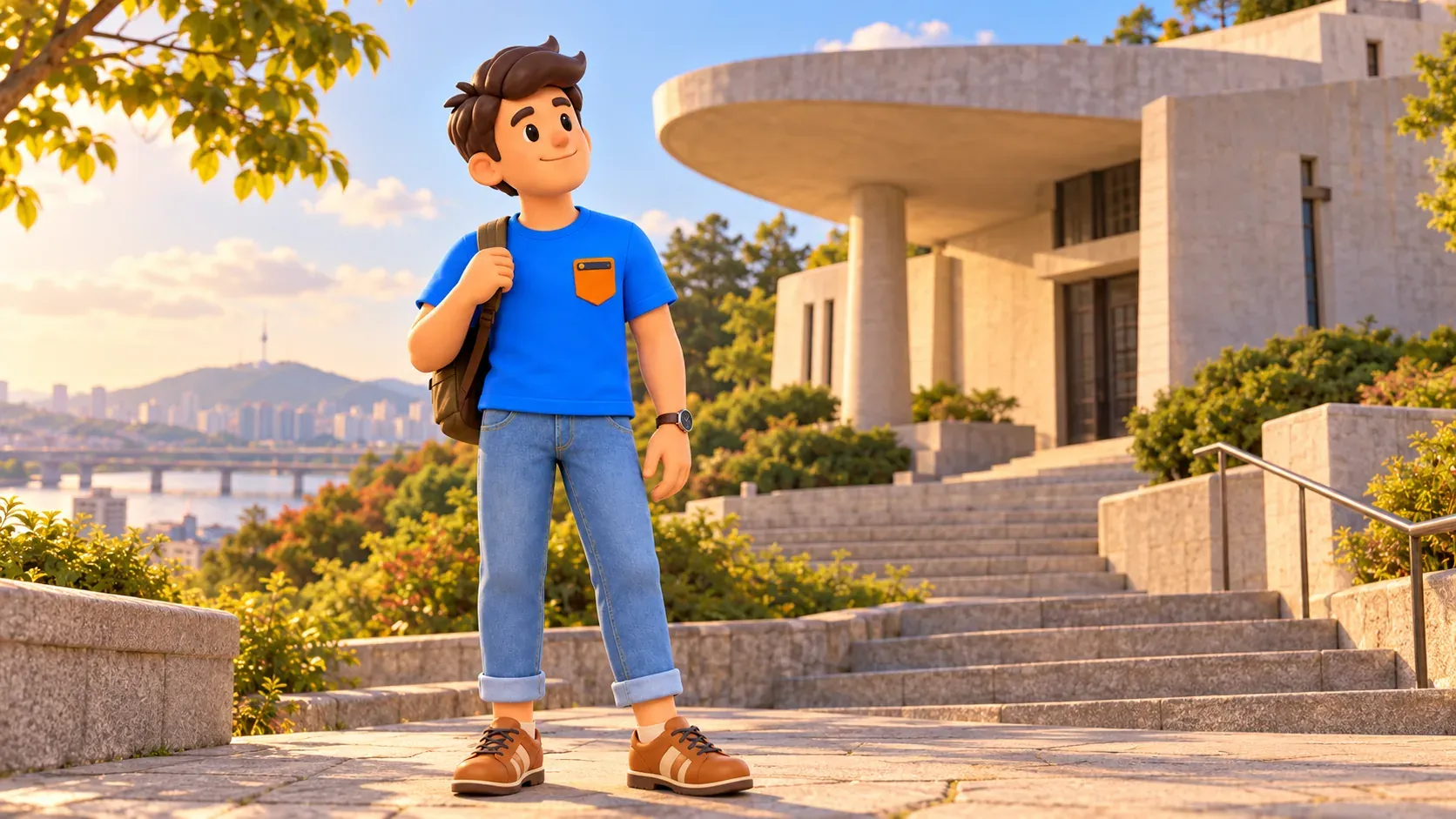
Architect Lee Hee-tae’s design belongs to Korean modernism. Rounded volumes and projecting roof planes create a different image from European Gothic Revival spires. Terrain matters: the complex relates to an elevation above the river, and its different spaces participate in a memorial arrangement. For a short exterior visit, notice how the building occupies its site, outlines its upper edge and directs movement between levels. These relationships help explain the architecture without a long technical lesson.
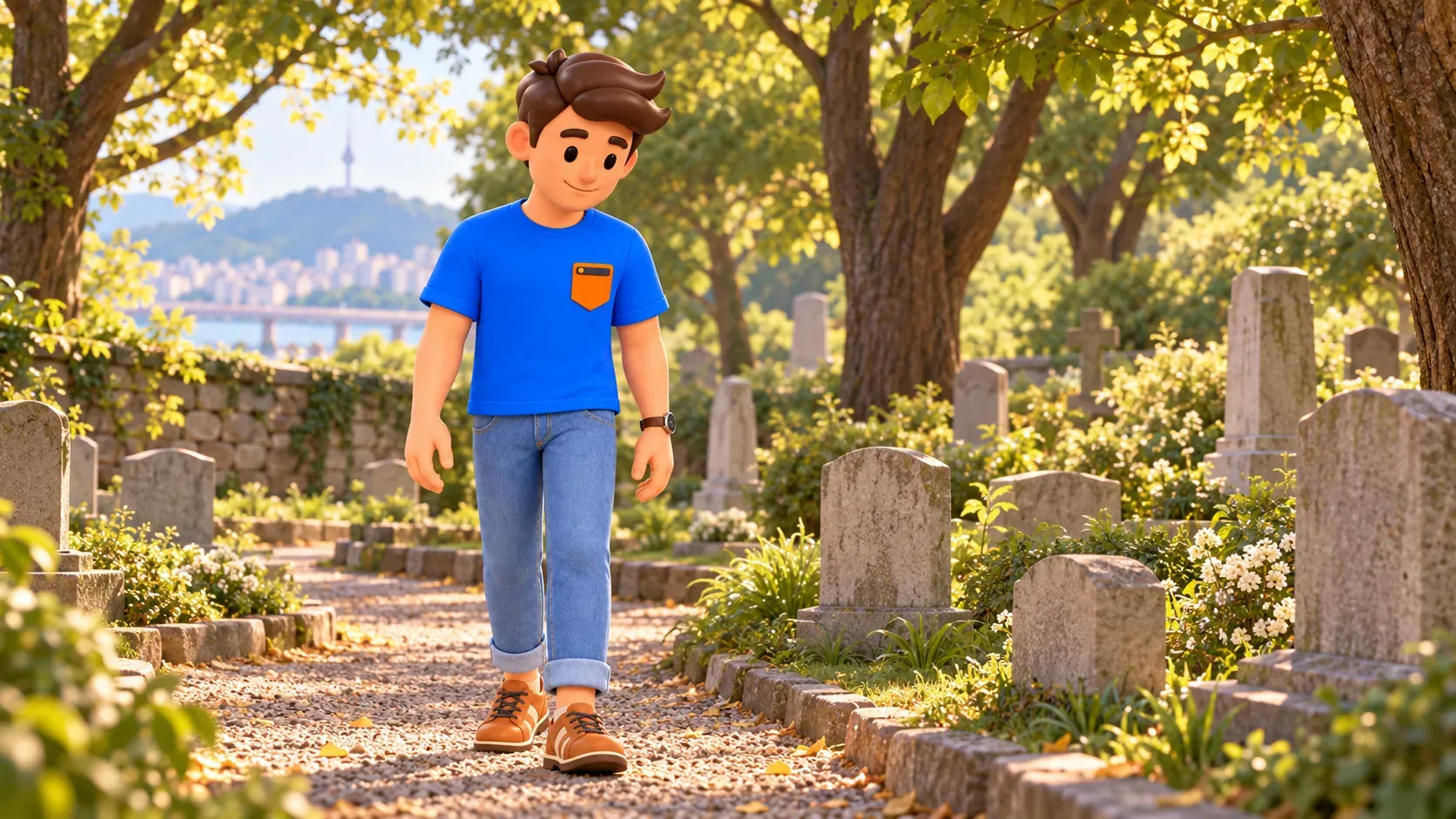
Choose one architectural question rather than searching only for the best photograph. How does a broad roof suggest shelter? How do substantial materials relate to open space? Where does the building follow the terrain, and where does its own form stand out? The illustrations convey the walk’s atmosphere and stylised motifs. They are not an exact contemporary façade record or confirmation of a particular viewpoint. Actual routes and permitted observation positions remain defined on site.
A focused museum visit
The museum presents the history of Korea’s Catholic community through documents, religious objects and materials about people. Begin with the broad chronology, then choose one story or group of objects. The value lies in connecting a material trace with a life, rather than completing every room. Not everyone represented in the memorial was executed on this particular hill. A community’s wider remembrance extends beyond the precise geography of one historical event.
Compare the presentation with Yanghwajin. There, individual biographies organise much of the experience; here, the collective memory of a religious community also shapes interpretation. Both illuminate the city while asking for different kinds of attention. A document preserves words and circumstances, an object evokes a practice, and architecture organises the experience of space. One clear example of those connections can provide a satisfying foundation for a short museum stop.
The museum opens Tuesday to Sunday, 09:30–17:00. Closures include Mondays, 1 January, the Seollal and Chuseok holiday periods, and other announced dates. Visitor information specifies a voluntary offering. Museum opening and worship schedules are separate: a Mass does not confirm exhibition access, while a museum closure does not mean religious life has stopped. For this particular walk, use the museum calendar as the practical reference rather than the service timetable.
Finish where the rest of the day is easy
After the visit, allow a little more time outside before returning to Hapjeong along permitted public connections. Seonyudo island, a long riverside walk and a complete Hongdae evening need not become automatic additions. Other interesting places may be nearby, but this half-day already has a coherent shape: individual lives, a pause, collective remembrance and a return to ordinary streets. Stopping at that point preserves the distinction between a thoughtful visit and a hurried circuit.

Connect the walk with your wider stay more conveniently in RoadMe: the app develops a complete personal programme around your interests and distributes cultural stops and rest across your days. That makes it easier to choose a suitable rhythm and use time effectively while retaining space for your own discoveries.
The strongest impression comes from differences: between two histories, an old burial place and a modern memorial, a public street and a quiet interior world. Retain a few names and one architectural question instead of trying to memorise everything. The result is a more personal view of Seoul beyond the major palace routes, with a clear start, a manageable programme and time to think about what you noticed.


