
Hackesche Höfe and Haus Schwarzenberg: a Berlin courtyard walk

For a compact introduction to Berlin’s courtyards, start at Hackescher Markt, explore the Hackesche Höfe, return to Rosenthaler Strasse and enter neighbouring Haus Schwarzenberg. Finish along Sophienstrasse near Sophienkirche. Within a small area, the walk brings together Art Nouveau architecture, working cultural spaces and a quieter neighbourhood street.
Allow around two hours with short stops and a modest break, or reduce the outing to ninety minutes if needed. The allowances are editorial estimates, not measured walking times. A museum visit, theatre performance or cinema screening needs its own time. Choose one deliberately once you know which aspect of the area interests you most.
A route built around changes of atmosphere
Begin on Hackescher Markt and find the Hackesche Höfe entrance at Rosenthaler Strasse 40. After exploring, return through the same street entrance. This makes the connection to Haus Schwarzenberg at neighbouring Rosenthaler Strasse 39 straightforward. Afterwards, go back to the street, head north and turn west into Sophienstrasse towards the Sophienkirche area.
To make this walk part of your wider visit, try RoadMe: the app develops a personal trip plan around your dates, interests and pace. It is a more convenient way to give architecture, art or quieter neighbourhoods the place they deserve in your own Berlin itinerary.
As a guide, give the square and approach ten minutes, the Hackesche Höfe thirty, the return and neighbouring entrance five, Haus Schwarzenberg twenty-five, a break fifteen, Sophienstrasse twenty and the finish with a small reserve fifteen. Connections within each section are included. Together, these make two hours without assuming that you will enter every venue along the way.
The aim is to notice how light, sound and use change behind a street façade. The proximity of the two complexes is particularly valuable: their different approaches to working and spending time in the city remain fresh in your memory. You can compare them directly rather than travelling across Berlin to find a contrasting example.
Hackescher Markt: look at the street first
At Hackescher Markt, pause beside the main pedestrian flow. The square and station give you a practical starting point, but begin the courtyard experience with an ordinary street view. Notice shopfronts, doorways and people moving past. Soon you will be behind façades that currently seem to separate a public street from individual buildings.
On the approach to Rosenthaler Strasse, see how much a passage reveals before you enter. Sometimes a single arch suggests a different scale of city beyond it. Keep that observation for the rest of the walk: a doorway can lead to a visitor courtyard, an individual business or an ordinary residential entrance, each asking for a different response.
If meeting companions, choose a specific place beside the square without blocking movement. Then head towards number 40. You can have coffee at the start and move the planned break forwards, keeping the overall sequence intact. That may suit a morning when you would prefer to explore the two complexes without interrupting the comparison halfway through.
The first courtyard: Art Nouveau in the details
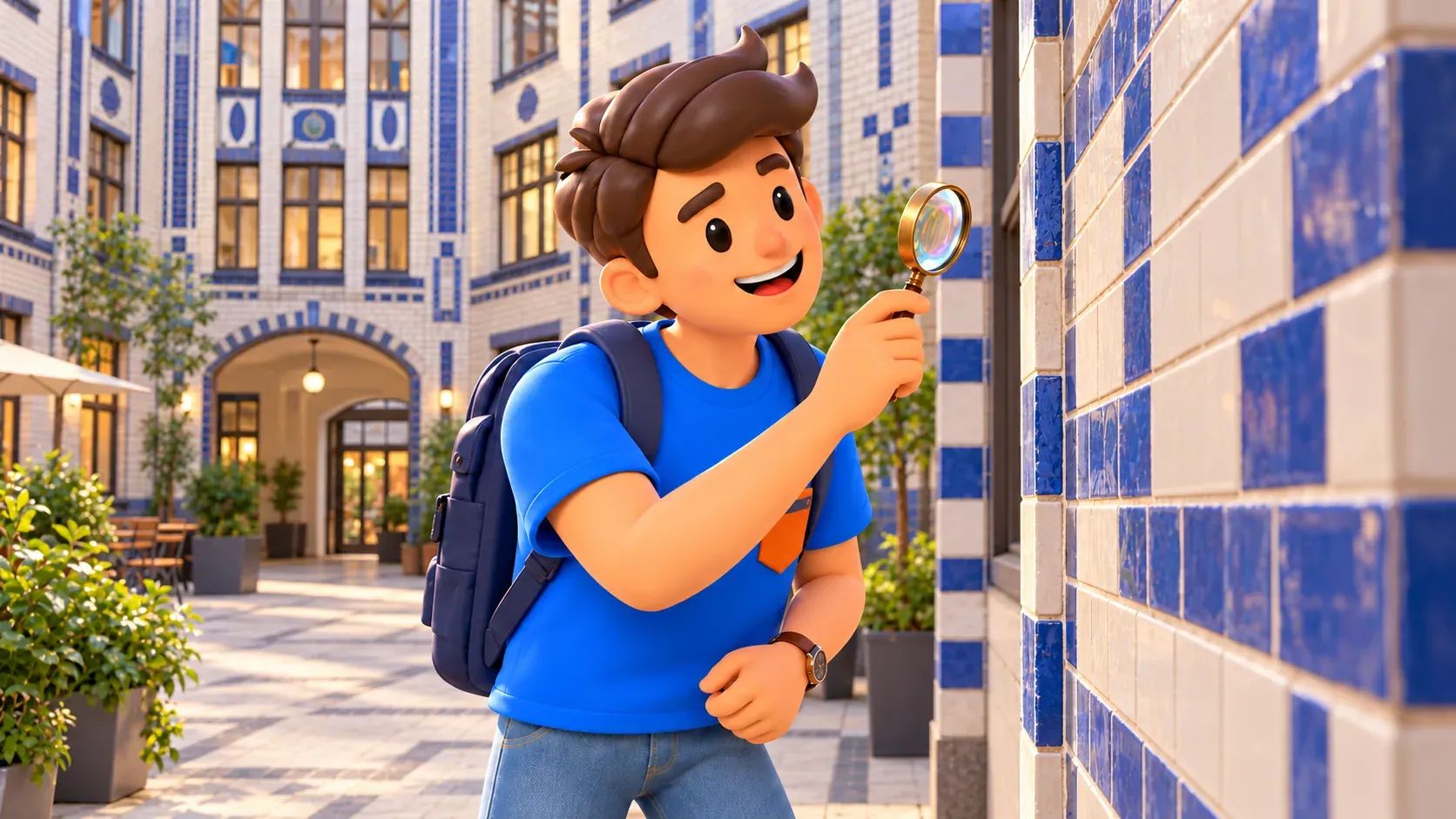
The first courtyard makes a strong impression. Its façades are associated with August Endell, whose use of colour and rhythm animates the building’s underlying structure. Look first at the overall pattern, then select one small area. Gradually you notice how a line moves between windows and how colour changes the apparent weight of a wall.
Unlike a monument in an open square, a courtyard does not reveal itself in a single view. Turn, look upwards and return to the level of the entrances. You are inside an architectural space rather than standing before an isolated frontage. A few attentive minutes can be more rewarding than trying to fit every window into one photograph without people.
The complex dates to 1906 and the scheme of architect and developer Kurt Berndt. Endell gave the front courtyard and selected interior spaces their distinctive decorative treatment. Keeping those roles separate is useful: one shaped the arrangement of a substantial ensemble, while the other helped give its most immediately visible part a memorable artistic character.
Choose a colour, a curve or a relationship between windows that appeals to you. There is no need to identify every decorative motif. Making a small personal selection gives the architecture meaning even if you rarely read building descriptions. Later, you can compare that impression with a very different kind of wall surface next door.
Further inside: work and homes together
Eight connected courtyards form the Hackesche Höfe, but counting them is only a starting point. Commercial and residential uses were combined in the original scheme. A compact site held a network of different activities. Shops, cultural venues and apartments still make it part of a functioning city rather than a preserved stage set.
Explore a few accessible sections and compare them with the first courtyard. Decoration, openness and the character of the entrances change. When colour stops commanding attention, the proportions of the space become easier to notice. You can treat the sequence as a small investigation: which places encourage you to linger, and which naturally draw you onwards?
The appearance you see today also reflects restoration and redevelopment in the 1990s. A neat surface has a history of change behind it; old architecture does not mean everything remained untouched. For a first visit, the relationship between historic form and contemporary daily life is enough. The detailed history of each room can wait for a more specialised interest.
If a shop catches your attention, choose one and give it some time. Businesses set their own opening hours. In residential areas, keep conversation considerate and remember that attractive windows still belong to someone’s home. After a modest circuit, return to Rosenthaler Strasse through your original entrance to make the next part of the route clear.
Haus Schwarzenberg: another character next door
Find the passage at number 39 into Haus Schwarzenberg. The impression changes quickly: more varied surfaces, street art and signs of many cultural activities replace the front courtyard’s coordinated decoration. Compare the places without deciding which is the “real Berlin”. Both are living environments, with different ways of organising work and expressing themselves.
Haus Schwarzenberg is associated with Schwarzenberg e.V., established in 1995. Art and cultural spaces, galleries, cinema and other projects work here. An apparently informal setting still relies on everyday organisation: rooms, programmes, participants and visitors. Seeing it only as a free background for photographs misses much of what gives the place its value.
The name identifies this particular Berlin cultural site. Its origin connects with Schwarzenberg in the Ore Mountains, but this walk is not moving to another German town. For navigation, use the Rosenthaler Strasse address. Searching only the word Schwarzenberg can bring up something unrelated to the small courtyard you are trying to reach.
Stop where you leave the passage clear and take in the courtyard as a whole. Then choose one section of wall. The variety can make it tempting to photograph everything at once. Looking more selectively helps distinguish a work you enjoy from the general visual background and makes your response to the place more personal.
Street art and working cultural spaces
Images in the courtyard can change. Come for the experience of the place and the possibility of finding something that interests you, rather than expecting an exact reproduction of an old guidebook photograph. Notice scale, material and proximity: a small image and a large wall can affect you differently even when they occupy the same view.
The neurotitan gallery and shop offer a way to develop the art theme. Check the current programme and their own hours if they matter to your plans. Choose one continuation that appeals, whether an exhibition or browsing art and publications. The complex’s different activities are possibilities, not a list that every visitor needs to complete.
Compare two walls you have now seen: the first Hackesche courtyard’s decorative rhythm and Haus Schwarzenberg’s more changeable visual layer. In one, you followed a coordinated architectural idea; in the other, you encountered artistic statements sharing a setting. The contrast makes the short connection worthwhile even without shopping or attending a special event.

Leave a different kind of time for remembrance
Rosenthaler Strasse 39 also contains the Museum Blindenwerkstatt Otto Weidt. During the Second World War, Weidt employed mainly blind, visually impaired or hearing-impaired Jewish workers and tried to protect them from persecution and deportation. This is a substantial historical subject deserving calm attention, rather than an incidental detail on a street-art walk.
Museum admission is free. If you choose to visit, extend the outing or reduce the art section and break; a meaningful exhibition visit does not fit invisibly into five minutes of connecting time. Check entry and group arrangements separately. For someone whose main interest is history, the museum can become the central experience of this small area.
Keep that visit’s atmosphere distinct from searching for colourful photographs. A short pause between the neighbouring spaces can help. Their different uses do not make the area less coherent. They show how several histories occupy one building and why each deserves its own way of looking, rather than being folded into a single mood.
Sophienstrasse: finish with a quieter street
Leave Haus Schwarzenberg for Rosenthaler Strasse, go north and turn into Sophienstrasse. Ordinary street façades become interesting again after the more concentrated courtyards. Your perspective has changed: you know the surface visible from a pavement can be only the first layer of a much deeper arrangement of urban spaces.
Continue towards the Sophienkirche area and look at the church from accessible public places. It was inaugurated in 1713, and its Baroque tower adds another architectural character to the walk. Notice how the vertical form appears among lower street buildings. This can be a complete ending without starting another major interior visit.
Keep time for an unhurried finish and deciding where to go next. You can take the planned break here if you skipped it earlier. Returning to Hackescher Markt station or reaching another stop is an additional connection. Finishing near the church does not mean you have already arrived on a railway platform.
Choose the next direction in RoadMe, where your personal trip plan can develop around what interested you here. The app helps arrange architecture, artistic spaces and deeper visits across your days at a pace that suits you.
Make a few choices before setting out
Choose daytime. The Hackesche Höfe operator’s pages show conflicting access hours, so check an early or late arrival immediately before visiting. Shops and cultural venues have their own schedules. For the shorter version, remove the coffee break and reduce your courtyard circuit, retaining the comparison between the two neighbouring addresses.
Haus Schwarzenberg’s published rules limit ordinary groups to twelve people, with stated exceptions, and prohibit commercial photography and filming. Photograph people only with consent and leave passages clear. These are manageable conditions for a small independent visit when you approach the site as a working environment for its participants.
Check a particular entrance if accessibility matters: courtyard, shop and museum arrangements can differ. In rain, do not expect every passage to form a continuous covered route. If you want more open space afterwards, consider our Museum Island exterior walk, adding both the connection and the walk itself to your day.


