
Greenwich Village on Foot: Washington Square to Jefferson Market
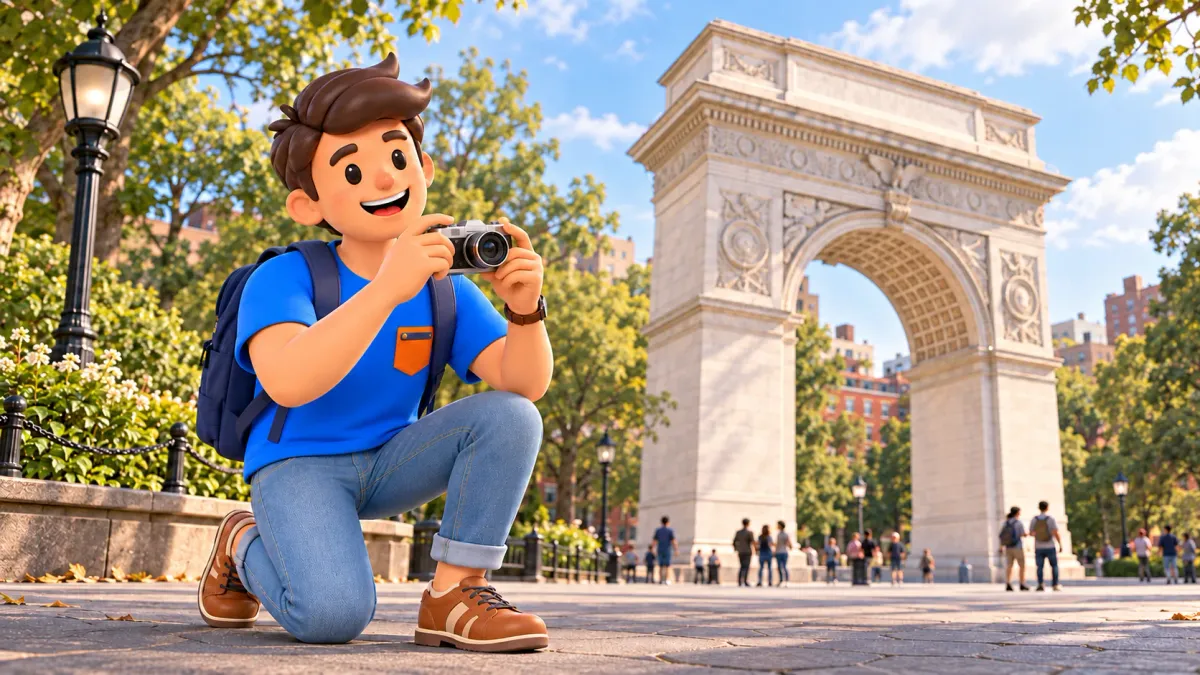
For a short Greenwich Village walking route, start at Washington Square Arch, spend time inside the park, then head west towards Christopher Street before finishing at Jefferson Market Library. A brief look at the Hess Triangle adds a small discovery along the way. The attraction is the change of scale: a monumental arch, ordinary neighbourhood life and an unexpected former courthouse.
Allow roughly one and a half to two hours for the outdoor walk, or two to three hours with a proper food break and an optional library visit. These are editorial planning estimates. You can shorten the outing by going from the park directly to the library, leaving the Christopher Street detour for another time.
Choose a neighbourhood walk, then leave room to notice it
This route suits a first visit when you want a more intimate view of Manhattan after its tall avenues. It is also useful between larger activities: give the Village a defined part of the day rather than treating every appealing street as another obligation. Architecture, a park pause and a small piece of urban history provide enough variety without a long list of interiors.
For a personal trip plan shaped around your interests, dates and pace, try RoadMe: it makes arranging a neighbourhood walk alongside the rest of your visit much more convenient. You can focus on the kind of New York you want to discover instead of manually joining separate sightseeing lists.
The suggested walking distance is approximately 1.5–2 kilometres, including some wandering inside the park. It depends on your chosen paths and crossings; this is not a measured accessibility itinerary. Time spent looking, waiting at junctions and sitting down matters more than an optimistic walking-time estimate. Anyone who needs a specific step-free route should check the actual approaches and facilities beforehand.
Keep the order simple: Washington Square, the Christopher Street area, Jefferson Market. Do not attach a second district merely because it looks close on a city map. Decide where the walk ends before adding lunch or an evening booking. That gives you the freedom to enjoy an interesting corner without wondering whether you are already late elsewhere.
Begin at the arch, then walk into Washington Square Park
Washington Square Arch provides a clear starting point at the northern edge of the park. Look at it from a comfortable public position before moving through the surrounding space. One wide view explains its role better than several hurried photographs taken directly beneath it. Keep clear of people using the paths and avoid stopping in the middle of a busy approach.
Stanford White designed the permanent marble arch, built in the early 1890s and formally dedicated in 1895. It followed a temporary arch celebrating the centenary of George Washington’s inauguration. That distinction is useful when you encounter different dates: the temporary celebration and the surviving monument belong to different stages of the story.
You do not need to turn the start into a detailed sculpture lesson. Notice the single large opening, the pale material and the way the monument frames the park. Then change your position and see how quickly the impression changes. This is a useful habit for the rest of the walk, where buildings often reveal themselves from an angle.
Continue into the park before heading west. Set aside around half an hour, more if you want a longer pause. Look towards the fountain area, follow a short section of path and find a place to stop if seating is available. Working water, a particular performer or an empty bench should not be the condition that makes the visit worthwhile.
The park’s public life has a history of its own. Neighbours helped defend it against plans for expanded through traffic, preserving space for people to gather. Remembering that makes a simple pause more meaningful: this is a working neighbourhood meeting place, shared by residents and visitors, rather than scenery placed around a monument.
Use the park pause to decide the length of your walk
Before leaving Washington Square, check how everyone feels. If the group wants an easy architectural outing, continue towards Jefferson Market without the western detour. If people are still curious about the neighbourhood, include Christopher Street and the Hess Triangle. Making that choice while you are comfortably stopped is easier than debating it at a busy intersection.
| Your available time | Keep in the plan | Leave optional |
|---|---|---|
| About an hour | Arch, a short park pause, library exterior | Christopher Street and an interior visit |
| Around two hours | Park, Christopher Street detour, library exterior | A longer meal or library visit |
| Two to three hours | The same outdoor route plus a seated break | Library interior if open and suitable |
These options describe how to allocate time, not guaranteed completion times. Arrival from another part of the city and the onward journey are extra. If you have a ticketed event later, keep a buffer that belongs to that transfer. A modest walk should not quietly consume the time you need to reach a venue or find the right entrance.
Head west for the change of street scale
From the park’s western side, move towards the Christopher Street area. Waverly Place helps connect this part of the walk, with Sixth Avenue marking an important crossing. Use the appropriate pedestrian crossings and check your direction while standing aside. The Village is better explored by reading street names than by assuming every block follows the familiar Manhattan grid.
Along the connecting streets, look for differences in brickwork, window proportions, entrance steps and the relationship between shops and upper floors. You can enjoy these details without assigning a famous resident to every building. Unless an address has a verified public programme, a handsome doorway remains somebody’s entrance rather than permission to explore inside.
A useful photography rule is to choose one detail and one wider scene. Stand on the public pavement, keep doorways clear and avoid photographing directly into homes. If the pavement is crowded, take the wider picture later. Getting a photograph does not require crossing a threshold, blocking a stoop or stepping backwards into traffic.

Let the Hess Triangle be a small discovery
The Hess Triangle is a tiny pavement mosaic at Christopher Street and Seventh Avenue South. Its story comes from land left after the avenue’s extension; the mosaic was installed in 1922. It is a good reminder that changes to a large city can leave very small traces.
Treat this as a brief stop rather than the centre of the afternoon. Move aside before looking down, allow other people through and avoid gathering a group across the pavement. The detail is easy to miss, which is part of its appeal, but finding it should not turn a pleasant walk into a search conducted from the roadway.
A short explanation is enough to connect the mosaic with the surrounding street pattern. Save the legal details, ownership history and competing versions of the anecdote for a dedicated account. Here the purpose is to notice how a small object changes the way you read the neighbourhood, then continue while that observation is still fresh.
Finish at Jefferson Market, with the exterior as the main visit
Continue towards the north and east, using West 10th Street to approach Jefferson Market Library at Sixth Avenue. The tower makes a strong visual finish after the smaller street details. Pause from a public viewing position where you can look up without obstructing the entrance or standing in a crossing. A large junction calls for a little more attention than a park path.
Completed as a courthouse in 1877, the building became a public library in 1967 after a preservation campaign supported by neighbours. Its Victorian Gothic character provides a satisfying contrast with the marble arch. The changing use is the point: an impressive civic building continues to serve everyday neighbourhood life.
Look for the clock tower, pointed forms and contrasts between brick and pale stone. You can appreciate those features without a scheduled tour. The name Jefferson Market does not mean that this stop is a contemporary food market, and a library visit does not automatically include the tower. Keep the exterior as the part of the route you came to see.
If you want to go inside, check the branch’s current opening information and any notices for your date. Treat it as a functioning public library: speak quietly, follow staff guidance and respect areas being used for reading or programmes. An interior visit is optional; the outdoor walk still has a complete ending when the branch is closed.

Plan a real break and a sensible next step
Choose a seated food or drink break according to what is actually open, available and suitable for your group. Check a menu before joining a queue, and allow more time when several people want different things. You do not need a particular famous café for the pause to count. The useful outcome is being rested before deciding what comes next.
Bring your preference for architecture, neighbourhood stories or relaxed breaks into RoadMe and build a more convenient personal plan for the trip. It is an easier way to give this walk the right place in your day than trying to fit every attractive address into one afternoon.
In hot weather, shorten the outdoor sections and give the break more room. In persistent rain, reconsider a walk that depends mainly on pavements and park paths; an optional library stop is not a guaranteed indoor substitute for the whole outing. In colder months, choose daylight for noticing façades and small pavement details, and wear shoes suitable for the conditions.
Before setting off, check the park’s current notices, the library calendar if you want an interior, the weather and your onward transport. Information was reviewed on 17 October 2026; temporary access arrangements can change. End with one clear memory of the arch, the streets or the former courthouse, leaving enough curiosity for a different Village walk another day.


