
Green Poblenou: two parks and industrial history in 2½ hours
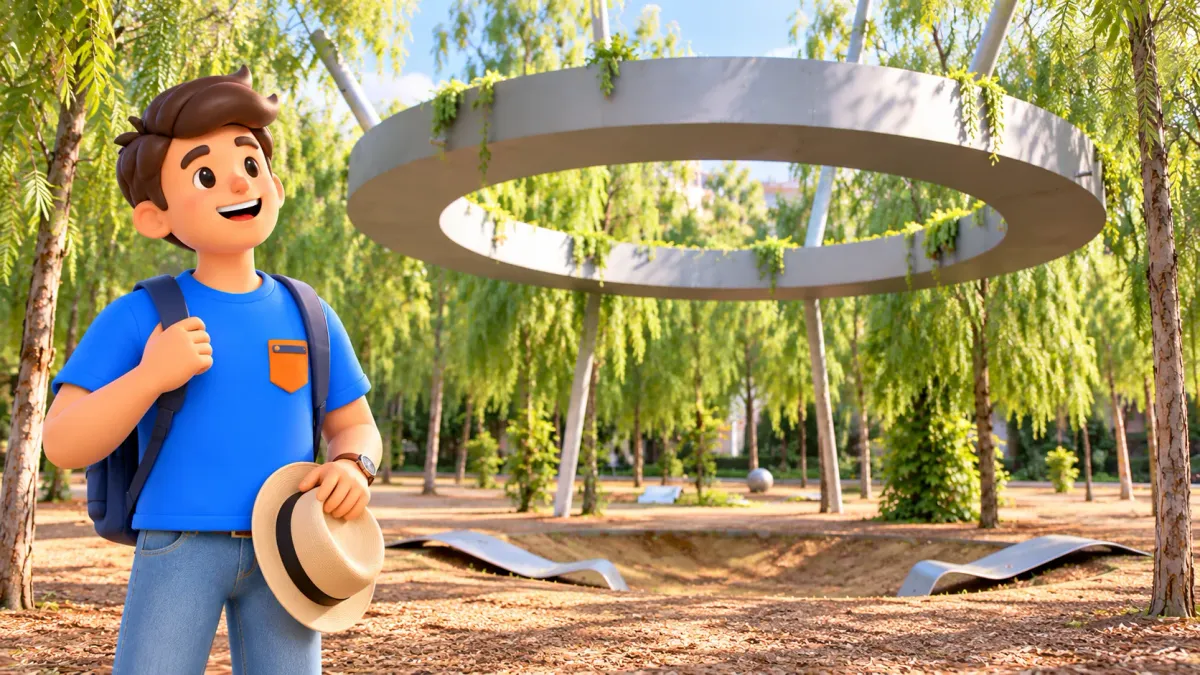
Poblenou offers a Barcelona walk where the planting can be as interesting as the buildings. In one park, trees and metal structures suggest rooms with open skies. In another, paths branch out beneath curved pipes and enormous mosaic planters, with residential towers beyond. Between them is a working urban neighbourhood; within the first park, a former machinery workshop provides a reminder of its industrial history.
This daytime itinerary links Parc del Centre del Poblenou, the exterior of Oliva Artés and Parc de Diagonal Mar in about two and a half hours. The planned stops are free outdoor visits. A museum interior, a beach session and a full lunch are separate choices, requiring additional time. Come for a comparison of landscape design and industrial memory rather than a complete survey of the district.
A manageable 150-minute morning
Use 10am to 12.30pm as a worked example. Give the first park forty minutes, including your approach to Oliva Artés within its grounds. Spend fifteen minutes outside the former workshop, then allow thirty-five minutes to walk through ordinary city streets to Diagonal Mar. The remaining hour covers fifty minutes in the second park, including a fifteen-minute rest, followed by ten minutes to leave.
To fit this walk into a trip that reflects your interests, try RoadMe: the app works out a personal day-by-day plan around your dates, pace and budget. Having a coherent Barcelona programme to follow is more convenient and effective than assembling each day from separate suggestions.
The arithmetic is 40 + 15 + 35 + 50 + 10 = 150 minutes. These are planning estimates rather than walking times measured on site. The rest is already included in the second park’s fifty minutes; it is not another quarter-hour to add afterwards. Travel to the start and away from the finish also sits outside the calculation.
Your starting reference is Parc del Centre del Poblenou at Avinguda Diagonal, 130. Keep the word Centre when searching: the coastal Parc del Poblenou is a different park. Oliva Artés stands within the first park, towards its northeastern section, so reaching it does not involve a separate cross-city journey.
Jean Nouvel’s park: reading the planting as architecture
Parc del Centre del Poblenou opened in spring 2008, following a design by Jean Nouvel. Think of it as a composition of living materials, light and supports rather than simply an expanse of lawn. In his own account of the project, Nouvel puts shade at the centre of the idea. It becomes a way of shaping space, rather than merely a welcome side effect of planting trees.
Begin with the boundary, where vegetation separates the interior spaces from the surrounding city. Then look upwards. Broad metal rings, supports and trailing plants change the scale of a familiar garden structure. Something that might normally frame a small patch of planting begins to suggest a ceiling or a room, with leaves filtering the light instead of a solid roof.
The planting is alive, so its appearance depends on season, growth and maintenance. Do not expect every structure to provide dense shade or every climber to be flowering. Choose an actual comfortable patch on the day, rather than relying on a general description of the park as a cool refuge. There are open areas here, and the later street connection is outdoors too.
For the first thirty-five minutes, a short circuit and a few pauses are enough. Find one view combining a tree trunk, a metal support and light patterned across the ground. Ask which elements seem natural and which have clearly been arranged. You do not need to identify every plant species to notice how the landscape has been composed.
Keep the final five minutes of this forty-minute section for moving towards the workshop. There is no need to inspect every part of the park first. Its spaces are divided, and you should follow the passages that are actually open. A closed gate or a barrier is a reason to adjust the circuit, not to cross a planted area in search of a shortcut.

Oliva Artés: a workshop within the green setting
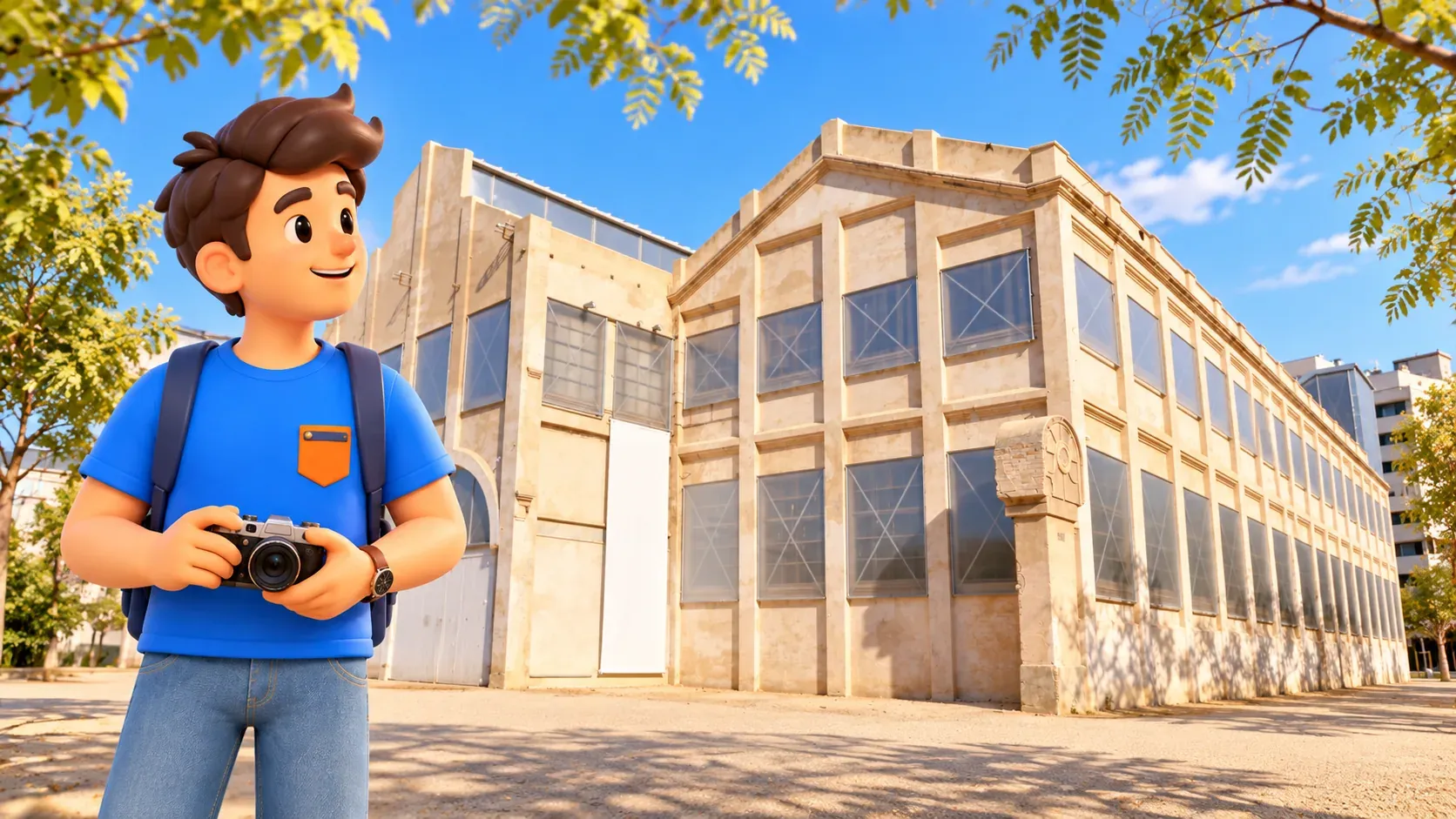
The Oliva Artés building brings a different Poblenou into focus. Built in 1920, the workshop produced and repaired machinery. That distinction matters: an old industrial building is not automatically a textile factory. Even a brief exterior stop gives the word industrial a more specific meaning, connecting the district’s history with the practical work once carried out here.
Today it is a MUHBA Barcelona History Museum space concerned with the modern city and industrialisation. Our itinerary, however, includes the exterior only. It does not depend on the exhibition being open. If you want to visit inside, check the museum’s current admission arrangements and opening hours separately, then allow a different amount of time.
Outside, look at the repeated rectangular windows and the long working volume. The building’s practical rhythm contrasts with the freer forms of the surrounding planting. Its interest does not depend on resembling a decorative palace: it shows another relationship between space, daylight and use. The old structure and the newer park can be understood together without becoming the same kind of architecture.
Fifteen minutes allows a look at that contrast and perhaps a photograph from a public position without obstructing anyone. Stay out of service areas and do not treat a closed door as an invitation to search for a technical entrance. If urban history is a major interest, a proper museum visit deserves its own place in your trip rather than being squeezed into this outdoor pause.
The connection is a city walk
At about 10.55am, leave for Parc de Diagonal Mar using the public street network. The thirty-five-minute allowance includes orientation, crossings and reaching an open entrance. Carrer de Llull, 356–360 is your destination reference. This is not a continuous green corridor: pavements, junctions and stretches with different amounts of sun connect the two parks.
Use public streets and check the actual crossings. An opening visible between buildings is not necessarily a pedestrian route, and a former industrial site is not public simply because its façade is interesting. The article supplies the sequence and a time allowance; use current navigation for the precise connection between the available gates.
The ordinary streets also contribute to the walk’s meaning. After the composed green spaces, housing, traffic and daily activity become noticeable again. There is no need to find another attraction at each corner. Seeing how a park sits within the surrounding neighbourhood is part of understanding it, rather than an interruption between the worthwhile stops.
In hot weather, be especially realistic about this section. If the first park has already used your energy, finishing after the workshop is a sensible choice. The museum is not automatically available as a shelter, and the next park does not guarantee continuous shade. Preserving the full list is less useful than having a comfortable morning.
Diagonal Mar: curves, branching paths and oversized pots
Designed by Enric Miralles and Benedetta Tagliabue, Parc de Diagonal Mar dates from 2002. Its site was associated with the MACOSA metalworking enterprise. Industrial history therefore returns at the second park, even though the workshop you have just seen is no longer in view. The change of use is easier to appreciate when the earlier life of the land remains part of the story.
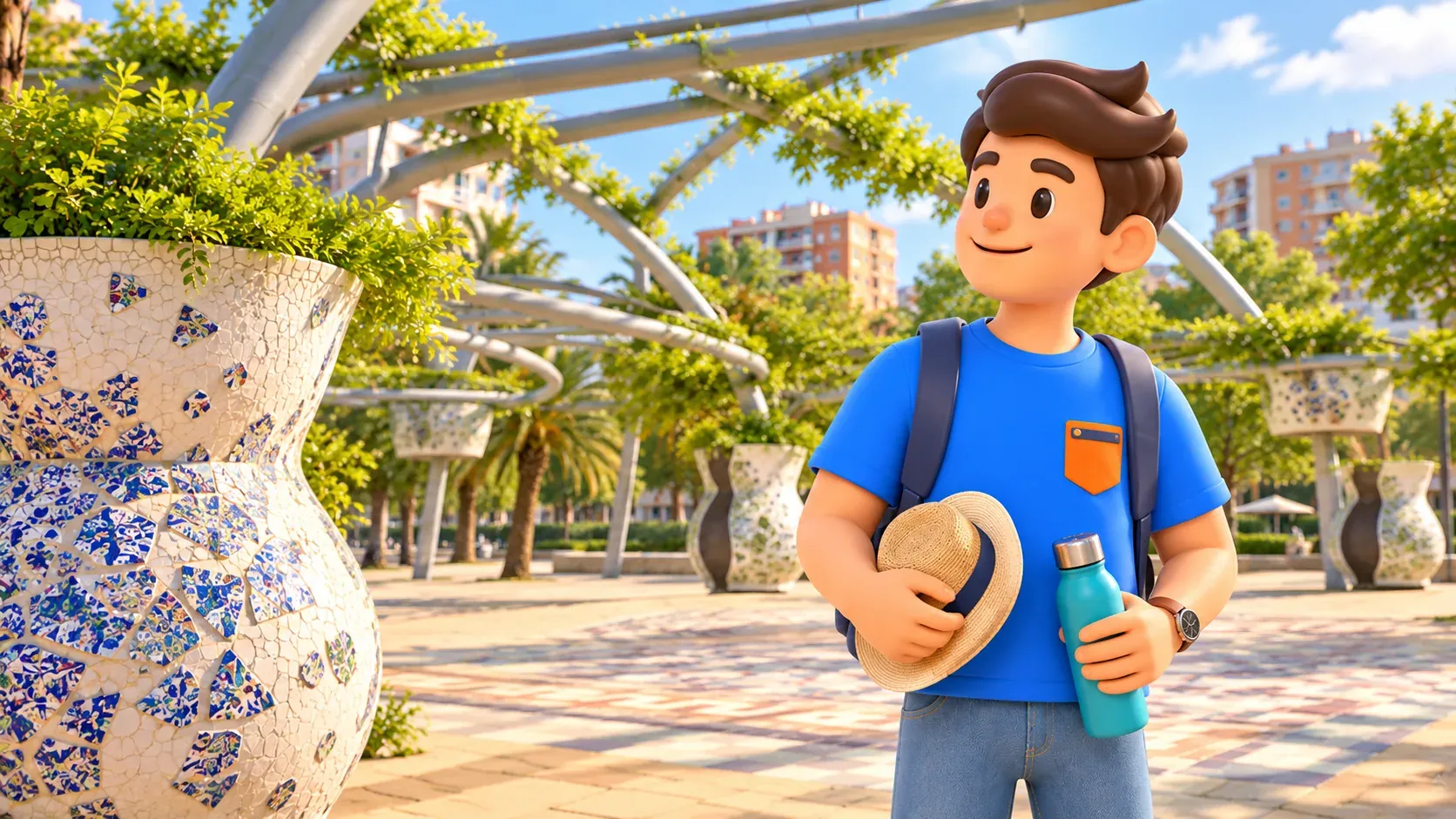
Here, pay attention to lines. The paths suggest a branching system, metal pipes curve through the space, and enormous mosaic-covered planters shift the familiar relationship between plant and pot. The patterned paving deserves a look too. It participates in the composition instead of acting as a completely neutral surface beneath the objects.
Do not automatically attribute the mosaic work to Gaudí. This is a different design team and a different moment in Barcelona’s history. A more useful comparison is with Nouvel’s park: one draws attention to planted shade and architectural supports, while the other often leads your eye along a curve or towards a branching route. Neither requires specialist knowledge to enjoy.
Allow around thirty-five minutes for an unhurried walk through an accessible part of the park, followed by fifteen minutes of rest. Together they occupy 11.30am to 12.20pm. Water belongs to the design, but the condition of ponds and the operation of individual features can change. This walk does not depend on a fountain display, and ornamental water is not a place to swim.
If landscape design and green walks appeal to you, make them part of a personal RoadMe trip plan built around your interests and pace. The app makes a considered programme easier to use in the city, reducing the daily work of deciding how many more places can realistically fit.
During the rest, ask which park you would choose to revisit without any sightseeing task. People travelling together may give different answers: one enjoys the large sculptural objects, another prefers looking through foliage. Those reactions are useful when choosing later days, because they tell you more about your interests than the number of places already ticked off.
Opening hours, weather and an uncomplicated finish
Both parks are free, but they have gates and seasonal hours. Municipal listings give an 8.30am opening for Centre del Poblenou and 9.30am for Diagonal Mar. Listed closing times are 7pm from November to March and 9pm from April to October; the city also describes closing around dusk as approximate. Check current notices and the signs at the entrance before committing to the walk.
That makes the daytime 10am–12.30pm example more straightforward than turning the same itinerary into a late-evening outing. Normal hours do not rule out temporary restrictions. If an area is closed, shorten the visit to the accessible section or choose another morning rather than assuming you can circle the entire perimeter within the remaining time.
Bring water, suitable sun protection and comfortable footwear. The rest depends on finding an available place; the plan cannot reserve a particular bench. In rain, strong wind or heat, visiting one park instead of connecting both can be the better choice. The metal structures and giant planters are landscape features, not climbing equipment.
At 12.20pm begin leaving towards the public edge by Llull, aiming to finish around 12.30pm. Lunch, the sea and your return journey are the next part of the day. For a separate outing focused on contemporary Barcelona, save the Diagonal Mar and Fòrum itinerary. Its longer programme includes a museum stop, so it cannot all be added to these 150 minutes.


