
Gotokuji and Setagaya: Temple and Castle Traces
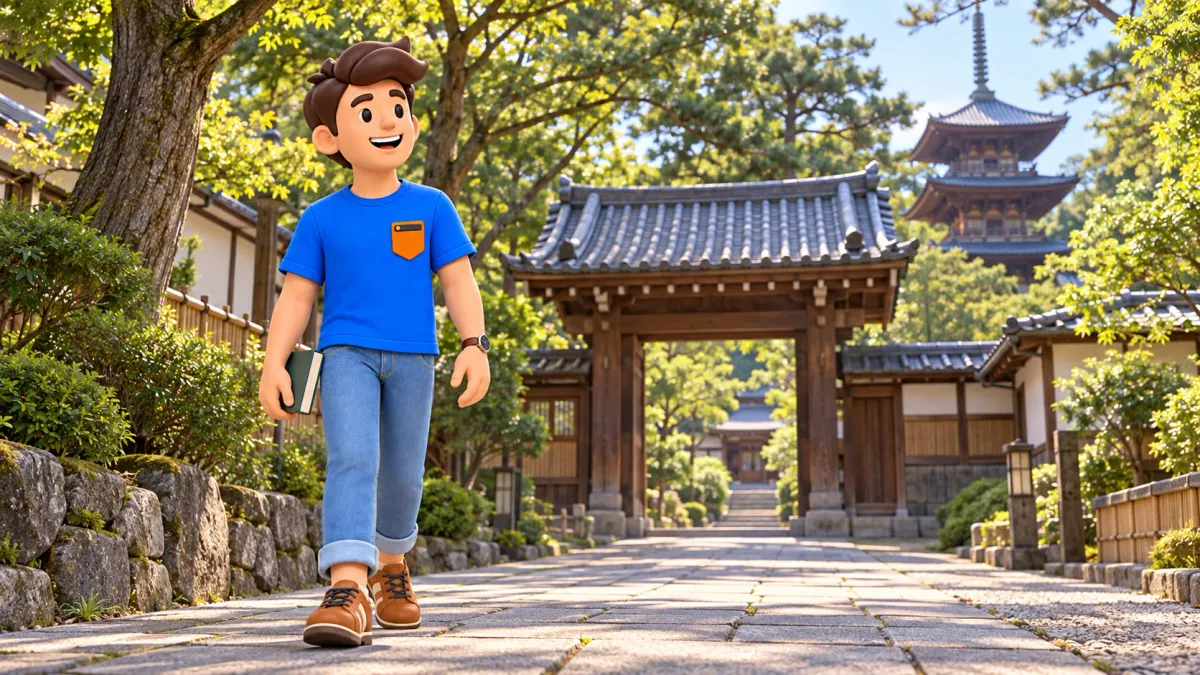
Gotokuji can be more than a stop for its famous white cat figures. Use the temple as the beginning of a small Setagaya walk, continue to the park on the former castle site and finish with an ordinary neighbourhood break. This is a local combination rather than an attempt to cover the whole large Setagaya area in a few hours, and the modest scale is part of its appeal.
Allow roughly half a day for the temple, small park and food, counting travel from your part of Tokyo separately. This is an editorial planning estimate, not a measured timetable. If obtaining a temple figure matters, an earlier arrival is important because the grounds and office have different hours. The word open does not answer every practical question about what you can actually do during the visit.
Decide what you want to do at the temple
The official visiting hours are 6:00–17:00, while the temple office receives visitors from 8:00 to 15:00. General viewing and obtaining an item therefore involve different windows. Do not arrive late in the afternoon expecting every service to remain available until the gate closes. If the office matters, put it near the beginning and read the current official notice before travelling rather than relying on an older guide.
RoadMe helps develop a personal programme around your interests, giving the temple priority and placing the park and food nearby without overloading the outing. Try preparing the walk at your own pace, with travel and the hours of your actual intended visit counted separately.
A figure is optional rather than necessary for a worthwhile walk, and arriving early alone does not guarantee availability. Check the current selection and arrangements at the temple. If an item is unavailable or you do not wish to buy, let the visit remain an experience in its own right. The price of a keepsake and the meaning of a religious place are different questions; no purchasing budget is included here.
Choose the approach that suits your journey
The temple gives approximately five minutes on foot from Miyanosaka on the Tokyu Setagaya Line, and fifteen from Gotokuji on the Odakyu Line. The station sharing the temple's name is therefore not necessarily the nearest. Choose according to your actual starting point, transfers and onward plan. These published orientations do not replace your own allowance for leaving the station, crossings and finding the correct visitor approach.
Save the full address, 2-24-7 Gotokuji, Setagaya, and the Japanese name 豪徳寺. Use public streets towards the current visitor entrance instead of going straight towards the nearest point on the boundary. This is a residential area: private driveways and neighbouring courtyards are not extensions of the temple. Ordinary street walking belongs to the outing rather than being an inconvenience between two tourist pictures.
Mark Setagaya Castle Site Park and a possible finishing station before entering. There is no need to plan ten branches. A clear temple, park and rest sequence keeps the outing local. If you choose to continue by the Setagaya Line afterwards, check the correct station and direction. The train is a transport connection here rather than a promised free performance arriving at your preferred minute.
See the temple setting before concentrating on the cats
After entering, do not automatically head towards the densest group of figures. Notice the trees, arrangement of buildings and movement of visitors. Gotokuji has a setting that is not exhausted by the familiar cat photograph. A few quiet minutes provide context: this is a working Buddhist temple, not a themed shop with a freely arranged decorative display for visitors to handle.
Do not enter closed areas or make worshippers the main subject of a photograph without consent. Follow current instructions when a service takes place or a section is restricted. Open gates do not provide admission to every room. Leave passages clear and avoid holding a narrow area for a prolonged photo session. That simple organisation lets you look while respecting the purpose of the grounds.
The temple also includes cemetery space that calls for particular care. The basic walk does not require turning it into a separate sightseeing circuit. Unless you are following a specific historical interest, a respectful general sense of the complex is sufficient. Do not seek an unusual angle through barriers or enter where access is restricted or clearly involves a private moment for other people.
White cats are part of a tradition, not photo props
The temple's official account begins with a cat said to have beckoned Ii Naotaka into the temple, where he escaped a thunderstorm. Present this as a temple tradition rather than a documentary report of an animal's behaviour. Its value is in explaining why the small figure belongs to a local story of gratitude and good fortune, beyond simply providing an attractive repeating shape for a picture.
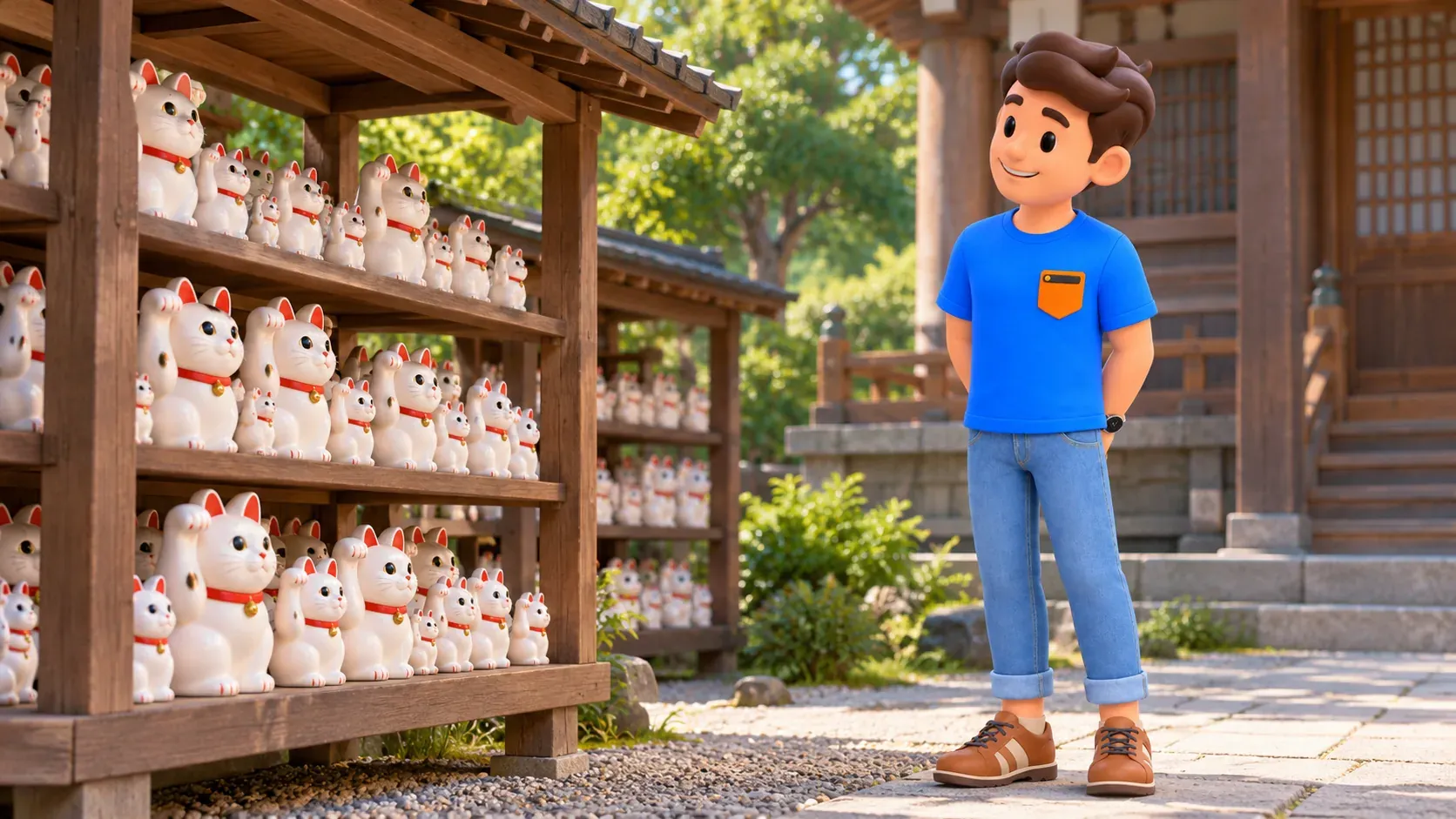
Gotokuji highlights two details of its figures: the right paw is raised and there is no gold coin. Observe the repeated shape and different sizes from a permitted position. You need not find a perfectly uniform row or rearrange objects to make symmetry. These are items dedicated at a religious place, not free components of a visitor's composition. Leave them where they are and do not borrow someone else's figure for a photograph.
An official warning specifically concerns writing on the cats. Do not draw or leave messages on the figures. If you have your own item and questions about dedication, ask the temple about the arrangements instead of copying an action seen at random. Ordinary viewing requires neither buying a figure nor immediately adding a newly obtained one to the others; the visit can remain complete without a transaction.
Use the pagoda for a small change of scale
The official account also invites visitors to find cats in the three-storey pagoda's decoration alongside zodiac animals. This offers a manageable task after the rows of figures: change scale and look at an architectural detail from an accessible path. You do not need to establish a total count at any cost. Finding a few details helps show how the theme develops across different parts of the temple.
With children, choose one simple observation and finish without another lengthy circuit. Comparing small objects with a large building can be more engaging than counting every possible example. Do not climb fences or use closed passages for a better look at the upper decoration. A safe permitted position is sufficient, and an incomplete view does not make the visit unsuccessful or require a return through every corner.
If you are planning a commercial guided visit or staged photo activity, check the official arrangements first. The temple publishes a separate notice on commercial tours and activities; ordinary visitor admission should not be treated as consent for every working format. For an independent visit, follow current rules, behave quietly and respect those who use the place for prayer rather than treating it as an attraction devoted solely to photography.
At the castle site, expect terrain rather than a tower
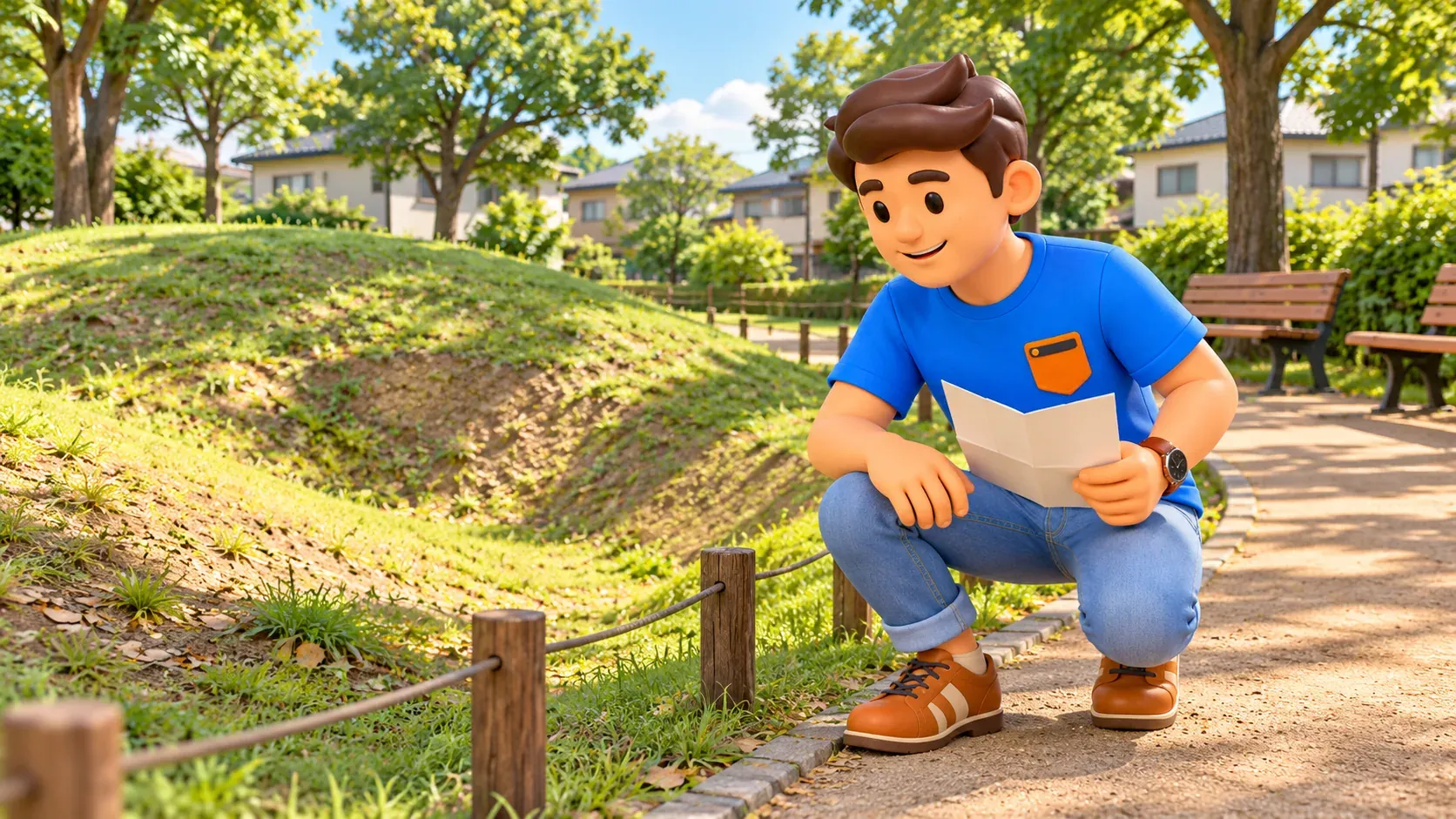
Continue by public streets to Setagaya Castle Site Park at 2-14-1 Gotokuji. The name refers to a historical location, not a surviving castle with a tall keep and furnished rooms. The municipal page describes earthworks, small hills and depressions among trees. That modest landscape is what you have come to read, rather than a monumental skyline borrowed from another Japanese castle city.
The local digital museum connects the site with the Kira family and notes uncertainty about the exact original construction date. A short historical frame is enough without presenting a precise foundation day as established fact. Look at changing ground levels and a dry depression. Do not automatically identify every visible piece of park landscaping as an untouched medieval structure just because it stands within a castle-site park.
The park is small and sits within a residential setting. Give it a distinct quiet part of the outing without expecting hours of archaeological exhibits. A useful question is how traces of a former fortified place can be read within an ordinary present-day neighbourhood. Terrain, trees and urban boundaries explain more than mentally rebuilding an enormous fortress and then feeling disappointed that it is absent.
Walk the park according to conditions and energy
Choose available paths according to their surface and your group's ability. Uneven terrain and green slopes may be unsuitable for some visitors after rain. Do not leave permitted paths to test the depth of a depression. With difficulty on slopes, limit yourself to a comfortable view and a pause. The temple and a short introduction to the park still retain the combination's main purpose without a demanding full circuit.
The municipality lists toilets, benches and play equipment, but their presence does not guarantee a particular free seat at the needed moment. With children, give rest actual time rather than making the play area a reward only after another historical explanation. Adults can sit too. A small neighbourhood park can matter precisely for that ordinary opportunity, not only for the age of the place named on its sign.
Shoin Shrine is an optional continuation towards Wakabayashi
If you want another historical episode after the park, choose Shoin Shrine in Tokyo's Setagaya. Its official address is 4-35-1 Wakabayashi, which helps distinguish it from the similarly named place in Hagi. The history, access and route of that other city should not accidentally enter this plan. Check the public connection and your remaining time before continuing; the shrine is an extension rather than the park's neighbouring door.
The official visiting window is 7:00–17:00 throughout the year. Amulets and talismans are offered from 9:00 to 17:00 except on office closure days, while particular services need separate checks. A short respectful visit is sufficient to encounter another kind of religious space. Do not treat temple and shrine as interchangeable scenery or expect Shoin to repeat Gotokuji's white cat figures.
Afterwards, consider finishing at Shoin-jinja-mae on the Setagaya Line. The official orientation between that station and the shrine is approximately three minutes; check your actual approach and onward transfer. If energy is low, leave Shoin for another visit. The temple, castle-site park and rest still make a complete shorter outing without this additional branch.

Let lunch or coffee provide an ending
Choose an open place along a convenient route towards transport according to its current menu, price and queue. Do not add a famous address at the opposite end of Setagaya merely for another name. The task is a compact neighbourhood day. Lunch can be simple; a worthwhile break needs no compulsory queue, elaborate presentation or cafe that reproduces someone else's photograph exactly.
During the pause, decide whether you still want to walk. If the main experience already feels complete, finish near a suitable station. If you have energy, add a short ordinary street section after checking direction. Remaining time should not automatically expand into all the museums, temples and shops of a large ward. Those can be interesting, but they belong to another scale and a separately chosen purpose for a future outing.
Use RoadMe to develop a personal programme where a small temple outing, history and rest get time according to your interests. The app helps prepare your own rhythm, whether you finish the half day here or preserve energy for another part of the journey.
Shorten sensibly and choose the return connection
With limited time, retain the general temple visit, cats without a purchase and a brief look at the castle terrain. Remove extra shops and prolonged detail hunting. In rain, shorten the park rather than promising a fully covered substitute inside temple buildings. The office's 15:00 finish remains a separate constraint even when grounds viewing is still possible; a late start cannot restore a service whose hours have already ended.
Finish at Miyanosaka, Gotokuji or another station genuinely suited to the actual route. Check line, entrance and transfer rather than returning to the start only to create a symmetrical loop. A short temple visit, terrain properly observed and a normal rest already make the walk complete when each receives attention, instead of pursuing the largest possible number of markers before heading back into the rest of Tokyo.


