
Getty Center and Getty Villa: Two Different Experiences

Getty Center and Getty Villa offer two different experiences, rather than two names for one museum on neighbouring streets. The Center sits in the Brentwood hills, combining art, modern architecture, a garden and views across Los Angeles. The Villa is near the coast in Pacific Palisades, where ancient Greek and Roman art appears in a building recreating the idea of a Roman country house.
For a first trip, choosing one around your interests is sensible. If both appeal, give them different days instead of racing between sites. A shared name does not mean one entrance, adjacent grounds or a single reservation. The differences below help explain why to visit, without an exhaustive collection catalogue or a compulsory list of every gallery.
Choose an experience rather than the more familiar name
Ask what attracts you now: different periods of art in a modern setting or a more focused encounter with antiquity. The Center supports a combination of galleries, architecture and garden. The Villa connects ancient objects with colonnades and garden courts. Either visit can be relaxed or attentive to details; neither needs to become a museum you must complete in its entirety to feel satisfied.
Let RoadMe develop a complete personal trip plan around your interests, dates, budget and pace. The app makes it much easier to choose a suitable museum day and connect art, walks, meals, travel and rest into one journey than to assemble the programme from separate famous names.
Do not decide only through a photograph. Behind an attractive court or pale buildings are different subjects, and interest in them matters more than recognised camera angles. An antiquity enthusiast need not visit the Center as a compulsory first step. A European-art enthusiast need not add the Villa for completeness. One well-matched visit can offer more than two with no attention left between them.
Consider the group. Someone wants to examine objects, someone prefers outdoor walking and someone tires quickly in galleries. Find a shared main interest and leave optional additions. Choosing the site then becomes part of a good day for everyone, rather than an attempt to prove that one is universally better for every traveler and every trip. Neither choice needs a defensive explanation.
Getty Center: art within modern architecture
Getty Center opened to the public in 1997. Architect Richard Meier is associated with the complex, whose modern geometry and pale stone form an experience of their own. It stands on a hill in Brentwood, away from the Villa's Roman court. The first useful distinction is spatial: buildings, open areas and their relationship to the large city below shape the way you look.
The museum offers European art across different periods and other fields, including photography. For an introduction, choose one subject and a few available galleries. Do not assume that every famous work is currently on display. Collection holdings and the present installation are different things, especially during gallery improvements. Interest and attentive looking provide a better foundation than a long list of compulsory works to find.
Garden and architecture can be equal parts of the day. Robert Irwin's Central Garden helps shift attention between art space and living landscape. There is no need to divide the visit into a real museum indoors and an allegedly secondary outdoor walk. An interest in form, light and planting fits the place. Simply avoid turning a seasonal garden into a promise of particular flowers in bloom.
City views depend on visibility. Even with a hazy distant horizon, the complex does not lose all value. Give architecture and art their own meaning, with the panorama an additional possibility. The journey will then not depend entirely on clear air or a perfect photograph. That is particularly helpful when a museum day has already been chosen for reasons deeper than the view.

Getty Villa: antiquity and the idea of a Roman home
Getty Villa opened in 1974 and, after later renovation, reopened in 2006 with a focus on the arts and cultures of antiquity. Ancient Greek and Roman objects are central to today's visit. That focus differs from the broader art experience at the Center. Arrive ready for a particular cultural area rather than expecting a reduced copy of the other Getty with the same contents.
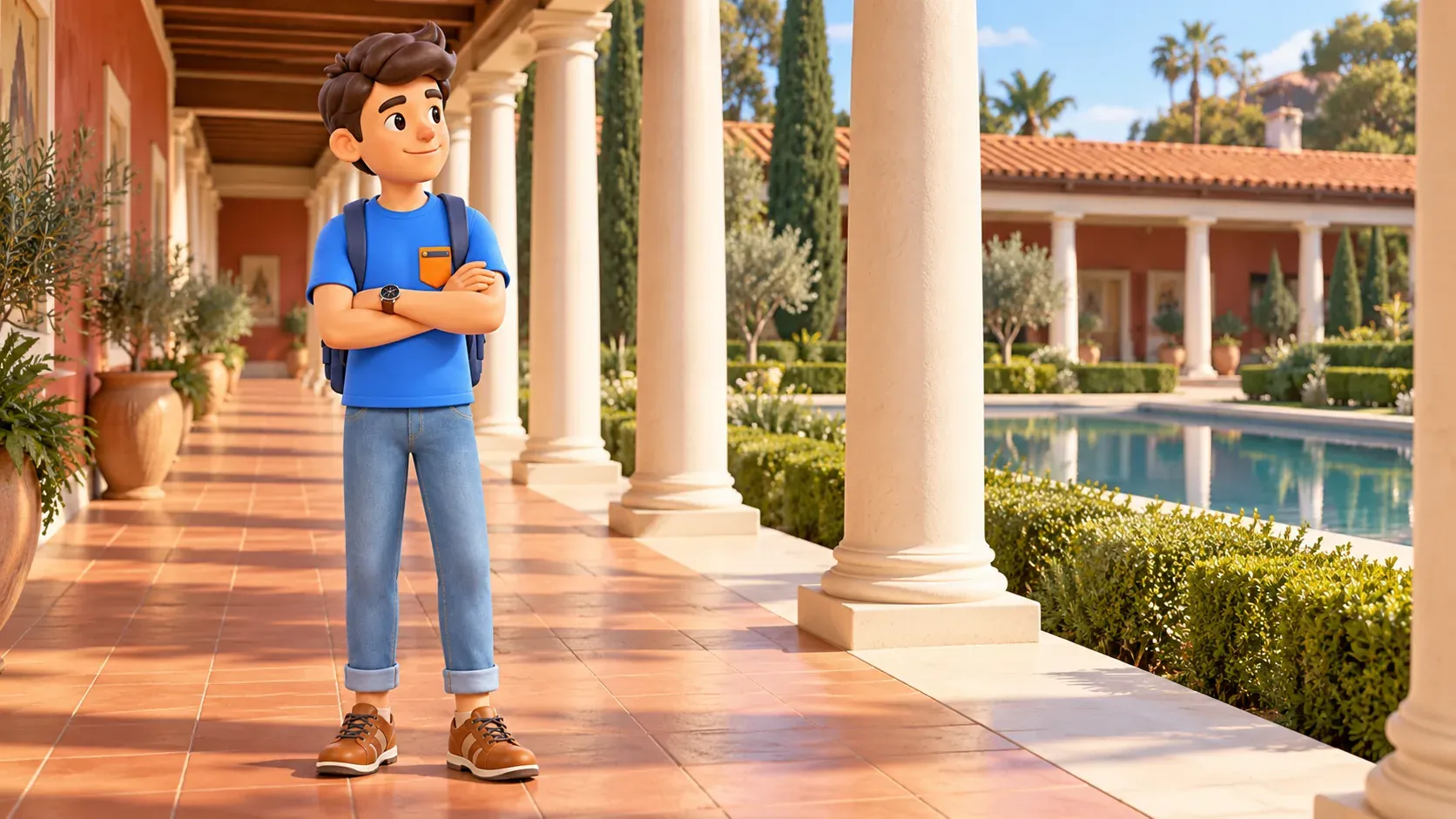
The building is not an ancient house transported to California. It was constructed in the twentieth century, modelled after the Villa dei Papiri in Herculaneum. Because the original is not fully excavated, architects also used elements of other Roman houses. This modern interpretation helps suggest a setting for ancient art, without being genuine ruins or a complete exact reconstruction of every detail of one excavated building.
Colonnades, courts and garden support the museum's subject. Notice how architecture connects open air with indoor space and changes the rhythm of attention. Ancient objects remain individual works with their own histories rather than decorations for an attractive courtyard. Choose a few you want to examine, allowing questions about form, material or purpose without making the visit an examination in classical knowledge.
You do not need to remember every deity or understand archaeological periods beforehand. Curiosity and willingness to read an explanation for an interesting object are enough. Art may become one visitor's main memory, spatial design another's and the combination a third's. This makes the visit approachable without promising identical reactions or automatic access to the entire collection. Your own attention can give the day its structure.
The coast provides the Villa's geographical context, but a museum day does not require a beach visit. These are separate decisions with different approaches, conditions and time. “Near the ocean” does not promise a quick walk to any beach or an open coastal access point. Add a seaside continuation only when it fits the particular day rather than attaching one through a general place name.
One shared name, different addresses and reservations
The Center is at 1200 Getty Center Drive; the Villa at 17985 Pacific Coast Highway. They are different places with separate arrival arrangements. Reaching both requires a real journey, not a walk through one campus. Read the full site name in your confirmation. An address mistake affects the day more than missing one gallery or failing to find the desired photographic angle.
Admission to both museums is free, but each requires a timed-entry reservation. Free admission does not mean arrival without one, and does not make parking free. If using a car, count parking separately under present conditions. Check amounts for your visit rather than building the whole plan on an old number or an assumption that both sites operate as one combined product.
The usual weekly closing days differ: the Center closes Mondays, the Villa Tuesdays. Holidays, events and improvements can affect access. For selecting a day, check the chosen site's information and reservation confirmation. Do not transfer one Getty's timetable to the other. This short practical check lets you concentrate afterwards on the interesting part rather than an unexpected closed entrance or wrong location.
Account for Getty Center improvements
At preparation time, parts of the Center are closed for renovation: South Pavilion, North Pavilion galleries and the East Pavilion's plaza-level galleries. This does not mean the whole Center is closed in 2026. It does mean that the full usual gallery offering should not be assumed. For a particular field or work, check the available display instead of inferring access from an older guide.
There is a separate future change. Getty has announced a public closure of the Center beginning March 15, 2027, with reopening planned for spring 2028. A planned return is not a guarantee. For travel in that period, establish the museum's latest information first. Do not confuse the coming full pause with today's partial restrictions, or automatically apply the Center's announcement to Getty Villa.
These conditions can influence the choice without reducing the comparison to availability alone. The Villa is interesting for its own subject, rather than solely as a fallback. Choose the Center for what is available and appealing on your dates too. A good museum day is built on real content and suitable pace, rather than trying at any cost to fulfil an original picture from a list.
If both appeal, give different days different purposes
Separate the experiences by meaning. A Center day might focus on modern architectural space, several galleries and garden. A Villa day might concentrate on ancient objects and their Roman architectural setting. These are directions for attention rather than two compulsory timed programmes. You need not repeat the same museum rhythm when interests and energy suggest a different approach. Let the second visit feel distinct from the first.
Do not compensate for travel by reducing each stop to a photograph. For many visitors, one site already provides enough for a day, especially with transport and food. Choose one honestly if the trip is short. On a longer journey, if both matter, put another activity between their days. Differences become clearer when the next visit begins with curiosity rather than exhaustion from the previous one.
In a group, discuss one wish each: a painting, ancient object, architecture, garden or a relaxed shared day. They need not match completely. Find a common priority and leave room for individual observations. Afterwards, compare memories without competing over gallery counts. The two Getty sites become opportunities to understand interests rather than a double obligation to complete a museum list or justify every available hour.
Meals, rest and the return belong in the normal day. Free admission does not automatically make a visit brief or effortless. If someone has accessibility needs, establish the chosen site's arrangements beforehand. A museum's general reputation does not describe every path, slope or interior. Personal choice matters for the artistic subject and for the comfort of the entire journey, not only for which collection sounds appealing.
In RoadMe, getting a fully developed personal itinerary or whole-trip plan around your interests and pace is much more convenient. Let the app bring museum days, walks, meals, travel and rest together, so Getty Center and Getty Villa find suitable places in your journey without constant scheduling along the way.
The Center and Villa share the Getty name, while their differences make choosing worthwhile: a modern hillside complex and ancient art in a recreated Roman house, a wider urban outlook and a focused cultural subject. Choose one or visit both on different days. The essentials are the right reservation, a clear interest and time for your own impression rather than the largest possible museum tally.


