
Gardens of the World and Kienberg: a green day in eastern Berlin

Give Gardens of the World and Kienberg about six hours locally: take the cable car to Wolkenhain, see eastern Berlin from above, then continue to Gärten der Welt and choose a few gardens rather than trying to see everything. Start and finish at U5 Kienberg — Gärten der Welt. The main plan needs an operating cable-car day and suitable weather; travel from your accommodation is additional. This is a green day with lunch and pauses, not six uninterrupted hours of walking.
The neighbouring spaces offer different ways of looking. Kienberg provides height and a broad urban setting; Gardens of the World invites closer attention to landscape compositions. One view travels far, while another pauses over water, stone, planting or ornament. The contrast helps keep the day varied. Your main decision is how much time to give the walk and which garden spaces interest you. A successful visit does not require a complete collection of themed corners or matching photographs taken by someone else in a different season.
A six-hour plan: height first, gardens afterwards
At about 10am, follow signs from the U5 station to the Kienbergpark cable-car station. Ride to the intermediate Wolkenhain station, stop there, then continue to the Gärten der Welt station by Blumberger Damm. Use the designated visitor access to enter the paid gardens and choose an internal loop on the current park plan. After the gardens, lunch and rest, take the cable car back to the original side and the underground. The outline uses one return journey with an intermediate stop, rather than repeated rides.
RoadMe makes developing a personal plan for your whole trip much more convenient, matching your dates, interests and preferred pace. Try preparing your Berlin days in the app so a dedicated green outing fits naturally among cultural visits, city walks and proper rest.
Allow 20 minutes for the approach and first ride, 40 at Wolkenhain, and 20 for the second leg and garden entrance. Then keep 120 minutes for three selected garden spaces, 45 for lunch, 60 for an unstructured walk and rest, 35 to leave and return to the underground, and 20 in reserve. These total 360 minutes, including short connections and waiting within sections. They are editorial estimates, not a measured track. A start around 10am gives an approximate 4pm finish; queues or longer stops change that calculation.
The cable car, paid Gärten der Welt and freely accessible Kienbergpark have different admission arrangements. For this main route, select a ticket covering the gardens and one return cable-car journey with the intermediate Kienberg stop. Do not confuse it with garden-only admission or a product allowing multiple rides. There is no need to leave the paid gardens for lunch and re-enter. That matters because an ordinary garden day ticket does not permit re-entry after leaving. Read the product you are buying rather than assuming neighbouring areas share one access rule.
Kienberg: see the city before the garden details
The ascent is interesting because of its urban surroundings. Paths, green spaces and residential neighbourhoods remain below; this is not an Alpine resort. Notice how the scale changes as distances familiar on the ground become part of a wider landscape. It is a useful transition after the underground journey. You can put the phone away and look through the window for a few minutes. Photography need not occupy the entire ride: the sensation of movement and height differs from the single view preserved in a still picture.
At the intermediate station, follow open signs towards Wolkenhain. The cloud-shaped viewing structure was created for IGA Berlin 2017 and rests on slender steel supports. Its form feels different from a conventional solid tower. For a first look, notice the idea of a light structure above trees. Do not promise yourself a particular distant landmark, as visibility depends on the day. Even a shorter view can reveal how green land, built neighbourhoods and open space relate. Allow the panorama to be a pause rather than another list of objects to identify.
The platform and plateau have their own seasonal hours and may close in slippery weather. Kienbergpark is a public green space, which does not mean every structure is accessible around the clock. A lift is provided for visitors with mobility limitations, but that does not establish identical conditions on surrounding slopes. Match the approach to actual needs. If the viewing area is unavailable, respect barriers and continue only in an accessible format, preserving time for the gardens. The day does not depend on reaching one structure at any cost.

Choose three different garden experiences
After the next cable-car leg, use the current entrance and park plan. The Chinese, Japanese and Oriental-Islamic gardens make a possible selection when open on your date. They need not be visited in that order: arrange a convenient internal loop around available connections. The two-hour allocation includes walking between them. If one garden particularly appeals, stay longer and reduce the number afterwards. Noticing different ways of organising space matters more than covering three names at equal speed. Let the selection serve your interests rather than dictate them.
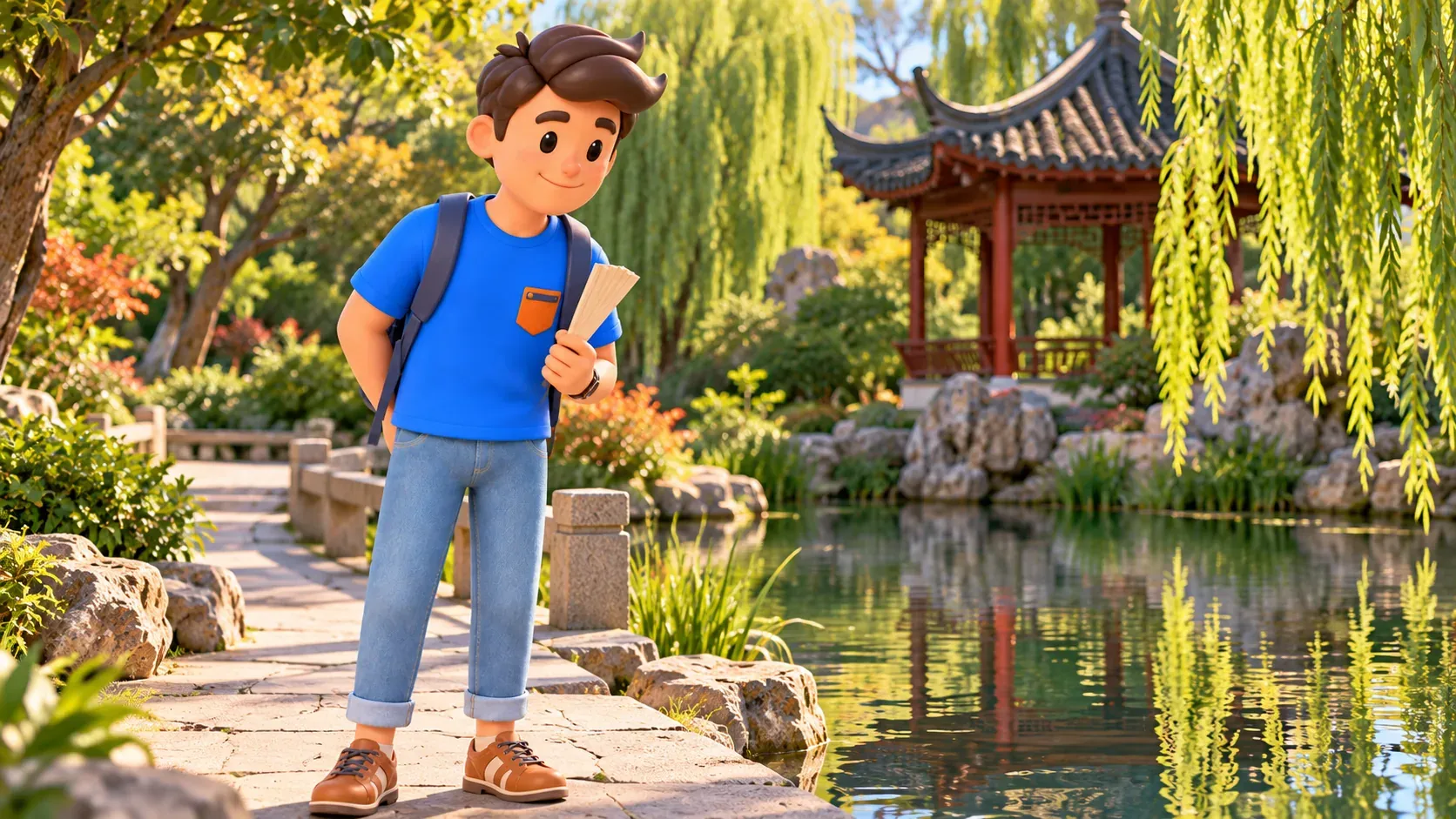
In the Chinese Garden, look at relationships between water, rocks, planting and pavilion. Stay on visitor paths and change your viewpoint several times. Notice how a turn reveals a composition or allows a nearer element to hide part of it. No detailed lecture is needed to appreciate that sequence. The garden becomes more than a group of architectural objects: movement and stopping both contribute to the experience. For a photograph, choose one clear view while keeping the path available to others, then give yourself time to look without the camera.
In the Japanese Garden, try a different task: seek fewer dramatic photographs and notice distances, boundaries and open areas. Where does the path encourage you to slow down, and how do neighbouring surfaces compare? Do not transfer a promise of blossom from spring photographs to your particular visit. Garden interest extends beyond flowers, although seasons produce different pictures. The name is not a complete account of an entire country either. You are looking at a particular landscape composition, best approached attentively rather than treated as a ready-made cultural encyclopedia.
In the Oriental-Islamic Garden, concentrate on geometry, repetition and ornament. After the other spaces, this organising language becomes easier to notice. Choose a detail and consider its part in the wider rhythm, without inventing meanings for every element. A ceremony, concert or special service is not implied by ordinary park admission; events have their own programmes. For this walk, the open garden and your own attentive looking are enough. The value lies in comparing how different spaces guide the visitor, rather than turning each into a lengthy lesson.
A little history without an exhaustive garden list
The original park opened in 1987, while the international garden exhibition in 2017 marked an important stage in the development of this area and neighbouring Kienberg. Those two dates help explain the mix of landscape themes, modern infrastructure and recreation. You do not need to compare every pavilion with buildings elsewhere in the world. It is more useful to see how an urban park invites attention to different garden-making approaches. Variety appears in boundaries, materials, scale, water and the way a person moves through the space, as well as planting.
After the three selected gardens, ask what stayed with you: an enclosed composition, an open view, a material or a transition between them. That is more useful than trying to remember every name immediately. Companions may answer differently. One might want more garden architecture next, another a less formal park, and another a city panorama. Those differences need not become an argument about the best place. They are practical clues to the experiences each person wants to continue during the trip, making later choices easier to discuss.
Lunch and an hour without compulsory stops
Keep roughly forty-five minutes for lunch at an available venue or a permitted place for your own food, following the rules of that particular area. A decorative lawn inside a themed garden is not automatically a picnic space. A specific menu, free table or lack of a queue is not guaranteed. If lunch takes longer, use part of the free hour afterwards. Its purpose is flexibility and enjoyment, so there is little reason to fill it in advance with several more compulsory attractions and lose the room it provides.
The remaining sixty minutes can go to open general paths, a bench, a favourite view or one additional available garden section. With children, a suitable playground may take some time, but a particular activity need not become compulsory for everyone. Do not insist on adding the maze, tropical hall and bobsleigh ride within this hour: they have different conditions and demands. The day already includes height, movement, garden culture and rest. An unstructured section lets it feel like a journey rather than a succession of timed tasks.

Work with the season and current restrictions
The gardens open daily from 9am and close at nightfall; individual gardens and entrances have additional limits, and some themed areas close in winter. The Japanese Garden opens at 10am. October 2026 notices also list the Brazil and Thailand garden cabinets as closed for renovation; they are outside our core selection. On 22–24 October, the park closes at 5pm. Start the six-hour visit in the morning and finish before that deadline rather than assuming every corner remains accessible for as long as you wish.
The cable car operates 10am–5pm in October through 1 November 2026, with maintenance suspension beginning on 2 November. Strong wind or thunderstorms also stop operation. Without a ride, approach the main garden entrance at Blumberger Damm 44 and make a three-to-four-hour garden visit. Calculate any Kienberg walk separately using open ground-level routes. This is a different plan: the timings and elevated experiences of the main version do not transfer automatically. A shorter visit can remain rewarding without presenting a walk and a cable-car journey as interchangeable.
From 14 October 2026, northern Wolkenweg and the Eisenacher Straße approach are closed until approximately mid-November; the operator directs walkers to southern and eastern alternatives. Follow current signs. This does not close the entire hill, but it rules out automatically repeating an old northern route. Before leaving the gardens, also compare the time with the return journey: garden access and cable-car operation have different closing times. Keep the allocated return minutes even when the main sightseeing feels complete, rather than treating the final connection as something that will resolve itself.
With RoadMe, preparing a personal plan for the whole trip around your interests and pace is easier and more efficient. Try arranging your days in the app so eastern Berlin’s gardens, urban views and restful pauses become a thoughtful part of the journey.
Return with a few clear impressions
When the cable car operates, finish through the designated exit and take the return journey to Kienbergpark, then the underground. Do not leave this until the final operating minute. Our first-time Berlin planning guide can help shape the other days. A panorama, a few attentively visited gardens and enough rest already make this a full day. You do not need a complete inventory of every corner, just a handful of clear impressions that actually feel like your own.


