
Flushing Meadows Walk: Around the Unisphere and One Museum
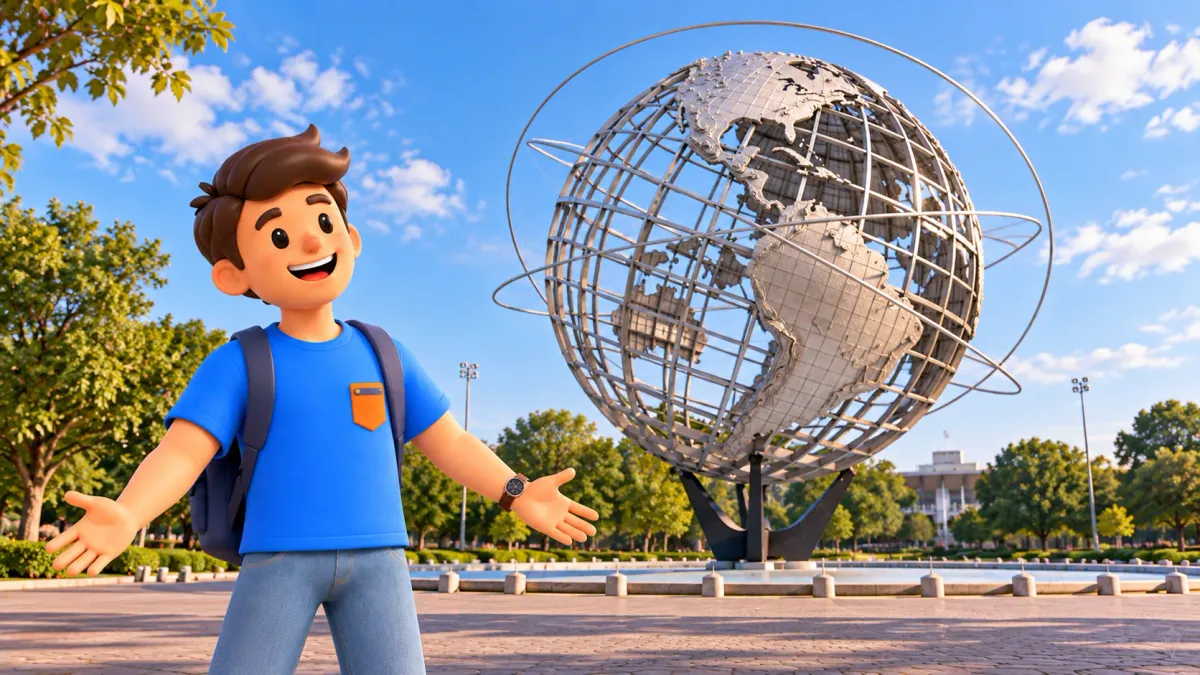
The Unisphere makes an immediate promise: a whole world suspended above a park. The useful way to visit is much smaller. Choose the area around the globe, the Queens Museum and the New York State Pavilion, then decide whether one museum belongs in the day. Flushing Meadows–Corona Park is large enough that a short visit benefits from a clear boundary.
This route uses five places from our New York collection: the park itself, the Unisphere, Queens Museum, New York Hall of Science and New York State Pavilion. They are options within a practical park plan, rather than five required interiors. Allow roughly two to two and a half hours for the outdoor core; one substantial museum visit changes the time and, in the science version, the finishing point.
Give the park one clear centre
For a first walk, use the Unisphere as the anchor. Approach from the north, look at the globe, decide on the nearby Queens Museum, then continue towards the pavilion for an exterior view. Return north if that is your chosen transport route. This keeps the afternoon around the former fair's central landscape instead of trying to join every lake, sports venue and cultural institution.
Tell RoadMe whether you prefer open-air architecture, a miniature city or hands-on science, and it can build a personal plan around your interests, dates, pace and budget. Planning in the app is more convenient than turning every nearby attraction into another obligation on the same park walk.
The outdoor version is approximately two and a half to three and a half kilometres including the northern approach and return, depending on entrances and the paths you choose. That is an editorial estimate, not a measured track. Give yourself extra time on an event day or when walking with children. The point is to protect an enjoyable area, not to complete a precisely advertised distance.
For the Queens Museum, add about an hour to an hour and a half to the outdoor plan. For the Hall of Science, think in terms of a longer half-day and a different branch, with at least a couple of hours indoors if that is the main interest. Neither allowance is an official visit length. Trying to fit both interiors into the short outdoor budget defeats the purpose of choosing a manageable zone.
Arrive at the right part of a very large park
Mets–Willets Point on the 7 subway line is a useful approach to the northern park. Follow the current pedestrian signs towards the park and the Unisphere, rather than navigating to the middle of an enormous green area. The Queens Museum describes the approach along the boardwalk and a tree-lined path, and asks visitors to allow about fifteen minutes from the station to the museum.
That is a planning allowance, not a promise about your own speed or the day's route. Keep arrival time separate from the time spent looking at the globe. A few minutes are also useful for finding your bearings after leaving a station. Open space can be less intuitive than a street grid, especially when several broad paths seem to lead in similar directions.
If you need step-free travel, check the exact journey with the transport operator beforehand. MTA describes the accessible exit from the Flushing-bound platform as a game-day arrangement, not ordinary all-day accessibility from both directions. Do not assume that a station near major attractions automatically provides the same access for every journey. Your outward and return trips may require different planning.
Sports fixtures and other large events can change the feel of the northern approach. A park visit and a stadium visit are different plans, even when they share a station. Leave a margin for crowds and current service changes. No particular train frequency, express service or event-free path is assumed by this walk, and no ticket to a sports venue is needed to make its cultural core worthwhile.
The Unisphere: walk around the idea
The steel globe belongs to the legacy of the 1964–65 World's Fair. You do not need a full history of the fair to enjoy the immediate encounter. Start from a little distance, where the outline is clear, then change your viewpoint along the permitted surrounding paths. Continents, structural lines and orbital rings overlap differently as you move.
The useful activity here is comparison rather than a single photograph. Notice how a shape that seems solid opens up when seen from another angle, and how the sky becomes part of the structure. A cloudy day can make the lines feel crisp; bright light gives a different impression. This is enough to turn a familiar image into something you have spent time looking at.
Allow twenty to thirty minutes if the globe is one of the main reasons for coming. Stay outside the basin and respect any barriers. Fountain operation varies, so the route does not depend on water jets being on. The object remains worth seeing when the basin is dry; a photograph of fountains from another season should not set an expectation for your own date.

Queens Museum: exchange the world for a city
The Queens Museum is close to the Unisphere, making it the most natural interior for this compact version. Its Panorama of the City of New York offers a model of the five boroughs, created for the 1964–65 fair. That change of scale is a good reason to go inside: outside you look at a world, while inside the city becomes something you can study as a whole.
The Panorama is a historical model with later changes, not a live and perfectly updated representation of every current building. Look for relationships between land, water and boroughs rather than expecting it to settle a present-day navigation question. A museum model and a current street map serve different purposes. The pleasure is in understanding the shape of New York through an object made to represent it.
Current museum hours are noon–5 p.m. Wednesday–Friday and 11 a.m.–5 p.m. Saturday–Sunday, with Monday and Tuesday closed. Last ticketed gallery entry is at 4:30 p.m. Admission is pay-what-you-wish; an individual timed reservation is encouraged. Groups must book ahead. Check the day's exhibition information before making this the indoor anchor, particularly when a particular collection display matters to you.
Avoid treating the last entry as a useful start for a leisurely visit. If you want an hour or more inside, arrive with that time genuinely available. The museum currently has no public coat check and asks visitors to leave large bags elsewhere. With children or specific access needs, check the museum's visitor arrangements in advance rather than extrapolating from the broad openness of the surrounding park.

The pavilion is an exterior stop
Continue towards the New York State Pavilion, south of the globe. The surviving structures make an engaging contrast to the Unisphere's complete sphere: tower forms and the pavilion's open framework suggest a different approach to spectacle. A short exterior look gives the outdoor route another visual chapter without turning the day into a detailed survey of every World's Fair remnant.
This itinerary includes viewing from permitted public paths only. It does not promise entry to the pavilion, access to its interior grounds or a climb to the observation platforms. Restoration, occasional special openings and ordinary public access are separate matters. Remain outside any barriers, and do not turn a historical photograph of people on a tower into evidence that visitors can do the same today.
Give this part fifteen to twenty minutes if you enjoy architecture, then take a proper break. A seat and something to eat are more valuable than extending the walk simply to tick off another landmark. Choose according to what is open and suitable when you arrive; the plan does not depend on a particular concession, a market operating on that day or a café table being available.
RoadMe can work this park visit into a personal New York trip, balancing your chosen museums and outdoor time across the days available. Building the wider plan in the app is more useful than saving several long attraction lists that all compete for one afternoon in Queens.
Choose science as a different branch
The New York Hall of Science is an alternative main visit, not a quick extra inside the central loop. It stands at 47-01 111th Street, west of Grand Central Parkway. Use the designated pedestrian connection over the highway and a current map; do not treat a straight line between the museum and the Unisphere as an ordinary road crossing. The highway matters to how you organise the walk.
If science is the priority, begin there while everyone has energy, then keep the Unisphere and a shorter outdoor section for later. The museum's visitor information gives 111th Street on the 7 line as its subway approach. That provides a different start from the northern park version. Your plan can finish at the central park or return west, according to the actual onward journey rather than an arbitrary need to complete a loop.
NYSCI currently lists Wednesday–Sunday, 10 a.m.–5 p.m., with last entry at 4 p.m. Some experiences close earlier. General admission does not include every additional experience, so inspect what your chosen ticket covers rather than assuming that a museum entry buys all activities. School-holiday openings can differ from the ordinary week. Verify your date before assigning the morning or afternoon to this branch.
Hands-on science is a different kind of attention from a panorama model or a monumental globe. Let the people travelling with you help choose: some prefer an activity they can try, others want to look and discuss. Leave room for that difference instead of describing one museum as an automatic replacement for another. If the science visit runs longer, shorten the park rather than hurrying the last part indoors.

Finish within the plan you actually chose
The outdoor core can end by returning towards the northern approach after the pavilion and a pause. The science branch may use the western approach instead. Before leaving, check the onward journey from where you really are. Meadow Lake, a zoo visit or a sports event can each be a separate extension, but none belongs automatically inside the original two-hour promise.
Keep the final choice simple: a globe and open space, a globe plus one museum, or a science-led half-day with a shorter park walk. The fair's history can support another visit with a different focus. For this one, a clear centre, realistic walking time and a museum selected for your interests are enough to make Flushing Meadows feel like a place you experienced rather than a park you tried to exhaust.


