
Scientific Florence: the Galileo Museum and a different way to see the city
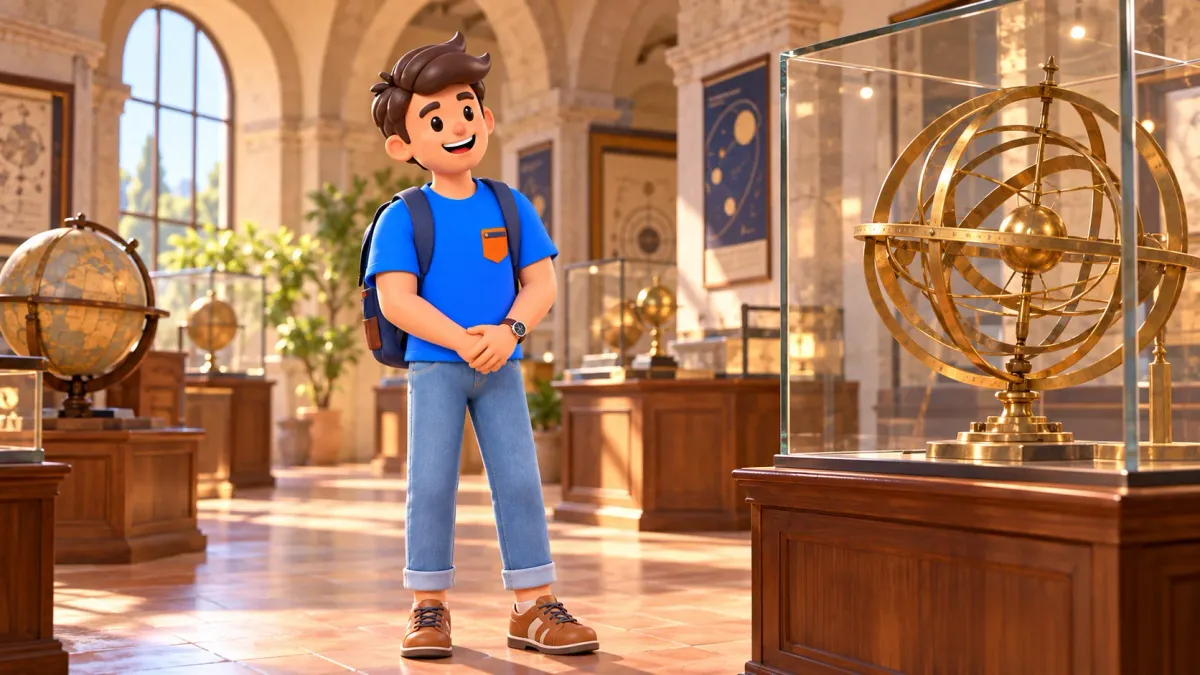
Florence’s scientific history changes the familiar image of a city of paintings, sculpture and palaces. Instruments also belonged to its workshops, collections and courtly ambitions. A telescope, a globe or a measuring device can tell you how people tried to make the world understandable, and how skilled hands turned an idea into something that could be used. The Galileo Museum is a good centre for that different day. Its value reaches beyond one famous name: it introduces observation, experiment and the material history of knowledge as part of Florence’s wider cultural life.
Allow roughly two and a half to three hours after reaching the museum for one selected visit of about seventy-five to one hundred and five minutes, a modest riverside observation, actual local approaches and a pause. This is an editorial planning framework, not a measured circuit or a promise of every room’s availability. Arrival, onward travel and a full meal are separate. La Specola and the Giardino dei Semplici offer different scientific subjects, but belong to separate choices rather than automatic additions. One main museum gives this outing a clear shape and leaves enough attention to understand a few instruments rather than simply pass many cases.
Start with a question an instrument was made to answer
Before choosing favourite objects, ask what someone wanted to do: measure an angle, model the heavens, demonstrate a physical effect or compare an observation. That question makes an old instrument easier to read. Material, scale, moving parts and the way it stands can all matter. An ornate object may combine scientific purpose with the prestige of its owner, while a simpler device can be historically significant without looking spectacular. The aim is not to rank objects by decoration. It is to recognise that knowledge required practical means, trained makers and ways to explain results to other people.
RoadMe makes the whole stay much more convenient to prepare: the app develops a personalised itinerary around your interests, dates and comfortable pace. Scientific history, art, neighbourhood time and proper breaks become a coherent trip, so less effort goes into arranging separate stops and more attention stays with the Florence you want to discover.
Choose a small set of questions rather than expecting to master the history of science in one visit. You do not need advanced mathematics to appreciate the relationship between a device and its task. A label, diagram or explanation can help, but the physical object deserves its own attention. How would a person position it? What could be read or compared? What kind of skill would accurate construction require? Those questions connect science with craft, even if you usually visit Florence for art.
Palazzo Castellani puts newer knowledge inside older Florence
The museum occupies Palazzo Castellani, a building with origins reaching back to the medieval city. Its early history connects with the fortified house known as Castello d’Altafronte, followed by changing ownership and functions. The scientific institution settled here in the twentieth century. This matters to the experience because instruments of later scientific culture are encountered inside much older urban architecture. The walls do not make every object medieval. Instead, the setting offers another example of Florence’s ability to house new kinds of knowledge within inherited spaces. You can notice that relationship before concentrating on any particular display.
Begin the selected visit by understanding the museum’s broad historical strands, according to the actual presentation. The Medici collected mathematical and astronomical instruments alongside works of art and rarities. Such objects could serve observation, teaching and calculation, but also the image of a learned court. Later Lorraine rulers continued and reorganised that tradition. The collection therefore records different questions and institutions rather than one unchanging scientific taste. Knowing that is enough to orient the first part of the visit. Let the cases become answers to particular purposes, instead of assuming everything belongs directly to Galileo or was used in precisely the same setting.
Compare courtly instruments with a changing culture of experiment
The Medici material can be approached through the connection between precision, decoration and patronage. A beautifully made object was not necessarily only ceremonial, and a scientific function did not exclude artistic ambition. Look at the work required to join parts, mark a scale or create a clear model. The same city that valued visual skill also needed skilled makers for instruments. That comparison broadens the familiar opposition between art and science. Both could depend on practical knowledge of material, form and the requirements of a patron, even though the object’s purpose and standards of success differed.
The later Lorraine strand introduces another context for scientific teaching and systematic experiment. In 1775, Grand Duke Pietro Leopoldo established the Museum of Physics and Natural History under Felice Fontana. Its workshops made instruments for demonstrating natural laws, and collections expanded through new fields. This is a useful historical connection, not a claim that every object from that institution is now in one room here. Compare the kinds of tasks that instruments address. A model for public explanation, a device for measurement and an apparatus for demonstration may ask different things of their makers and viewers, even when they stand close together in a museum today.
Do not force the comparison into a simple story in which ornate objects were old and inaccurate and later ones suddenly became real science. The relationship between precision, display and use is more interesting than that. A courtly collection could support serious observation, while demonstration remained important in later scientific education. Choose one visible difference that you can explain in your own words. Perhaps one object represents a system while another makes an effect observable. A modest comparison helps you retain the visit without needing to memorise an entire chronology of rulers, inventions and institutional changes before leaving the gallery.
Galileo’s instruments reward a slower kind of attention
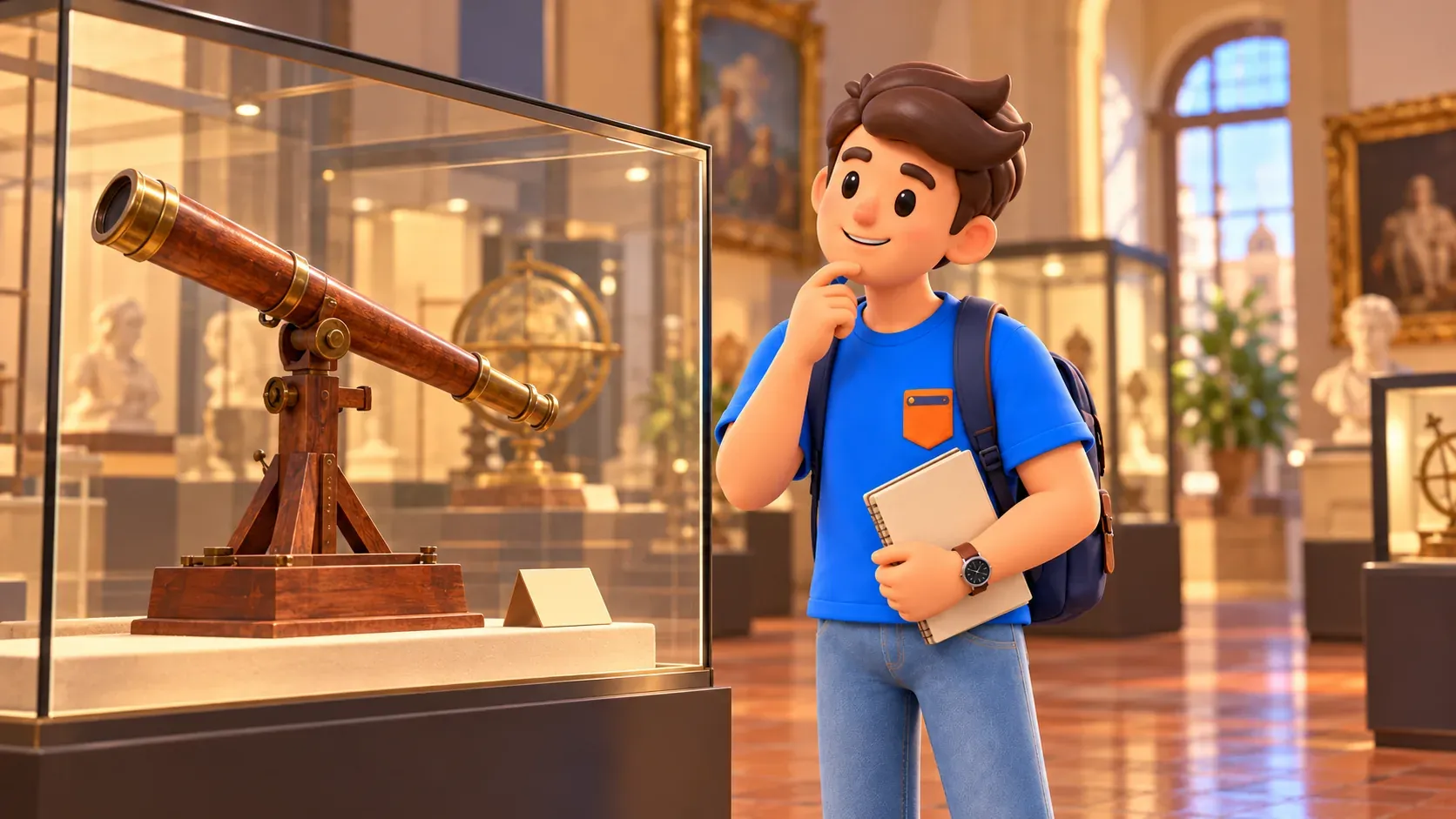
Among the museum’s most significant objects are surviving instruments associated with Galileo, including telescopes connected with his observations. Their importance does not come from enormous size or elaborate appearance. Relatively modest things can recall major changes in ideas about the heavens. Look first at the physical scale and construction, then relate that to what an observer was trying to see. The instrument is evidence of a practice rather than a magical object that produced knowledge by itself. Making, observing, interpreting and communicating results belonged together, and the museum lets that relationship become tangible through material objects.
The surrounding collections include globes, astronomical models and physical apparatus. Treat each as an answer to a question, letting a famous instrument open a larger history of ways to know.
The objects survived changing states, institutions and display practices. Their preservation lets ideas be compared with makers’ work, materials and teaching habits. Science belongs to Florence’s social history alongside its artistic commissions.

Give the visit one clear ending before returning to the river
A selected seventy-five-to-one-hundred-and-five-minute visit is an initial budget, not a demand to hurry through all displays or a guarantee that a fuller programme fits. Actual room access and your interest should determine the selection. Before leaving, choose one instrument whose purpose you can now explain more clearly. A short answer is enough: what it measured, represented or demonstrated, and what visible part helped it do so. That is a satisfying conclusion even if many objects remain for another day.
Afterward, use suitable actual public approaches for a modest look near the Arno. Allow roughly twenty to twenty-five minutes for selected observation and around ten to fifteen minutes for local connections as a first framework, not measured time. This is a pause in scale, not another major route or a promise of an uninterrupted view. The river and surrounding architecture offer a chance to think about perspective, distance and the way people represent space. You need no experiment or special equipment. The point is to let the museum’s questions remain active in an ordinary city scene before moving on to the next event of the day.
Keep around twenty minutes for comfortable rest, separately from a full meal. If you are already tired, shorten the outdoor observation rather than adding another district out of obligation. The two-and-a-half-to-three-hour shape works through a single chosen museum and a modest continuation. All upper estimates, waiting or longer reading can extend it. It does not cover an automatic second museum or a trip into the hills. A scientific day can be focused and complete.
La Specola is another scientific subject for a different plan
La Specola, the university’s historical natural history museum, offers a related but distinct encounter. Its traditions reach back to eighteenth-century public collections, and the name recalls an observatory. Zoological and mineralogical material, botanical wax models and historical wax modelling connect observation, collecting and teaching. Those subjects should not be treated as spare rooms of the Galileo Museum. They ask another question: how could specimens and models make the natural world understandable to students and a wider audience? Choose a separate visit if that is your main interest, with current information about the actual sections you want to see.
The models were teaching tools as well as examples of skilled making. Form, colour and spatial relationships could be preserved in ways useful before modern imaging. Natural specimens and constructed models therefore offer a different comparison from mathematical or physical instruments. Some historical spaces may have separate access arrangements, and anatomical material is a distinct subject to consider when choosing what suits your party. Do not assume one ordinary museum visit includes every special area. The value is a thoughtful selection based on the real display, rather than the expectation that a historical science collection works as an unlimited set of interactive activities.
The Semplici garden connects learning with living plants
The Giardino dei Semplici offers another independent direction north of the cathedral. Founded in 1545 under Cosimo I, it grew from the cultivation and study of plants, especially those important to medicine. The historical name relates to medicinal plant material. A botanical garden is a living teaching collection rather than simply a public park. Identification, comparison and the organisation of species make observation part of its purpose. If plants are your interest, choose that area with its own access, season and route. Do not silently attach it to the riverside museum plan or assume that every greenhouse is included whenever the garden is open.
RoadMe helps turn these interests into a complete personalised trip: instruments, natural history, plants or art can shape the itinerary across the days available. The app connects the chosen experiences and sensible pauses at your pace. Downloading the useful content beforehand makes the plan more convenient and effective to follow offline while exploring Florence.
Leave with a different image of Florence
The museum, La Specola and Semplici show different ways of observing, classifying, measuring and teaching. One selected subject is enough for a coherent outing. For another view of the city’s continuing life, the contemporary cultural spaces article explores changing uses of buildings. Here, the useful result is a new question to carry into the streets: what practical skill made an idea visible or testable? Florence becomes a city of instruments as well as images, with craft and knowledge participating in the same wider history. That perspective can change even an ordinary look at the river after a museum visit.


