
Immigrant New York: Ellis Island or the Lower East Side?

To explore immigrant New York, start with the question that interests you: arriving in a new country, or building a life after arrival? Ellis Island offers the scale of an immigration station and the experience of entering a large administrative system. The Tenement Museum on the Lower East Side brings the story closer to home, work, neighbours and family decisions. Both tell human stories, through very different spaces.
With only one free day, you do not need to combine them. The island involves ferries and security; a Tenement tour has a specific starting time. Choose your historical interest first, then the practical format. These alternatives leave room for lunch, reflection and the living city around the museums, rather than a race between two appointments.
Choose the question before the museum
Choose Ellis Island if you want to understand arrival through the place where it happened: a harbour journey, a large institution and the procedures people encountered. Choose the Tenement Museum if you are drawn to everyday questions about earning money, sharing space, raising children and maintaining connections. The difference is one of scale and emphasis, rather than which museum has the most moving stories.
RoadMe makes it much easier to build a personal New York itinerary around your interests, whether that means family stories, architecture, neighbourhoods or major historical events. Try the app to give your trip a clear theme and a comfortable balance of exploring, walking and rest.
| Your main interest | A good starting point | Time to protect |
|---|---|---|
| Arrival, inspections and immigration history | Ellis Island | A separate half-day with flexibility |
| Home, work and family life | One Tenement Museum tour | A few hours with lunch and a short walk |
| Community architecture and religious life | Museum at Eldridge Street as an optional addition | Extra time only when the calendar fits |
A particular family story may matter more to you than a famous building. Read the available Tenement tour descriptions before deciding. If your strongest wish is to stand in a great hall associated with arrival and uncertainty, Ellis Island is the more direct answer. A personal question makes the choice considerably clearer than a general ranking.
Ellis Island: arrival on an institutional scale
The federal immigration station opened in 1892 and closed in 1954. Its original wooden building burned down in 1897; the present Main Building opened in 1900. The building you visit therefore belongs to a particular chapter of the site's history, rather than providing an unchanged setting for the station's opening day.
The Registry Room, also called the Great Hall, is the emotional centre of many visits. Its high windows and broad interior help you consider waiting, inspection and the relationship between an individual and an institution. The space itself carries meaning: standing beneath a large ceiling is a different encounter with history from looking into a small domestic room.
It is equally important to remember that not every immigrant to the United States passed through Ellis Island. Other ports existed, and procedures differed between passengers. The island represents a major chapter, rather than the universal route of every family. Keeping that distinction in mind helps you read the museum as a specific historical place.
The museum opened in 1990 following restoration. It is a preserved and interpreted historic site, rather than a station left untouched when its work stopped. Follow one question through the displays available during your visit: waiting, inspection, personal possessions or what happened afterwards. You do not need to cover every room to leave with a coherent understanding.
Give individual accounts room to complicate your first impression. A grand building can suggest hope, anxiety or both, but a visitor's reaction cannot stand in for everyone's experience. Separate what the building shows from what a particular testimony says. This approach makes the visit more rewarding than treating every suitcase, photograph or corridor as a single universal symbol.

Allow enough time for the island
For an Ellis-focused outing, protecting roughly four to six hours is a sensible initial planning estimate. That block includes boarding, travel, the museum and spare time; it is not a guaranteed journey duration. Allow approximately two to three hours for the museum itself. If you also want a substantial visit to Liberty Island, the National Park Service advises setting aside most of the day.
Public access to Ellis Island is by ferry. Statue City Cruises is the sole authorised ferry operator and ticket seller for this service. Departures are available from the Battery area in New York and Liberty State Park in New Jersey. Choose the departure point deliberately, using your accommodation location and the operator's current timetable.
The time printed on your ticket is the time to join the security screening queue, not a guaranteed ferry departure time. Waiting can take an hour or more during busy periods. A tightly timed Tenement booking immediately after your expected return would therefore create unnecessary pressure. The buffer reflects how the visit actually works, rather than an arbitrary preference for slow travel.
The museum does not charge a separate admission fee, but the required ferry transport is paid. Calling it a free museum does not make the outing free. Nor does ordinary admission automatically include special programmes or access to the island's other historic buildings. The separate Hard Hat Tour is a different booking, not a standard part of every museum visit.
Check the operating timetable, weather notices and available museum sections for your date. An old notice about a closure lasting several weeks cannot establish today's gallery access. Equally, a general description does not guarantee that every exhibition will be open. Confirm the relevant arrangements once, then leave enough flexibility to enjoy what is available.
The Tenement Museum: a life within a few rooms
The Tenement Museum changes the scale of the conversation. Family histories, domestic space and daily work move into the foreground. The historic building at 97 Orchard Street was constructed in 1863. Such buildings offer a way to consider what happened after relocation: earning a living, organising a household and making decisions together.
Visits take the form of guided tours, rather than unrestricted access to apartments. Most programmes last approximately 60 to 90 minutes, with the exact format depending on the tour. Recreated interiors help tell real family histories, but do not assume that every story unfolds in an entirely unchanged apartment where every person mentioned once lived.
Choose the description as carefully as you would choose a performance. Work and household income may interest one visitor; childhood, language or generational connections may interest another. There is no need to hunt for a single universally best introductory tour. A programme that matches your curiosity is more valuable than adding another simply to feel thorough.
All public tours start at the Visitor Center at 103 Orchard Street. Arrive at least ten minutes before the scheduled start. Advance booking is recommended; any tickets sold on site depend on availability. The opening hours of the shop and Visitor Center do not mean that visitors may independently enter the historic apartments whenever they wish.

A manageable Lower East Side history day
Make one Tenement tour the main appointment. Including early arrival, an unhurried lunch and a short walk, the outing might occupy about three hours. That is a useful scale when the rest of your trip already contains large museums. Time before the tour is better reserved for arriving calmly than filled with another compulsory attraction.
Afterwards, step into the present-day neighbourhood and let the story settle. People continue to live and work here; the streets are not a museum set. Notice how older facades sit beside contemporary businesses without expecting the entire area to illustrate a particular guide's account. Respect private entrances and avoid turning residents into characters in your historical photographs.
Lunch provides a natural pause. A particular dish, however, cannot prove an unbroken tradition belonging to one family or community. Choose somewhere comfortable and discuss a question that stayed with you. What made a place feel like home? Which decisions changed after relocation? These questions connect the visit with your own experience without inventing anyone else's biography.
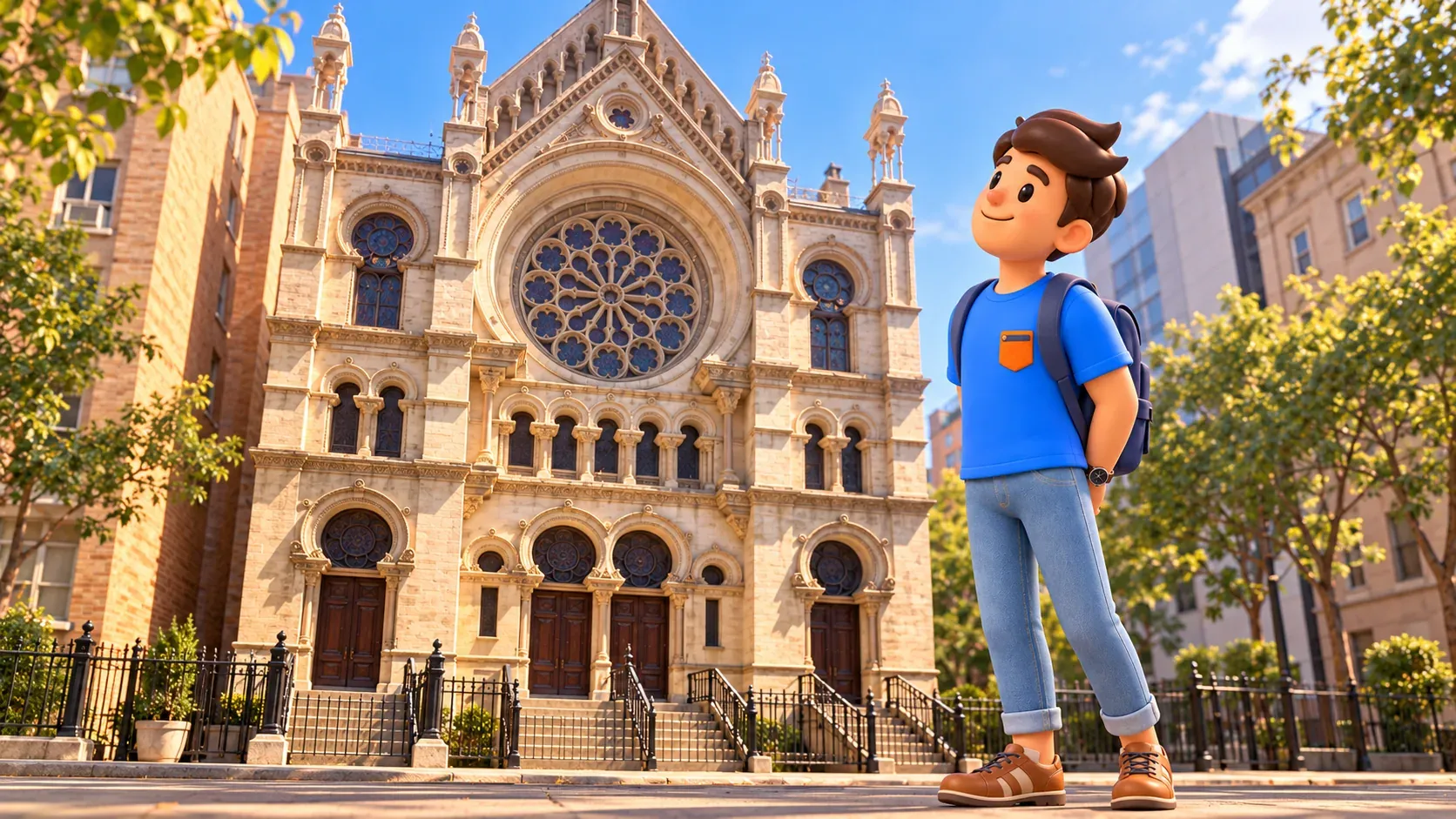
If you want to extend the architectural thread, consider the Museum at Eldridge Street. It occupies an 1887 synagogue associated with Eastern European Jewish immigrants. Community and religious life offer another perspective alongside the Tenement's domestic emphasis. One institution should not be treated as representing every migration story or the neighbourhood's present diversity.
When Eldridge Street makes a useful addition
Allow approximately fifteen minutes to walk between the Tenement Visitor Center and the Museum at Eldridge Street. A visit and the additional walking might add roughly one to one and a half hours to your programme. This is a planning estimate, depending on your interest, the exhibitions and which spaces are accessible. Add it only when the day remains comfortable.
The regular museum week runs Sunday through Friday, with Saturday closed; holidays and building work require separate attention. At the time of checking, 17 October 2026, the museum announces a closure on 19 October for renovation and a closed first-floor gallery. Those temporary conditions should not be projected onto every future visit: check the notice applying to your own date.
If the calendar does not fit, keep the day centred on one tour. Missing a second interior does not make your encounter with immigrant history incomplete. An available hour can deepen a conversation more effectively than another rushed entrance. The purpose is a changed perspective on New York, rather than the largest possible collection of museum tickets.
Check the practical fit before booking
Check the language arrangements for your specific Tenement programme. Translations and assistance do not apply equally to every tour, and reading this article in a particular language does not guarantee a guided visit in that language. Rules for young children also vary. If stairs are a concern, discuss a suitable accessible programme with the museum rather than generalising about every historic room.
For Ellis Island, consider the whole journey, including the dock and ferry, rather than only the museum lift. Travel light and read each institution's baggage and storage rules separately. Island admission does not grant access to every building; a Tenement ticket does not mean you can freely move between tours once they have begun.
With RoadMe, it is much more convenient to develop this interest into a personal trip plan: spend longer on family histories, add architecture, or keep a relaxed day around one tour. Use the app to bring your interests and preferred pace together in a comfortable, meaningful New York visit.
Choose Ellis Island for the historic place of arrival, and the Tenement Museum for a closer conversation about life after moving. If both matter to you, give them different days. Water, great halls and small domestic spaces can then complement one another without forcing the city's complex history into a single rushed itinerary.


