
El Call, Barcelona: a ninety-minute walk through Jewish history
El Call can be crossed in a few minutes without becoming much clearer. The lanes are short, the buildings have changed repeatedly, and much of their significance survives in records, objects and names. A small museum gives this part of Barcelona a useful starting point. Afterwards, three nearby streets make more sense than a hurried search for every doorway described as extraordinarily ancient.
This walk takes about ninety minutes, beginning at MUHBA El Call on Placeta de Manuel Ribé at 11:00 and returning nearby around 12:30. Standard museum admission is paid; the street section uses free public space. Other interiors, a guided tour, lunch and the journey to the starting point are separate. The purpose is a manageable introduction to Jewish Barcelona, with enough context to understand what you see.
A ninety-minute plan with one museum visit
Allow 11:00–11:45 for MUHBA El Call, then five minutes to reach Carrer de Marlet. Spend 11:50–12:00 by the commemorative inscription at number 1. Give the next ten minutes, including the short connection, to Carrer de Salomó ben Adret, and 12:10–12:20 to Arc de Sant Ramon del Call. Keep the final ten minutes for returning towards Manuel Ribé and a pause. The total is ninety minutes.
These are planning estimates, not times measured on a visit. The route is compact, but museum reading and observation need space. If an exhibit holds your attention, shorten the streets section. The point is to leave with a coherent story, rather than collect a photograph at every corner. A doorway can belong to an ordinary home even when the surrounding street has historical importance.
To fit this walk comfortably into your whole trip, try RoadMe: the app develops a personal day-by-day itinerary around your interests, dates, pace and budget. A complete plan is more convenient to use around the city than a collection of ideas still waiting to be organised.
Choose an ordinary Tuesday–Sunday opening day and check the museum before leaving. A Monday or announced closure changes the experience to a shorter outdoor walk. It does not make a different interior with a similar name an automatic substitute. Each institution has its own content, admission and timetable, and this plan includes only the museum specified here.
MUHBA El Call: begin with a weaver’s home
The museum stands on Placeta de Manuel Ribé, without a street number. It belongs to Barcelona’s city history museum and explores the Jewish community in relation to the wider city. Jucef Bonhiac, a veil weaver, once had his home here. That detail gives the visit a human scale: work, households and urban relationships belong in this story alongside religious buildings.
The building retains medieval elements from the thirteenth and fourteenth centuries, but its present form developed through later changes. You are not entering an untouched medieval house with its original furnishings. Modern interpretation helps explain surviving evidence. Nor is this museum itself a synagogue: its standard ticket should not be understood as admission to every other Jewish heritage interior nearby.
For a forty-five-minute introduction, follow three threads: everyday life, intellectual culture and connections with Barcelona beyond the quarter. Read one object carefully rather than assigning identical time to every case. Ask who used it and why it mattered. This gives a small display room a clear purpose without turning the visit into a test of how many dates you can retain.
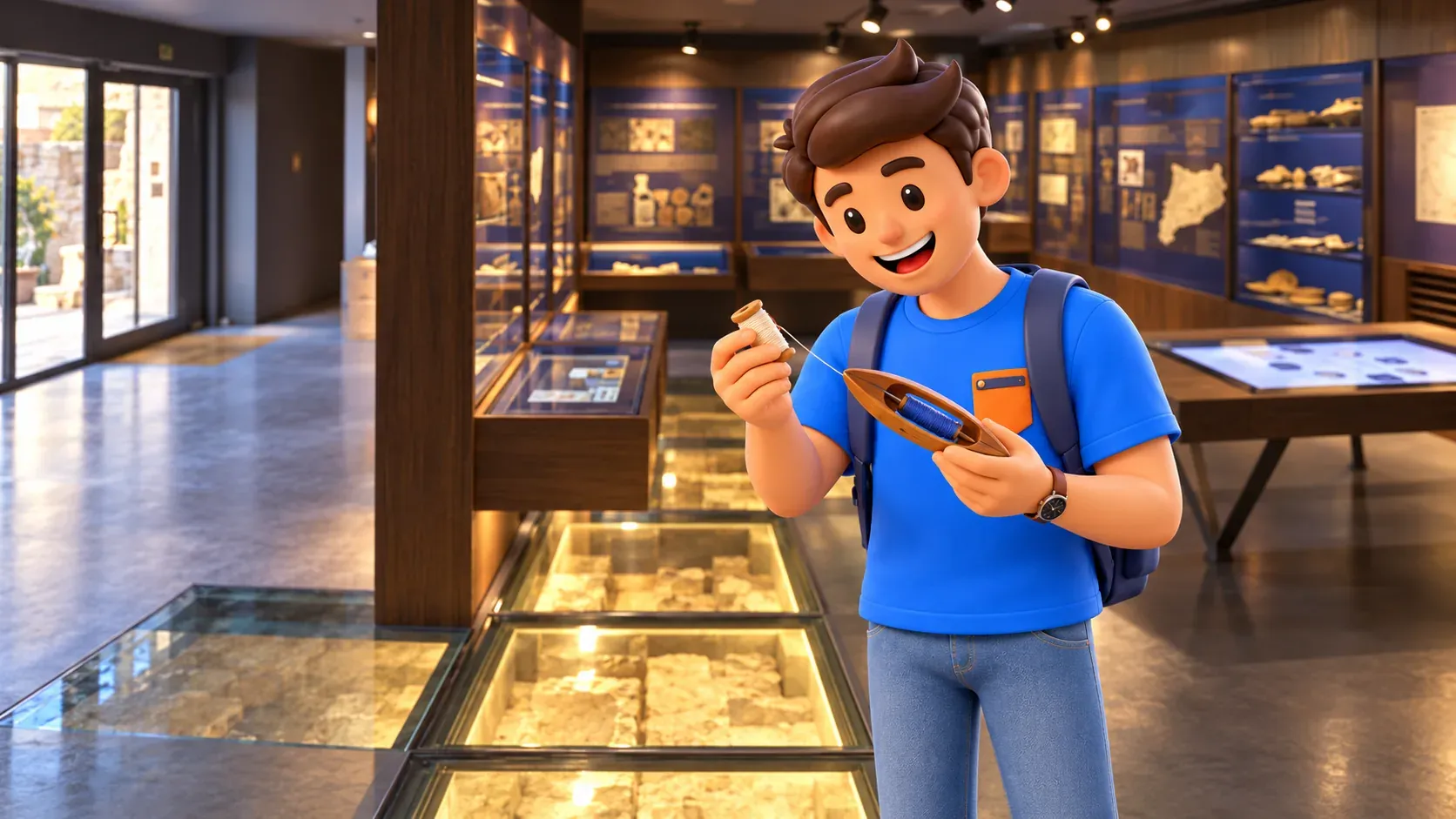
The weaver is a useful person to remember when you return outside. A neighbourhood was a place of occupations and exchange, not simply a collection of monuments. Avoid reducing an entire community to a single profession or a familiar financial stereotype. The museum’s wider frame makes room for different kinds of work, learning and relationships with the surrounding city.
What the name El Call describes
The museum’s explanation of call is a small street or lane, a name that extended to the Jewish quarter. The organised community was known as the aljama. The distinction matters because a physical district and the people who organised communal life are different things. Knowing a name is a starting point for understanding institutions, rather than a complete explanation of them.
Barcelona had a Call Major and a Call Menor. This route concentrates on a small part of the former and does not cover all Jewish heritage across the city. It makes no detour to Montjuïc and does not claim every atmospheric Gothic square as part of the quarter. A limited scope helps you look carefully instead of attaching an unsupported story to every old wall.
Relatively little of the original built quarter survives. A historical sign can therefore identify a meaningful location without marking a complete medieval structure still standing. Manuel Ribé’s small square also reflects later urban change. Its value lies partly in showing how present-day Barcelona identifies an earlier neighbourhood whose original appearance cannot simply be recovered by looking around.
Marlet: a small inscription about community care
Reach Carrer de Marlet, 1 around 11:50. The Hebrew commemorative inscription set into the wall here is a reproduction. The museum’s walking guide connects the original with the pious foundation of Samuel Ha-Sardi. This is a useful distinction: it commemorates a charitable institution, rather than serving as a tombstone for someone buried beneath this street. The façade copy is not an ancient original preserved in its first position.
Ten minutes are enough to consider why such a modest text matters. It draws attention to organised care, one part of community life that a monuments-only walk can overlook. You do not need to read Hebrew or produce your own literal translation. Start with the museum’s explanation rather than an impressive claim about the quarter’s oldest gravestone.
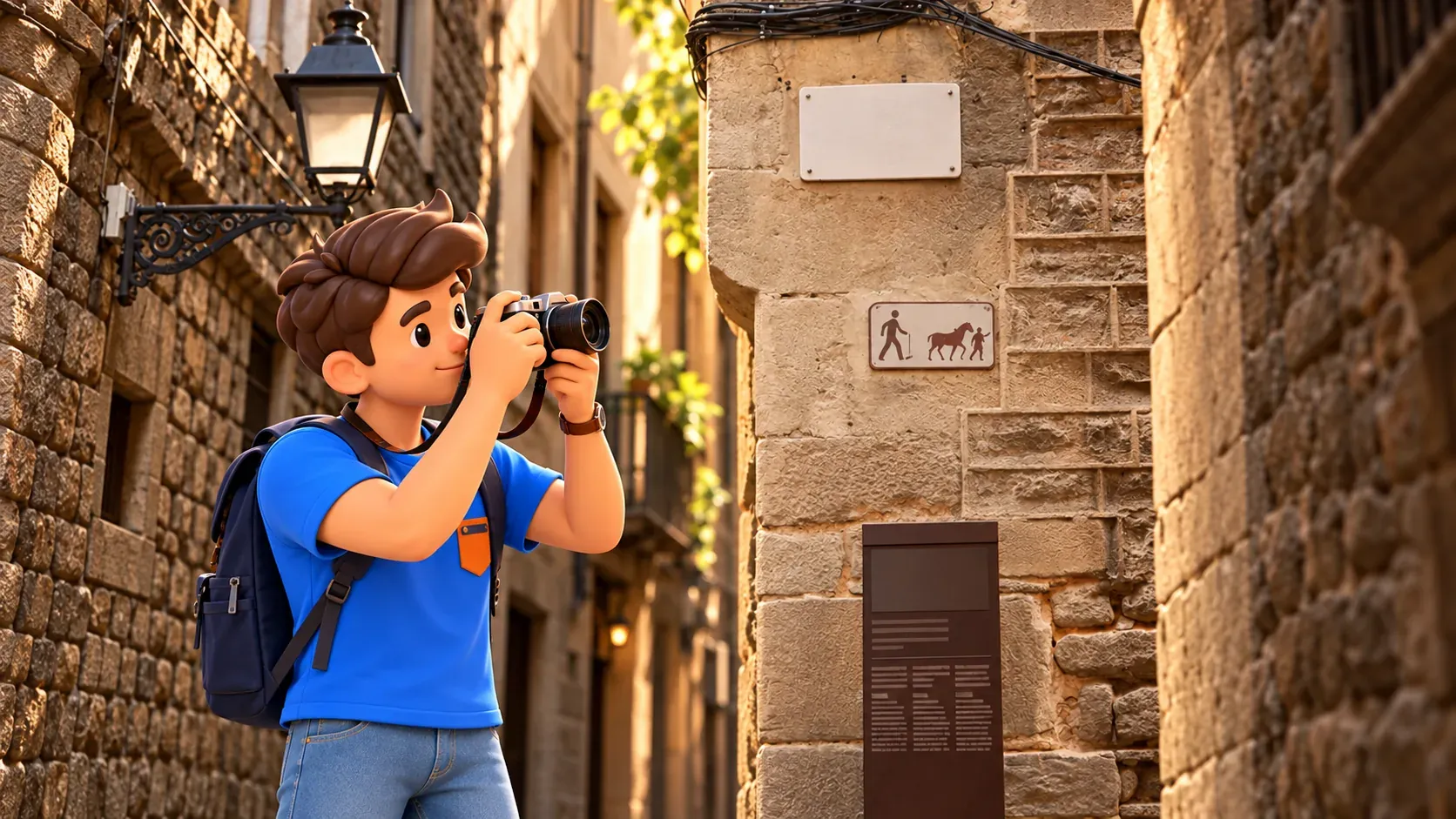
Look from the public street and keep the passage clear. Leave the inscription untouched and do not enter a residential doorway to improve a camera angle. This is historical evidence set within a working neighbourhood. One overall view and one detail are sufficient; interest in the past does not give visitors extra rights over the homes around it.
Salomó ben Adret: a street name with a person behind it
Spend the next ten minutes along Carrer de Salomó ben Adret. Older maps and photographs may call it Sant Domènec del Call. The street was renamed in 2018 for Barcelona’s rabbi and scholar Salomó ben Adret, who lived from 1235 to 1310. Different labels do not necessarily mean that two sources are describing different streets.
Ben Adret became an influential authority on the Talmud and Jewish law. His written responses to questions from other communities connected Barcelona with people far beyond its walls. This is a useful contrast to the lane’s physical scale: a narrow urban setting could participate in a wide intellectual network. You do not need a long bibliography to appreciate that contribution.
The change of name is also part of the visit. A modern city has chosen to make an individual visible in its public memory. Read the street name as a brief invitation to learn about him, while distinguishing commemoration from ownership. It does not prove that every nearby building belonged to the scholar or that all the interiors preserve their medieval arrangement.
Arc de Sant Ramon: observe several layers
Between 12:10 and 12:20, continue to Arc de Sant Ramon del Call. Look at the bends of the lane, property boundaries and changing materials. Its historical course followed the inner side of the old Roman wall. That does not promise a continuous exposed stretch of masonry today: later buildings conceal much of the earlier fabric. This is a living street, not a fully uncovered archaeological site.
A small hollow beside a doorway is not automatically enough evidence to identify a mezuzah fitting, and an old opening does not date an entire house. Where a specific feature lacks a reliable explanation, leave the question open. Observing a change in stonework or levels can be worthwhile without resolving it into a single, dramatic story.
The short scale of the route makes this easier. You can notice the light in a passage, read a useful marker and continue without adding another dozen destinations. Step aside for residents or deliveries, choosing a wider place to pause. The visit works best when stopping and looking fit naturally into the street’s ordinary use.
Remember 1391 without reducing the quarter to tragedy
The pogrom of 1391 is essential to understanding El Call. Violence, deaths and forced conversions profoundly damaged the medieval community. It would be misleading to explain the neighbourhood’s transformation solely through the expulsion decree of 1492, as though everything had continued unchanged until then. A short travel article still needs an accurate sequence and careful language.
Yet catastrophe alone is an incomplete memory of a community. The weaver’s home, the charitable inscription and the scholar’s name point to lives and institutions before that violence. Jewish life in contemporary Barcelona also continues; the historical quarter does not represent all of it. This circuit concerns particular heritage, rather than suggesting that a culture exists only in museum cases.
If the subject matters especially to you, give further study its own time. Adding several paid interiors to the final minutes is unlikely to produce a clearer understanding. A group can usefully agree how much museum reading suits everyone and when to rest. The practical aim is to preserve attention for a complex history instead of exhausting it through an overfilled schedule.
For a trip with several interests to balance, prepare a personal itinerary in RoadMe: the app arranges a day-by-day programme around your chosen pace and budget. This gives a thoughtful heritage visit its place beside other experiences, with a whole plan that is easier to use while travelling.
Current opening hours and a calm finish
Under the museum timetable effective from August 2026, MUHBA El Call opens Tuesday, Wednesday, Thursday and Sunday 10:00–14:00. Friday and Saturday hours are 10:00–15:00 and 16:00–19:00. Mondays are closed, and last entry is thirty minutes before closing. Annual closures are listed for 1 January, 1 May, 24 June and 25 December. Check date-specific notices before visiting.
Standard museum admission is paid; any concession or free period depends on applicable conditions. The public streets require no separate ticket. For particular accessibility needs, check the entrance, internal route and street approaches individually: short distances do not establish a barrier-free journey. Returning towards Manuel Ribé leaves the final ten minutes for a pause and deciding what comes next.
On another day, our Roman Barcelona walk explores an earlier urban layer through a different theme. There is no need to combine both immediately. For today, three clear ideas are enough: a craftsperson, community care and a scholar whose name returned to a street. They help make El Call a history of people rather than a collection of mysterious doors.


