
A rainy day in El Born: Picasso, history and short walks
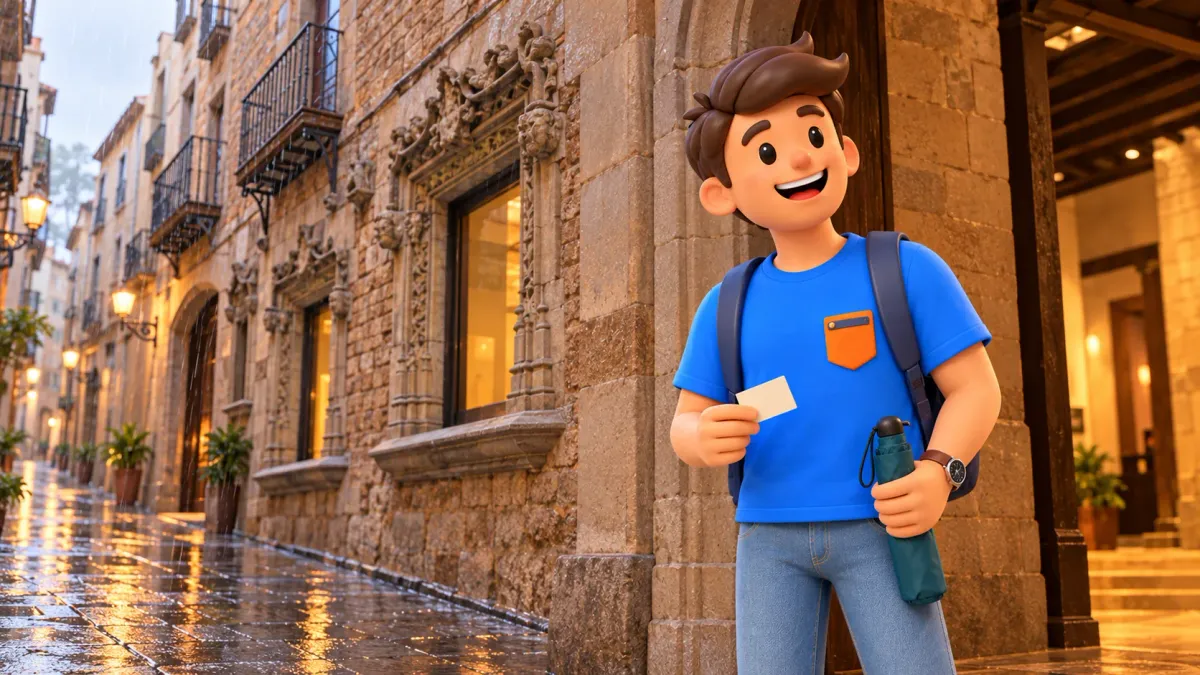
A rainy morning in El Born can explore two different ways of seeing Barcelona: through Picasso’s work first, then through traces of the old city beneath a former market roof. A short connection along real streets separates them. This is a compact programme built around worthwhile visits, rather than a promise to remain completely dry all day.
Allow about three hours, from 10:30 to 13:30: the Picasso Museum, a ten-minute walk to El Born and time in the former market’s free public space, followed by a small break. A full archaeological tour, another art museum and a restaurant lunch are outside the plan. It suits ordinary rain when moving around remains comfortable; shorten it if the weather deteriorates significantly.
Book the museum first, then arrange the rest
The anchor is a Museu Picasso ticket for a suitable time. Take 10:30 as the example: the first fifteen minutes cover admission, belongings and orientation. From 10:45 to 11:20, consider selected early works, then give until 11:55 to several works from the Las Meninas series. Allow another ten minutes for an absorbing section and the final ten for collecting belongings and leaving by 12:15. That is 105 minutes, rather than an attempt to complete the collection.
To combine museums, walks and downtime into a practical trip, try RoadMe: the app develops a personal day-by-day programme around your interests, dates, pace and budget. A complete Barcelona itinerary is much easier and more effective to use than assembling tomorrow from separate ideas every evening.
Walk to the former Born market on Plaça Comercial from 12:15 to 12:25. Give its accessible upper public space and historical layers forty minutes, until 13:05. Keep the final twenty-five minutes for a short connection to an open nearby café and roughly twenty minutes of rest. The total is 105 + 10 + 40 + 25: 180 minutes.
All intervals are estimates, without an on-site timing exercise. If a different museum slot is available, shift the later blocks and check the second stop’s opening hours. Arrival at the start and travel after the finish are additional. A delayed entry or unavailable seat should extend the outing, rather than make you rush a painting merely to protect the timetable.
When this route works
The ordinary version is for Tuesday to Sunday. The Picasso Museum closes every Monday, as well as 1 January, 1 May, 24 June and 25 December. Its published winter schedule, from 29 September to 29 March, is 10:00–19:00. In the summer period, from 31 March to 27 September, Tuesday, Wednesday and Sunday run from 09:00 to 20:00, with Thursday to Saturday extending to 21:00.
On 24 and 31 December the museum closes at 14:00, which still accommodates this morning visit. Ticket sales end half an hour before closing. Check the calendar and a suitable admission slot again for your date. Rain does not create extra tickets or empty popular galleries. If admission is unavailable, choose another day rather than expecting everything to work out at the door.
At the check on 17 October 2026, ordinary general admission bought online for the collection and temporary exhibitions cost €14 per person. Under-eighteens qualify for free admission with the relevant proof; visitors under fourteen must be accompanied by an adult. A free category does not remove the need to arrange the correct visit.
Use the museum’s official purchase channels and check the date and time carefully. Tickets are personal, valid for the selected slot, and the rules do not provide exchanges or refunds. Designated free periods also require reservations. A 10:30 start is not a universal free-entry opportunity, and a temporary exhibition should be current for your date rather than simply appearing in an old recommendation.
A folding umbrella and a small bag help
The rainy-day plan starts with practical belongings. Bring a folding umbrella that can be put away and avoid turning a museum visit into luggage transport. Bags and backpacks larger than 30 × 30 × 25 centimetres cannot enter the galleries. A free cloakroom accepts larger items within a maximum of 56 × 45 × 25 centimetres. Do not bring a large suitcase assuming that any spare locker will accommodate it.
The rules specifically exclude non-folding umbrellas. Follow staff directions at entry, put wet belongings away calmly and ask about a suitable route for particular mobility requirements. Food and drinks are not permitted in the museum. That is why the café pause comes after the visits, rather than between two galleries with a planned return.
You cannot leave and re-enter on the same ticket. Before the final exit, decide whether you want another look at a selected work and collect your belongings. A confirmation ready on your phone, a small bag and a clear sequence save more energy than numerous objects brought just in case. They leave attention for the reason you came.
Picasso’s Barcelona connection, rather than every masterpiece
The museum opened in 1963 and is particularly valuable for understanding the artist’s formative years. Academic training and early experiments can look very different from a familiar image of mature Picasso. The collection reflects his relationship with Barcelona as a young artist, but it is not an uninterrupted illustrated biography containing every celebrated work.
You do not need to study an art-history textbook beforehand. Bring one question: what changes in the way a person or a space is represented? It works in front of an early painting and a later reinterpretation of another artist’s composition. Choose several works available in the current display and actually spend time with them, instead of arriving with a long compulsory list.
Science and Charity, from 1897, can offer a reference point for the young painter’s academic ability. Look at the arrangement of the scene, relationships between figures and sense of space, then read the museum’s interpretation. If that particular work is temporarily unavailable, the same question can be addressed to another early work on view. One absent picture need not determine the value of the visit.
Las Meninas: a familiar composition becomes a study
In 1957 Picasso created his own series responding to Velázquez’s Las Meninas. Look beyond how different the faces appear. The relationships between figures, lines, colour and the organisation of space also change. These are independent works engaging with a known composition, rather than exercises in copying it accurately.
Choose several available versions and compare one element. Where does the strongest emphasis fall? What happens to the rectangles suggesting a room? How does your eye travel through the painting? Such questions make differences visible without requiring an immediate explanation of every figure. You do not have to give each work exactly the same amount of time.
If travelling together, look silently first and then compare responses. One person may remember light, another a large figure or an unusual rhythm of lines. Those differences make the conversation interesting. The ten flexible minutes can return to a work that has stayed with you instead of automatically taking in another section.
The Montcada palaces are part of the experience
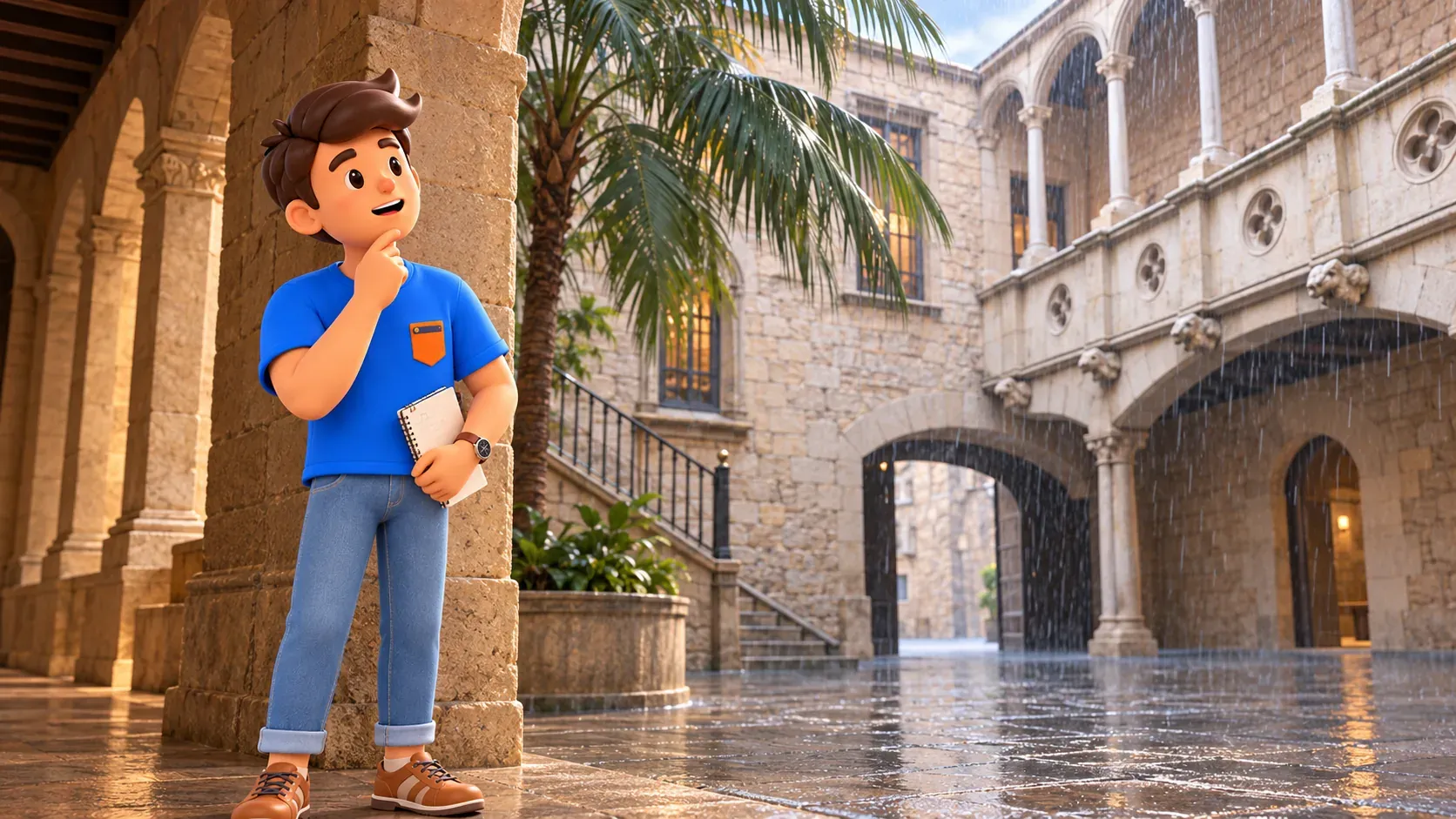
The museum occupies several historic palaces on Carrer de Montcada. Stone portals, courtyards and stairways suggest the earlier scale of life on this street. Moving through these spaces differs from visiting one large contemporary exhibition hall. Notice the architecture along the way without turning it into an additional hour-long tour.
A courtyard, however, is not a fully enclosed room: parts of the setting are open to the sky. This rainy route does not promise a continuous dry gallery from the first door to the last. Use designated passages and follow the current visiting arrangement. Before a photograph, find somewhere that does not interrupt other visitors and observe the museum’s rules.
Personal photographs without flash are permitted. Small sketches have separate limits: dry techniques such as pencil, a sketchbook no larger than 21 × 28 centimetres and no easel. Staff may restrict drawing when galleries are crowded. The simplest option is to remember an idea and sketch it later during the break.
A short walk that remains outdoors
After leaving, follow open public streets towards Passeig del Born and Plaça Comercial, 12. Ten minutes allows for finding your direction and managing an umbrella. This is a planning estimate, not a covered museum-to-museum corridor. Increase it for a slower pace; there is no need to turn the approach to the second stop into a race.
One look at a stone façade or a promenade perspective is enough along the way. The basic programme does not add visits to Santa Maria del Mar, Ciutadella and another museum merely because they are nearby. A rainy half-day stays compact because only a small number of entrances are essential.
An iron roof with a city beneath it
The former Born market opened in 1876. Its spacious metal framework, associated with Josep Fontserè’s design, represents a different period from Montcada’s stone palaces. The institution’s current name is El Born. Museu d’Història de Barcelona; the earlier cultural-centre name remains common in travel guides.
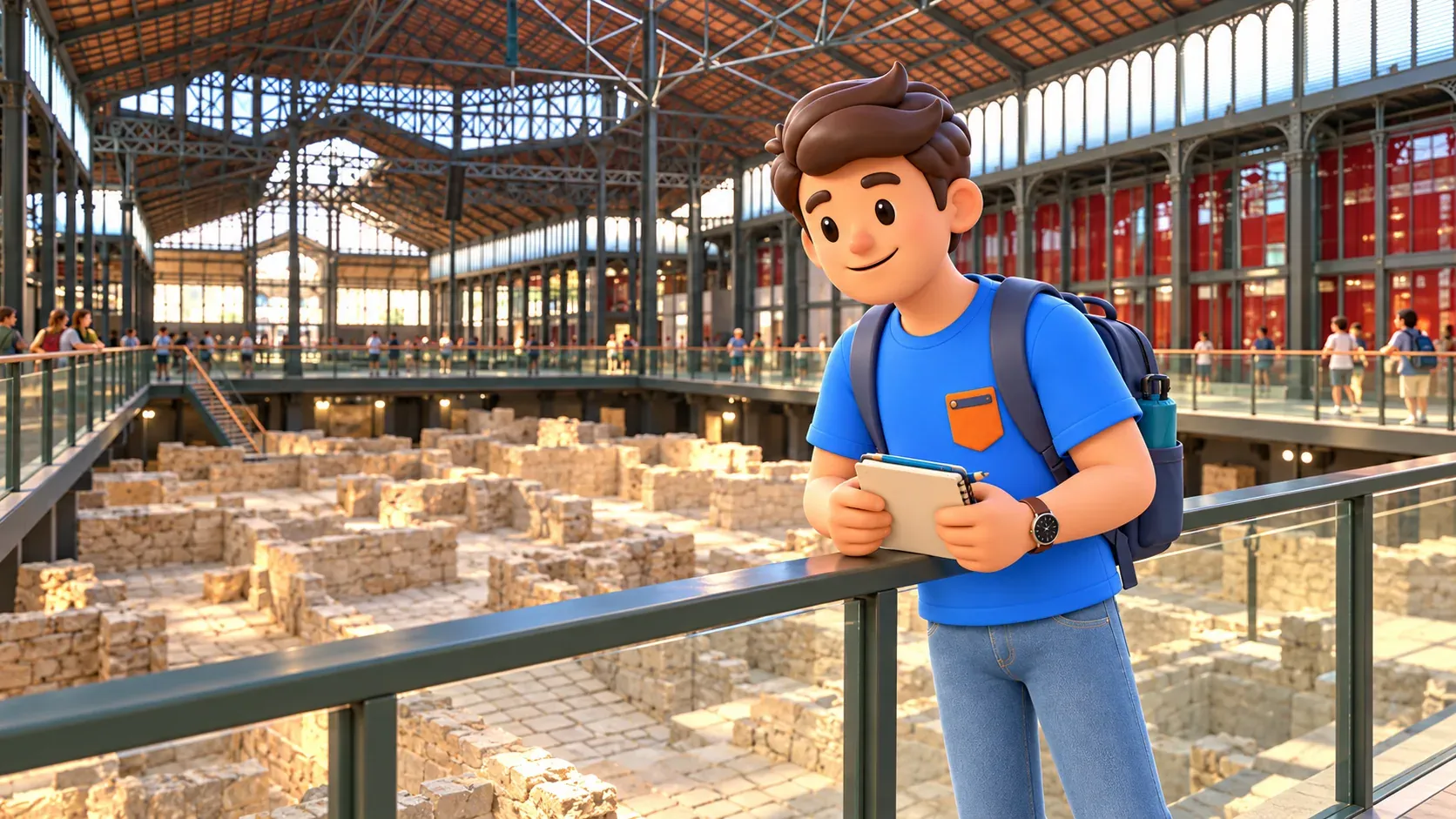
Under the roof are remains of streets and houses from old La Ribera, explaining life in the seventeenth and early eighteenth centuries. These are not Roman ruins. Several periods come into one view: an earlier urban fabric below, the nineteenth-century market above and the present way of presenting heritage. Recognising those layers gives a first visit a clear purpose.
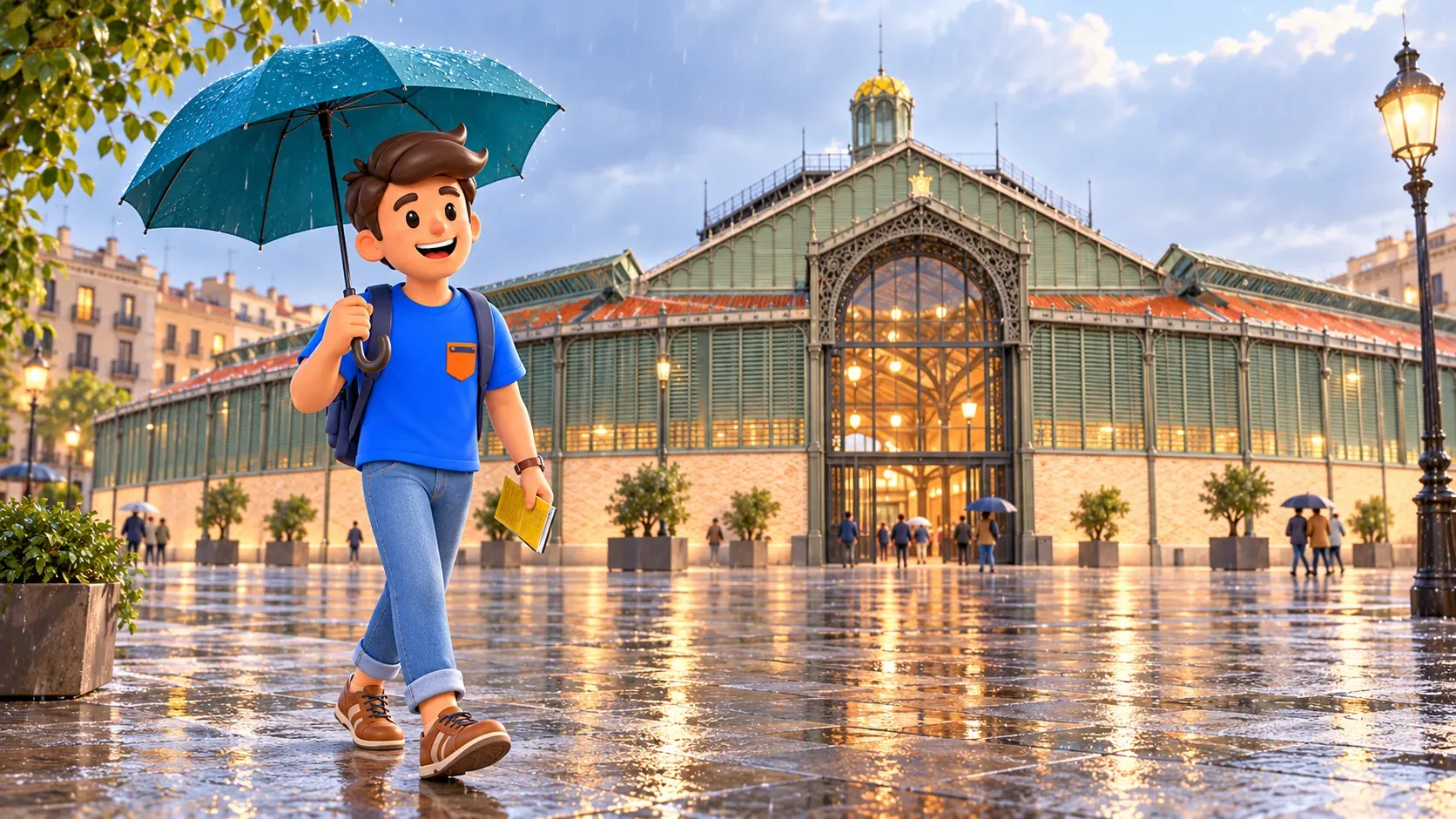
Admission to the building’s public space is free, but it does not include access to the archaeological site. These forty minutes are for the accessible upper level and views from permitted passages. A descent, guided tour or separate exhibition requires its own current conditions and more time. Do not follow a group through a barrier when it has a different visiting arrangement.
If this morning leaves you wanting more history, with architecture or parks on other days, prepare your trip in RoadMe. The app develops a personal programme around your interests and pace, making the full itinerary easier to use in the city and reducing daily planning time.
Finish without an obligatory extension
El Born has seasonal hours, ordinarily opening at 10:00 from Tuesday to Sunday. March to October closes at 20:00; November to February closes Tuesday to Saturday at 19:00 and Sundays and public holidays at 20:00. Holiday exceptions and a shortened 26 December apply. For a midday visit, the essential check is whether your date is an operating day and the public space is available.
The last twenty-five minutes can become a short pause at an open café around Plaça Comercial: about five minutes to reach one and find a place, then twenty to rest. This is not a guaranteed table or a full lunch. If you want longer, continue without another tight booking. If El Born is closed, finish after Picasso and the pause; returning to the art museum after exiting is not assumed.
For better weather on a different day, keep the two-hour El Born walk, which introduces Santa Caterina market, squares and Estació de França. Today, one attentive art visit, a short encounter with urban history and time to discuss what you noticed make a complete morning.


