
Echo Park in Two Hours: Lake Paths and Nearby Streets
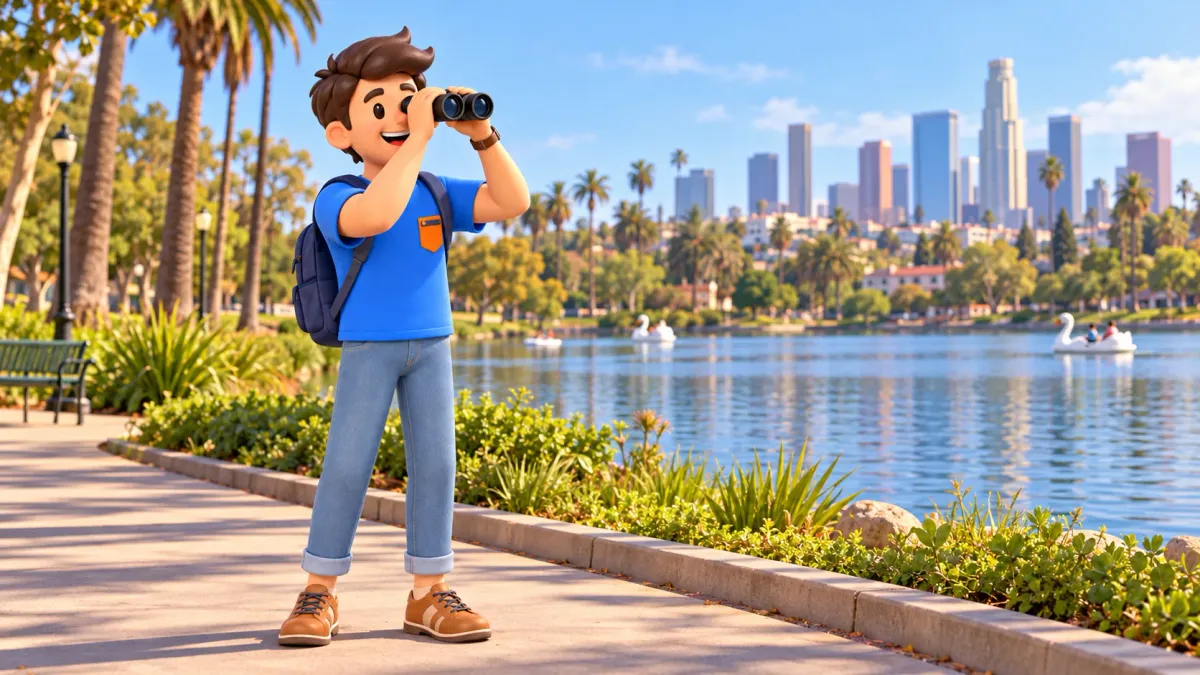
For two hours in Echo Park, start at the northeast edge of Echo Park Lake, where Park Avenue meets Echo Park Avenue. Follow the lakeside path clockwise: down the eastern shore, around the southern end and north along the western side. Add an exterior stop at Angelus Temple, then return east along Park Avenue to your starting junction. The result is a compact outing with water, a city backdrop and a little architectural history.
Two hours here means the whole visit with pauses, not two hours of continuous walking. The lake does not demand a sporting pace. Its interest lies in changing reflections, planting and views towards Downtown. The plan includes neither a boat rental nor a church visit or a full meal. Each is a separate choice that can alter the duration.
Choose the kind of pause you want
This part of Los Angeles works well between busier sightseeing days, when you would rather spend time beside water than add another large museum. The lakeside path remains the centre of the outing. Nearby streets appear as a short finish, so there is no need to turn these two hours into an attempt to cover all of Echo Park, Silver Lake and the surrounding hills.
RoadMe develops a complete personal trip plan around your interests, dates, pace and budget. The app makes it convenient to give an unhurried lake walk its place alongside more active days, creating a visit that matches the way you want to travel.
The suggested daylight version runs roughly 09:00–11:00. These are planning times, not special visiting hours. Check park access and current notices before leaving. If part of the path is closed, do not cross a barrier to complete the circuit. Walking a stretch of accessible shoreline and returning the same way can still make a satisfying short outing.
For the shortest version, keep the northern shore, one pause and an exterior look at Angelus Temple from public space. For a longer visit, decide beforehand whether you are adding boats, food or more streets. That choice prevents the first stop from consuming every spare minute. On sunny days bring water and expect exposed stretches; palms and greenery do not create uninterrupted shade around the lake.

09:00–09:15: establish the north edge and the view
Begin at Park Avenue and Echo Park Avenue so that the finish is an identifiable junction. Park Avenue bounds the park to the north, Echo Park Avenue to the east, Bellevue Avenue to the south and Glendale Boulevard to the west. Those four sides are more useful for this outing than a long catalogue of attractions: you can understand where you are in relation to the water and your starting point.
From the northern edge, look across the water towards Downtown Los Angeles. The appearance depends on visibility, weather and your exact position; there is no single compulsory photograph to reproduce. Compare the near shore with the buildings beyond and find a composition in which water remains the main subject. If the fountain is operating, it adds movement, but the visit need not depend on that.
Slow down before taking out a camera. Notice the light and where people need to pass. A broad scene, a reflection and one close detail usually produce more varied memories than repeating the same view every few steps. Work from the accessible path without stepping into planting or approaching the water for a supposedly better angle.
If meeting friends, agree on the direction: south along the east side first, then north on the west. It is a simple circuit with a return, not a collection of separate journeys. If arriving from elsewhere in Los Angeles, allow additional time to reach the park and leave afterwards. The two-hour allowance begins at the lake, rather than outside your hotel.
09:15–09:45: eastern shore and southern end
Walk south along the eastern side with the water on your right. You can look at the boathouse area and the shape of the shore without treating every structure as a separate mandatory stop. This section helps reveal how an urban park accommodates different uses: some people are moving quickly, while others linger. Keep part of the path clear when you pause to talk or take a photograph.
Echo Park Lake is more than an attractive reflecting surface. It forms part of the city's stormwater detention system while providing recreation and habitat. Landscape rehabilitation incorporated wetland planting and renewed paths. That small piece of context changes the way you see the edges: the vegetation is not simply decoration for photographs, but part of the relationship between public space and urban water management.
You can observe that without a specialist tour. Notice where planting thickens along the margin, where water remains open and where planted areas separate it from the path. There is no need to identify every species or explain every feature. Seeing recreation, water and habitat care sharing a small area is enough. Ongoing maintenance may temporarily change access to individual sections.
At the southern end, keep following the accessible lakeside path west, then north. Do not drift beyond Bellevue Avenue looking for a continuation: this version stays around the lake itself. The proposed thirty-minute block includes observations and small stops. If you walk faster, keep the spare time for a rest rather than automatically collecting extra addresses.
09:45–10:10: western shore, planting and a break
Continue north along the western side. The changing angle makes this a useful moment to compare the lake with the opening view. Lotus planting is part of the landscape, but flowers are not guaranteed throughout the year. The summer Lotus Festival connects these plants with Asian and Pacific Islander communities. Outside flowering season, the shape of the shore, the water and the surrounding city still provide reasons to visit.
Do not base the whole outing on a promise of pink flowers during a particular week. If flowering is your priority, check current planting conditions and the event calendar separately. A festival also changes the nature of the visit: an ordinary short circuit and a major event day require different expectations for pace and attendance. This is a daylight walking plan, without a promise of empty paths.
Leave a few minutes for a bench or another permitted resting place. That is what gives the two-hour allowance meaning: you spend time in the place rather than merely finish a circuit. If birds are nearby, watch from a distance without attracting them with food for a photograph. A particular species or behaviour should not become another scheduled attraction you feel obliged to find.
After the pause, decide whether the architectural stop still appeals. The northern edge is close, so it is easy to finish without further commitments. For the temple, first reach the north side of the park and identify Angelus Temple at 1100 Glendale Boulevard. Use public pavements and marked crossings whenever you need to change sides. There is no need to enter private grounds for an exterior view.

10:10–10:30: see Angelus Temple from outside
Angelus Temple stands by the northern side of the lake and introduces a different scale. Completed in 1923, its distinctive feature is the large dome over a concrete-and-steel structure. From public space, look at the overall form and compare it with the openness of the park. That is enough for an architectural stop even when the doors are not open for casual sightseeing.
The building is associated with evangelist Aimee Semple McPherson, early religious radio broadcasting and the social history of Los Angeles. This brief context explains why it matters beyond a silhouette beside the water. It belongs to a city where public performance, new communications and community activity developed alongside entertainment. A short walk does not need a full account of the founder's life to make that connection visible.
This remains an active church. Service times are not general tourist opening hours, and the outside stop does not automatically include the auditorium, café or other rooms. The congregation's current visitor page lists a Sunday service at 10:00. If attending interests you, check the arrangements separately and allow different time. A service is not a twenty-minute building tour to slip into this sequence.
Do not treat church parking as presumed free parking for a lake walk. It has its own purpose and rules. Choose a photograph position that leaves worshippers, staff and pedestrians room to move. If an event is taking place near the entrance, an overall look from an allowed pavement is enough. The route's value does not depend on getting close to the doors.
10:30–11:00: Park Avenue and the return
Return to the north edge and follow Park Avenue east towards the starting junction with Echo Park Avenue. This short stretch shows the connection between the park and everyday streets. Notice the difference between open space beside water and the facades beyond its boundary. Public pavements provide plenty to see without entering residential yards or doorways in search of neighbourhood atmosphere.
The last half-hour includes returning, another pause and a crossing allowance. If you want coffee or a snack, choose somewhere actually operating after checking on the day. The boathouse café's operators and arrangements can change, so an old guide's business name is not a firm foundation for the itinerary. A proper meal with ordering and waiting works better as a continuation after 11:00.
To combine the lake with food, architecture and other neighbourhoods, RoadMe makes it convenient to get a fully worked-out personal plan based on your interests, dates, pace and budget. The app helps assemble a day with room for experiences and rest as well as the journeys between them.

What would change this short plan?
Swan-shaped pedal boats are a separate possibility, not part of the walking circuit. Wheel Fun Rentals currently requires advance reservations and does not accept walk-ups at this location. Operation depends on the weather. If you want to go out on the water, choose an available slot first, then shorten the shore walk or extend the outing. Check actual prices and conditions for your date.
Parking around the lake is limited, and searching for a space falls outside this schedule. Read the restrictions of the particular place rather than assuming another parked car establishes permission. For a bus journey or vehicle drop-off, decide where you will arrive and how you will leave. Finishing the circuit does not mean instantly reaching the next neighbourhood.
If it is hot, you are tired or a section is unavailable, choose an out-and-back along the northern part with one pause. If you want more, neighbouring streets deserve their own time. This walk already has a complete result: you see the lake from different sides, understand a little of its role in the city and notice an architectural neighbour that can disappear behind the familiar image of palms and boats.


