
Eastern Hong Kong Island: art and maritime history in half a day

Eastern Hong Kong Island offers a different way to understand the harbour: through work, art and the preservation of urban memory. Start at Oi! on Oil Street, where a former yacht club became an art space, then travel east to the Alexander Grantham fireboat in Quarry Bay Park. If time and interest remain, continue to the Hong Kong Film Archive in Sai Wan Ho. The first two stops form the core; the archive is a deliberate addition.
Allow roughly four to five hours including approaches, the transfer and a pause. A chosen film screening makes the programme longer. Do not describe the connection between Oi! and the ship as one uninterrupted waterfront walk. These are separate urban sections linked by an eastward direction and a theme: how a maritime city gives buildings, equipment and images a new public role.
Two main stops and one possible ending
The first stop is at 12 Oil Street in North Point. Oi!'s official information identifies Fortress Hill station Exit A as a useful approach. Afterwards, allow separately for travel towards Quarry Bay Park. Nearby district names on an overview map do not turn the sites into a single compact attraction. The distance between them affects how much walking your half-day involves.
A starting allocation is about an hour at Oi!, roughly another for the ship and exhibition, with the remaining time for transport, the shore and rest. These are planning estimates, not measured times. If the art exhibition engages you, do not shorten it solely to make the Film Archive compulsory. The third stop should remain an option rather than depriving the first two of their own time.
For a day connecting art and urban history, try RoadMe: the app develops a personal route around your interests and pace, and a trip plan around dates and budget. It makes it easier to choose the right amount of walking and give a favourite subject proper space.
Decide which interest matters most: new uses for an old building, real maritime equipment, or film history. That small hierarchy helps if time becomes limited. You do not need to explore all three subjects equally deeply. The route remains coherent when one gets priority and another becomes a reason for a later visit.
Plan the core during daytime and check each calendar separately. The art space does not determine ship hours, while an open archive building does not guarantee a suitable film in the cinema. Agree within your group which part is essential, so that an extension does not depend solely on whoever is willing to keep going longest.
Oi!: a former waterfront now inside the city
Oi!'s historical complex opened in 1908 as a yacht clubhouse on North Point's then waterfront. Land reclamation moved the shoreline away from the older site. Today, that relationship helps show that Hong Kong's coast has not remained fixed. A modest brick building can explain urban geography as effectively as a large viewpoint when you understand why it stands where it does.
After restoration, the complex opened as a public art space in 2013; later expansion added new indoor and outdoor areas. Consider Oi! as a relationship between an historical building and a contemporary cultural venue. There is no need to choose which part is “real”. Older material and present use answer different questions: one explains origins, the other the district's current life.
Red brick, roof tiles, chimneys and details recall Arts and Crafts architecture. For a shorter visit, compare wall texture, roofline and opening sizes with later elements. Avoid trying to date every repair by appearance alone. It is more useful to see where materials make a former purpose legible and where a new way of using the site becomes apparent. The contrast is part of the experience.
The current exhibition adds an independent artistic reason to come. An art space does not promise a fixed selection of works, so check the programme for your date. Choose one question: how does an artist respond to a place, transform an ordinary object, or invite attention to the surroundings? This connects art with the site instead of reducing the stop to a quick façade photograph.

At the check on 20 October 2026, Oi! normally opened at 2pm on Mondays and 10am from Tuesday to Sunday, with holiday and special-date arrangements to check separately. A morning combination with the ship therefore needs a different sequence or day on an ordinary Monday. Do not arrive at a closed entrance based on the general assumption that cultural venues always open in the morning.
Follow current exhibition rules indoors and outside. An artwork is not automatically interactive because it stands beside a lawn. Entry to the complex does not mean a tour of every service area either. If some rooms are unavailable, comparing the older building with its urban surroundings remains worthwhile, but it does not replace a specifically promised exhibition. Keep those expectations distinct when choosing the day.
The eastward connection: choose how you want to travel
The next destination is the Fireboat Alexander Grantham Exhibition Gallery in Quarry Bay Park. Treat the connection from Oi! as an urban transfer in its own right. Public transport can preserve energy for the exhibition; more walking can be a deliberate choice. The actual approach from a stop depends on current crossings and signs, not a straight line towards the ship symbol on a map.
If you walk between areas, account for heat, ordinary streets and crossings. Do not expect a continuous harbour view throughout. The outing has a waterfront theme, but that does not make every connecting section a promenade. In a mixed group, using transport may help everyone retain the same interest in the next stop.
A short pause can fall before or after the ship. Decide according to comfort rather than a rigid sequence. If you want food, allow time separately; a café or shop en route does not guarantee immediate service. The aim is to reach the technical exhibit with enough attention left, instead of arriving tired from an unexpectedly long connection.
Alexander Grantham: the harbour as a working environment
The fireboat entered service in 1953 and worked until 2002, responding to fires and rescue operations. It was built by Hong Kong & Whampoa. This adds a useful dimension to the familiar harbour image of water between skyscrapers. Maritime life required equipment, organisation and skilled crews whose work is not always visible in a tourist panorama. Safety belongs to the history of the port as much as trade does.
The museum venue opened in 2007, preserving a genuine working vessel. Today the ship is displayed on land in the park and does not depart on a sightseeing voyage. A separately advertised event involving an operational fireboat, if available, is not the ordinary visit described here. The historical hull, permitted visitor areas and explanations about marine firefighting are enough for this route.
Begin with an exterior view that shows the vessel as a whole. Compare the hull with the arrangement of the superstructure and equipment. In an ordinary seascape, such a boat might appear as a small detail; here its form becomes the main subject. Moving from silhouette to working function is the value of the stop. It helps you see specialised craft differently when looking at the harbour later.
In the visitor-accessible areas, look for the relationship between equipment and task. Water around a ship does not make firefighting simple: delivery, direction, crew positions and coordination all matter. You do not need to understand every mechanism. It is enough to see why a specialised vessel organises space differently from a passenger ferry. Technology becomes a way to read the history of everyday protection.
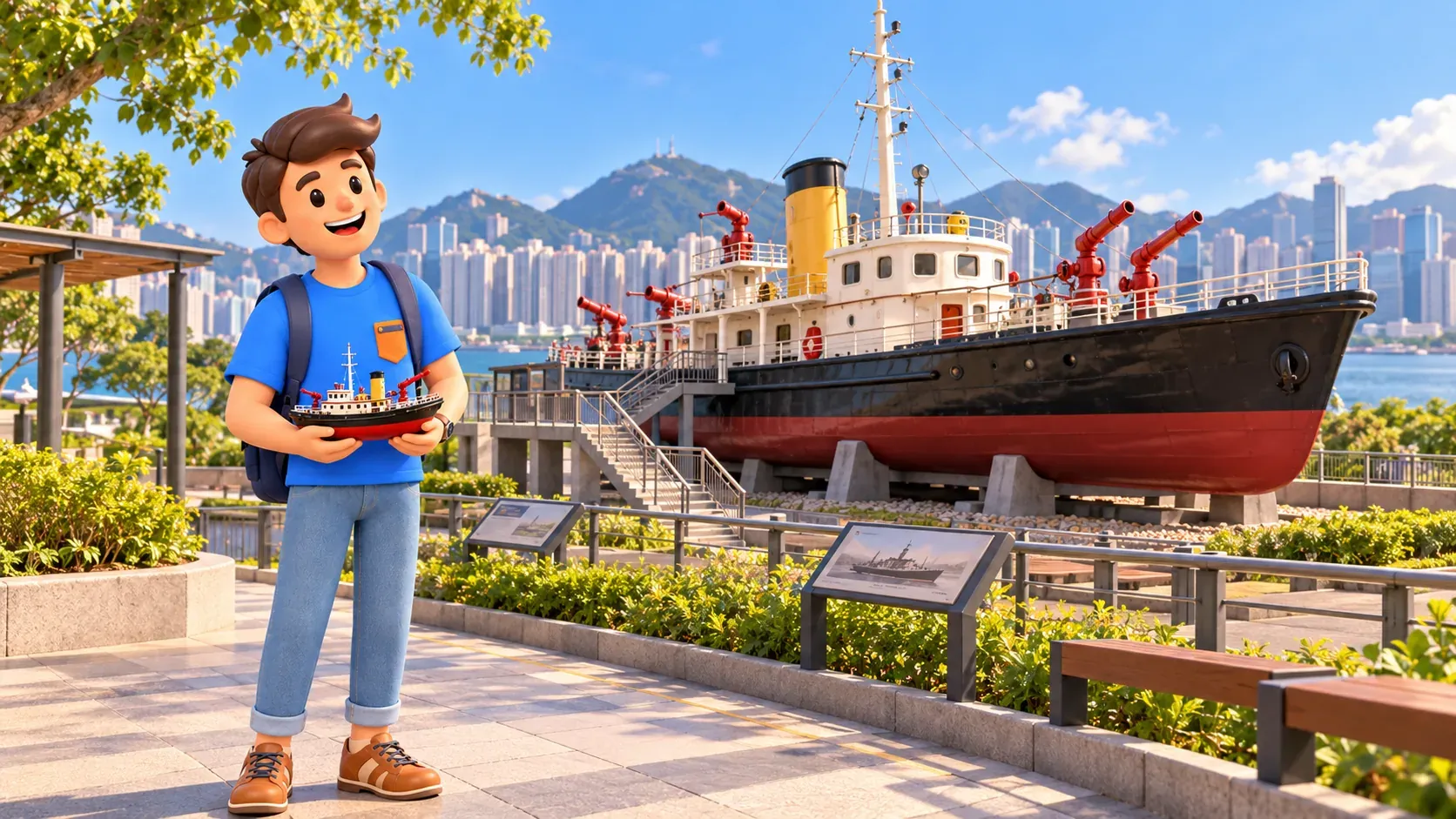
Do not assume every visible compartment is open or treat equipment as play apparatus. Current signs determine the visitor route. If step-free access matters, check the particular area: information about museum ramps and the upper deck does not imply entry to every technical space. That distinction is useful both for families and for visitors with a strong interest in engineering.
With children, choose one question: how does a fireboat differ from a passenger boat? Let the answer begin with visible shape and equipment rather than a long technical explanation. This is informal observation within the exhibition, not a promised rescue exercise or permission to operate machinery. Interest in teamwork can develop without turning the museum into a ride or an activity centre.
The Film Archive: how a city preserves images
The Hong Kong Film Archive is at 50 Lei King Road in Sai Wan Ho. Its permanent building opened in 2001, following earlier work to establish the institution. The archive preserves films alongside posters, photographs and production materials. The point of continuing is to encounter another form of urban memory: technical care now supports screen heritage rather than rescue work on the water.
For a short visit, choose the available public exhibition or a programme you have checked beforehand. The building serves several functions, but ordinary admission does not open storage vaults or restoration laboratories. The resource centre, exhibition and cinema are not one service with a single set of visitor arrangements. If you need a particular resource, check its own conditions rather than assuming general entry covers it.
A screening can make an excellent ending when the film, language, time and ticket suit you. It also turns the half-day into a longer cultural outing. Do not expect a screening simply because the archive is open. Looking at exhibition materials can already complete the theme, especially when you want a shorter continuation after the art space and ship rather than several more hours.
To distribute art, maritime history and cinema across suitable days, prepare your trip in RoadMe: the app creates a personal plan around interests, pace, dates and budget. You can choose a fuller day with the archive or a shorter route while giving other themes proper time elsewhere.
Consider the work behind what reaches a screen: preservation, cataloguing and restoration. A familiar film remains available to new viewers not only because it was made, but because people continued to care for it. The archive broadens a conversation about cinema beyond favourite actors and memorable scenes without requiring professional knowledge or a long list of films already watched.

Choose the day and a useful finish
At the check on 20 October 2026, the fireboat museum and Film Archive normally closed on Tuesdays except public holidays, with additional holiday closures to consider. Oi! follows a different pattern, including a later start on ordinary Mondays. Check the overlap of calendars, not just one venue. Screenings and special events need their own programme check as well.
If time contracts, retain the two main experiences and drop the compulsory archive extension. In rain, reassess outdoor sections; in severe weather, follow venue and transport announcements. Accessibility in one building does not establish an entirely step-free connection between every stop. Select precise approaches according to your needs instead of relying on a broad description of the district.
Finish near useful transport in the eastern part of the island rather than returning to Oil Street for a closed loop. For the wider stay, use the three-day Hong Kong plan. This outing is memorable for different forms of preservation: an old building, a genuine working vessel and screen materials receive distinct but connected new lives.


