Flamingos among the skyscrapers: Dubai’s wetland story
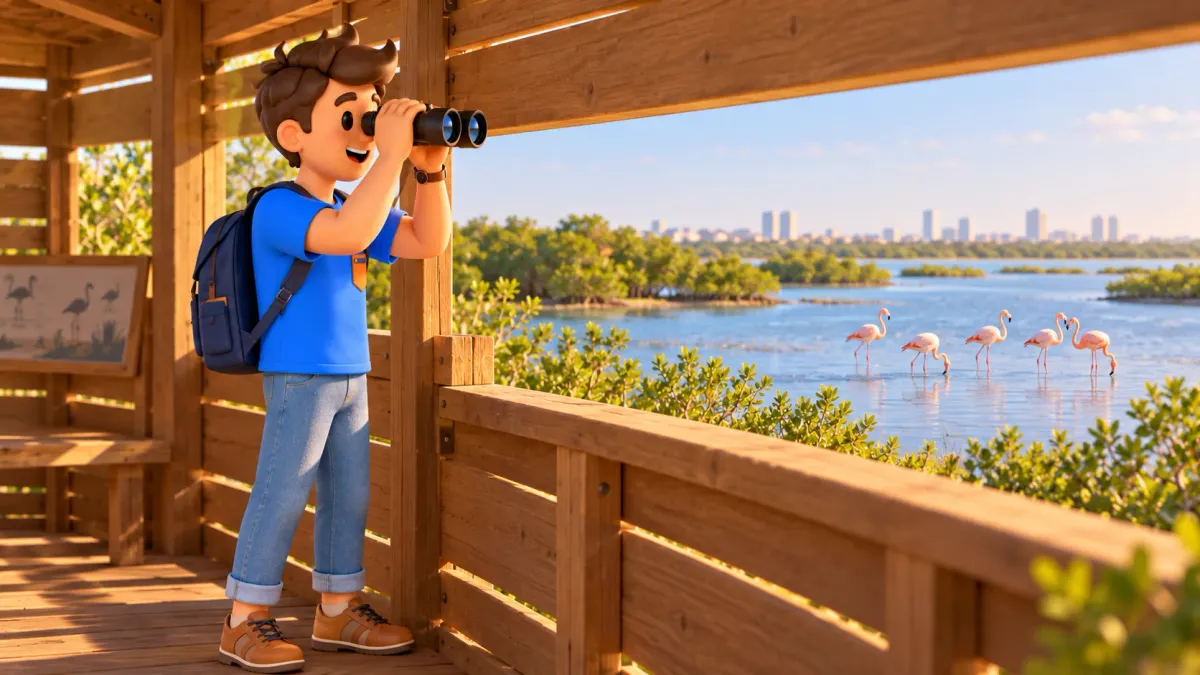
Dubai’s Creek has a natural story alongside its trading and architectural ones. At Ras Al Khor, shallow water, tidal ground and mangroves support a wetland landscape within a heavily urbanised setting. Flamingos make that relationship particularly memorable, but they are one part of a larger system.
This is a subject for attentive observation rather than a guaranteed checklist of sightings. Before arranging a visit, confirm the current status of the specific observation point. Understanding the habitat remains useful, while the practical outing must follow the access actually available.
Start with the wetland, not only the pink birds
The recognisable image is a flamingo against the distant city. The more interesting question is what makes the place useful to birds: water, feeding areas, resting space and different kinds of ground. The habitat explains the image.
RoadMe develops a personal Dubai trip plan around your interests, dates, pace and budget, making it much more convenient to give nature a coherent place alongside the city. Use the app to balance your interests across the journey while confirming each venue’s current access separately.
Ras Al Khor became the UAE’s first Ramsar wetland site in 2007. That recognition concerns the ecological place, not an admission product or one particular viewing hut. Keep the reserve, its habitats and its visitor facilities distinct.
The selected hide determines only one perspective. It does not turn the entire wetland into a free-roaming walking area. Plan around the official arrangements rather than drawing a route through whatever looks open on a map.
Access comes before a birdwatching plan
As checked on 21 October 2026, Dubai Municipality’s booking page marks Mangrove Hide as temporarily closed. That notice specifically concerns that hide. Confirm the current status of Flamingo Hide and Lagoon Hide separately before relying on either.
A general visitor-information page and an individual facility’s status answer different questions. Do not assume an old timetable, map pin or image confirms an available visit today. Use the municipality’s current arrangements for your chosen point and date.
If access is not confirmed, keep the nature chapter flexible rather than travelling to an assumed entrance. This article explains what makes the landscape significant; it does not promise an operating visitor route or an opening date.
Once a visit is confirmed, establish the actual entrance and return journey. Observation points are different facilities, not automatically linked by a visitor path. A short distance across the habitat on a map is not a reason to attempt a crossing.
The useful planning choice is a single available observation chapter, with enough time to pause. More facilities do not necessarily produce a better experience, especially when the main interest is watching changes in one view.
Flamingos make behaviour visible
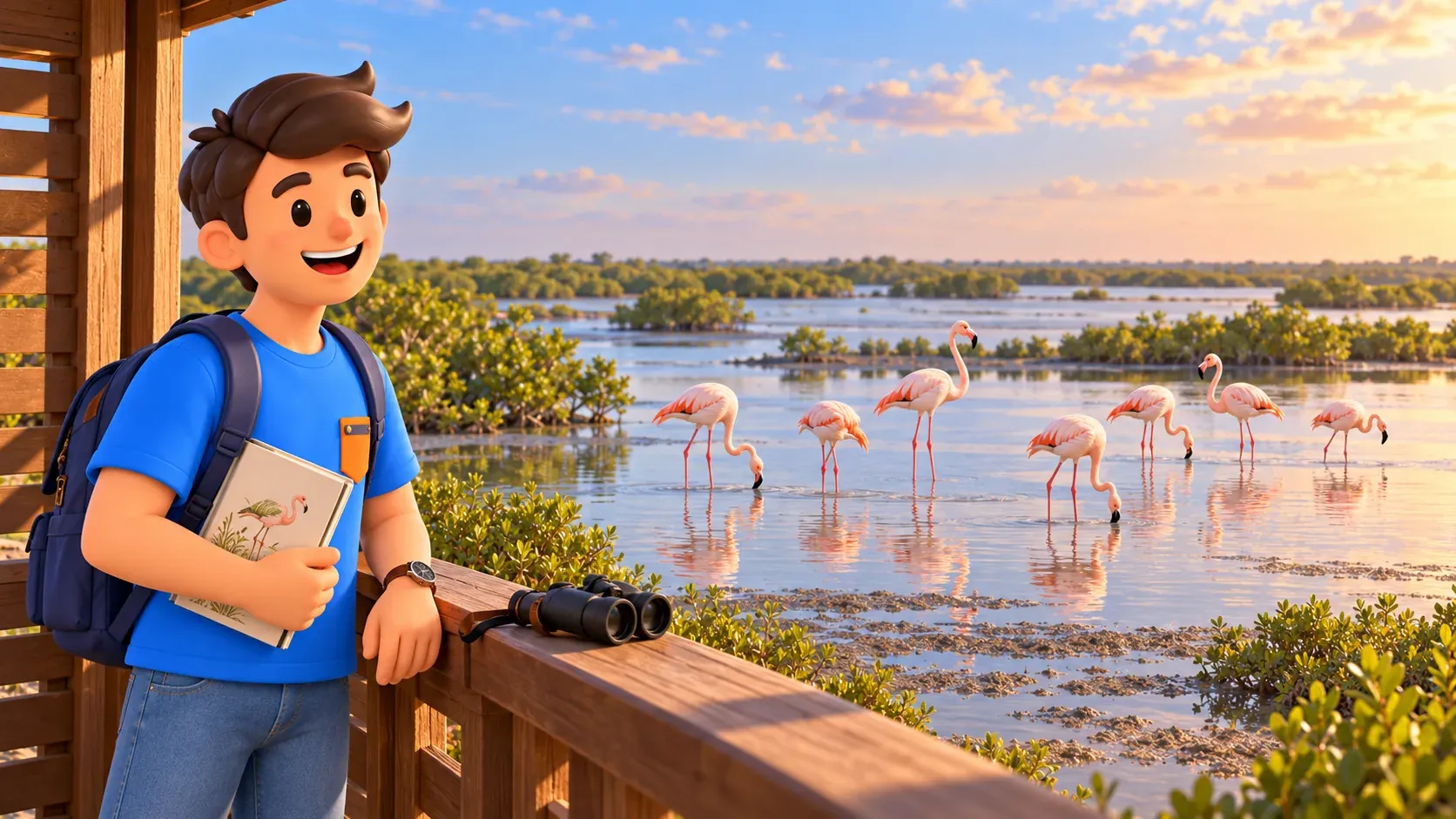
The striking colour attracts attention, but movement can reveal more. Watch how a bird stands, changes position in shallow water or relates to others in a group. A sequence of observations gives a richer picture than one pose.
Do not turn a general association with flamingos into a guarantee of a certain number, distance or arrangement. Wildlife does not organise itself around a visitor’s photograph. The time you spend looking and the actual conditions shape what you can notice.
Compare an individual with the wider group. Gaps, clusters and changing positions give the scene rhythm. Then look at where the birds are in relation to water and exposed ground rather than treating the landscape as a background only.
Keep any interpretation modest. You can describe visible movement without claiming to know the purpose of every action. The observation becomes more precise when you separate what happened from what you infer about it.
Use suitable optical equipment if you have it, and follow the chosen facility’s guidance. A distant bird can remain part of a valuable experience. The aim is attention from the permitted place, not achieving the closest possible encounter.
For a family, choose one simple question to share: what changes when we look again? Comparing two moments can make birdwatching accessible without requiring everyone to identify species or use the same equipment.
Shallow water is a changing landscape
Wetland space is not one uniform sheet of water. Lagoons, shallow areas, tidal mud and saline ground offer different conditions. Even nearby patches can differ in how they are used by birds and other life.
Look at edges: open water meeting exposed ground, a shallow channel or vegetation changing the view. These transitions can be more informative than searching only for a single spectacular feature.
The birds’ distribution helps draw attention to those differences. A patch that seems empty at first may become interesting when viewed as part of the wider habitat. You do not need every part of a landscape to contain a visible animal at once.
Let the observation develop at its own scale. A wetland outing differs from a show with a fixed sequence. There may be quiet moments, and they can leave time to see the organisation of water and ground more clearly.
The city in the distance adds context rather than removing the natural value. Ras Al Khor is significant precisely because this wetland system exists within an intensely developed urban landscape.
Mangroves draw attention to life near the roots
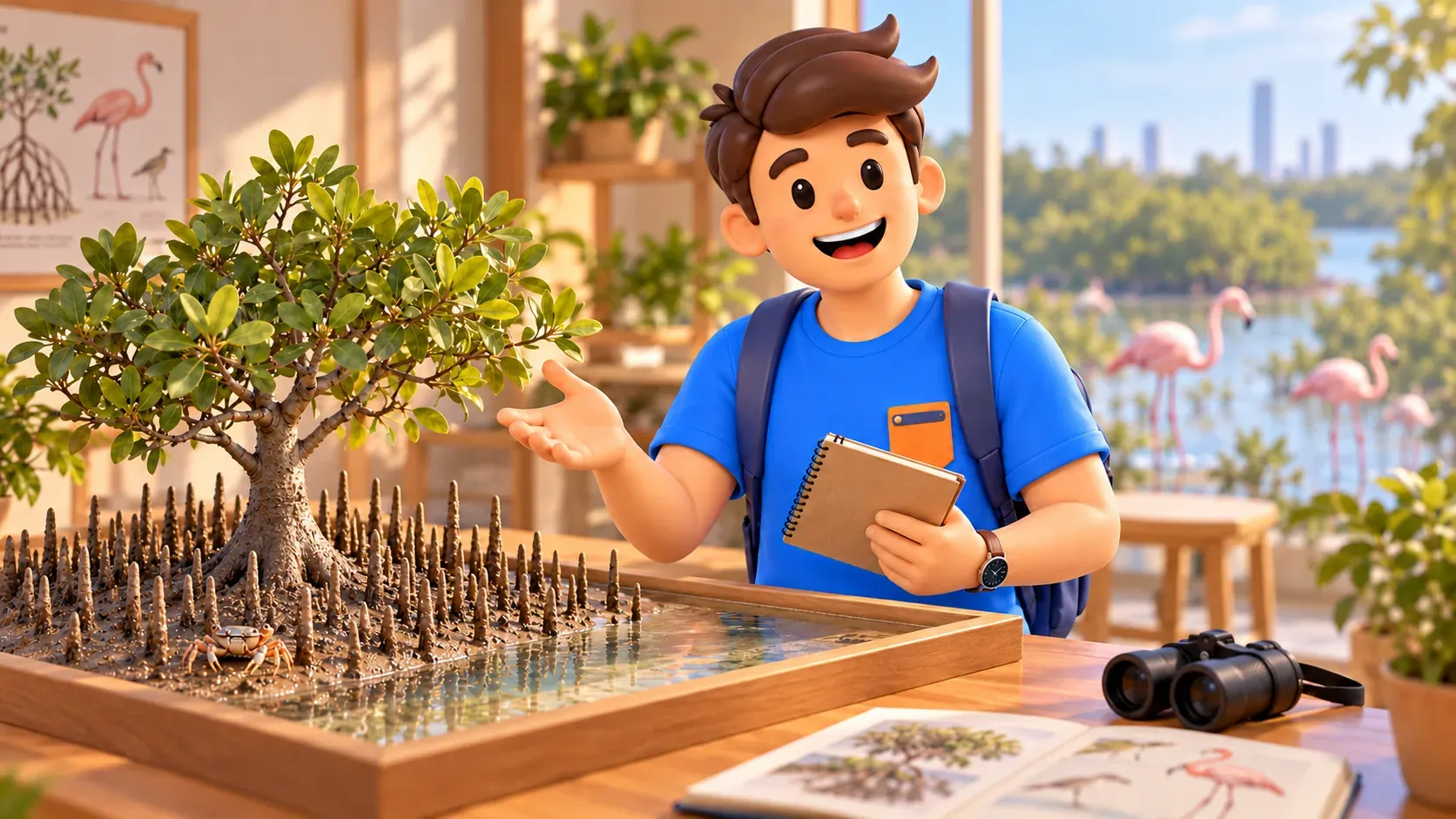
The mangrove environment adds another part of the story. The local grey mangrove, Avicennia marina, is associated with the meeting of land and saline water. Its value is more than the appearance of trees in a coastal view.
Roots retain sediment and create a setting for smaller organisms. Fish, crustaceans and molluscs belong to relationships that can also involve birds. Much of the habitat’s significance is therefore close to the water and less immediately visible than a large bird.
This gives a useful shift in attention. Instead of looking only at the most colourful animal, consider the physical setting that supports different forms of life. A tree, a shallow area and an animal’s position become connected observations.
Understanding that subject does not establish access to Mangrove Hide. Keep the current closure notice in mind and confirm any future change before arranging a visit. Do not seek an alternative way into a restricted part of the habitat.
The general lesson can still inform another confirmed nature visit: visible scenery is supported by relationships that a quick photograph may miss. Slower observation helps connect the large view with its smaller parts.
A hide is a boundary as well as a viewpoint
An observation facility frames the landscape and keeps visitors in a selected place. Its role is not only to make seeing easier. The separation between people and habitat belongs to the purpose of the visit.
Stay within permitted areas, follow staff guidance and keep the activity quiet. Avoid feeding, approaching or trying to reposition wildlife for a picture. A respectful view does not require the landscape to respond to you.
Prepare according to the actual facility’s rules, including belongings and photography. Do not assume a nature area allows the same activities as a public park. Follow the current local guidance for what can be brought and used.
RoadMe turns your priorities into a personal day-by-day programme, so organising the whole trip becomes easier and more effective. Let the app balance your nature interests, cultural discoveries and rest at the pace that suits your group.
Give the return a clear place in the plan. Once you have finished an available observation period, a comfortable departure may be better than adding another uncertain facility. The value lies in attention rather than a count of viewpoints.
Build a nature chapter that remains realistic
Confirm one accessible point first, then decide how much of the day to give it. Keep the rest of the programme modest enough to accommodate the actual journey and your group’s energy.
Do not make a sighting the condition for a successful trip. You may remember water patterns, the relation of birds to ground or the contrast with the distant city. Those are meaningful observations even when the imagined photograph does not appear.
For different interests, choose a shared moment and a simple pause afterward. One person can notice behaviour, another habitat and another the urban context. Their observations can complement one another without identical enthusiasm for birding.
If the access you need is unavailable, preserve the subject for another date. A confirmed activity elsewhere is more useful than treating an ecological explanation as evidence of an open entrance.

For example, a family can choose to compare the same view twice during a confirmed visit. First describe the broad arrangement of water, vegetation and birds. Then look again for one change. A traveller interested in photography can begin with the same observation before deciding whether an image is worth making under the facility’s rules. Neither approach depends on a guaranteed close bird.
Another way to organise attention is to separate three things: what you saw directly, what an explanation taught you and what you still wonder about. A movement is observable; its exact cause may remain uncertain. This gives a useful memory without turning every impression into a scientific claim.
The natural chapter can therefore remain modest and still be complete. Understanding one relationship within the wetland may add more to the trip than collecting several unconfirmed viewing locations.
The Creek’s natural history belongs to Dubai too
Read Ras Al Khor through birds, water, ground and mangroves, with visitor facilities treated as separate, currently checked arrangements. Its value reaches beyond one species or photograph.
This perspective gives the city a wider story. Alongside trade and architecture, the Creek holds a wetland world whose interest rewards patience and respect for the access actually available.