
Colosseum to the Capitoline: A Two-Hour Exterior Walk
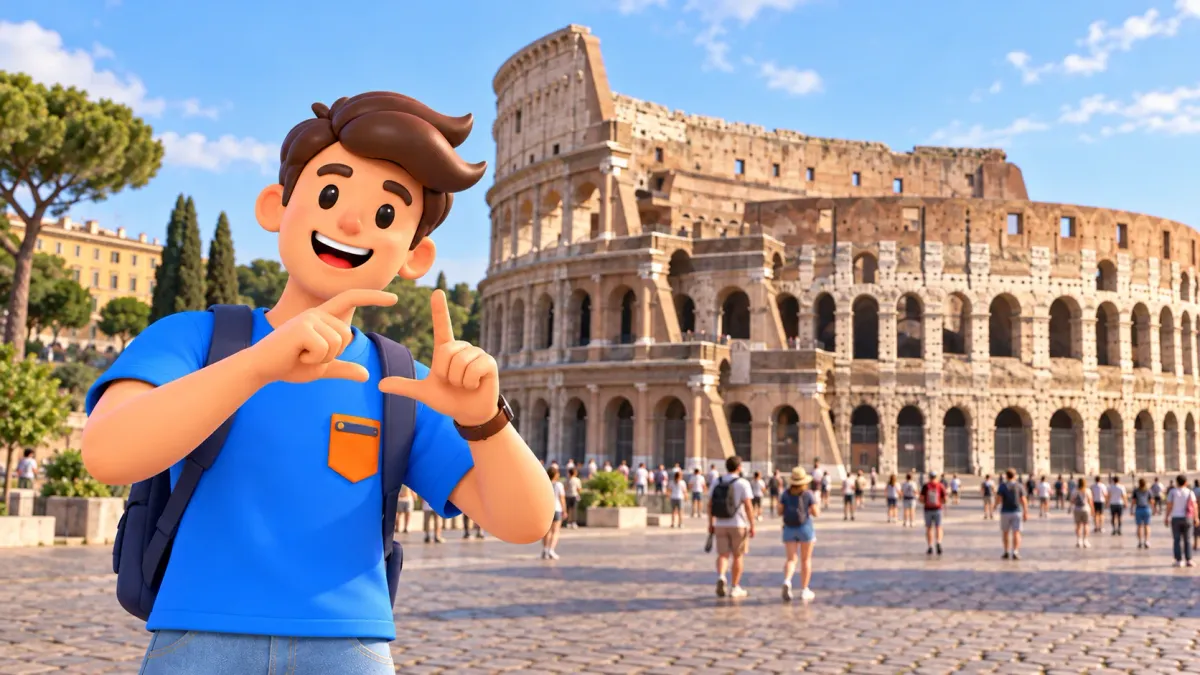
The Colosseum, the Arch of Constantine, the ruins beside Via dei Fori Imperiali and the Capitoline can form a short Rome walk with a clear story. Begin with the scale of an ancient amphitheatre, continue past images of power and victory, and finish in a square later reimagined by Michelangelo. The experience is a city landscape in which ancient remains sit among streets and buildings from other periods.
The basic version takes roughly two hours on public streets and squares. Colosseum admission, entry into archaeological areas, the Palatine and the Capitoline Museums are excluded. The timings are an illustrative allocation rather than measured journey times; travel to the start and onwards from the finish is additional. Works around Piazza Venezia can alter the open pedestrian approaches and the time required.
Choose exterior views or a ticketed visit
This walk suits a first introduction, a return to the area or a day when you prefer looking at architecture outdoors to a long museum visit. If the arena, the Colosseum interior or walking among the Forum ruins is your main aim, build the day around that specific admission and its current arrangements. It cannot simply disappear into the minutes between two exterior stops.
RoadMe makes it easier to develop this day as part of a personal itinerary for the whole trip, shaped around your interests, dates, pace and budget. With the plan and map together, using the programme in Rome is more convenient and effective than assembling separate notes as you go.
The exterior sequence explains the relationship between landmarks, while an interior visit offers different spaces and details. Both are worthwhile formats. Decide which you want now, so that a short walk does not lose much of its time beside an entrance while you try to reorganise the day. A monument being nearby is useful context, not an automatic admission opportunity.
A workable allocation for 120 minutes
| Time from the start | What it includes |
|---|---|
| 0–20 minutes | Colosseum exterior: overall scale and selected arcade details |
| 20–35 minutes | Arch of Constantine and the approach to the start of Via dei Fori Imperiali |
| 35–65 minutes | Street walk with selected views of the ruins |
| 65–80 minutes | Trajan’s Column from an available public approach |
| 80–110 minutes | About ten minutes of seated rest and roughly twenty for walking, crossings and the ascent towards the Capitoline |
| 110–120 minutes | An overall look at Piazza del Campidoglio and the finish |
This pace allows short observations rather than detailed study of every complex. If crossings or diversions take longer, extend the outing or finish at Trajan’s Column. Preserve the rest you need instead of chasing a formal endpoint. Allow more than two hours from the outset if you want prolonged photography or extended discussion of the history.
Before leaving, locate both ends in relation to your accommodation. A district name on a map does not determine your easiest return. For a later reservation, count backwards from the required arrival: the final stop, leaving the area and onward travel happen in sequence. An hour remaining after sightseeing is not necessarily a whole hour available for another attraction.
The Colosseum: scale first, then the rhythm of arches
Start from public space where the amphitheatre's overall volume is visible and you are clear of entry flows. The Colosseum belongs to the Flavian period and the public spectacles of the first century CE. For a first look, understanding the shape and scale of the building matters more than recalling a complete catalogue of events held inside over its long history.
Notice the repeated arches and the way passing people give the height a human measure. Then choose one patch of stone or one line of arcades. Overall form and close observation work together: first comes scale, then texture. You do not need to circle the entire perimeter to appreciate that contrast; the short programme provides for a selective exterior introduction.
Take photographs from somewhere you can stop comfortably without stepping into traffic or blocking a passage. One wide image and one closer detail may be enough. If the search for an empty background starts to consume your attention, put the camera away briefly. People moving through the setting also help explain the monument's size.
The Arch of Constantine: different ages in one monument
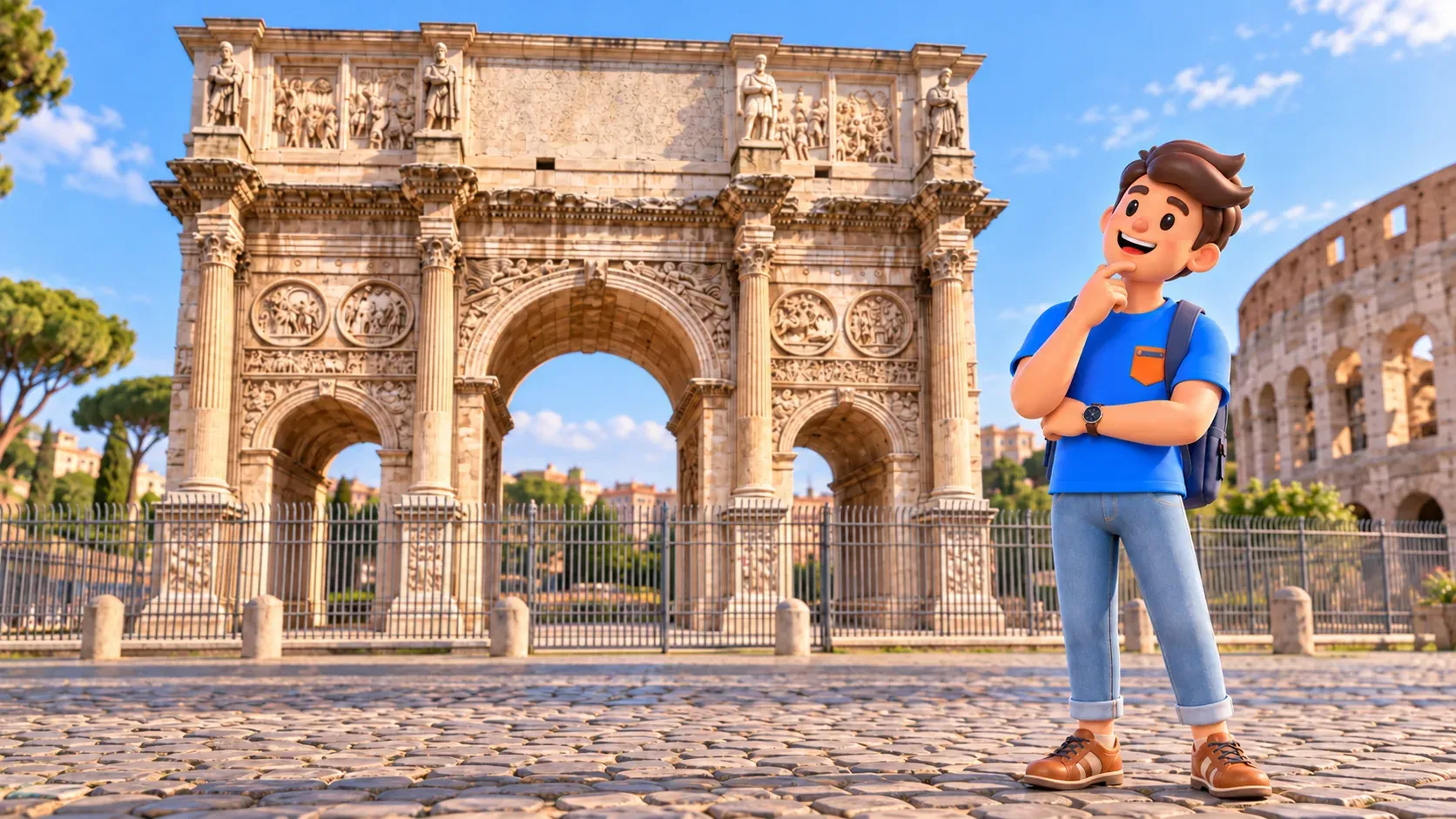
The Arch of Constantine stands beside the Colosseum. It was dedicated in 315 CE following the emperor's victory over Maxentius. Its decoration incorporates reliefs from earlier imperial monuments. That makes it interesting beyond its dimensions: a new image of authority was assembled using artistic forms and stories already associated with the past.
Look first for the three openings, then for the round reliefs and other sculpted areas. You do not need to identify every scene at a distance. One question is enough: why do details on the same monument look different? It links the history of reused sculpture to something you can observe, rather than a long list of names and technical terms.
Remain on an open public approach and respect the barriers. The arch's proximity does not mean you can walk underneath it. The fifteen-minute block includes a short look and the approach towards the avenue. If you stay longer here, reduce the number of later observations or expand the total duration while keeping the walking allowance.
Via dei Fori Imperiali: a modern street among ancient remains
Continue along pedestrian routes beside Via dei Fori Imperiali towards Piazza Venezia. This city axis opened in 1932; it is not a surviving ancient road. Its construction altered older buildings and the archaeological landscape. Knowing that helps you see several periods dealing differently with the same place, rather than imagining an untouched strip of antiquity.
The Roman Forum and the Imperial Fora are not interchangeable names for a single square. The ancient complexes developed at different times, while today's street walk shows fragments from outside. Each view does not amount to a complete archaeological visit. Looking across a barrier reveals an arrangement of remains; walking inside a controlled archaeological area is a different experience.
Select two or three available stopping places that leave movement clear. At one, consider a wall's height; at another, a line of columns or the difference between levels. Let the rest form the setting. The walk works without continuously consulting a long list of names: it encourages attention to space instead of confirmation that every catalogue entry has been covered.
Looking at ruins without being an archaeologist
Begin with a simple relationship: where are you standing, and where is the ancient level in relation to you? Then find a repeated element, such as columns, supports or masonry lines. It can suggest the direction and size of a lost space. You do not need to name every temple confidently. If an official diagram is available, compare it with what is actually visible.
Avoid reconstructing a building's exact appearance from one fragment. Instead, keep a small question for later: what connected here, how did people move between these parts, or why is the level below the street? Curiosity becomes a useful continuation of the walk. A future visit inside one complex can explore the answer without requiring every archaeological entrance today.
With children, look for contrasting shapes and materials; with adults, compare what you noticed at two stops. One person may register height, another the empty space between surviving elements. Discuss it while moving, leaving narrow sections clear. An exterior walk benefits from shared looking rather than companions waiting through an endless sequence of photographs.
Trajan’s Column: a story rising in a spiral
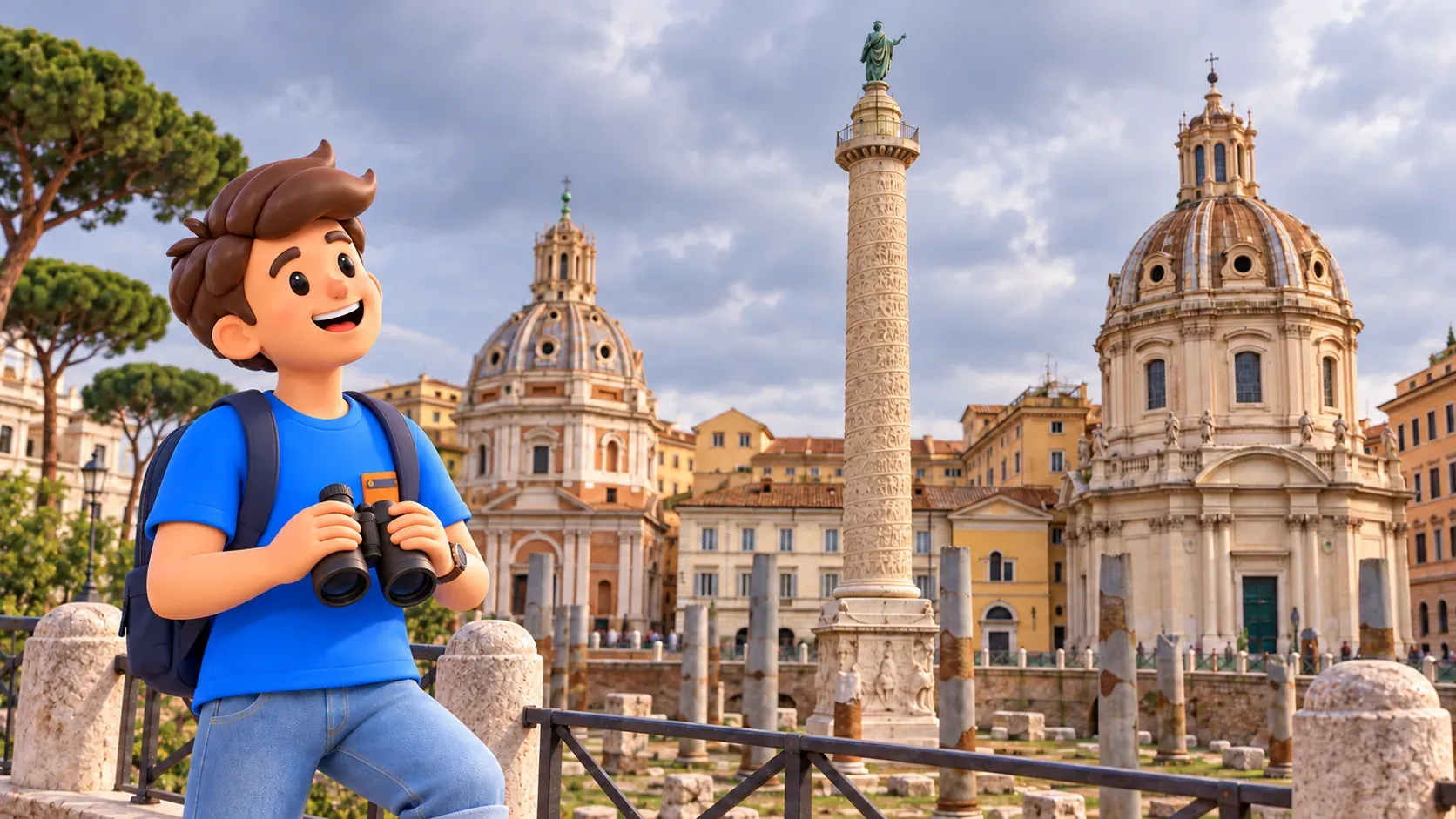
Near the end of the avenue section, find Trajan’s Column from a permitted public approach. Erected in 113 CE, it carries spiral reliefs about the emperor's Dacian campaigns. Look first at the overall vertical form, then follow the direction of the band. Unlike the arch, this sculptural narrative wraps around a shaft and climbs above the viewer.
Do not expect to read every scene from street level. For this short outing, understanding the idea and noticing one visible fragment is enough. Binoculars or a zoom camera can help if you have them and can stop somewhere appropriate. Additional equipment is optional, and a public approach does not provide unrestricted access to every part of the monument.
The figure at the top today is St Peter, replacing an earlier statue of Trajan. It is another reminder that Rome changed after antiquity. Looking at the column is not a climb inside it; this programme promises no such access. Fifteen minutes provides an introduction to its silhouette and the principle of the carved narrative.
Rest before the approach to the Capitoline
Before the final stage, find somewhere suitable for a short seated pause, or use a café if you can extend the schedule when necessary. The example allows about ten minutes for rest rather than a complete lunch. Roughly twenty further minutes cover the approach, crossings and ascent towards Piazza del Campidoglio. Actual diversions may require a larger allowance.
Metro works affect the Piazza Venezia area, while improvements in the archaeological centre continue. As of October 2026, future expanded pedestrian spaces should not be treated as fully completed facilities. Follow current signs and permitted crossings rather than an old photograph through a fenced section. The plan gives a sequence of places, not a guaranteed passage along a particular side of a worksite.
One approach to the square is the Cordonata, a broad stepped ascent from the Via del Teatro di Marcello side. It is still an uphill section. Choose an actually available route under current conditions. If you are tired or the required passage is closed, ending at the column remains sensible. Do not bypass restrictions to preserve the advertised two hours.
The Capitoline: an ancient hill, a later square
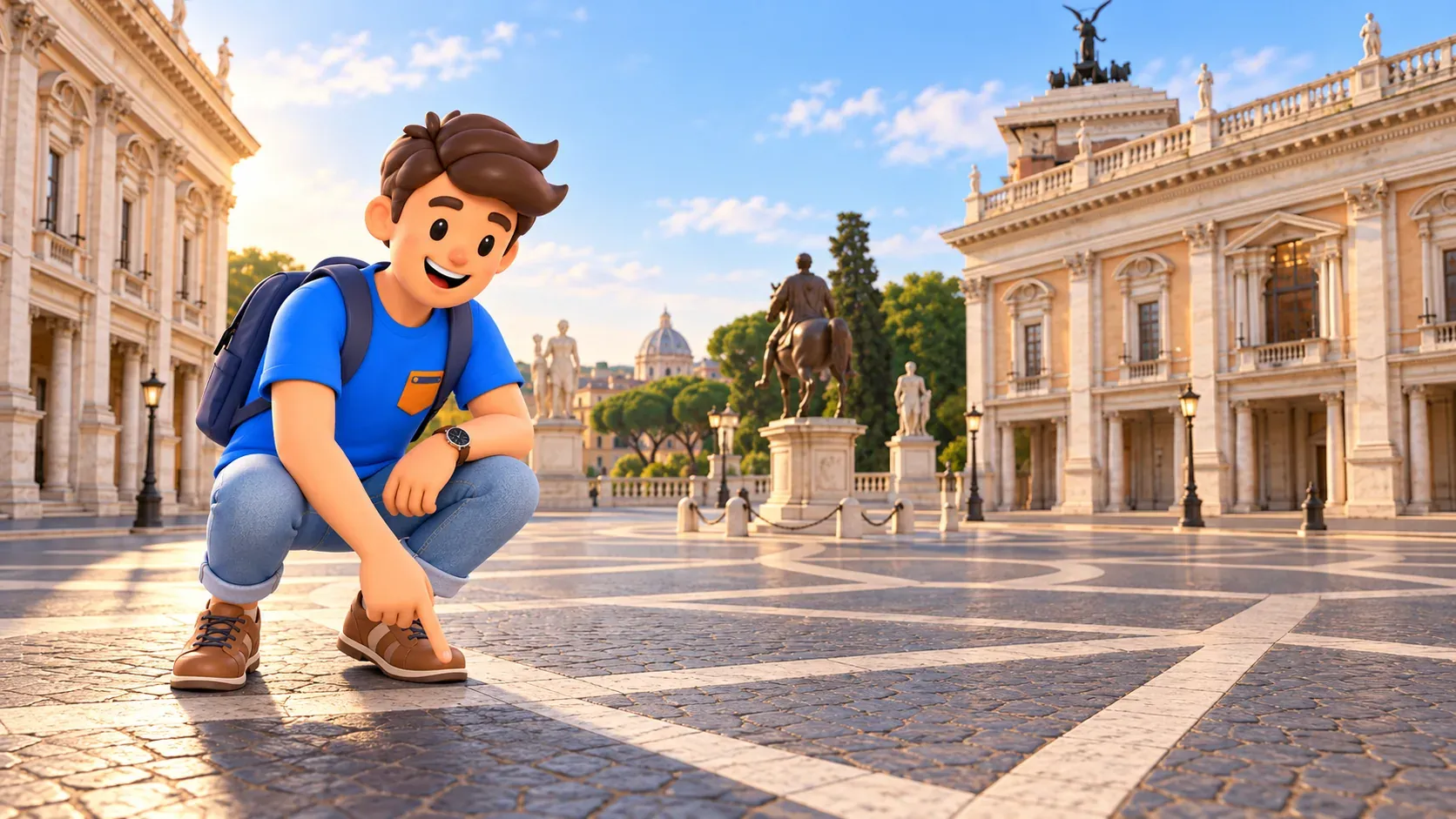
At Piazza del Campidoglio the architectural language changes. Its coherent composition is associated with Michelangelo's sixteenth-century design and the work of later architects. Look at the boundaries of the square, its façades and the pavement pattern. The finish shows how a later Rome reimagined an ancient hill, rather than continuing an uninterrupted sequence of exclusively ancient structures.
Compare the feeling with the start: the amphitheatre's open arcades have given way to a contained square. Entering the Capitoline Museums is unnecessary for this ending; that is a separate visit with its own duration and arrangements. The final ten-minute block offers only an overall impression. Extend the outing for an unhurried look and plan the onward journey separately.
Choose a theme for another day
If monumental architecture appealed most, return for one detailed admission. If sculptural storytelling held your attention, choose a museum day. In heat, shorten exposed stops and increase rest; in rain, consider surfaces without assuming that any interior will be available as shelter. Ending sooner can preserve the wish to return.
In RoadMe, these impressions are easier to develop into a personal programme for the whole trip, taking your interests, pace, dates and budget into account. A thought-through combination of walks and visits makes the finished itinerary more convenient and effective to use on the ground.
For a broader introduction, see our one-day Rome plan. This two-hour stretch can remain a complete experience: the Colosseum's scale, stories carved in stone and the changing composition of the city provide enough material to see the ruins as more than a photograph's background.


