
COEX and Bongeunsa: Starfield Library and a temple among towers
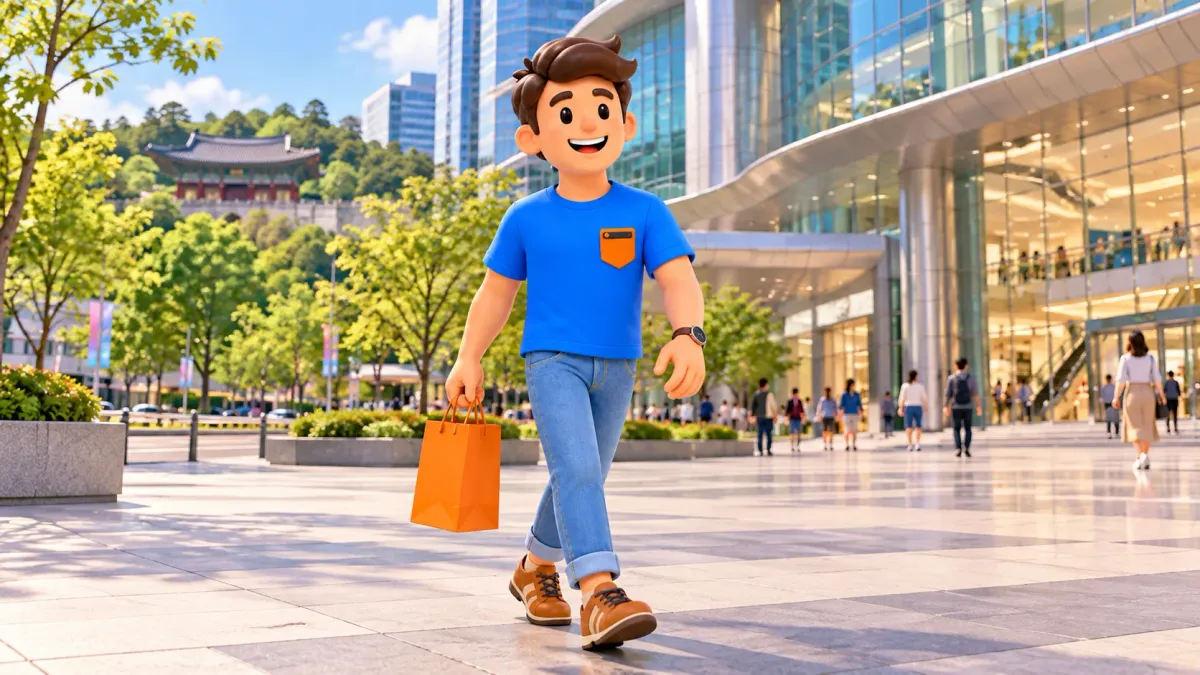
COEX and Bongeunsa combine well in a three-to-four-hour outing: Starfield Library, a short break in the complex, then an active Buddhist temple. The pleasure is a change of scale, from towering bookshelves and shopping passages to timber halls, courts and a large Maitreya against modern Gangnam. The stops are close enough to connect without making the day a district-wide expedition.
No shopping or paid attraction is necessary. Basic stops are free, while meals, organised programmes and additional visits are separate choices. Travel from your hotel is outside the estimate. Aquarium, cinema and extended shopping can occupy another half-day, so do not treat them as invisible additions. A compact selection gives the contrast enough time to become more than two photographs.
Start with the library and finish more quietly
A useful order is Samseong, Starfield Library, a COEX pause, Bongeunsa and the subway home. A large public interior gradually gives way to closer attention to architecture and religious life. Reverse the order for an earlier temple visit if preferred, remembering that the library opens at 10:30. The sequence should suit your arrival rather than force an unnecessary wait.
Planning this day is much more convenient with RoadMe: the app develops a complete personal plan around your interests, dates and pace. Architecture, culture, walks and rest become a trip programme that is easier and more effective to use on the ground.
| Part | Approximate allowance | Purpose |
|---|---|---|
| Entry and orientation | 20–30 minutes | Find library and onward exit |
| Starfield | 40–60 minutes | Shelf scale and reading |
| COEX and break | 40–60 minutes | Food or a comfortable seat |
| Temple connection | 15–25 minutes | Real exit and permitted crossing |
| Bongeunsa | 60–90 minutes | Courts, halls and Maitreya |
These are editorial allowances, not measured timings. Exit, crowds and actual route affect them. Do not remove the connection simply because markers look close on a map. A large building has several levels, and crossing an ordinary city road remains part of the outing. Keep it unhurried rather than treating the passage between main stops as time that does not count.
Two stations and different sides of the complex
From Samseong on Line 2, a passage linked with Exits 5 and 6 reaches COEX through Millennium Plaza. From Bongeunsa on Line 9, the mall connection uses Exit 7 and ASEM Plaza. Choose the approach that suits your journey and follow current indoor signs. The two options are useful alternatives, not instructions to make an unnecessary loop through both stations.
The temple is another destination: its station-side reference is Bongeunsa Exit 1. Do not automatically use a mall exit number for the monastery entrance. Save 별마당도서관 and 봉은사 to explain your destination and distinguish the library from a bookshop. A precise name helps more than asking vaguely for the complex's best-known interior or a nearby religious building.
Inside COEX, identify where you entered, where the library sits and the direction of the temple-side exit. Underground passages can make turns less obvious than on a street map. You need not learn every shop: a clear general axis prevents much backtracking. Recheck a current directory if a passage changes instead of assuming a familiar shop will remain a permanent landmark.
Starfield: why a library became a city stop
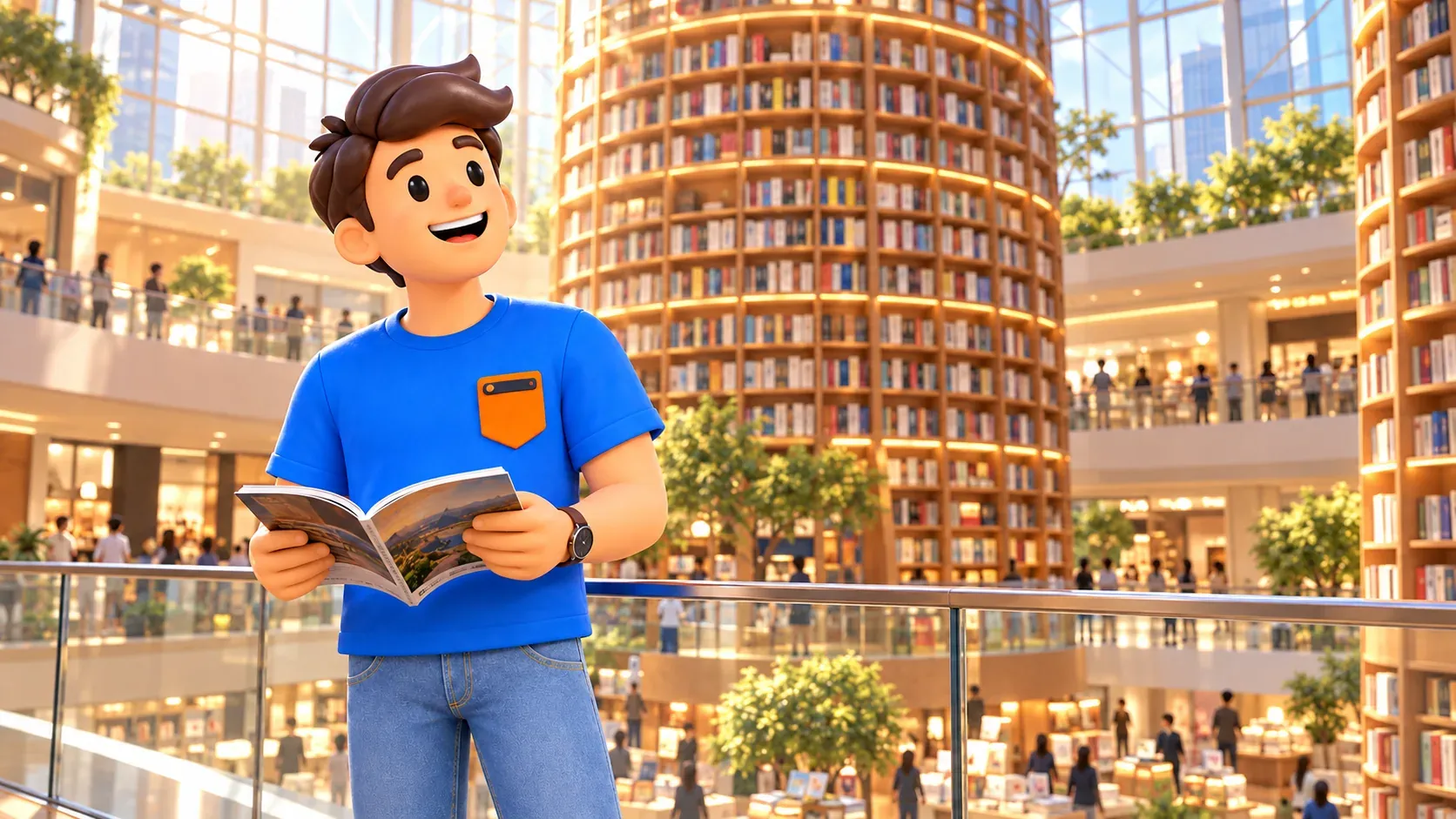
The library opened in the shopping complex's central space in 2017. Its tall shelving reaches roughly thirteen metres and brings two levels together. An ordinary commercial environment gains a place to stop, read, look and meet without buying anything. The architectural interest lies in how a shared interior changes the experience of moving through a much larger development.
Look at the overall volume from below, then find the accessible upper level when open. Height is clearer from one position, while the relationship between reading places and passages appears from another. These are different observations, not a requirement to reproduce one image. Seasonal decoration and events change the centre, so a previous winter photograph is not a permanent navigation plan.
Do not expect a silent research archive. People pass, talk and take pictures within an operating mall. That is part of its urban character. For sustained reading, judge sound and available seats rather than assuming one table will always be free. The public life around the books can be interesting even when the room does not match an empty promotional photograph.
A book, a magazine and a short pause
Give the stop something beyond a picture. Browse an available book or magazine, select an appealing subject and sit briefly. Foreign-language materials are included, but a particular language or title is not guaranteed. Even without extended reading, notice everyday use rather than only camera positions. The difference between a place being photographed and a place being inhabited is part of this visit.
The high shelving is not an invitation to find your own way to every volume. Use accessible materials and follow rules. Avoid blocking movement with a pose, spreading shopping over a reading table or occupying an adjacent seat with a bag unnecessarily. Free access comes with ordinary consideration. A shared cultural space works best when the next visitor can use it comfortably too.
Cultural events take place here, but a concert or author meeting does not accompany every visit. Confirm the separate programme if an event matters. Architecture and a brief reading pause are enough for the basic route. That keeps the outing meaningful when the calendar changes and avoids building the afternoon around an unconfirmed performance or an assumed timetable.
COEX: choose one task inside
After the library, define one next step: eat, stop at a cafe or enter a shop that interests you. Each new passage can feel like a continuation of the same walk, allowing the complex to consume more time than intended. A choice preserves a real temple hour instead of a hurried final dash. You can enjoy the building without making its entire retail offer your responsibility.
Choose food by availability, menu and a manageable queue. Not every venue shares the same conditions, and complex hours do not settle every restaurant's schedule. Establish where you can sit and how long you want to wait. For a leisurely meal, reduce retail browsing while retaining an unhurried outdoor transition. A comfortable break is more useful than insisting on one famous table.
SEA LIFE COEX is a separate paid visit with its own duration and ticket. It can anchor another day, especially for a family, but does not form part of the library's free entry. Cinema and exhibition events also need independent choices. Proximity does not merge everything into one ticket or one short route. Select an extended version deliberately rather than discovering its time cost halfway through.
Reach Bongeunsa and change your behaviour
Find a public exit towards the temple and cross at a permitted crossing. Do not expect an uninterrupted covered journey from library to temple court. Bongeunsa stands north of the complex within an ordinary city setting. Rain requires an umbrella and suitable shoes even after an indoor beginning. The connection is straightforward in principle, but it still belongs to the outside world.
Slow down at the entrance. This is an active religious institution, rather than scenery attached to a shopping centre. Lower conversation, give worshippers space and see which areas are open. If a service occupies a hall, the sightseeing task can wait. This adjustment makes the contrast perceptible without a long historical explanation. You are entering a place with its own purpose and daily rhythm.
A long history among newer buildings
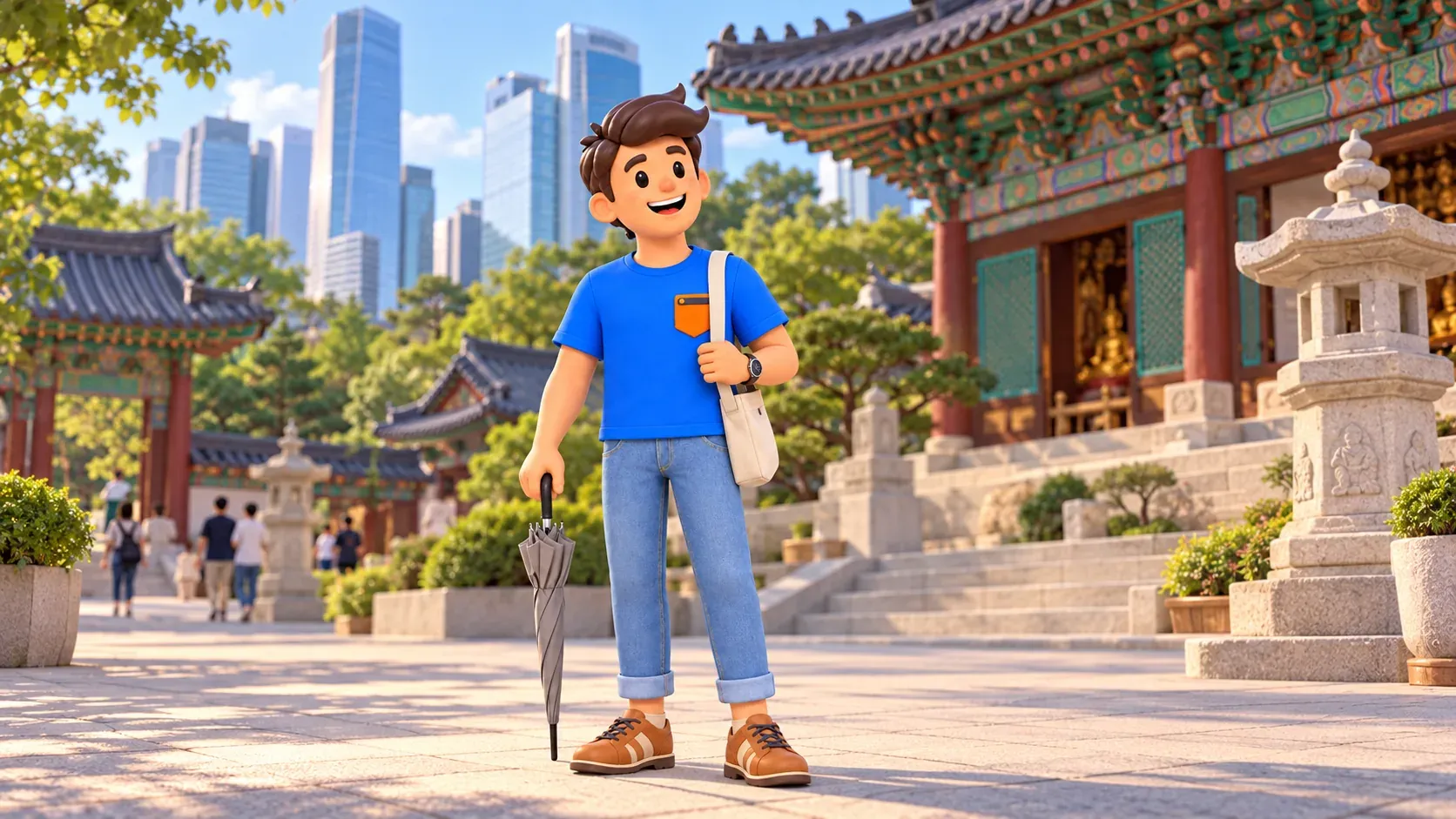
Bongeunsa's foundation tradition goes back to 794 in the Silla period, under the earlier name Gyeonseongsa. Queen Jeonghyeon supported refurbishment and the current name in 1498. The institution moved to its present site later, during Myeongjong's reign. Its age therefore differs from the age of each visible building. Keeping that distinction allows renewed architecture to retain a meaningful place in the story.
Destruction and rebuilding form part of its continued religious life. Royal patronage and Buddhist education were significant during Joseon. For this walk, one relationship is enough: the place did not preserve a single untouched year, but continued changing long before the neighbouring office towers appeared. The monastery's persistence is more interesting than pretending every painted beam has survived unchanged from its foundation.
Look at the sequence of courts and halls near the slope. Timber supports, projecting eaves, tiles and painted surfaces combine construction with expression. Compare them with COEX glass. The contrast is clear at human scale: moving between smaller courts produces another rhythm from a long shopping passage. You can notice this through an ordinary permitted walk without entering every room or recording every building name.
Maitreya: a modern layer of temple tradition
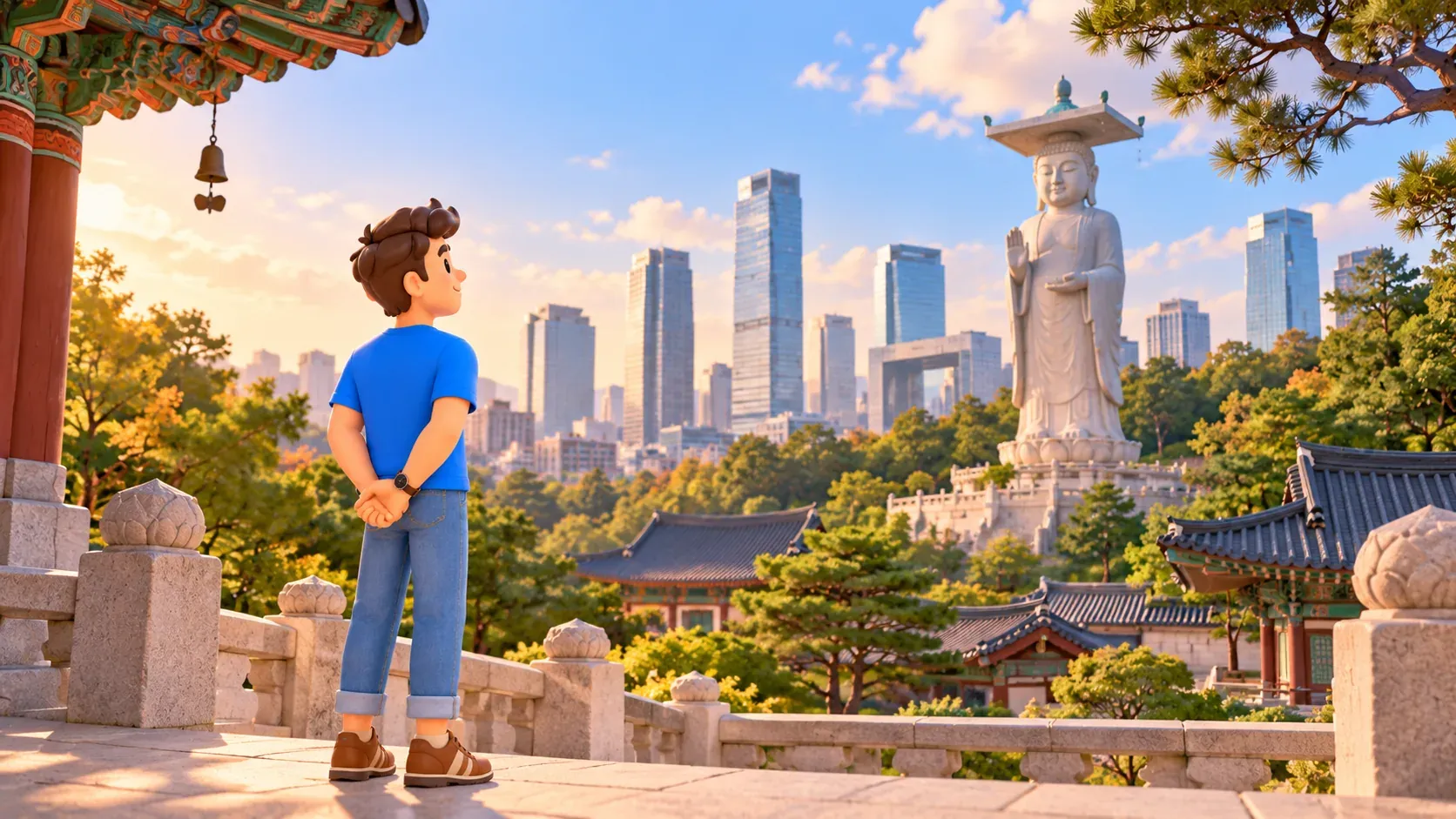
The large stone Maitreya was completed in 1996. It is a continuation of monumental Buddhist art in the late twentieth century, rather than a figure surviving from the monastery's foundation. Maitreya is revered as the future Buddha. That context makes the sculpture a religious image as well as a striking photographic subject. A recent date does not reduce its place within a living institution.
The figure and base reach about twenty-three metres. Low roofs and people nearby convey its scale. Look from a permitted area without occupying prayer space for a staged picture. Comparison with modern buildings is interesting, while the exact view depends on position, light and today's available zones. The article's illustrations evoke the contrasts rather than document an exact architectural arrangement or current ceremony.
Access without additional promises
General temple entry is free. National tourism guidance gives a daily 05:00–22:00 reference, while individual halls and activities follow services and internal arrangements. Daylight suits this route best. Footwear, photography and indoor behaviour follow signs and staff guidance. Open grounds do not make all rooms available. A brief respectful exterior visit remains worthwhile if prayer changes the access to a particular hall.
Temple programmes, tea, meals or overnight stays need separate confirmation and booking where applicable. An ordinary walk does not automatically include a monk conversation or ceremony. Courts already provide a meaningful contrast with the library. An additional experience works well when genuinely available and given sufficient time. It should enrich the visit rather than become an expectation borrowed from another traveller's account.
The library normally opens 10:30–22:00 and is free to all. Check announcements and transport connections before travelling. For reduced mobility, ask about mall lifts and accessible temple paths: a level retail passage does not guarantee an equivalent hillside route. Shorten the circuit if tired while preserving a clear journey home. A manageable return is part of a successful outing, not time beyond its plan.
Fitting Gangnam into the journey is easier with RoadMe: the app prepares a personal plan for the whole trip around your interests and comfortable pace. Contemporary architecture, temples, other districts and rest receive a suitable place among the days, making the programme more convenient to use.
Finish by recalling two places where books and texts have different lives: an open reading space and a religious centre with written heritage. There is no need to list every shop or building passed. A satisfying walk leaves a clear picture of Gangnam, where newer urban life and an older tradition exist together and invite different kinds of attention.


