
Centrale Montemartini: Why Visit Rome’s Statues Among Machines?
At Centrale Montemartini, ancient sculpture stands beside enormous machines in a former power station. Marble appears against dark metal, and your attention shifts between the scale of a human face and an engine occupying a substantial stretch of the hall. That encounter provides a reason to come beyond Rome’s familiar central sightseeing routes.
The museum is in Ostiense, at Via Ostiense 106. Choose it for the way the collection is presented and allow around two hours from the museum door to your exit. This is a selected visit with a pause, rather than a promise to see everything or include the pyramid, cemetery and other neighbourhood stops in the same allowance.
Who will enjoy a museum among machines?
Consider Montemartini if industrial buildings, architectural reuse or the effect of a setting on art interest you. A straightforward visual question gives you an entry point: what happens to a human figure when a vast engine stands nearby? You need not recognise every ancient deity to begin finding the contrast interesting.
Nor must this museum be reserved as a reward for people who have already completed the famous sights. Choose according to curiosity rather than a compulsory order of attractions. If machinery and sculpture appeal, this may deserve space early in your trip. If they do not, one striking photograph may be too little reason for a separate journey.
To give this museum the right place in a personal plan for the whole trip, try RoadMe, which considers your dates, interests, pace and budget. The app makes it more convenient to balance museum days and walks while allowing time for travel and rest.
A useful test is to imagine leaving your camera unused. Would you still want to compare materials, look at portraits and understand the building’s history? A yes gives the visit a purpose of its own. Montemartini can offer more than a single surprising composition, but that benefit emerges through attention rather than the unusual address alone.
Why are ancient statues in a power station?
Two histories meet here. The plant opened in 1912 as Rome’s first public electricity generating station. It served a modern city, rather than functioning as an ancient workshop. Steam turbines and their boilers, alongside diesel engines, belong to industrial history; the Roman sculpture and mosaics are much older than the machinery around them.
The station was decommissioned in the mid 1960s. In the late 1980s, Acea began transforming the historic complex and restoring its machines. These rooms are therefore not simply a place unlocked after decades and left exactly as it was on the final working day. Conversion into a cultural space became another chapter in the building’s history.
In 1997, a selection from the Capitoline Museums moved here temporarily during refurbishment. The exhibition “The Machines and the Gods” kept works on public display while testing an unexpected relationship between objects and setting. In 2001, the experiment became a permanent museum. Today’s institution is a destination, rather than temporary storage that happens to admit visitors.
Those few dates help make sense of the space. Ancient Romans did not build the diesel engines; the statues did not stand here while the station generated electricity; and displaying art was not the building’s original purpose. The interest lies in bringing different contexts together deliberately, without turning them into one imaginary period.
In the Machine Hall, look at space before a single figure
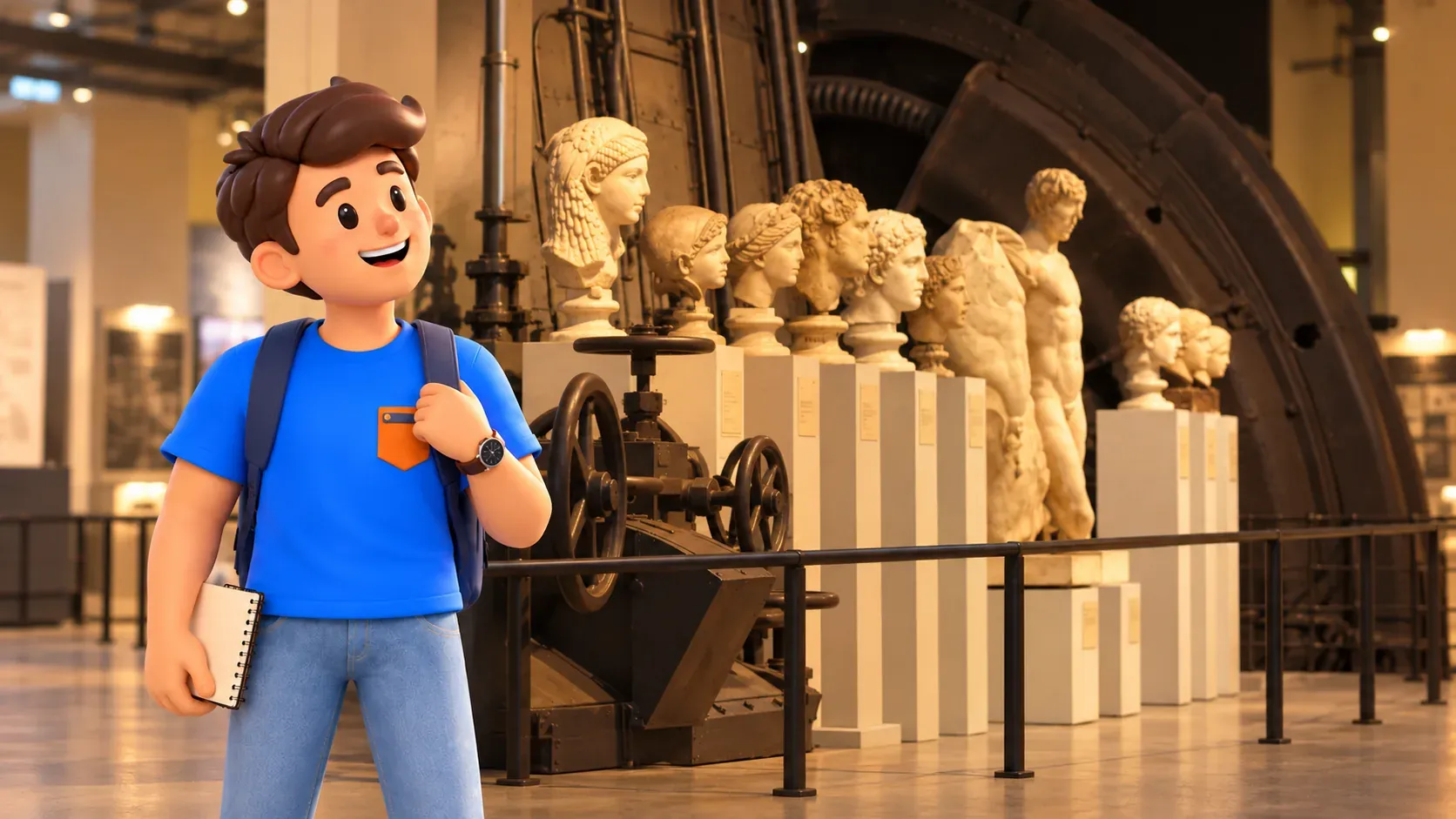
The Machine Hall contains two substantial diesel engines, installed in 1933, and a steam turbine. The installation date matters: a plant opened in 1912 did not necessarily receive every surviving machine that year. The industrial complex changed during its working life before its equipment became something to conserve.
Do not begin by trying to identify every pipe. First consider the length of the machines, their repeating components and the height of the room. Then select one available sculpture. Look at its expression, folds, head position or surviving surface on its own terms before bringing the surrounding machinery back into your view.
The contrast soon becomes more than white against black. Stone has shadows, wear and variations of texture; machinery has rhythm, lines and an organisation of its own. Both deserve attention. If you consider only the engine’s size, a sculpture can shrink into a convenient scale marker instead of remaining a work in its own right.
Compare two kinds of repetition. In a mechanism, repeated components contribute to the working whole; in sculpture, folds or features guide the eye differently. This is an invitation to observe, not a claim about an ancient artist’s hidden intentions. Keep what you can actually see distinct from the associations you bring to it today.
Preserved equipment does not promise a demonstration of a working station. Do not expect engines to start, controls to operate or every industrial staircase to be open to visitors. Follow the available museum route and its restrictions. Stillness allows you to study form; it does not make the machinery an interactive playground.
Give the antiquities time of their own
After the large machines, change your question. Instead of asking only how unusual a statue looks beside an engine, consider the kind of space for which it was made. Sculpture, mosaics and other finds come from Roman contexts. Read the provenance information for a chosen object to distinguish public display from private decoration.
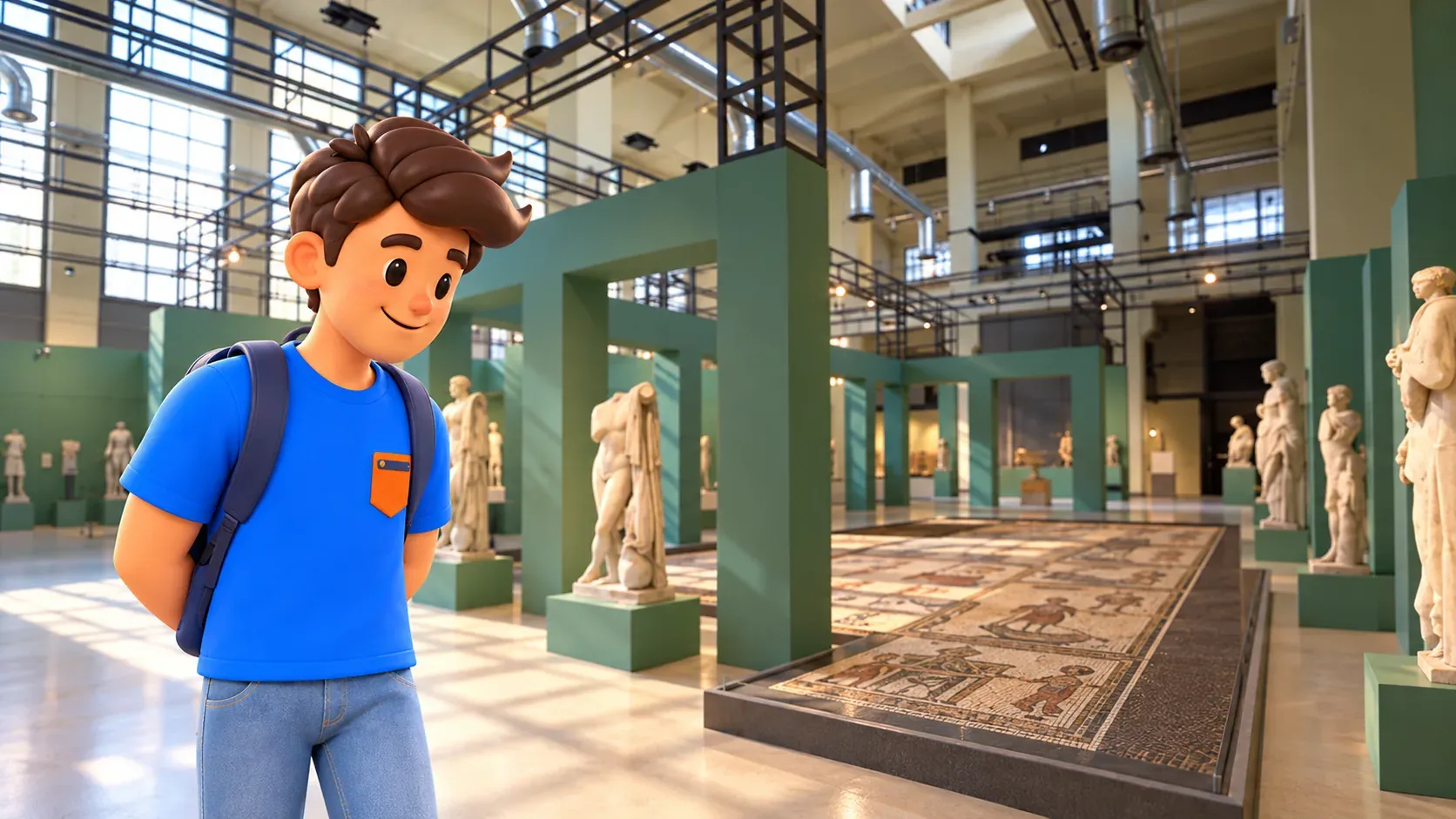
The Boiler Hall includes works associated with gardens and residences, as well as a surviving large steam boiler. You do not need a complete list of owners or excavation sites. Choose an object and compare its suggested original setting with the industrial surroundings in which the museum presents it today.
A mosaic invites a different pace. Rather than volume and silhouette, you follow a surface, a pattern and the relationship of its parts. Look from the permitted position and stay off the exhibit. If a specific work is temporarily unavailable, the exercise can continue with another suitable object that is open to view.
Not every unfamiliar form requires immediate identification of a deity or historical person. Notice visible clues, then read the label and compare it with your first idea. An incorrect guess does not spoil the visit. It reveals the difference between looking carefully and simply recognising a name you already know.
Two hours from the museum door to the exit
For selected displays, allow fifteen minutes for admission and orientation, twenty for an introduction through an ancient object, thirty-five for the Machine Hall, ten for a permitted seated pause, twenty-five for selected works in the Boiler Hall, and fifteen for collecting belongings and leaving. The total is one hundred and twenty minutes.
For example, arriving at the museum door at 10:00 suggests finishing around noon under ordinary admission conditions. This is an editorial allocation, not an official tour duration or a measured queue. Follow the open circulation route on the day; moving between levels belongs within the selected visit and is not a reason to hurry at any cost.
If admission takes longer, finish later or reduce the number of works. Do not automatically remove the rest. Use designated seating rather than plinths, machine components or the edges of display structures. The point of these two hours is to keep your attention on several things, rather than complete every room against a stopwatch.
This allowance does not include every temporary exhibition or a detailed visit to the separate display of Pius IX’s train carriages. If those are your priority, adjust the allocation beforehand. Travel from the station, your hotel journey, lunch and the return are extra. A district name does not turn nearby attractions into one museum site.
For a trip with several cultural interests, use RoadMe to prepare a personal day by day plan shaped around your pace and budget. Planning the whole stay in the app makes it easier to connect Montemartini with other days and avoid loading several major visits onto one outing.
Check hours, admission and access before setting out
Under the ordinary schedule checked in October 2026, the museum opens Tuesday to Sunday, 9:00–19:00, with final admission at 18:00. It closes on Mondays, 1 May and 25 December. On 24 and 31 December it closes at 14:00, again with admission ending an hour earlier. Check other holiday arrangements for your particular date.
Final admission does not leave two hours for the visit. Choose an earlier start for this suggested approach. If Monday is your only available day, move the museum to another date; looking at the exterior cannot reproduce the encounter between statues and machinery. Current notices matter especially when a particular room determines your decision.
An ordinary tourist visit is paid. Advance purchase and tickets on the day are available under the museum’s current conditions; its ticket page specifies credit card payment at the desk. Concessions depend on an evidenced category, not the language you speak. Check that you are buying access to this museum: belonging to the Capitoline collections does not make every ticket valid at every address.
The museum describes a protected accessible pedestrian route through the courtyard from Via Ostiense 106, lifts serving the Machine and Boiler Halls, and seats for resting. Access arrangements have been updated, including improvements completed in 2026. If a particular facility is essential, confirm its operation for your visit; a general description does not establish that a lift is working at every moment.
With a child, focus on one comparison of scale and one figure rather than demanding the full collection. Keep the conversation short and recognise fatigue. Family facilities cannot promise two hours of sustained interest, and machinery resembling an enormous toy does not give permission to touch museum objects.
Leave the next part of the day open
After leaving, pause before assigning another attraction. Have lunch, return to your existing plans or discuss what stayed with you: a face, a mosaic pattern or the size of a machine. That conversation can clarify why the museum worked for you without requiring a ranking against Rome’s more familiar collections.
If the neighbourhood interests you, allocate separate time for exploring, travel and rest. If it does not, a selected two hour museum visit already has a complete purpose. You have seen different periods share a building and considered how the setting changes your view of each, without turning all of Ostiense into a compulsory checklist.


