
How Carlo Scarpa changed the way we see Castelvecchio
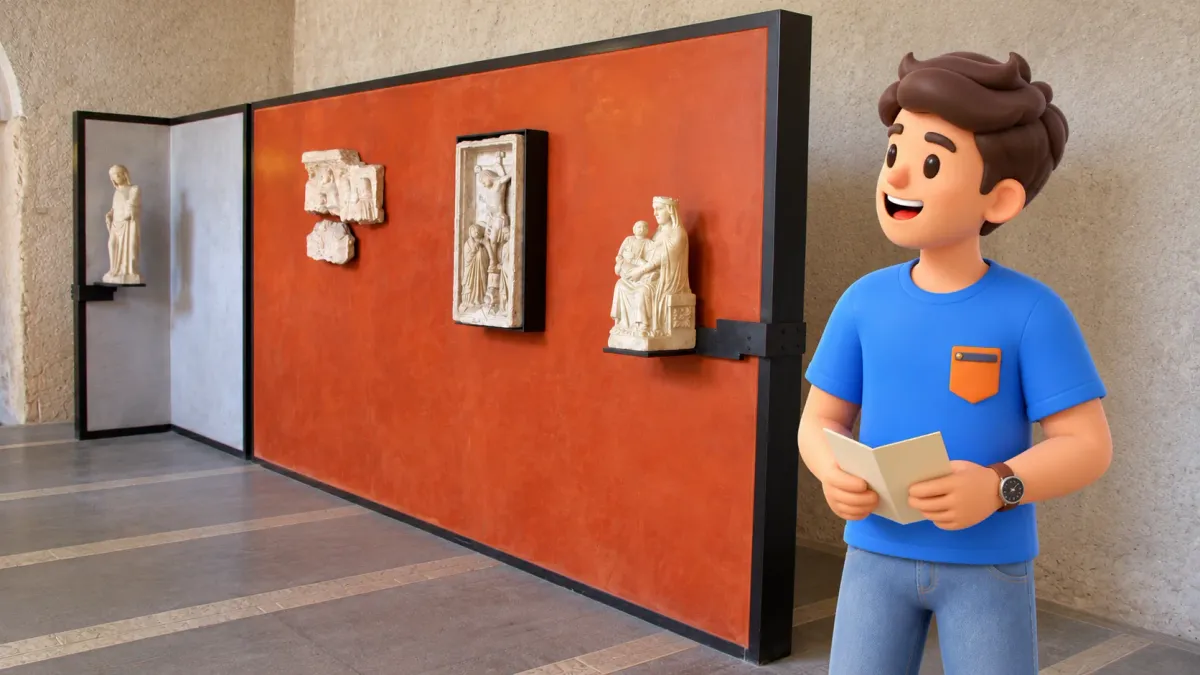
You can visit Castelvecchio for a medieval castle, sculpture or paintings. There is another reason to choose this museum: to notice how looking itself is arranged. Where does an artwork stand? What is behind it? From what distance does it first appear, and why can you see the next room from here? Carlo Scarpa made those questions part of visiting.
You need not understand twentieth-century architecture beforehand. Briefly shift attention from an individual exhibit to the relationships surrounding it. Support, wall, opening and human movement begin contributing to the experience. Castelvecchio then becomes more than an old building containing a collection.
Bring one question to Scarpa’s museum
Choose a question for the visit: how does space help me see the work? It does not replace interest in art or require looking only at stairs. Instead, it reveals how many decisions support an encounter with a painting or sculpture before you begin reading its title.
RoadMe makes preparing a personal whole-trip plan around your interests and pace much more convenient. Try distributing museums, architecture and walks in the app, giving Castelvecchio sufficient attention and rest around it.
This suits anyone who dislikes turning a museum into a count of completed exhibits. Choose a few works and examine them more closely. What matters is not the number of rooms but noticing why a work makes a particular impression in this particular position.
Agree on a rhythm with companions beforehand. One may linger before a painting while another studies a connection between spaces. Those interests can coexist without requiring identical stops at every object. There is enough here for each person to find a way of looking.
A medieval castle and a twentieth-century museum
Castelvecchio began as a fortified Scaliger complex in the fourteenth century, associated with Cangrande II della Scala. By Scarpa’s time, the castle had undergone substantial changes, including conversion into a museum. The architect was therefore working with several periods, rather than an unchanged medieval building.
Director Licisco Magagnato played a central role in the new approach, inviting Scarpa to take on the work. It developed through several phases from the later 1950s and continued afterwards. This was a prolonged creation of a museum environment, rather than one decorative refurbishment.
For visiting, the useful principle is that old and new need not disguise themselves as one age. Modern materials and new connections between parts of the complex can remain identifiable. Visitors can then notice how the building changed and how people learned to use it differently.
Do not try immediately to date every wall. Look for meetings of materials, a deliberately retained gap or a change in direction. Architecture begins to read through relationships, rather than only a historical note about the castle’s first construction.
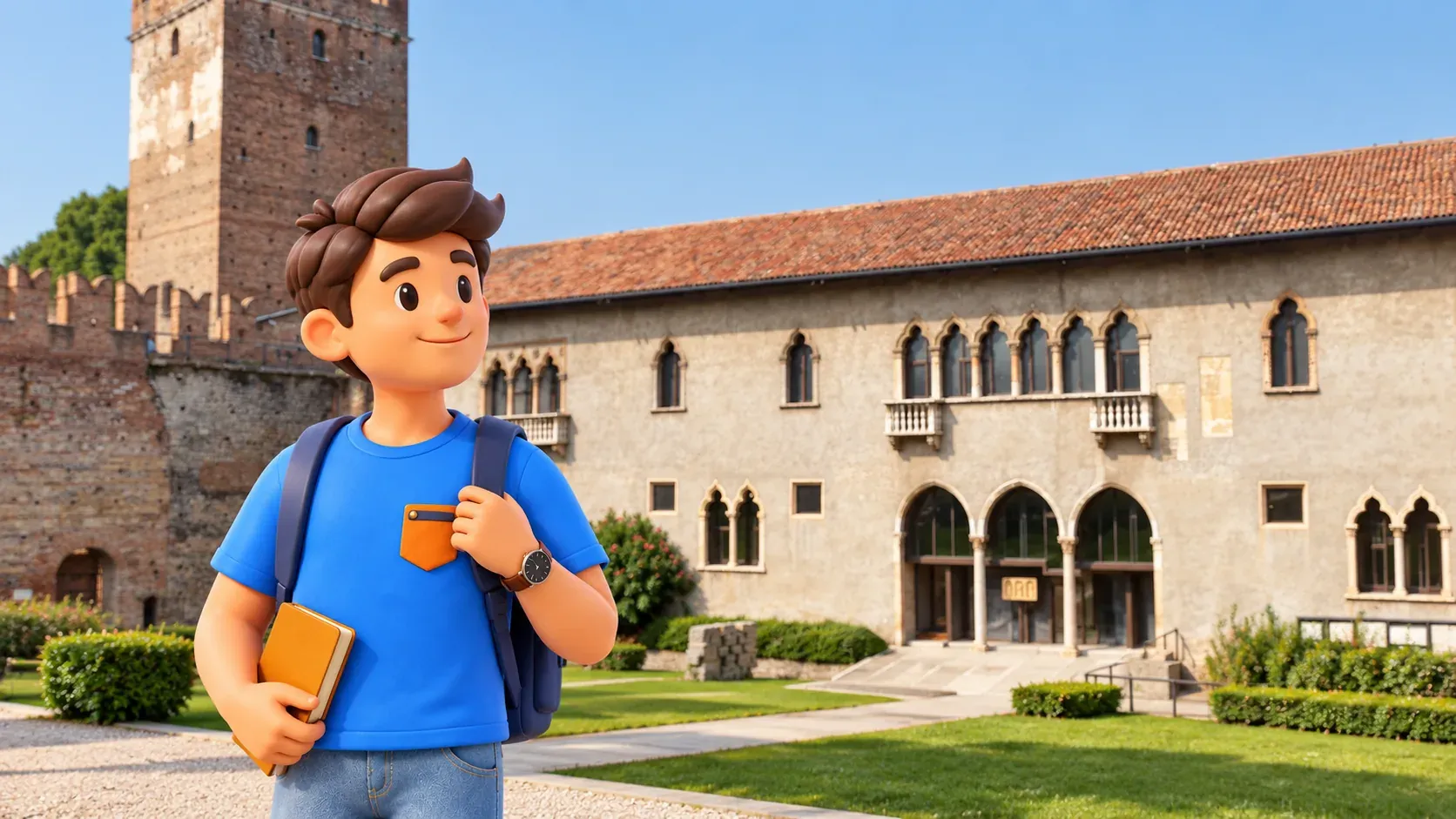
Begin reading the museum in the courtyard
In the courtyard, it is easy to mistake the long gallery facade for one continuous medieval setting. Yet this part also belongs to a later history. The gallery developed in the nineteenth century, and its appearance changed during an earlier museum transformation. Here especially, avoid determining age solely from the shape of a window.
Scarpa did not remake the whole courtyard in one modern style. His decisions connected different parts while allowing differences to remain visible. The entrance position, for example, need not obey the central symmetry you might expect from a facade. Such a modest change affects a visitor’s first step and subsequent attention.
Look around before trying to find every feature you have read about. Where is the convenient path? How do courtyard and gallery relate? Which openings appear important? Then follow the current entrance arrangement. This brief look does not replace the display, but gives a starting point for comparing outside and inside.
If the visitor route brings you back into the courtyard after the rooms, recall your first impression. A familiar window may now mean more than an attractive shape: it can suggest light or a relationship to an artwork’s position. That mental return connects the museum instead of leaving rooms as unrelated pictures.
For personal notes, three short observations are enough: which work stayed with you, what helped you see it and which transition changed your impression? You need not compile a detailed catalogue. These questions retain the connection between art and architecture and provide something to discuss during a separate pause.
Why a support is more than a stand
Attention in a museum usually goes directly to the sculpture. At Castelvecchio, look at its placement too. Scarpa developed solutions for individual works: support, height and position within space helped arrange an encounter between artwork and viewer.
Try a simple thought experiment. Imagine the same object against a wall, then slightly away from it, lower and higher. Without changing the object itself, you obtain different impressions: silhouette, shadow and relationship to a person shift. In the room, display design creates those effects.
Notice whether a contour separates from its background and how a side becomes visible. A support may let a sculpture register as an independent volume rather than a wall decoration. You do not need to cross barriers or seek an inaccessible side. Use the positions permitted to visitors.
The point is not to admire every metal detail separately. Notice how it serves the work. A useful question is brief: what would change in my view if the object were simply placed differently? It makes a museum decision understandable through your own eyes.
Cangrande: an artwork and its surroundings
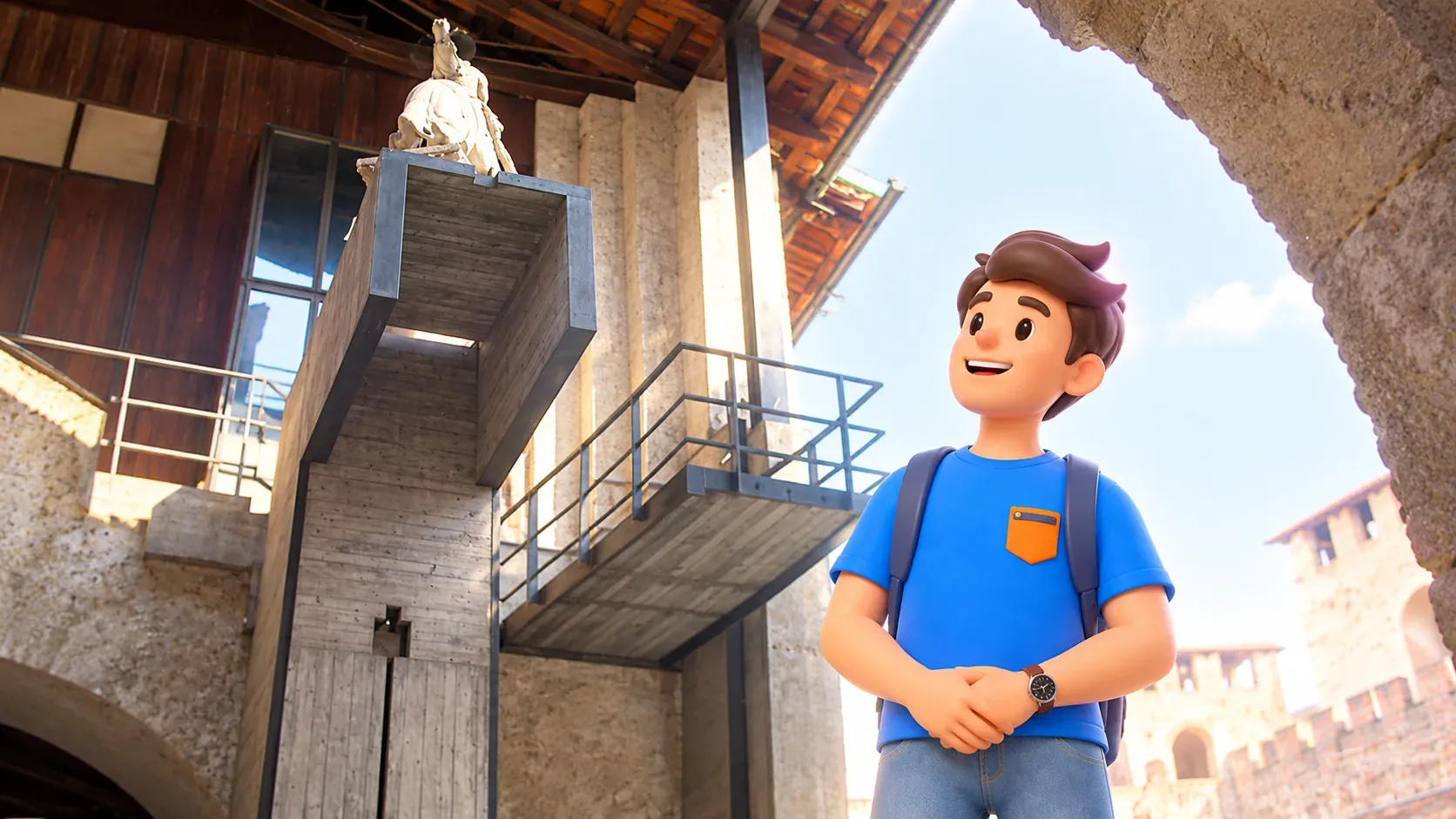
A central example is the equestrian statue of Cangrande I della Scala. Do not confuse him with Cangrande II, associated with the castle’s construction. The sculpture came from the Scaliger Tombs complex and received an expressive museum position on a tall concrete support.
Scarpa placed it at a junction connecting different parts of Castelvecchio. What matters is not only the rider but also distance, height, openings and possible directions of view. The work belongs to the sequence of visiting rather than merely occupying an available space of suitable size.
Observe your first impression when the statue comes into view. Which registers first: rider, support, background or surrounding construction? Then change position if the open route allows. Even a small permitted movement shows how an exhibit and its setting are experienced together.
Do not assume every angle familiar from architectural photographs will be available. Individual areas can close and visiting routes depend on current arrangements. You need not reproduce every image to understand the principle; use the route open today.
Light, frames and space between works
A painting exists as more than its image. Framing, wall and distance from neighbouring works alter perception. Scarpa attended to those details at Castelvecchio, linking the display to architecture. Even a gap between objects contributes to how clearly they register.
Choose one work and first look from an available position without reading its explanation. Then read the title and return to the image. Afterwards, notice its surroundings. This order preserves the encounter with art without turning the exercise into an inspection of frames alone.
Consider light too. What becomes clear, where does shadow appear and what changes when you enter the next space? You need not assess ideal museum lighting technically. Your experience matters: which relationships became visible because of the work’s particular placement?
If you want a photograph, check current rules and find a position that keeps the passage clear. A picture can retain a thought about display, but need not replace time in front of a painting. One photograph after attentive looking can be more useful than a rapid sequence of every room.
Movement belongs to the display
A museum route does more than transport you from the first object to the last. An opening can reveal the next section, a turn alter scale and an exterior space provide another background for experiencing the castle. At Castelvecchio, this connects artworks with architecture belonging to different periods.
Notice one transition you would like to remember. What is visible before it, and what appears afterwards? When do you stop looking at an isolated object and begin sensing a whole space? This does not require standing for a long time on stairs or interrupting other visitors.
Courtyard, gallery and more complex route sections do not share identical access conditions. If you need a step-free sequence, ask about the required parts beforehand. Partial museum accessibility does not mean that every famous architectural angle is reachable by everyone.
Nor should an old notice about a closed area be treated as permanent. Maintenance and visiting conditions change. A particular date requires current information; a historical account of the design does not replace it.
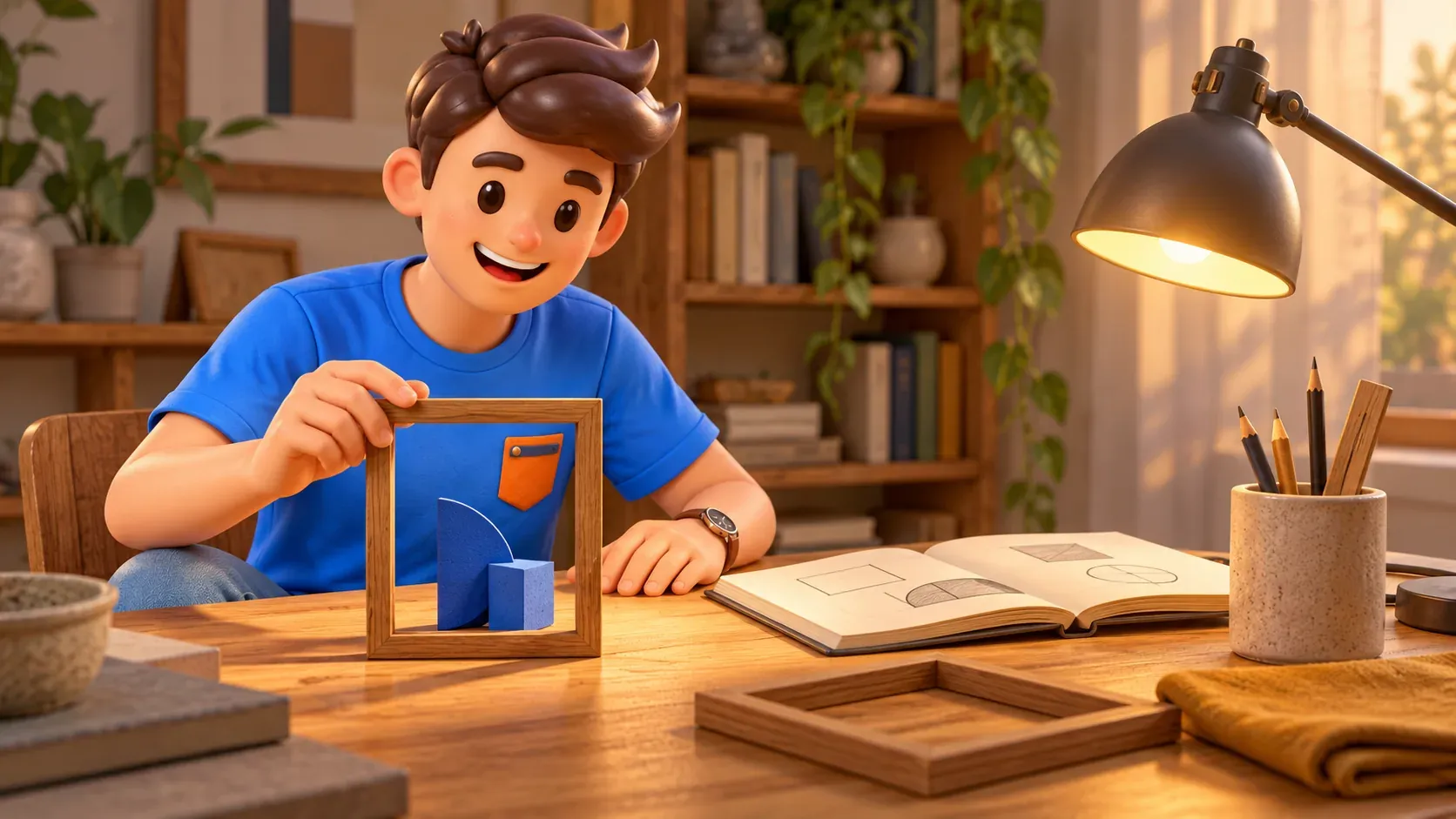
Allow time for an attentive visit
For a selected museum encounter, allow roughly 90–120 minutes, 20–30 for an exterior courtyard impression, 30–45 for a separate pause and 20–30 as a buffer. That totals approximately 160–225 minutes. Travel from your accommodation, returning there and extra queues are additional.
This is an editorial estimate for a selected visit, not a promise of the complete collection and every exterior passage. If one work holds your attention, shorten the next activity. Understanding a museum decision does not require finishing every available section at one pace.
The nearby Scaliger Bridge can be another walk, but proximity does not make it compulsory. If you are still selecting the day’s museum, use our comparison of Castelvecchio, Maffei and the Forti gallery. It helps compare interests before purchasing and distribute attention.
With RoadMe, an interest in one museum can become a thoughtfully personalised plan for the whole trip. The app helps combine favourite themes, walks and rest across your days, so a rich experience has room to settle.
Leaving Castelvecchio, remember not only a work you liked but also a way of seeing it. This is the strength of Scarpa’s work for an ordinary visitor: afterwards, supports, distances, light and transitions become more noticeable elsewhere. The collection retains its importance while your attention gains another useful tool.


