
Brooklyn Heights: a historic neighbourhood walk in a few hours

Brooklyn Heights rewards a few hours of looking at ordinary streets with unusual care. Low houses, front steps, old civic buildings and churches give this part of Brooklyn a different scale from Manhattan's towers. Start at Brooklyn Borough Hall, continue to St. Ann & the Holy Trinity and the Center for Brooklyn History, then take residential streets towards Plymouth Church.
Allow about two and a half hours for the outdoor walk and pauses. One chosen interior can extend the outing to roughly three or three and a half hours. A Brooklyn Bridge crossing, a separate DUMBO circuit and a long waterfront walk belong in another time allowance. The purpose here is to understand a neighbourhood, with enough room to notice the streets between its landmarks.
Choose the story that interests you
You can approach Brooklyn Heights through architecture, civic identity or nineteenth-century social movements. Borough Hall recalls Brooklyn's life as an independent city. Churches reveal how congregations participated in that city's public debates. The history centre introduces the work of preserving documents and memories. These subjects sit close enough together to make a compact walk, while giving different visitors different reasons to linger.
RoadMe makes it much more convenient to build a personal walking or trip plan around your interests, from architecture and local history to culture and quieter neighbourhoods. Try planning in the app so a few free hours become a day that suits you.
Decide on a priority before setting out. If houses and architectural details appeal most, protect time for residential blocks. If antislavery history is your main interest, investigate a confirmed Plymouth tour first. For exhibitions and archives, look more closely at the history centre's programme. The broad walking sequence remains useful in each case; extra depth belongs at one selected stop.
Do not expect every interior to open together. The Center for Brooklyn History closes on Sundays, while St. Ann's advertised open sanctuary hours differ from Plymouth's usual Sunday history tour. An outdoor route still works without that combination. Choosing one meaningful interior is more satisfying than spending a large part of the day waiting for doors or rushing between separate schedules.
Begin at Borough Hall and Brooklyn's former city centre
Brooklyn Borough Hall near Joralemon and Court Streets is a practical starting point. Find a suitable place on the public sidewalk or plaza to look at the façade. This is an exterior stop: the itinerary does not promise access to offices, a free interior tour or an unrestricted visit to ceremonial rooms. Several attentive minutes outside are enough to understand the building's public character.
The still unfinished City Hall opened in 1848, when Brooklyn governed itself as a separate city. Consolidation with New York City in 1898 changed both the building's name and its role. That history makes the stop more than an attractive piece of administration. It suggests a city with its own government, ambitions and wish to express importance through architecture.
The Greek Revival design is legible in the monumental stairway, six Ionic columns and triangular pediment. Light marble gives the façade a particularly formal presence against its surroundings. Look first at the proportions and then at one column detail. You do not need the complete construction chronology to see how a familiar classical language makes a civic institution appear dignified and substantial.
Set aside around twenty minutes for the building and your initial orientation. Subway exits, crossings and the surrounding streets can require a little additional attention. Use designated crossings and step clear of the pedestrian flow before taking photographs. The next part leads towards Montague and Clinton Streets, where the scale becomes more intimate and easier to appreciate at a relaxed walking pace.

St. Ann: a change in architectural language
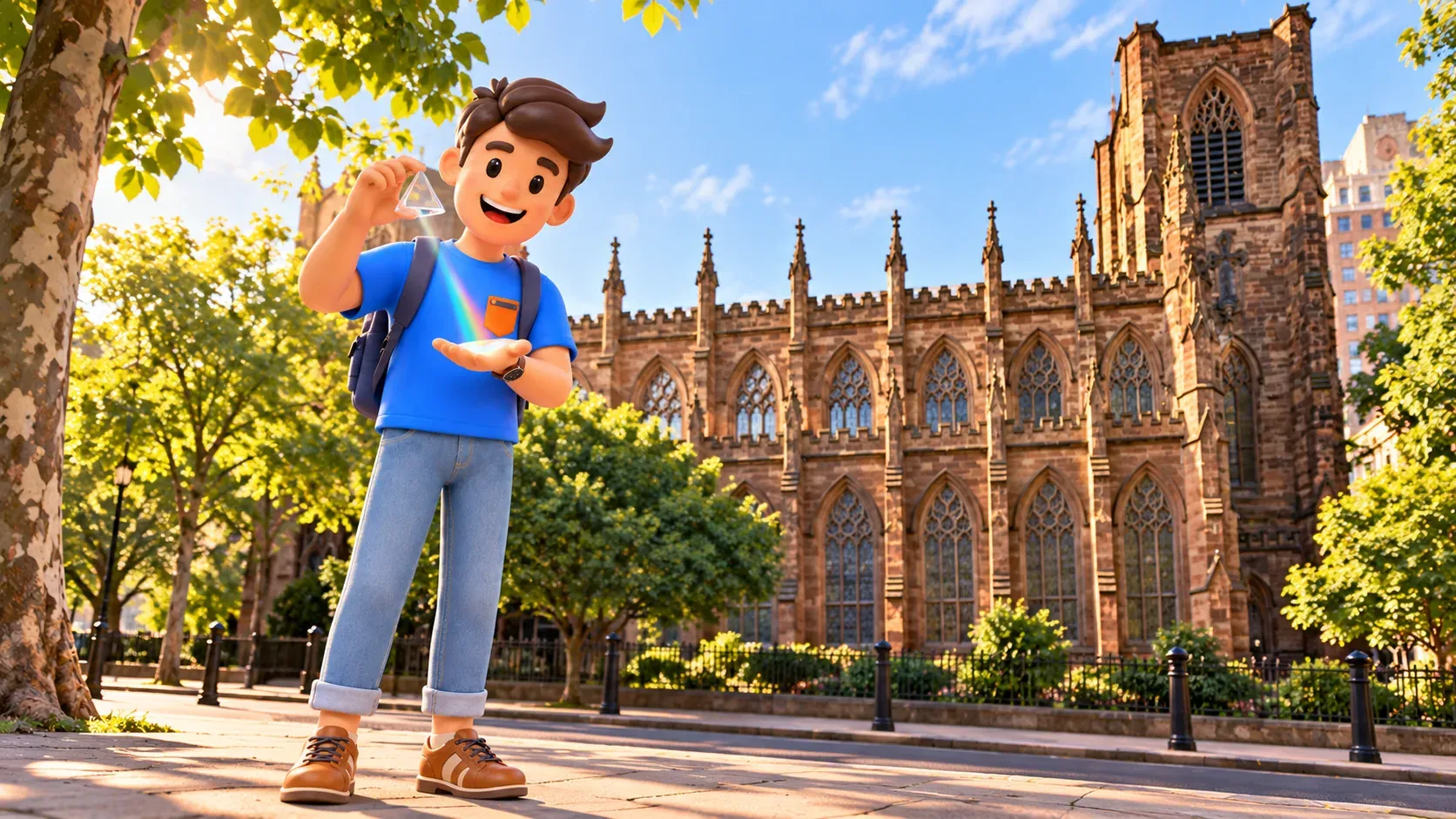
St. Ann & the Holy Trinity stands close to Montague and Clinton Streets. Notice the vertical lines, pointed forms and warm stone tones from the sidewalk. After Borough Hall's classical front, the contrast is rewarding. Two nearby public buildings attract attention in different ways: one through a composed symmetry, the other through a more elaborate Gothic rhythm.
Minard LaFever designed the church, which opened in 1847. Its present name also holds two institutional histories: St. Ann's congregation moved into the Holy Trinity building in 1969. The age of a congregation and the date of its current home are different things. For this short walk, it is enough to recognise an architectural landmark that remains an active place of worship.
If the interior matters, the website currently lists Open Sanctuary on Wednesdays from noon to 6pm. Sunday services are a separate part of the calendar, rather than a promise of unrestricted sightseeing. Recheck the schedule for your date. Worship, events or necessary restrictions may change access to particular areas even when the general timing appears suitable.
Inside, the stained glass by William Jay Bolton, assisted by his brother John, was made between 1845 and 1848. Choose one composition instead of trying to examine every window. Observe how coloured light changes the room, respect worshippers and follow photography rules. Do not assume that stairs, galleries or close views of every window are automatically available to all visitors.
The history centre: exhibitions and archives need different plans
Nearby on Pierrepont Street, the Center for Brooklyn History offers another architectural pause at the building designed by George B. Post. It also introduces a useful distinction: the past you can see from a street and the past reconstructed through evidence. A house may survive, while photographs, letters and personal accounts help explain the everyday lives once connected with it.
The institution traces its beginnings to the Long Island Historical Society, founded in 1863. In 2020, Brooklyn Historical Society joined Brooklyn Public Library and became the Center for Brooklyn History. Those changes of name point towards a relevant idea for a visitor: a neighbourhood's history is more than façades and famous residents. People continue collecting, studying and sharing it through public programmes.
At the time of checking, building hours are Monday to Friday, 10am–6pm, and Saturday, 10am–4pm; it is closed Sunday. Exhibitions and events can have their own arrangements. Choose one public offering that genuinely interests you and give it an additional thirty to forty-five minutes. Treating it as a separate allocation is more useful than squeezing it into whatever remains after other commitments.
The Othmer research library has a different schedule: Tuesday to Thursday, noon–5:45pm; Friday and Saturday, 10am–3:45pm; closed Monday and Sunday. Research appointments are encouraged. Some collections are stored elsewhere and require advance notice. A casual visitor should not expect immediate access to any archival item simply because the building is open when they pass it.
If you intend to undertake research, consider the rules for bags and handling materials beforehand. That is a separate kind of visit, rather than a quick photo stop. For this outing, the exterior or one public programme is enough. An accessible entrance is provided to the right of the main entrance, but check individual needs and the particular spaces you plan to use.
The residential blocks are part of the experience
Continue on public sidewalks towards Henry and Orange Streets. Around twenty-five minutes allows for the journey from the centre to Plymouth and some small pauses. The shortest line is not always the most rewarding choice. A quiet block observed through its entrances and cornices can provide more pleasure than several additional addresses glanced at while moving quickly.
Look for repeating features: house heights, window rhythms, steps, small fences and the relationship between a door and the street. Then identify one difference within that pattern. Architecture becomes easier to read without naming every building's style. Much of the district's value comes from neighbouring houses and streets working together, rather than from isolated monuments with their own guidebook entries.
Brooklyn Heights became New York City's first designated historic district in 1965. That is a useful brief frame for the walk: preservation involves choices made by people and public institutions. A coherent streetscape does not mean time has stopped. Everyday life continues behind the windows, buildings need care, and residents and visitors use the same public spaces at the same time.
Stay on the sidewalk. A home's front steps are not a public bench, and an open gate is not an invitation inside. A good picture does not require looking into windows or blocking someone's entrance. For a longer pause, find an appropriate public place. This small consideration makes the experience better for neighbours and helps retain the walk's unhurried character.
RoadMe helps develop a personal plan around your interests and fit this historic neighbourhood into the whole trip. Planning in the app makes it easier to decide where your time belongs: architectural details, an exhibition or the history of social movements.
Plymouth Church: public history behind a quiet façade
Plymouth Church on Orange Street is associated with Henry Ward Beecher and the antislavery movement. Pause here to consider the district through its social history. Attractive streets existed alongside difficult questions of their time. The story becomes more substantial when it includes those questions as well as the visual qualities of the buildings around you.
The Underground Railroad in the church's history means a network helping people escape slavery, not a literal underground railway. Do not expect a tourist tunnel or a guaranteed basement visit on an ordinary walk. A confirmed history tour is a better setting for exploring documented events, separating them from dramatic urban stories and asking about the congregation's particular role.
Current guidance says history tours are held most Sundays at 12:30pm after worship, with sanctuary entry on Orange Street. They are volunteer-led, so confirm the date. There are no Saturday tours. Other visits require arrangement: the published weekday time windows are not general walk-in hours. A suggested donation applies, and a request for a particular date does not itself confirm availability.
If the tour is your main reason to visit, confirm it first and adjust the walking order around it. Otherwise an exterior pause and a little historical context still make sense. Do not force a Sunday tour together with a history centre that is closed that day. These are separate interests, each deserving an appropriate opportunity rather than a rushed compromise.
Finish with a little time still free
Head back towards Montague Street through residential streets, for example Willow and Pierrepont, using the current map and available sidewalks. This continues the neighbourhood experience without requiring a race to the exact starting point. Roughly two kilometres is an estimate for the whole walk. Your street choices, crossings and ending will alter it; it is not a measured navigation track.
If you have energy left, make a brief optional detour to the Promenade to look towards Manhattan. Do not automatically add the waterfront piers or DUMBO to the main programme. Keep another quarter of an hour for a quiet pause or an unexpected delay. Conditions were checked on October 17, 2026; review your chosen interior's calendar and current local restrictions before visiting.


