
Bolshaya Nikitskaya and Vozdvizhenka: Music and Mansions
A walk between Vozdvizhenka and Nikitskiye Vorota brings together several ways Moscow buildings express character. Begin with Arseny Morozov’s unusual mansion, continue through the streets to the Conservatory and Tchaikovsky monument, then follow Bolshaya Nikitskaya towards the Great Ascension Church. Architectural imagination, musical history and the ordinary life of central streets make a coherent small outing.
Allow roughly two to three hours for the main exterior route with pauses. This is an editorial planning estimate rather than a measured walking time. A concert, guided tour or interior visit needs separate arrangements and additional time. With a longer free half day, you can add a literary stop on Novinsky Boulevard, but the main walk already has a satisfying finish at Nikitskiye Vorota.
Connect two streets without filling every gap
Begin by Arseny Morozov’s mansion at 16 Vozdvizhenka, viewing it from the permitted public side. Continue along Bolshoy Kislovsky Lane to Bolshaya Nikitskaya, the Conservatory and Tchaikovsky monument. Then follow Bolshaya Nikitskaya towards Nikitskiye Vorota and the Great Ascension Church. Choose metro exits, street crossings and any detours using current signs and navigation rather than an old exit number.
The sequence is about changing impressions, without needing to enter every building. Allow around an hour and a half to two hours for façades and links, leaving the rest for a substantial pause and your own observations. If one stop particularly interests you, stay longer and shorten the next. A few attentive pauses give this walk more meaning than trying to explain every neighbouring house.
To connect music, architecture and breaks around your own interests, try RoadMe: the app creates a personal trip plan for your dates, preferences and pace. It is a convenient way to organise a whole day instead of manually joining addresses from separate selections.
Before a concert, adapt the direction to the actual hall. You could begin near Nikitskiye Vorota, finish at the Conservatory and save the mansion for another walk. That keeps entry and cloakroom arrangements from depending on how long you linger farther away. The venue and time on your ticket matter more than the order suggested here; several halls belonging to one institution do not imply one common entrance.
Vozdvizhenka: a mansion that immediately raises questions
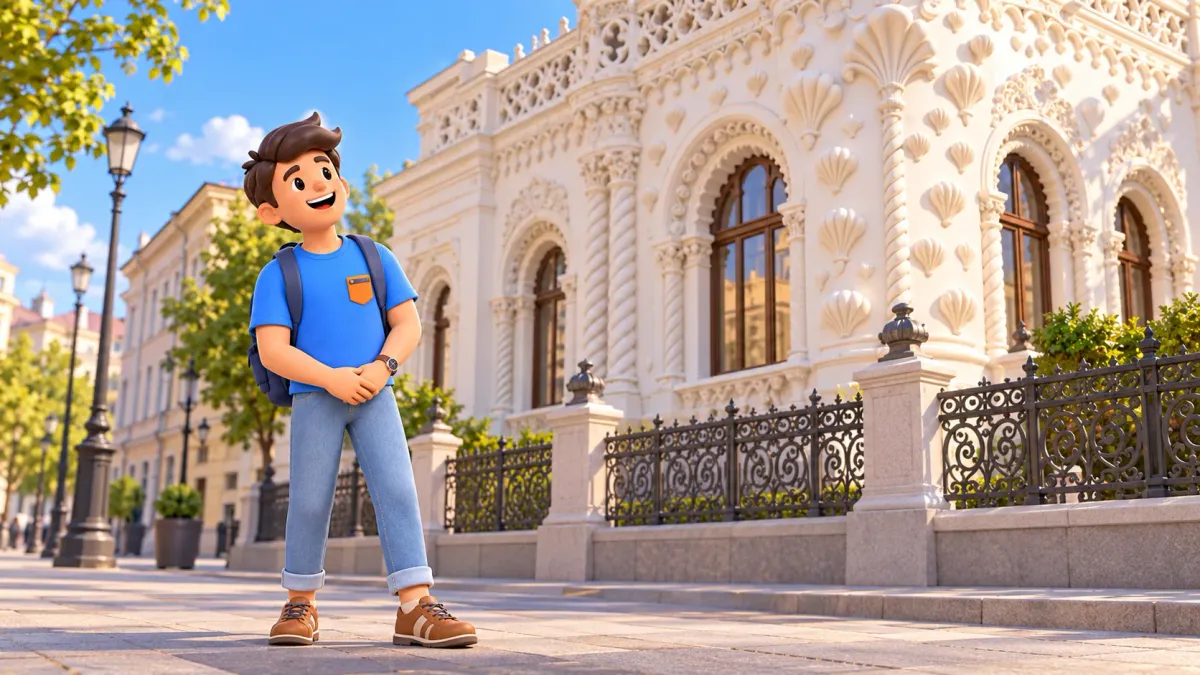
At Arseny Morozov’s mansion, look first at the overall shape, then at its details. A white façade, unusual window surrounds and abundant decoration differ sharply from a more familiar idea of a Moscow townhouse. Describe your first impression in your own words: festive, theatrical, like a palace remembered from a journey? You do not need to learn architectural terminology before making that observation.
The mansion was built in the late nineteenth century to a design by Viktor Mazyrin. Its appearance is associated with neo-Moorish motifs and a free combination of decorative forms. That gives a short historical key to why it looks so unusual. A full biography of the owner and history of the interiors can wait; here, notice how an individual architectural fantasy changes the character of a street.
The building is used as the Russian Government’s Reception House, so do not treat it as an ordinary museum with guaranteed public entry. The route includes exterior viewing. Do not pass through closed gates or assume you can enter because another nearby cultural building is accessible. Any particular visiting programme would require a separate check of whether it exists and under what conditions.
Find a place where you can stop without blocking pedestrians. Avoid crossing the road for every camera angle; use authorised crossings and respect the traffic. Choose one memorable element, perhaps a window shape, ornament or arrangement of volumes, to compare with the Conservatory. The walk then acquires a connecting idea without becoming a detailed catalogue of everything on the façade.
Bolshoy Kislovsky: a transition towards the musical street
Continue along Bolshoy Kislovsky Lane towards Bolshaya Nikitskaya. The link is more than a way between two pins: it changes the scale after the expressive mansion. In the shorter street, your eye can move to gateways, windows, entrances and the spaces between buildings. You do not have to name each noticed house as another attraction for the walk to remain interesting.
Check the route against current maps and signs. A courtyard that looks like a useful shortcut is not necessarily open to passers-by. The main connection uses public streets, so closed areas and service entrances are unnecessary. If works or barriers interrupt the way, take an authorised detour that preserves the order of the areas rather than an imagined perfectly straight line.
Decide along this section whether you would prefer a break before or after the Conservatory. A named cafe does not need to become a compulsory stop: table availability, queues and your own energy may change the choice. Before an evening concert, keep time for a proper meal. On a self-contained daytime walk, a pause can simply be a chance to discuss which building you remember most clearly.
The Conservatory: identify the right address first
The main landmark is the Tchaikovsky Moscow State Conservatory and its Great Hall at 13/6 Bolshaya Nikitskaya. Use that address for the principal ensemble and the composer’s monument. The Conservatory name covers several buildings and halls, so check a concert ticket separately. A street walk and a booked event raise different practical questions even when they share an institution’s name.
The Conservatory was established in 1866 on Nikolay Rubinstein’s initiative. That founding date does not mean all its present buildings appeared at once. The architectural ensemble developed over time; the Great Hall opened in 1901. For this outing, it is enough to distinguish the musical institution’s history from the history of the particular setting where concerts now take place.
Compare the atmosphere with your starting point on Vozdvizhenka. At the mansion, unusual decoration drew attention; here, consider the identity of an institution and its relationship with the street. Which seems more restrained? Where do you notice the silhouette first, and where do you seek a detail? Such questions make architecture approachable without deciding which façade is better or turning the walk into an art-history examination.
Do not expect music to be drifting from an open window or free access to teaching rooms. This is a working educational and concert institution. To enter a hall, check the programme, entrance and rules for the chosen event. A musical evening can be a fine continuation, but it requires its own ticket arrangements and time block regardless of how close you already stand to the building.

The Tchaikovsky monument: a small pause with a human focus
Look at the monument to Pyotr Tchaikovsky in front of the Conservatory. It was unveiled in 1954 and is associated with sculptor Vera Mukhina’s work. That short context is enough to recognise a connection with the site’s musical history rather than an unrelated street sculpture. You do not need to recite the composer’s biography or name every composition; the shared name already links monument and institution.
Observe the figure’s position in relation to the building and the street. After large façades, shift attention to a person, a pose and the surrounding space. With children or a companion without musical training, ask what mood the figure suggests. That discussion can create more shared interest than a long explanation that nobody has time to connect to what is in front of them.
One personal choice is enough to extend the musical theme: remember a familiar work or think about a concert you might like to attend. There is no need to turn the monument stop into a compulsory outdoor listening session, particularly with sound that disturbs others. Save the idea for later if you want to listen. The connection between a walk and a growing interest can continue beyond these few hours.

Bolshaya Nikitskaya and Nikitskiye Vorota: another change of scale
Continue along Bolshaya Nikitskaya towards Nikitskiye Vorota. After the Conservatory, avoid rushing directly to the next address. Look at the street itself: the changing façades, places where the space opens and the direction of views. For a walk about contrasts, this section matters as much as the well-known stops. It shows how different buildings continue to belong to one living city.
At the Great Ascension Church, another architectural character enters the sequence. View its overall composition from accessible public space and compare it with the musical ensemble and mansion. This is a working church. Interior entry, services and conduct are not part of an ordinary exterior route. If you want to go inside, respect the current situation and staff guidance rather than expecting every interior to be available at any time.
The main walk can finish here. Choose your onward journey on a current map instead of adding another area merely to lengthen the list. If a concert follows, allow separately for returning to the right hall. If your free time has ended, three clear impressions—the unusual house, the Conservatory and the church setting—already make a coherent outing.
More time? A literary continuation on Novinsky Boulevard
Leave the Joseph Brodsky monument as an optional extension rather than an essential part of the two-hour plan. It is on Novinsky Boulevard between buildings 22 and 28. This is a different section of the city, so check the onward route separately. Do not copy unexplained coordinates from old selections or assume that a named monument must be close to the previous stop.
The choice suits a desire for a literary note after music and architecture. If you are tired, the weather changes or an entry time is approaching, save it for another day. A good walk does not become less successful because an optional stop remains optional. Its main meaning already comes from connecting two streets and noticing how their buildings differ.
If you want to continue the day with literature, music or more lanes, prepare a personal trip with RoadMe: it arranges a day-by-day plan around your preferences and pace. The walk can then fit your own journey more naturally, with room for the interests you actually want to develop.
Check the visits you really intend to make
Keep the main street order, choose a clear finish and check only the indoor activities you genuinely plan to use. A concert needs the right hall and starting time, the mansion remains an exterior landmark, and the church is an active religious place. Suggested durations do not account for individual needs: check surfaces, steps, entrances and resting opportunities separately for your group.
Leave space for food and the journey afterwards. If the day already includes a major museum or long transfer, shorten this outing to mansion and Conservatory, or the musical section and Nikitskiye Vorota. There is no requirement to do everything. Its value lies in noticing several different relationships between architecture and city life, then deciding which theme you would enjoy exploring next.


