
Where to watch sunset in Berlin: waterside walks and city views

For sunset in Berlin, choose one evening format rather than a long list of viewpoints. Near Oberbaumbrücke, look for the breadth of the Spree and the city beyond. Around the Bode-Museum, choose architecture and reflections. At Panoramapunkt, choose the scale of rooftops from above. These are three independent alternatives: about 90 minutes by the broad river, an hour beside central-city water, or 90 minutes for a paid viewpoint when opening hours fit. You do not need to reach all three for one sunset. Arrive where you want to watch the light change.
No city viewpoint guarantees a visible solar disc on a perfectly clear horizon. Buildings, clouds and the sun’s seasonal direction affect the experience. Sunset can mean sky colour, reflections and changing light on stone even when buildings hide the sun before its astronomical setting time. Do not arrange the same evening meeting at the same hour in winter and summer. Choose the date, find Berlin’s local sunset time and then allow for approaches, a pause and the return. That gives the walk purpose without a race for a promised photograph.
Choose the light before the location
RoadMe makes developing a personalised plan for the whole trip more convenient, fitting evening walks around your interests, dates and pace. Try planning in the app so experiences connect comfortably and your Berlin time works more efficiently.
Call sunset on your chosen date T. Use Berlin local time rather than the time zone at home. The frameworks below are relative to T, avoiding a universal instruction to arrive at seven. Sunset does not mean light disappears from every street at that exact minute: buildings can block the sun and twilight continues afterwards. A venue’s timetable still applies independently of the sky. A late summer sunset cannot be fitted onto a platform that closes earlier. If the calendar does not work, change the format rather than assuming an exception.
Choose the broad Spree near Oberbaumbrücke for space and a long water view. Choose Ebertbrücke near the Bode-Museum for a short central walk and architectural reflections. Choose Panoramapunkt for the overall scale of Berlin, checking sunset against opening hours before buying. The first two rely on public outdoor spaces; the third requires paid admission. Food, travel and additional activities are separate. A free view does not promise solitude, and a paid ascent cannot create clear weather. The right choice depends on the kind of evening you want, not simply on height.
Oberbaumbrücke: broad water and the evening city
Around Oberbaumbrücke, the evening feels expansive: broad water, movement and the city in the direction of the centre. The bridge links Friedrichshain and Kreuzberg; its late-nineteenth-century red-brick structure and trains above make it recognisable. Division changed its role, and it later became a symbol of restored connections. A little context is enough for this outing. It is not a full Berlin Wall route or a catalogue of East Side Gallery paintings. Evening light receives its own time and remains the main subject rather than a hurried addition after every nearby sight.
Start at street level outside S/U Warschauer Straße about an hour before T. Allow 15 minutes to approach the bridge, 30 for a short walk on available public waterside and bridge paths, 20 for observation, 15 back to the station and 10 in reserve. That totals 90 minutes, finishing about half an hour after T. These are editorial estimates, not a measured track. Travel from another district, dinner and a complete open-air-gallery visit are additional. You can reduce the short walk if needed while preserving the quiet observation block.
Choose a permitted pedestrian position looking towards the centre. Other people and transport use the bridge and approaches: keep paths clear and stay out of traffic for photographs. If a riverside section is inaccessible, remain on open public routes rather than searching through private land. Do not promise yourself the sun between particular towers or a yellow train at the right second. Such combinations can be chance occurrences, not conditions for success. A familiar bridge can offer a satisfying evening without recreating an image made on another date from a different position.
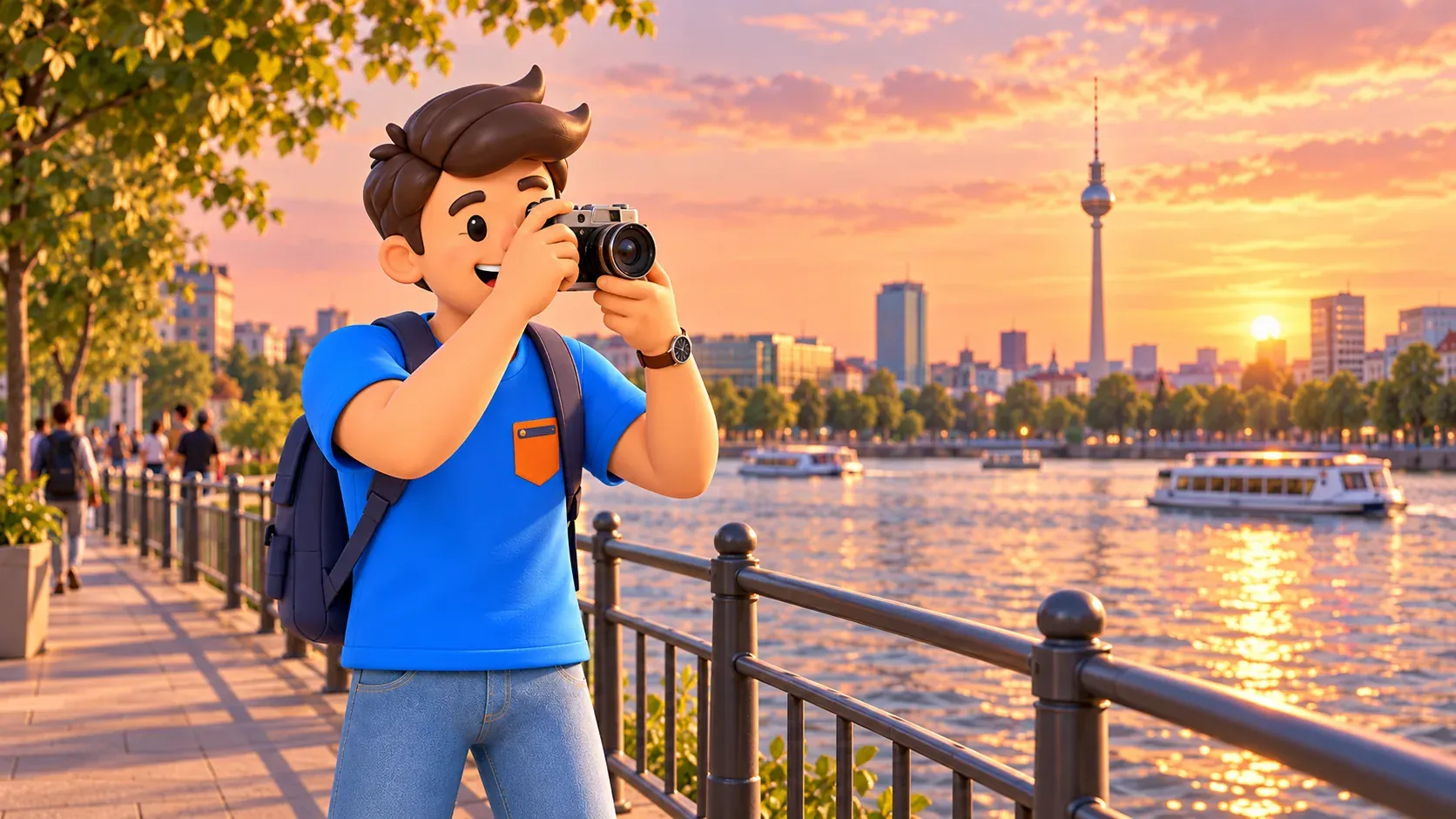
Look before raising the camera
Begin without a camera. Notice what changes: sky brightness, water colour or distant silhouettes. Take a few photographs afterwards, keeping some of the pause for the place itself. The river may be calm or moving, reflections long or almost absent. These are different conditions rather than a route failing. Under cloud, the evening can be soft and restrained instead of bright orange. A city walk cannot guarantee a particular visual effect. It can give you a chance to notice what is actually happening on this day rather than compare everything with a preset image.
Return along familiar public streets to the station. The last section may be in twilight, so do not spend reserve in advance on another distant stop. After a demanding museum day, keep this approach especially simple. Our East Side Gallery and Oberbaumbrücke walk offers a fuller introduction to the area. For an evening format, select a small portion rather than trying to complete that entire walk as the light disappears. The return is part of the outing, even when attention is naturally drawn to the water.
The Bode-Museum and Ebertbrücke: reflected architecture
For a more compact evening, choose Ebertbrücke and available public paths around the northern part of Museum Island. Here, water works differently: attention rests less on a distant horizon and more on the Bode-Museum’s architecture and its relationship with reflections. Watch light change stone without expecting the sun to appear directly behind a dome. This particularly suits a day already centred on Mitte. A short evening ending need not require crossing Berlin simply because another place was labelled best in someone’s list. Convenience can make the experience more relaxed and attentive.
The hour-long plan starts at S Hackescher Markt about 35 minutes before T. Give 15 minutes to approach Ebertbrücke, 15 to a small selected public waterside section and return to a suitable view, 15 for the pause, 10 towards S/U Friedrichstraße and 5 in reserve. Finish about 25 minutes after T. It is not a complete circuit of Museum Island or an interior Bode-Museum visit. Admission and museum hours are outside the plan: look at architecture from available outdoor public paths. Works may affect which connections are open on your actual date.
Choose somewhere you can stop without obstructing others. Barriers and works can alter familiar links between bridges and embankments. A small detour is fine within your available time; finding a closed passage to reproduce a photograph is unnecessary. Reflections need not resemble a symmetrical mirror, and parts of a building may already fall into shadow. That is the observation: actual water, movement and light. A pleasant architectural evening does not have to become a test of whether reality matches a promotional picture. Allow the details to differ while enjoying the same general subject.

Panoramapunkt: height when the calendar allows
Panoramapunkt in the Kollhoff Tower changes the scale: an expanse of rooftops replaces a single reflection. It is a paid viewpoint with open-air platforms, not a fully glazed room for every weather condition. Find the entrance on the Potsdamer Straße side opposite DB Tower; the complex address is Potsdamer Platz 1. Do not confuse that with a similar street address. The ascent becomes a separate experience. For choosing between high viewpoints more generally, see our Berlin viewpoint comparison. This evening plan concerns light and timing rather than another ranking of heights.
The operator lists summer hours of 10am–7pm, last ascent 6:30pm, and winter hours of 10am–6pm, last ascent 5:30pm. Do not invent the date of the seasonal switch. Compare the current schedule with T for your date before buying. If sunset comes after closing, an actual sunset from the platform cannot be promised. Choose earlier light and leave on time, or change to a public waterside option. Short winter days can fit a sunset visit better than long summer evenings. The attraction’s height does not override its operating calendar.
Allow 90 minutes from the visitor entrance and back: 20 for admission and ascent, 45 for the view, 10 for descent and exit, and 15 in reserve. Starting about an hour before T can show the changing light only when the whole budget fits before closing and last admission is respected. It is not a queue or lift-speed guarantee. If your ticket and actual conditions require another time, adjust the visit. Do not gain minutes by arriving late for the final ascent or assuming the platform will remain open beyond its stated finish.
The café follows its own timetable, and access does not include drinks or dinner. Wind feels different at an open-air height from sheltered streets below. For a stroller or wheelchair, establish the appropriate part of the visit: an elevator does not make every level equally accessible. Stay safely inside barriers. A subdued view through haze can still reveal the scale of urban fabric. If weather changes sharply, preserve the experience in another part of the trip rather than treating a purchased ascent as an obligation to wait for the sky you imagined beforehand.
One evening, one chosen format
Even under a clear sky, the choice is not simply the highest place. Broad water offers space, an architectural waterside offers detail and reflections, and a platform offers overall scale. In wind or fatigue, choose a short available route and an easy finish. Do not call any high hill a nearby substitute: approach and return may need a separate budget, particularly after dark. These three options keep the outing clear without a contest for Berlin’s single best sunset. A small evening experience can remain memorable without collecting every panorama during one journey.
RoadMe helps prepare a personalised plan for the entire journey more conveniently and efficiently, connecting evening walks, daytime visits and travel with your interests and pace. Start planning in the app so your chosen sunset has enough time and the day ends without a rush between distant places.
Find T for your date, choose one option, add travel from your district and decide how you will return. Do not expect identical reflections each evening or a viewpoint to stay open beyond its timetable. Changing light then becomes observation rather than a test for the city. Sometimes the best result is a few quiet minutes without a camera, when roofs or water begin to look different from daytime. That does not require collecting every possible view.


