
A Barceloneta walk: neighbourhood squares, public art and sea
Begin at Plaça del Poeta Boscà beside the Barceloneta market, then continue to Plaça de la Barceloneta and the church of Sant Miquel del Port. Walk through the residential streets towards the seafront around Carrer de l’Almirall Cervera, look at L’Estel ferit from the promenade, and follow the public waterfront southwest to Plaça del Mar. This sequence lets the neighbourhood emerge before the Mediterranean takes over the view.
Allow roughly ninety minutes to two hours for walking, brief stops and one pause. That is a planning estimate, not a measured duration. Swimming, a long lunch, a church interior visit, the harbour cable car and a complete Port Vell walk are additional activities. The finish beside the sea also leaves a separate journey to your next transport connection or address. It is a short neighbourhood outing with a clear endpoint, rather than a complete coastal sightseeing day.
Meet the neighbourhood before reaching the beach
Barceloneta is a residential quarter as well as a name associated with the beach. Its market, squares and parish church make sense as a small walk before you reach the open waterfront. Starting directly on the sand and spending all your time beside the waves can be enjoyable, but it gives you little sense of the streets behind them. This route makes room for both experiences.
For a more convenient and effective way to organise the wider trip, try RoadMe: the app creates a personal plan around your interests, dates, pace and budget. Decide how much space you want for the sea, neighbourhood walks and museums, then shape days that suit how you like to travel.
The main landmarks here are Sant Miquel del Port and Rebecca Horn’s L’Estel ferit; the market and public squares connect them into an outing. It is not necessary to include every recognisable object along Barcelona’s coast. Port Vell, Port Olímpic and the more distant beaches involve other walks. A landmark visible across an open view does not automatically become the next brief stop.
Morning works well for the neighbourhood section, especially if you want a working market, while daylight makes façade details easier to appreciate. Adapt the exposed seafront section to heat and wind. Choose the outing’s content according to the conditions of your own day, keeping a clear start and finish instead of assuming that a long waterfront pause will always feel comfortable.
Plaça del Poeta Boscà: start with everyday Barceloneta
Mercat de la Barceloneta stands on Plaça del Poeta Boscà. Begin by noticing how the building relates to the square, rather than focusing only on the entrance. People arrive to buy things, meet someone or continue through the neighbourhood. For a visitor, this is an opportunity to see a place with an ordinary practical role, rather than a setting created solely for sightseeing.
The market was comprehensively remodelled in 2005–2007 to a design by Josep Miàs. That modern layer sits alongside its continuing trading function. Look at the overall building and approaches before deciding whether to step inside briefly. A complete inspection of the stalls would change the nature of a short walk and deserves additional time if food shopping is one of your main interests.
The city directory lists usual hours of Monday to Saturday, 08:00–15:00. Confirm holiday arrangements and the traders you want for your date. This timetable does not automatically apply to every neighbouring café or restaurant. On Sundays or later in the day, plan an exterior stop instead of promising an active market hall. The square, church and sea still make a complete outing without a purchase.
If barriers or works occupy part of the square, use the open public passage and keep a particular playground out of the essential plan. A rendering of future improvements is not evidence that the equipment is already available. For this walk, the important things are the square’s role and the connection onwards. Starting at an accessible edge is enough; you do not need to inspect every part of it.
Plaça de la Barceloneta and Sant Miquel del Port
Continue to Plaça de la Barceloneta and its parish church, Sant Miquel del Port. This is a different square from the market square. Keeping the two names distinct helps the route make sense: first a trading space, then a historic neighbourhood centre. Step away from the doorway and compare the church’s proportions with the surrounding residential buildings before concentrating on a single sculptural detail.
The church was built in 1753–1755, while the new neighbourhood’s foundation stone was laid in 1753. Together, those dates introduce the planned growth of maritime Barcelona in the eighteenth century. This is a useful distinction from thinking of every densely built part of the old city as medieval. Barceloneta has its own story of creation and later change, even when its close streets feel much older at first glance.
The building also evolved. An extension designed by Elies Rogent was completed in 1863. Notice the central figure of Saint Michael on the façade, but do not assume it is an untouched eighteenth-century sculpture. The parish history identifies the present work as Emili Colom’s replacement, installed in 1992. A few such distinctions reveal the church’s changing biography without requiring a long explanation of architectural styles.
This itinerary uses an exterior stop. If the church is open to visitors and you want to enter, respect worship, parish instructions and the extra time involved. An open door is not permission to talk loudly, photograph everyone present or explore every part of the building. The façade and square are enough for this brief introduction; an interior visit should follow your interest and the circumstances.

The residential grid: notice the pattern without intruding
Continue through the quarter towards the promenade around Carrer de l’Almirall Cervera, using permitted public streets and crossings. There is no need to search for secret courtyards. Instead, notice repeated street directions, the way building corners meet, and the moment when a tightly framed view begins to suggest the open space ahead. A few observations give this connecting section a purpose of its own.
Barceloneta developed in the eighteenth century as a planned neighbourhood with a regular street layout. Repetition makes that structure readable today. However, do not imagine every present building as the same low house seen in an old photograph. The quarter changed and became denser. Its current character combines an underlying order with later layers visible in height, detail and the use of the street.
People live here. Entrances, stairwells and windows do not become sightseeing stops simply because they look interesting. Keep doorways clear, avoid pointing cameras into homes and do not treat an ordinary courtyard as a public visitor space. These small habits help keep attention on the neighbourhood’s form while giving residents room to continue their day. They also make the walk more relaxed for your own group.
Reaching the sea: a change of scale
At the promenade, pause outside the main flow and look along the shoreline. A harbour basin and the open sea create different impressions: here the horizon becomes central. “Barceloneta” is often used casually for the coast beside the quarter, although individual beaches have their own names. For this route, follow the public promenade towards the chosen sculpture and then the square beside the sea.
You do not need to walk onto the sand for the outing to count. The promenade lets you enjoy waves, light and the character of the shore while keeping an ordinary walking format. Swimming is a separate decision requiring attention to current flags, weather and local instructions. It is not included in the timing, and this article does not promise bathing as an available part of the programme throughout the year.
Notice how movement is organised before stopping for a panorama. Pick a place outside cycle movement and the pedestrian flow, then take your photograph. The open horizon can make it easy to forget that everyday city activity continues beside you: people running, walking somewhere or leaving the beach. A short pause is more pleasant when it leaves those movements enough room.
L’Estel ferit: four volumes and the memory of a district
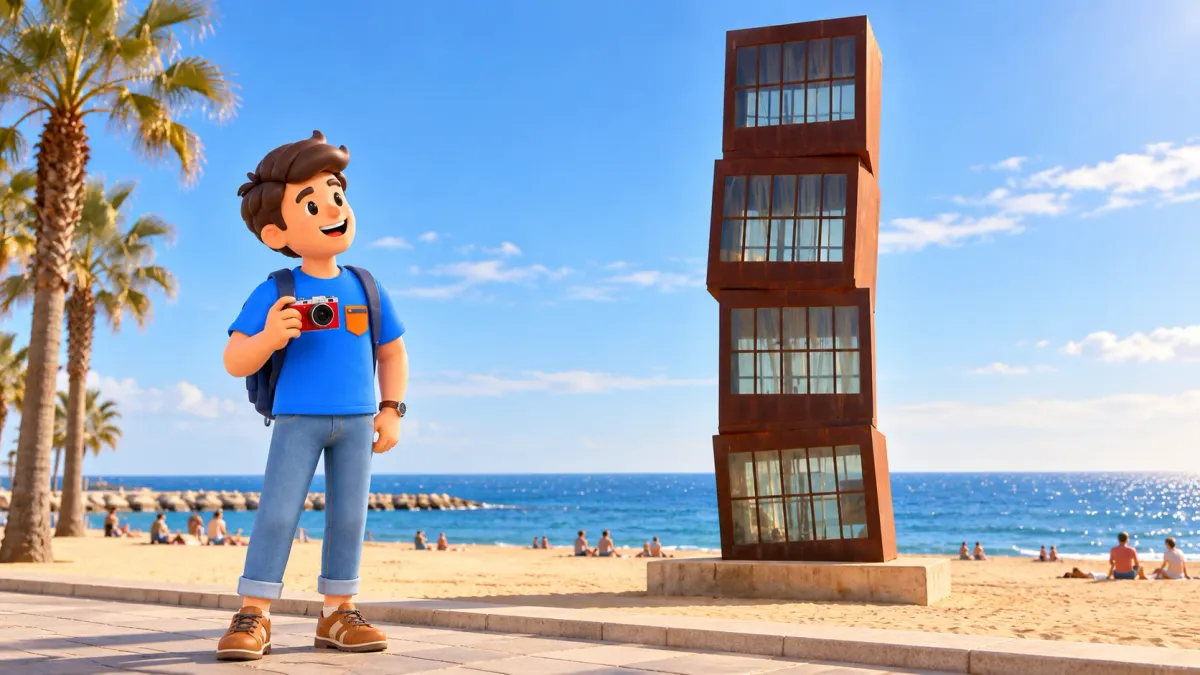
Rebecca Horn’s L’Estel ferit dates from 1992. Its four offset, windowed box-like volumes stacked one above another make it recognisable. People often call it simply “the cubes”, but remembering the actual title, commonly translated as the wounded star, changes the encounter. Rather than a random tower, it becomes an artwork whose name suggests fragility and a disruption of familiar order.
Barcelona’s tourism organisation connects the work with Barceloneta’s past. You do not need to choose a single exclusive explanation in which every element represents a particular everyday object. Compare its outline with the low line of the sea and notice how it changes when viewed from a slightly different position on the permitted promenade. There is no need to approach the base closely or climb onto the work.
After the historic parish church, the sculpture introduces another layer: the waterfront changes of the late twentieth century. This is why the route offers more than a connection from the market to the beach. Trading, worship, a residential grid and public art provide different ways of understanding the same quarter. Choose one detail that connected those experiences for you instead of trying to memorise every date.
Plaça del Mar: choose a finish and a pause
Continue southwest along the public promenade towards Plaça del Mar. End the main route here without automatically adding every large silhouette visible further away. The square gives the walk a clear conclusion: step out of the flow, decide whether you need a rest and only then choose the next address. Returning to transport or your accommodation remains a separate part of the day.
A food pause need not become a long lunch. One recognisable local option is the bomba de la Barceloneta, a fried potato croquette traditionally filled with minced meat and served with aioli and brava sauce. Check the particular recipe if ingredients or dietary requirements matter: a potato-based name does not make a dish vegetarian. Confirm the price and portion before ordering rather than assuming every version is identical.

To connect neighbourhood walks, food and maritime interests across several days, you can use RoadMe to develop a personal trip plan around your preferences and pace. It is a convenient way to distribute those experiences while keeping time for rest, instead of repeatedly piecing together the programme from separate notes.
A long meal, swimming or a longer coastal walk may become the main experience of your day; give it a separate time allowance. If boats and the harbour appeal more, choose the two-hour Port Vell walk for another outing. There is no requirement to combine both routes into one large compulsory itinerary simply because the neighbourhoods are close.

The purpose of this walk is to notice the quarter before it becomes a line of sea views. The market introduces practical life, the church its foundation and subsequent changes, and L’Estel ferit a modern reflection on the memory of the place. Ninety minutes to two hours can connect those impressions while leaving a pause for something simple: looking at the water with a clearer sense of the neighbourhood behind you.


