
Barcelona’s Water Towers: Everyday History Behind the Skyline

Barcelona gives you plenty of reasons to look upwards: church spires, colourful roofs and celebrated towers. Some urban height has a less obvious explanation, however. Water had to be found and lifted. The city’s water towers recall everyday work that helped turn new streets into places to live and industrial buildings into functioning workplaces.
Three examples offer a useful introduction: the tower inside an Eixample block, the Besòs tower in Poblenou and the Catalana de Gas tower in the Parc de la Barceloneta. These are different biographies, rather than three interchangeable viewpoints. They are better considered within the days you spend in their neighbourhoods than automatically joined into one long walking route.
What a water tower changes about the view
A sightseeing story often starts with a façade: who designed it, how it was decorated and which style it represents. Water infrastructure raises another question: how did the city work? New housing required supply, while industrial production brought its own technical demands. A tower makes one part of a much larger, mostly hidden system visible to a passer-by.
The basic principle can be understood without calculations. Water was raised to a higher reservoir so that the difference in level could help its distribution. That general idea does not automatically explain every pump, pipe or historical network. Looking from outside starts a conversation; it does not let you reconstruct a complete working system from one photograph.
It also helps separate appearance from function. A tall brick structure is not necessarily a chimney, bell tower or lookout. Notice where the upper part widens and how the outline changes, then connect those observations with the name and documented history of that particular object. Similar silhouettes can conceal different purposes.
If you enjoy Barcelona beyond its best-known façades, try RoadMe: the app prepares a personal plan around your interests, dates, pace and budget. It makes placing an unusual piece of city history in the right day much more convenient than adding unnecessary journeys to your trip.
Eixample: new houses needed water
The Eixample tower belongs to the early development of the nineteenth-century expansion. It stands inside a residential block rather than on a grand public square. That relationship matters: behind the geometry of new streets and impressive housing façades lay the practical task of providing everyday services to the homes being built.
The structure by Josep Oriol Mestres dates to 1867; in 1870 it was raised to increase pressure in the water distribution. A change in height therefore had a practical explanation. It offers a useful contrast to the familiar idea that city towers grew taller only for visual effect or competition on the skyline.
A steam engine lifted groundwater into the system. You do not need to remember the machinery’s power or the reservoir’s capacity for a first encounter. The link between housing, energy and water supply is more useful. This was part of the infrastructure of an expanding city, rather than an isolated decorative project hidden behind residential walls.
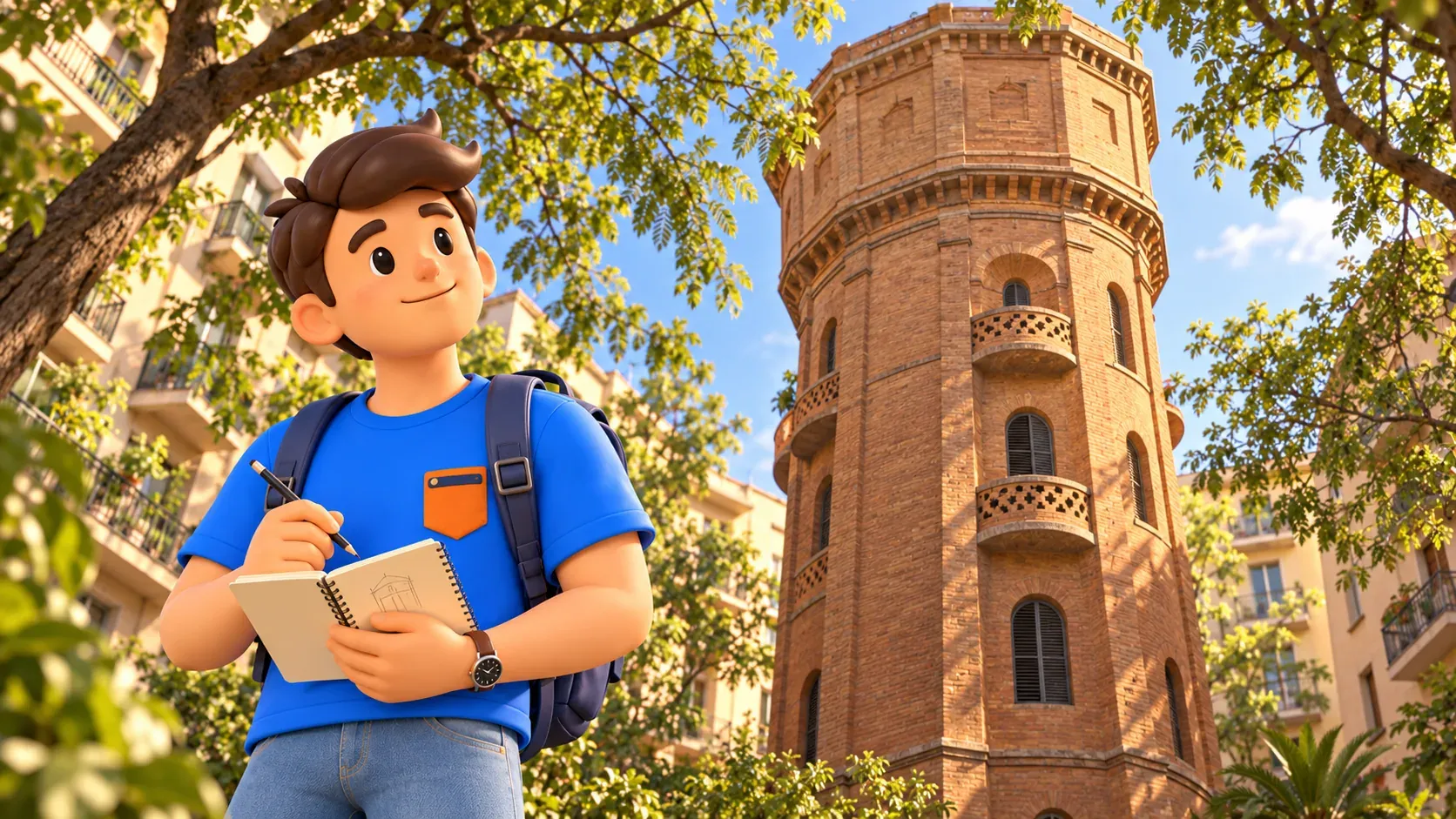
If the garden is open, look at the tower as part of the block’s interior. Brick, neighbouring apartment windows and tree branches reveal a different scale of the Eixample from its broad avenues. The garden entrance is approached from Roger de Llúria; a general marker for the block does not necessarily identify the passage you need.
An older description can create another kind of sightseeing trap by promising the “Eixample beach”. A small public pool did operate here, but the city’s tourism account describes that use as continuing until 2019. Do not plan a present-day swim around an old summer photograph or a description that belongs to that earlier period.
Nor should an inner-block garden be treated as a courtyard with unrestricted round-the-clock access. Such spaces have entrances and access arrangements. If a passage is closed, do not seek a way through residential entrances or private areas. The point is to understand the neighbourhood, rather than obtain one particular photograph at any cost.
Besòs: an ambitious project that changed its role
The Besòs tower has a different biography. It opened in 1882 as part of a scheme to supply drinking water drawn from groundwater around the Besòs. Its architecture is associated with Pere Falqués. Today, the tall brick form makes industrial history noticeable within an urban setting very different from the one in which it first operated.
The original project did not become an uninterrupted success story. Increasing salinity in the late 1880s led to the suspension of supply to the population. The system later served industrial needs and became connected with the metalworking enterprise Can Girona, subsequently Macosa. One tower participated in more than one phase of the city’s working life.
That change matters more than a picturesque legend. Infrastructure does not always retain its original purpose, and major projects do not necessarily develop as their promoters expected. A surviving building allows a story about changing conditions, adaptation and new uses, as well as achievement. The visible landmark can hold those different chapters together.
From outside, separate the slender vertical form from its heavier base and widened upper section. Then look at the surrounding buildings. There is no reason to imagine every present tree, path and home as part of the tower’s original setting. A historic structure can survive an almost complete transformation of the environment around it.
Interior visits now operate with a guide. The regular ascent involves stairs, so seeing the exterior and going upwards are different decisions. The easier format also involves steps and does not automatically provide a step-free viewpoint. Choose according to your own needs and the current offer, rather than a generic “tower” label on a sightseeing list.
For this introduction, the distinction is enough: Besòs connects an intended urban supply with later industrial water use. Cultural visits add a further chapter today. You do not need to turn each phase into a separate compulsory stop or learn a full inventory of technical equipment to understand that shift.
Catalana de Gas: gas production needed water too
The third tower’s name can be misleading. Its connection with a gas company does not make the structure a gas storage tank. It is a water tower, built in 1905–1906 for the Sociedad Catalana para el Alumbrado de Gas. The architect was Josep Domènech i Estapà, who should not be confused with Lluís Domènech i Montaner.
Today it stands in the Parc de la Barceloneta. That combination of name and location is enough to prompt another look: an apparently familiar green space can preserve evidence of former industrial use. A park does not erase history, although it changes how a passer-by experiences a surviving structure within it.
The architecture combines a narrower shaft, the volume of the tank and a distinctive finish with a conical roof. Decorative materials show that a technical function could receive a carefully designed exterior. This does not make every such structure a work by Gaudí, or every piece of ornament evidence of the same architect.
An archival view is especially useful here. In an old image, the tower rises above industrial roofs in a different setting. That picture can explain former relationships, but it is not a photograph of today’s park. When comparing past and present, first ask when the source was made and what lies outside its frame.

For a sightseeing introduction, exterior observation from permitted public areas is sufficient. An elaborate upper section does not prove the existence of a publicly accessible viewpoint inside. Do not build your day around the assumption that every water tower can be visited in the same way. Historical purpose and present access are separate questions.
Three questions to take on a walk
First, ask who needed the water: new homes, a city supply project or industrial production? The answer changes the meaning of a similar-looking vertical form. One story brings residential expansion into focus, another the fortunes of a major water scheme, and another the needs of a particular working environment.
Second, ask which part of the former system survives. An isolated tower can begin to look like an independent monument, although it once depended on equipment, other buildings and connections. You do not need to redraw those with engineering precision. Simply keep in mind that the visible fragment and the whole historical system are different things.
Third, notice what has changed around it. Gardens, parks, homes and newer streets provide another frame. Look beyond the oldest object to the differences of scale between it and its neighbours. History becomes visible through relationships, rather than only through a date recorded on an information panel.

These questions work well with children too. Start with a simple comparison: where is the wider part, what does the outline resemble and why is water connected with height? There is no need to present an abstract sketch as the actual tower plan or guess how an unknown pipe operated. Curiosity is more valuable than an unsupported confident explanation.
Including one tower in an ordinary day
You do not have to collect all three examples. They belong to different urban contexts, and a shared theme does not create a compact walking route. Choose the one that fits the area of your day: inner Eixample, Poblenou or Barceloneta. A small observation can then complement the outing rather than take over the whole trip.
If an interior visit at Besòs appeals, treat it as a separate activity with a chosen time and appropriate format. If you are interested primarily in the streetscape, an exterior view may be enough. Neither choice makes the experience more correct. Understanding your interest matters more than confusing architectural appeal with permission to enter.
Let RoadMe work out a personal trip plan around your interests and preferred pace, placing unusual places on days that suit you. It is a more convenient and effective approach than manually linking distant towers simply because they appear in the same article.
To follow the theme further, see our guide to industrial Poblenou. It explores how to read a neighbourhood through buildings and changes in its surroundings. Water towers offer a related discovery: behind a recognisable shape lie ordinary needs, from finding somewhere to live to keeping workplaces supplied.
At the end of a walk, try remembering one of those needs as well as the silhouette. The brick tower then becomes more than an unexplained ornament between trees. It is an understandable trace of a working city that solved practical problems long before some of its technical structures became cultural heritage.


