
Arbat and Its Lanes: From Pushkin to the Melnikov House

For an Arbat walk with more variety than a straight stroll past souvenir shops, start at Pushkin's memorial apartment, continue to the Okudzhava monument and turn into Krivoarbatsky Lane for the Melnikov House address. Return to Arbat for the Vakhtangov Theatre and the Princess Turandot fountain, then decide whether to finish or add the Tsvetaeva House-Museum as a separate extension. The main outdoor programme can take about two to three hours with a proper pause.
One important condition shapes this itinerary: at the time of checking, the official Melnikov Museum pages state that both the house and its grounds are closed for restoration. This walk does not include admission there. Any view from the public lane depends on actual barriers and sightlines. All durations are planning estimates; museum and theatre visits require their own available tickets and time.
Set a personal focus before choosing visits
The main route links different ways of living and creating in Moscow: Pushkin's domestic address, Okudzhava's remembered Arbat, Melnikov's architectural experiment and the theatre's public world. It works through exterior observation. Choose an optional interior only if its subject interests you; do not plan a Melnikov tour while the museum reports a restoration closure.
For a trip that follows your own balance of literature, architecture and walking, try RoadMe: the app creates a personal day-by-day plan using your dates, interests, pace and budget. It is a convenient way to turn these connected ideas into a programme that is easier to use on the streets.
Use Smolenskaya as the starting metro reference and choose your actual exit with current navigation. The basic walk heads from the western part of Arbat towards the theatre and eventually Arbatskaya. The Tsvetaeva extension crosses into another part of the neighbourhood and should be added deliberately, not treated as the next doorway on the same pedestrian street.
Pushkin on Arbat: begin with a real home
The memorial apartment is at 53 Arbat. Pushkin lived here with his wife in 1831, giving this address a domestic scale that differs from statues and grand literary celebrations. From outside, take a moment to look at the relationship between the house and the street. The useful idea is that a famous writer also rented rooms and organised an everyday life.
The museum belongs to the State Pushkin Museum devoted to the writer. It should not be confused with the Pushkin State Museum of Fine Arts elsewhere in Moscow. If you choose an interior visit, check the specific Arbat branch, current opening information and ticket conditions. The main museum's address or timetable is not a substitute for this branch's information.
Allow roughly an hour to ninety minutes if you want a selective museum visit, plus outdoor time. That is an editorial allowance rather than an official visit length. If literature is a secondary interest, an exterior stop can be enough. You are building a walk with related stories, not trying to complete every room associated with a famous name.
Walk towards Okudzhava and notice the street between
Continue east along Arbat towards the monument to Bulat Okudzhava near house 43 and Plotnikov Lane. A short distance can still contain a good part of the outing: look above the shopfronts and compare the heights, balconies and changing facade rhythms. Use the pedestrian street as a place to observe rather than a corridor to rush through between literary addresses.
Okudzhava's association with Arbat brings a different voice and period to the walk. The monument creates a point of remembrance within an everyday street. You do not need to know the words of his songs to understand why a poet and singer can become closely connected with a district. For a first encounter, that relationship is more useful than a long list of biographical dates.
Keep the passage clear while looking or taking photographs. Street performances, displays and seasonal crowds can change how quickly you move, so avoid treating estimated walking time as a timetable. If someone wants to browse a shop or listen briefly to a performer, agree on a nearby meeting point instead of losing the group.

Krivoarbatsky Lane: a different architectural question
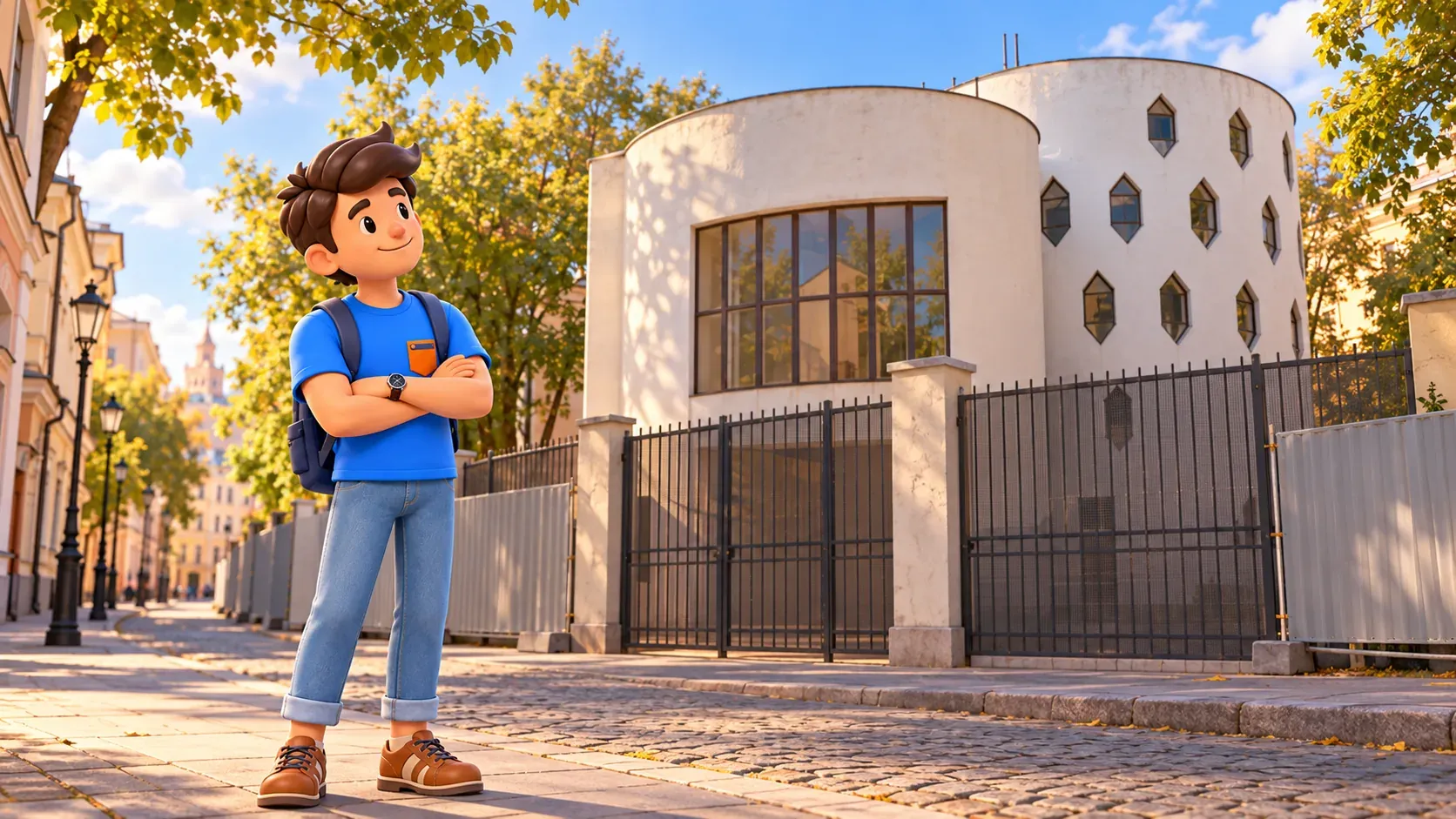
Turn towards Krivoarbatsky Lane and the Melnikov House at number 10, using the actual public pedestrian connection. This is a short change of environment rather than a journey to a separate distant district. The narrower setting helps explain why a modern architectural experiment can feel surprising in a neighbourhood associated with older houses and literary memories.
Built in the late 1920s as an architect's home and studio, the house is known for its intersecting cylindrical forms and distinctive windows. For this walk, the central question is simple: what changes when a home is designed around an individual way of working rather than a conventional street facade? You do not need to describe the whole floor plan to begin thinking about that.
Stay on public space and observe whatever is actually visible. Closed gates, fencing, equipment or restoration covering can limit the view. Do not try to look into windows, enter adjacent private property or reach around barriers for a photograph. If the building is substantially hidden, the address can remain a brief contextual stop rather than the visual highlight of your afternoon.
The Melnikov closure: keep the plan honest
The official house and courtyard information consulted for this article both announce closure for restoration. Older descriptions of small guided groups or ordinary courtyard hours should therefore not be used as an admission promise. Recheck the museum's current notice before your trip, especially if seeing the building is the main reason for choosing this walk.
If a future reopening is announced, read the actual new visitor rules and available bookings. Do not assume that a reopened courtyard automatically includes the house, or that a ticket to the Museum of Architecture's main site includes this separate address. Until current information confirms otherwise, this itinerary provides only an optional exterior orientation from the public lane.
Return towards Arbat when you have seen what is possible. Allow twenty to thirty minutes for the lane detour and a short look as a flexible planning margin, not a guaranteed viewing session. There is no need to wait for access that is not offered. The rest of the neighbourhood supplies a complete walk even if this stop is very brief.

Vakhtangov Theatre and Princess Turandot
Continue along Arbat to the Vakhtangov Theatre at number 26. Here the street shifts from private homes and remembered writers to a place people gather for a performance. The Princess Turandot fountain supplies a sculptural reference beside the theatre. Treat it as a visual stop without depending on the water being switched on in a particular season.
A theatre visit is a separate commitment, not a quick extra interior. Check the performance, language, duration and ticket conditions. The institution uses several stages at different addresses; a ticket bearing the theatre's name does not necessarily mean the main entrance at 26 Arbat. Read the stage and entrance on your actual booking.
If you already have an evening performance, make the walk shorter and leave a proper meal and arrival margin. If you do not, enjoy the exterior setting and keep moving at your own pace. Do not build the afternoon around an assumed possibility of stepping into the auditorium between performances.
Take a break before adding another literary address
By the theatre, you have already connected three different strands of the district. Take a seated break before deciding whether to continue. For a compact outing, finish by walking towards Arbatskaya with current navigation. For more literary context, consider the Tsvetaeva House-Museum extension, but account for the crossing beyond Arbat and the independent museum visit.
If you want literature to shape the rest of your Moscow trip, RoadMe can build a personal plan around that interest and the pace you prefer. Preparing the day in the app is more convenient than trying to assemble a workable route from unrelated saved addresses while walking.
This is also a good moment to compare expectations. A person who has visited Pushkin's apartment may prefer an outdoor finish, while someone else may be keen on Tsvetaeva. You do not have to make every participant visit both museums. Agree on a shared end or meeting place before splitting up.
Optional extension: Tsvetaeva in Borisoglebsky Lane
The Tsvetaeva House-Museum at 6 Borisoglebsky Lane is another destination, not a room attached to the Arbat walk. Use current navigation for the route across the larger roads, following the available pedestrian crossings. Do not shorten the line on a map by assuming a direct surface crossing where none is offered.
Choose this addition because you are interested in Marina Tsvetaeva and the literary house-museum format. It offers a different personal story from the Pushkin address. If you plan an interior visit, check this museum's programme, admission and opening arrangements separately. An exterior look is possible only from whatever public approach is actually accessible; surrounding courtyards should not be treated as open tourist passages.
Allow a meaningful extra block rather than a spare ten minutes. Walking there, entering a museum and returning to transport can turn the outing into a half day. If that does not suit the group, save the address for another time. A focused Arbat visit has already fulfilled its purpose without this extension.
Make the walk comfortable in different conditions
In dry weather, use the outdoor sequence and allow time for small details. In persistent rain, centre the day on the one literary museum you truly want, with brief street sections around it. Melnikov's closed house cannot be your indoor alternative. In winter, favour daylight for the lanes and keep pauses short enough to stay comfortable.
With children, a visual task can make the contrasts clear: compare a familiar rectangular house with the rounded Melnikov forms, if visible, or look for the difference between a statue and a fountain. Avoid promising an interactive museum programme without checking it. Anyone with limited mobility should ask the selected museum about actual stairs and access, rather than infer ease from the short route.
Before leaving, check current museum notices, the return journey and any fixed theatre start. Keep enough margin for food and orientation. Arbat becomes more interesting when the famous street is a framework for individual lives and experiments: a poet's home, a remembered singer, an architect's unusual address and a theatre can form a satisfying walk without turning into a race.


