
Half a day at Al Hosn: fort, crafts and culture

Al Hosn is a useful choice when you want a few connected hours of culture in Abu Dhabi without crossing between islands. Begin with the fort, give the House of Artisans one focused visit and finish with a chosen exhibition or activity at the Cultural Foundation. Together they connect the city's governing history, everyday skills and public cultural life.
Allow roughly four to five hours for this version, including a proper pause. That is an editorial planning estimate, not a measured route or an official tour length. It assumes selective visits rather than every gallery, demonstration and event. A booked workshop or performance may change the order and the length of the programme.
Give the half-day one clear theme
The simplest theme is how a city becomes a place where people govern, make things and share knowledge. Qasr Al Hosn provides the historic framework; the House of Artisans brings attention to materials and work; the Cultural Foundation opens the story towards education and the arts. This is a route through different ways of understanding the same area.
Before leaving, choose which part matters most. If you want history, protect the fort visit. If making interests you, begin with the craft programme. If a particular exhibition or performance is the reason for coming, arrange the other visits around its confirmed time. There is no benefit in preserving the order at the expense of the experience.
To make these choices easier, try RoadMe: the app prepares a personal itinerary around your interests, dates, pace and budget. It is a more convenient way to turn a cultural half-day into part of a complete trip that fits what you actually want to see.
Use a simple structure: a main visit, a shorter change of subject, a pause and one final experience. The benefit of Al Hosn is the compact grouping, not a reason to fill every available minute. Keep enough time to stop when one part becomes more interesting than expected.
First stop: read the city through Qasr Al Hosn
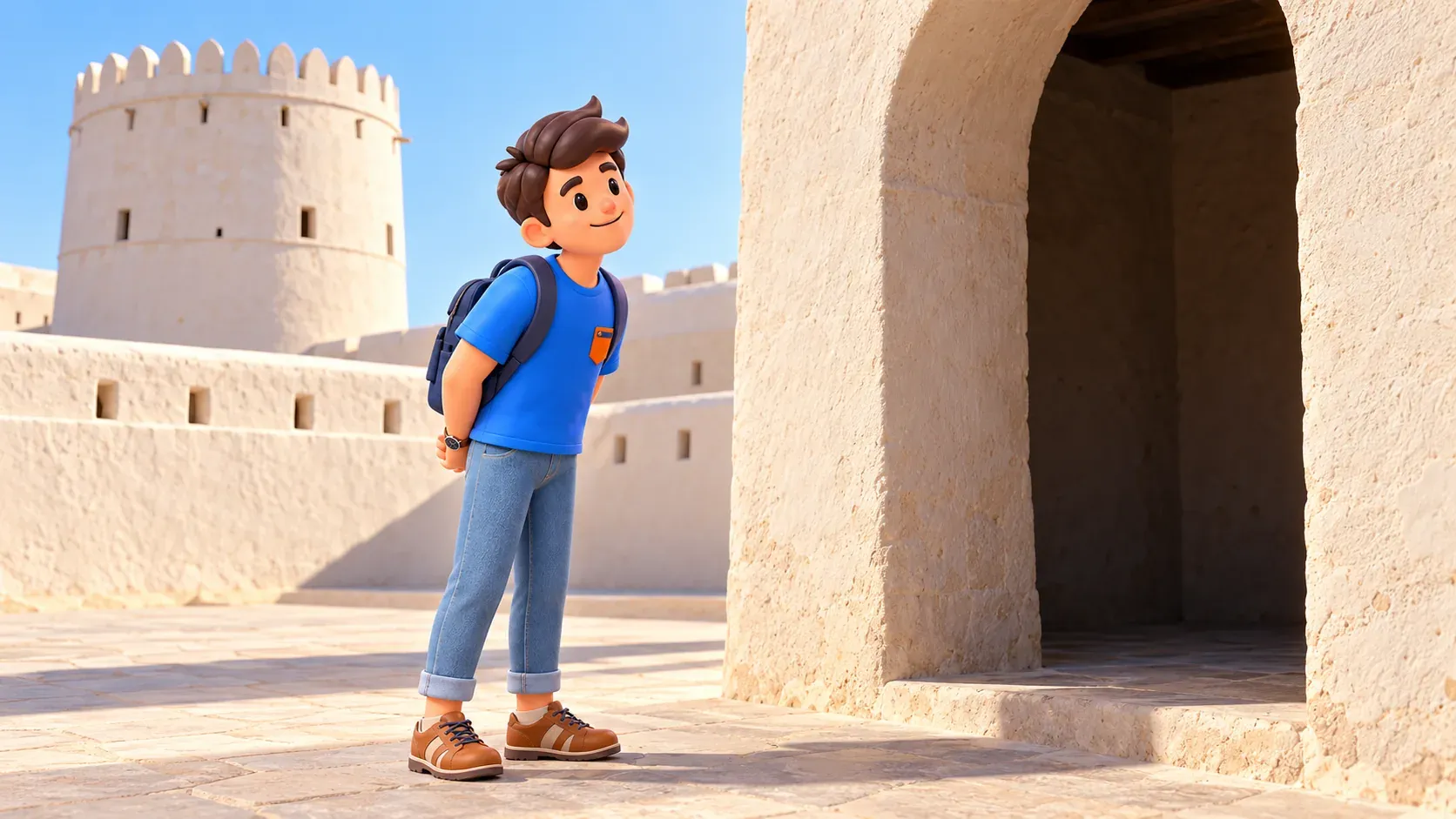
Begin at the historic fort when its actual visitor arrangements fit your day. Around an hour and a half to two hours can be a starting allowance for an attentive first selection. The exact time depends on how much of the interpretation you read and which areas are accessible on the date.
The complex grew through several stages rather than appearing as one finished monument. A watchtower, an inner fort and a later outer palace tell different parts of the story. Its roles as residence and centre of government help explain why the site matters beyond its recognisable white walls.
This history returns Abu Dhabi to the scale of a coastal settlement before the modern skyline. Fishing, pearling and trade shaped that earlier world. You do not need to learn a long sequence of rulers to understand the contrast: look at the relationship between fortified edges, domestic space and the courtyards within.
Give yourself a small observation task. Compare a shaded opening with an exposed wall, notice the depth of a passage or look at how a tower changes the scale of an otherwise low building. Such details make the architecture easier to remember than a quick circuit looking for the best photograph.
A selective visit is enough for this itinerary. Read the sections that explain the building's changing functions, then allow yourself to leave with a few clear ideas. The neighbouring stops will add other kinds of history; you do not need the fort to answer every question about the whole city.
Second stop: choose one material at the House of Artisans
The House of Artisans changes the scale from walls and institutions to things made by hand. Its subject is living skill: how available materials become useful and expressive objects. For a half-day route, choose one technique to look at closely rather than treating the visit as another list to complete.
Techniques include Sadu weaving, decorative Talli work and palm-leaf weaving. They are different traditions, with different materials and uses. Notice how a pattern belongs to a structure and how an object's shape responds to its purpose. This is a useful way into the subject even without specialist knowledge.
For a shorter visit, start with something ordinary such as a woven container, a textile or a decorative edge. Ask what needs to happen before the finished object exists: preparation, repeated movements, tension and finishing. The point is to recognise the skill behind a familiar-looking item, not to master the whole process in one stop.
Allow roughly forty minutes to an hour for a focused introduction as an initial planning estimate. If you want a workshop or demonstration, check the current programme and its booking conditions first. Do not assume that someone will be working at every station whenever you arrive, or that viewing and participation share the same admission.
Ask before photographing a person at work or handling an object. Observing a technique does not automatically mean touching the materials or joining in. A patient, respectful visit also leaves room to notice the rhythm of the work instead of concentrating only on the finished souvenir.

Take a real pause before the final visit
Place a meal or a seated break between the craft stop and the Cultural Foundation. After two information-rich visits, another gallery can become tiring even though it is nearby. A pause helps you decide whether you want more art, a shorter look at the building or simply an earlier finish.
Choose the break according to what is actually open and suitable on the day. Do not base the route on an unverified café name or assume that every cultural programme includes refreshments. Carry water and leave a little flexible time rather than reserving the entire gap for one tightly timed lunch.
The grouping is compact, but outdoor movement remains part of the day. In hot conditions, shorten exposed wandering and follow the designated access routes. A small distance on a map does not guarantee shade, and an indoor destination does not make the approach identical for every visitor.
Finish with one Cultural Foundation experience
The Cultural Foundation introduces a different period of the city's story. Opened in 1981, it was designed by The Architects Collaborative, or TAC. Its modern architecture and public cultural role offer a useful comparison with the older fort: the area connects a former governing centre with spaces for art, learning and gathering.
Look at the building as part of the visit, not simply a container for whatever is on. Courtyards, shaded passages and repeated openings provide a calm visual thread. You can compare their use with what you noticed at the fort without needing a detailed architectural lecture or trying to classify every motif.
Then select one current experience. An exhibition may suit an unhurried end; a scheduled workshop or performance creates a more definite appointment. The Children's Library is relevant to a different kind of family visit. Check the actual programme and conditions for the specific activity rather than assuming unrestricted access to every space.
If the fort has sparked a new interest, use RoadMe to shape the rest of your trip around it. Planning in the app is more convenient when you want history, crafts and contemporary culture to form a personalised itinerary across your available days.
As a first estimate, allow around forty-five minutes to an hour and a quarter for one selected Foundation experience, unless its scheduled format requires more. A performance belongs to its own timetable. If it is your priority, remove part of an earlier visit instead of treating it as a small addition.

Adjust the route to the people travelling
With children, give each stop one simple question: what did the tower do, how is this object made, or what do you notice in one artwork? The route works better as a sequence of manageable discoveries than as three long lessons. Choose any library session or workshop by its actual audience and participation rules.
For adults travelling with different interests, agree on the main visit first and shorten the least appealing section. Someone interested in architecture may enjoy the relationship between buildings more than another full exhibition. Someone interested in making may want to stay with one craft rather than hurry on to preserve a nominal balance.
If walking, standing or moving between levels matters to your group, confirm the practical access for the relevant entrances and activity. The closeness of the three destinations is helpful but does not establish step-free access or remove every outdoor section. Avoid turning a compact cultural area into a promise about conditions you have not checked.
What to check before setting off
Check the visit arrangements for the date, the first entrance you need, the booking for any timed activity and what the chosen ticket actually covers. Treat the fort, a workshop, a performance and a library programme as potentially different bookings. A general description of the site does not guarantee the same conditions for all of them.
Keep arrival and departure outside the estimated visit blocks. Follow the live visitor directions through the area rather than using this article as a turn-by-turn map. If a programme has changed, preserve the route's idea with a shorter available experience; there is no need to replace it with a distant major attraction.
Finish when the half-day has given you a clear picture. You may leave with one architectural detail, a new understanding of a handmade object and an exhibition you enjoyed. That is a complete cultural outing, with room left in the trip to follow whichever subject interests you next.


