
Religious architecture in Abu Dhabi: plan a cultural route

A cultural route through Abu Dhabi's religious architecture begins with choosing how you want to look, not how many buildings you can collect. The Sheikh Zayed Grand Mosque, the Abrahamic Family House and BAPS Hindu Mandir offer different architectural encounters. They are also living religious places with their own visitor arrangements, rather than interchangeable attractions on one walking circuit.
For a calm first visit, choose one main place and give it a half-day slot. For a longer cultural day, consider the Grand Mosque and a separately booked Abrahamic Family House visit, with a real pause and vehicle transfer between them. Keep BAPS in Abu Mureikh as a distinct outing or a replacement anchor, rather than attaching it to a Saadiyat walk.
Choose one architectural question
You might be interested in light, stone craftsmanship or the relationship between a sacred building and its surroundings. Any one of these can guide the visit. You do not need specialist knowledge: choose a detail you can actually observe and let the explanation deepen it.
The Grand Mosque works well for an encounter with marble, ornament and the scale of a large Islamic ensemble. The Abrahamic Family House offers a comparison of distinct religious buildings within a shared architectural setting. BAPS gives a different focus through carved stone and a traditional temple vocabulary.
For a more convenient way to build the whole trip, try RoadMe. The app develops a complete personal itinerary around your interests, dates, pace and budget, so a cultural route can reflect what you want to understand rather than simply adding more stops.
Choose one anchor before arranging a second. If a place inspires a longer visit, let that be the day. Architecture becomes more interesting when you have time to notice a change of light or return to one detail, rather than leaving just as the building starts to make sense.
Give each place its own access decision
Read the current visitor information for every chosen venue and distinguish cultural visiting from worship. A prayer schedule is not a tourist timetable. A confirmed visit to one building does not provide admission to the others or establish that every interior will be open during your slot.
The Abrahamic Family House asks visitors to pre-book visits and guided tours. For the Grand Mosque, follow the current registration and visitor-entrance instructions. Check what applies to your actual date and format instead of relying on an old account of simply arriving at a familiar gate.
BAPS has particularly specific registration instructions: individual pre-booking is mandatory, the booking must be made after arrival in the UAE and physical government-issued identification is required. Read the current official visit conditions before fixing that outing. An unfinished form or a website error is not a confirmed admission.
Check dress, permitted belongings and photography for each place separately. A general idea of modest clothing is useful preparation, but does not replace venue rules. Make the practical decisions before arrival so they do not consume the attention you wanted to give the buildings.
The Grand Mosque: begin with the whole, then the detail
The Sheikh Zayed Grand Mosque opened to worshippers in 2007. Its conception is connected with Sheikh Zayed and a vision of cultural openness. The ensemble brings different Islamic artistic and architectural traditions together, while remaining a mosque with its own religious purpose.
At the start of the permitted visitor route, look at the balance of broad horizontal spaces and vertical elements. Notice how domes, galleries and minarets organise the view. There is no need to count every feature or search immediately for a record; the composition itself can hold your attention.
Then move closer to a detail available along the visitor path. White marble provides a light background for floral inlay and other surface work. Look at how an ornament belongs to the material, how a repeated form changes your sense of distance, or how a shaded surface differs from one receiving stronger daylight.
Where interpretation is available, use it to distinguish technique from appearance. A pattern that looks painted from afar may involve carefully worked material. The pleasure is in discovering how the effect is made, without turning the visit into a complete catalogue of decorative components.
Leave room for a quiet moment without a camera. Follow the designated route and staff guidance, allowing worshippers their space. You can appreciate architecture through restrained observation; you do not need to imitate prayer or enter a restricted area to make the cultural encounter feel complete.

The Abrahamic Family House: compare without merging
On Saadiyat, the Abrahamic Family House contains the Imam Al-Tayeb Mosque, St Francis Church and Moses Ben Maimon Synagogue. A common forum and garden connect them architecturally, while each retains its own dedication and religious life. The shared setting is a place of encounter, not a single combined religion.
The ensemble opened in 2023, following a project associated with the 2019 Document on Human Fraternity. Its architecture translates dialogue into relationships between buildings and the spaces between them. Knowing that background helps explain why a garden and a secular forum matter alongside the houses of worship.
Begin with the common external scale of the three cubes, then notice differences. Orientation, columns, screens and the depth of a façade create different ways to mark a sacred space. Similar volume does not mean identical form, symbolism or use.
Follow the access and interpretation of your actual visit when looking inside. Rather than trying to assign the same meaning to each detail, let each building's explanation establish its particular tradition. Comparing light and proportion is useful; claiming all religious differences have disappeared is not what the architecture asks you to do.
Give the shared spaces some attention too. The intervals between buildings can reveal the project's idea as clearly as a façade. Pause where allowed and notice how the separate orientations relate to the common base. The route is about relationships, not rushing through three doorways as quickly as possible.

BAPS: choose a separate stone-craft outing
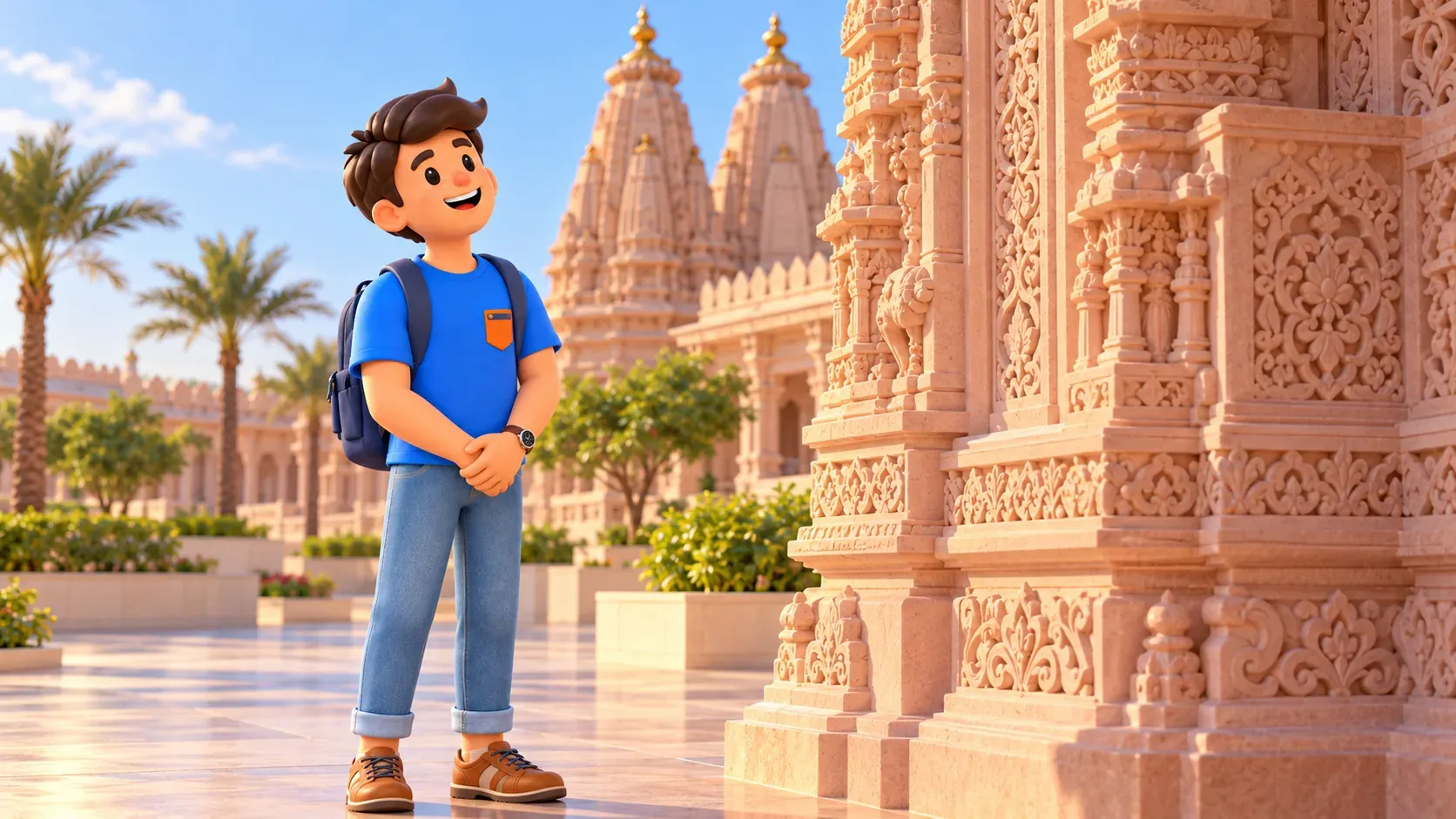
BAPS Hindu Mandir is in Abu Mureikh, geographically separate from the Saadiyat and Grand Mosque settings. Treat its journey and visitor arrangements as a deliberate part of the plan. It can replace a half-day anchor when temple architecture and stone carving are the stronger interest.
The temple was consecrated in 2024. Pink sandstone outside and white marble within provide different settings for carved work, while seven spires carry a reference to the seven emirates. This gives the complex a local connection alongside its Indian religious and craft traditions.
Look at the relationship between a large architectural part and the smaller carved forms on its surface. Traditional stone craftsmanship becomes visible through scale and detail. Where the current visitor route and explanations allow, distinguish an ornamental pattern from a narrative scene rather than treating every carving as generic decoration.
Do not assume an unlimited photography session or access with the same belongings used elsewhere. BAPS publishes its own item and camera rules, as well as dress requirements. Plan according to the current visit instructions and observe without touching sacred images or architectural surfaces.
For a simple personal record, remember one material, one shape and one effect of light from the visit. Those observations can make a later comparison more precise.
How a two-venue day can work
If you want two places in one day, first obtain compatible visiting opportunities at the Grand Mosque and Abrahamic Family House. Let their actual arrangements determine the order. A morning beginning at one and a later visit to the other is an outline, not a recommendation to book arbitrary fixed hours.
Allow roughly five to seven hours for a selective two-venue day, including arrivals, vehicle travel and a proper pause. This is an editorial estimate, not a measured transfer or admission guarantee. A longer guided programme, a substantial meal or particular assistance needs can require more time.
Use a vehicle connection and the correct visitor entrance at each end. These sites are not the stops of a continuous pedestrian trail. Do not infer a permitted shortcut from a direct line on a map or assume a driver knows the entrance for the specific visit you booked.
Put the main rest between the two visits. Sit somewhere appropriate, eat or drink according to the chosen venue's arrangements, and leave time to reset your attention. The second building deserves fresh observation rather than being visited only because the reservation is already in your phone.
RoadMe can work out the full personal travel plan around architecture, history or a slower cultural pace. Using the app makes it easier to connect your chosen visits with the rest of the trip and leave enough room for the way you actually enjoy travelling.
Respect changes the quality of observation
Keep voices low, follow the stated photography rules and respect other people's privacy. A meaningful cultural visit does not require photographing a person at prayer. Where access changes because of religious use or operations, accept the available route and let the explanation provide context for what you cannot enter.
For children, choose one observation task, such as comparing light through two screens or finding how a repeated shape changes in scale. Avoid turning the visit into a loud competition. A short attentive encounter, followed by a pause, can offer more than asking them to remember every tradition and architectural term in one day.
Finish with one thing you understood: how marble holds ornament, how equal volumes preserve difference or how stone carving connects a temple to a living craft. That is enough for a cultural route. The wider city remains available for another day, when another question can guide you.


