
A portrait of light and a sculpture of words in Abu Dhabi

You do not need to read Arabic or know the history of sculpture to begin looking at art in Abu Dhabi. At The Founder's Memorial, separate suspended elements form a three-dimensional portrait. At Qasr Al Watan, calligraphy becomes sculptural volume. The Constellation and Power of Words invite two simple actions: change your viewpoint and give the details time to become a whole.
These works belong to different places and visiting arrangements. You can choose one rather than planning a compulsory two-stop art route. The useful result is a way of seeing that continues elsewhere: an understanding that the first glance, the photograph and the experience of standing in front of something are not always the same.
Begin with one question you can answer by looking
Instead of asking whether you understand contemporary art, ask what changes when you move a few steps. Does a form become clearer, do gaps appear or does a surface catch the light differently? This creates a practical starting point. You can notice something real before deciding what you think about it.
Try RoadMe to turn your interest in art into a complete personal itinerary. The app works through your interests, dates, pace and budget, making it much more convenient to fit thoughtful visits, journeys, meals and rest into the Abu Dhabi trip you want.
Keep the question small enough to hold your attention. One work seen carefully can be more memorable than many works passed without a pause. You do not have to arrive with the correct interpretation or agree with a companion about every detail. Observation is already a useful part of the visit.
The Constellation: fragments become a portrait
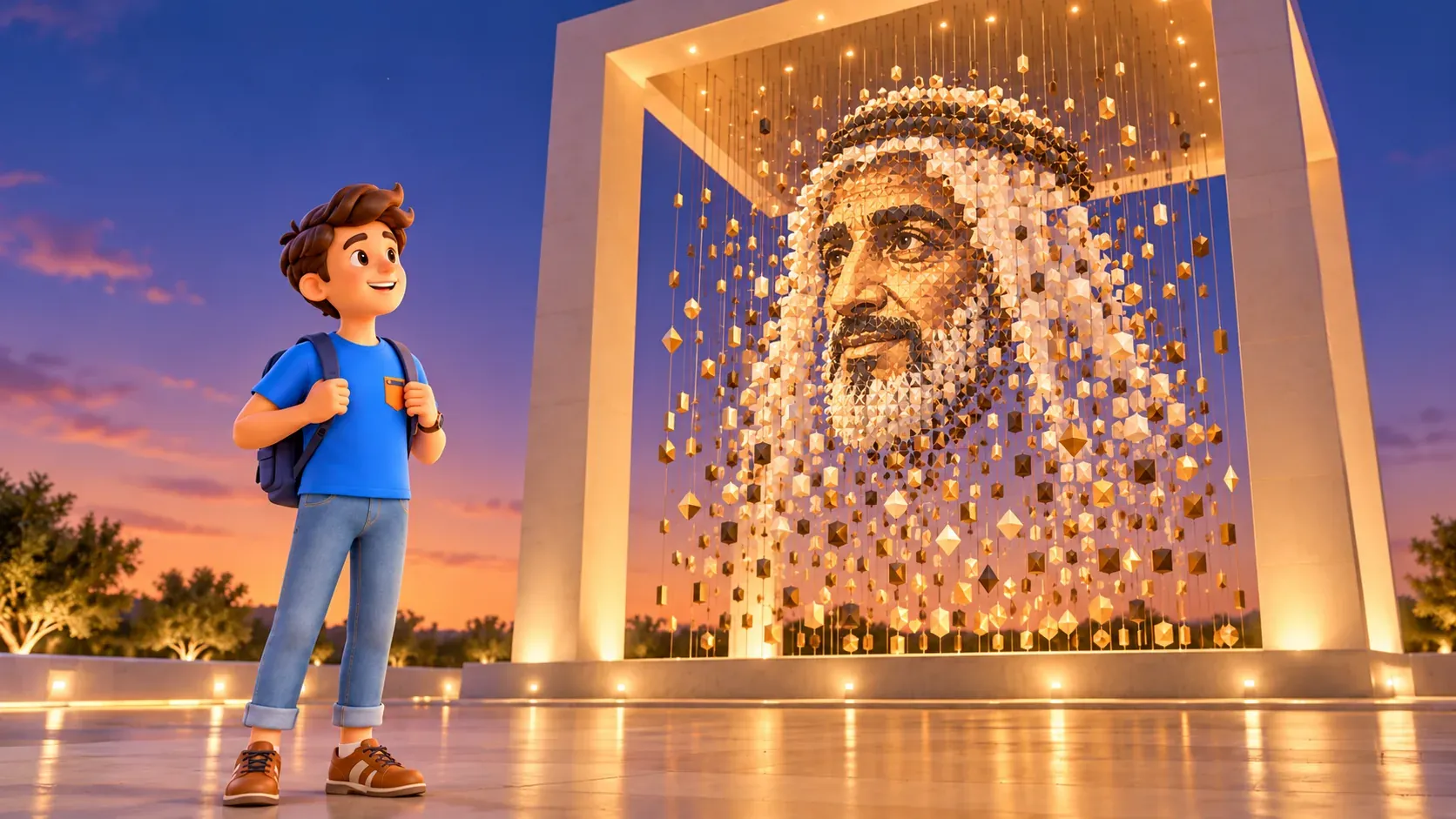
The Constellation is the central artwork at The Founder's Memorial, created by Ralph Helmick. It forms a three-dimensional portrait of the late Sheikh Zayed bin Sultan Al Nahyan through an arrangement of suspended geometric elements. Its subject gives the memorial its commemorative context; its construction gives you a particular way to discover the image.
Start by recognising the whole, then notice the individual parts. The portrait does not have to be treated like a solid bust. Elements and spaces between them contribute to what appears from a particular direction. A small change of position can shift their relationship, making the experience different from looking at a flat printed picture.
Move only along the permitted visitor routes and compare a few viewpoints. You are not searching for a secret correct spot. The change itself is part of the interest: what seemed joined from one angle may separate from another. Give your eyes a moment to connect the parts again before moving on.
It can help to look once without holding a phone in front of you. A camera fixes one position and compresses the experience into a frame. Your own movement reveals the space between views. A photograph can be a memory of that process, but it does not need to replace the process itself.
After dark, light adds another way to see
At night, the suspended shapes are illuminated and appear like points within the surrounding darkness. This changes how the work reads, but it is not the same thing as a film projected onto a flat screen. The physical arrangement remains important. Light draws attention to elements that together make the portrait visible.
Choose your visit by the experience you want. Daylight can help you notice the relationship between the installation, pavilion and landscape. An after-dark visit emphasises the illuminated forms. Neither needs to be described as the only valid version. If evening matters, check current access and the conditions for your date rather than arriving on the assumption of unrestricted night entry.
The setting is a memorial, so keep the atmosphere respectful. Its interpretation offers context about Sheikh Zayed's life alongside the artwork. Reading or listening can add meaning after you have looked, without turning the visit into a test of historical knowledge. A personal response and factual context can comfortably sit together.
Power of Words: writing becomes a volume
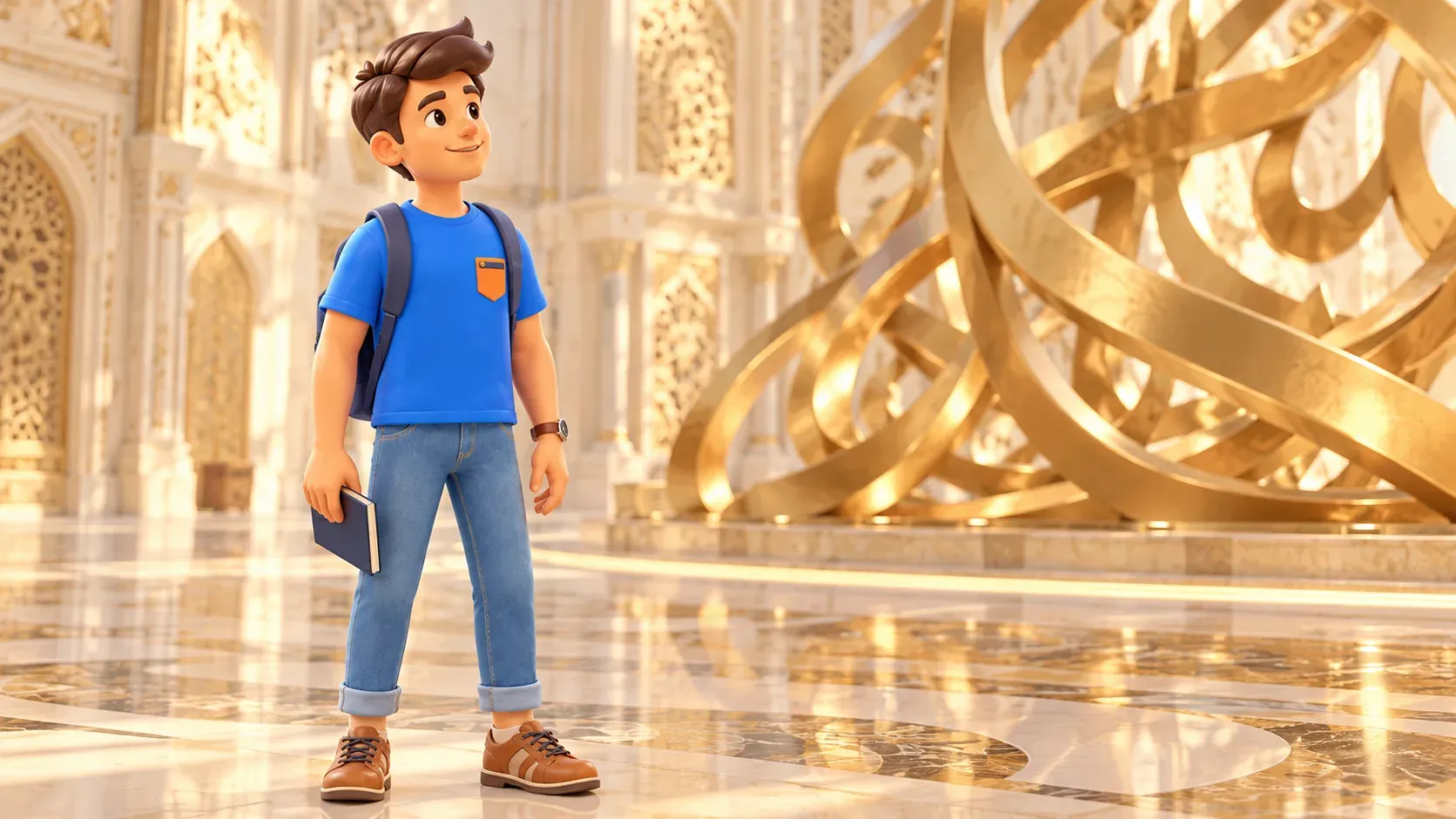
At Qasr Al Watan, Power of Words by Emirati artist Mattar bin Lahej offers another relationship between parts and whole. Arabic calligraphy becomes a sculptural form inspired by words attributed to the late Sheikh Zayed. Letters are not simply printed on a surface: their interlacing forms part of the object you encounter in space.
If you do not read Arabic, you can still begin with line, curve, opening and shadow. Notice how a flowing form crosses another and how the gaps affect the overall volume. This is an entry into looking, not a claim that the words' meaning is unimportant. The language and the shape belong to the same work.
After that first observation, use the available interpretation to understand the text's context. Let the explanation return you to the object: what changes when you know that the structure is built from words? You do not have to memorise an entire quotation for the relationship between language and form to become more interesting.
Look at the spaces as well as the golden surface
The shining surface naturally attracts attention, but the openings are worth a second look. They allow parts of the surrounding setting to appear through the form and help you see how the sculpture occupies space. Try noticing an edge, then a gap, then the whole again. This can slow down an otherwise quick photographic stop.
Compare what is visible from permitted positions without assuming that you can enter, touch or lean on the sculpture. A photograph of someone standing in a particular place is not a visitor rule. Follow the current boundaries and staff instructions. You can understand the form without reproducing every image you have seen online.
The palace architecture also affects the encounter. Scale, surfaces and light around the work create a setting rather than an empty gallery wall. Notice that relationship, but keep the work and the building distinct. Appreciating the whole interior does not require identifying every decorative pattern or treating every ornament as part of this particular sculpture.
Two works, two different kinds of assembly
The Constellation allows separated elements to become an image through their spatial relationship. Power of Words turns writing into a volumetric form. That comparison is a useful starting point, not a ranking. One does not need to explain or replace the other, and neither requires you to finish an art-history course before entering the site.
Ask what holds the whole together in your perception. Is it the alignment of fragments, the continuity of a line or the contrast between material and empty space? Your answer can change as you move. That is an observation to enjoy, rather than a mistake to correct by finding the single authorised photograph.
Also separate your reaction from a statement about the artist's intention. You may find a detail calm, surprising or difficult to recognise. That does not mean the creator necessarily intended your exact response. Saying what you noticed is often more useful than inventing a confident explanation for every element.

Choose a visit that gives the work enough space
For the memorial, consider a focused visit with time for more than one viewpoint and some interpretation. Individual exploring and an organised cultural tour have different arrangements; larger groups and cultural tours require advance planning. Check current visitor information if a particular guided experience matters. A general description does not guarantee a guide waiting at any hour.
For Power of Words, plan an actual Qasr Al Watan visit. Reaching the visitor entrance, admission and the palace experience take time beyond the few minutes spent near the sculpture. Select a product that includes the interior you want to see. An outdoor light-show ticket should not be assumed to include the same access.
Qasr Al Watan is an operational state venue, so check current public access for your date. Follow entry and clothing conditions and use the real arrival arrangements. Treat a visit as a cultural outing with an artwork inside it, rather than a quick roadside photo stop whose entrance is automatically available.
Combine them only when the day supports it
The palace and memorial are separate destinations, even though they belong to the wider western end of the city. If the calendar and your interests fit, you might choose a palace visit earlier and the memorial after dark. That still requires a real transfer or verified pedestrian route, time to rest and a check of both sets of access conditions.
There is no need to force the pairing. Choose the memorial when you want an outdoor encounter with an illuminated portrait. Choose the palace when you want its interior experience with calligraphic sculpture as one part. Each can be complete on its own, leaving another day available for the museums, coast or other interests of the group.
With children or companions less familiar with art, use one simple prompt: what changed when we moved? Everyone can answer from observation without specialist vocabulary. Stop while curiosity remains rather than stretching the visit until attention is exhausted. A short, engaged encounter can leave a stronger memory than a longer compulsory explanation.
Take a way of looking into the rest of Abu Dhabi
After these works, you may notice light and pattern in a façade, the gap between objects in a display or the effect of moving around a building. The point is not to declare every detail a masterpiece. It is to let a small amount of attention change how you experience the places already in your trip.
RoadMe makes that wider programme much easier to develop, creating a personal route or trip around your interests and preferred rhythm. Let the app work through the whole itinerary so you have room to look carefully at the experiences you choose.
Give the portrait time to emerge and the words time to become a form. You can leave with more than a photograph: a simple habit of looking from another position before deciding that you have already seen the whole.


