Verona with less walking: three compact outings in the centre

Seeing Verona with less walking starts with choosing a smaller area. A short outing can still offer a recognisable city view, something unexpected and time to sit down. You do not have to join the Arena, every square, both riverbanks and a hilltop panorama into a single circuit to feel that you have visited the city.
Here are three independent options: Piazza Bra and the Arena outside, Erbe with neighbouring Signori, or Castelvecchio with a brief look towards its bridge. Choose one to suit your interests and where you are staying. These are ways to spend less time moving between sights, rather than a promise to see all Verona without getting tired.
Choose one area and decide where the outing ends
The useful first question is not how many attractions fit on the map. It is where you would enjoy spending the next hour or two. Choose Bra for an unmistakable Roman landmark, Erbe and Signori for contrasting urban spaces, or Castelvecchio for a different encounter with brick-built Verona and the river.
RoadMe makes planning the whole trip around your interests and pace much more convenient. Try connecting walks, museums and downtime in the app, so that short outings become parts of a thoughtful personal itinerary.
You are not meant to complete all three options consecutively. Several small walks, joined by transfers, become another long sightseeing route. One area and a worthwhile pause are enough for a gentle outing. A second area can wait until another day or be chosen after a proper rest, with its approach considered afresh.
Name an endpoint before starting: return to your chosen side of Bra, finish after Signori, or stop in the castle area. An ending makes decisions easier. When the next attraction remains optional, the day is less likely to grow through an endless series of “while we are here” additions.
Option one: Bra and the Arena without a full circuit
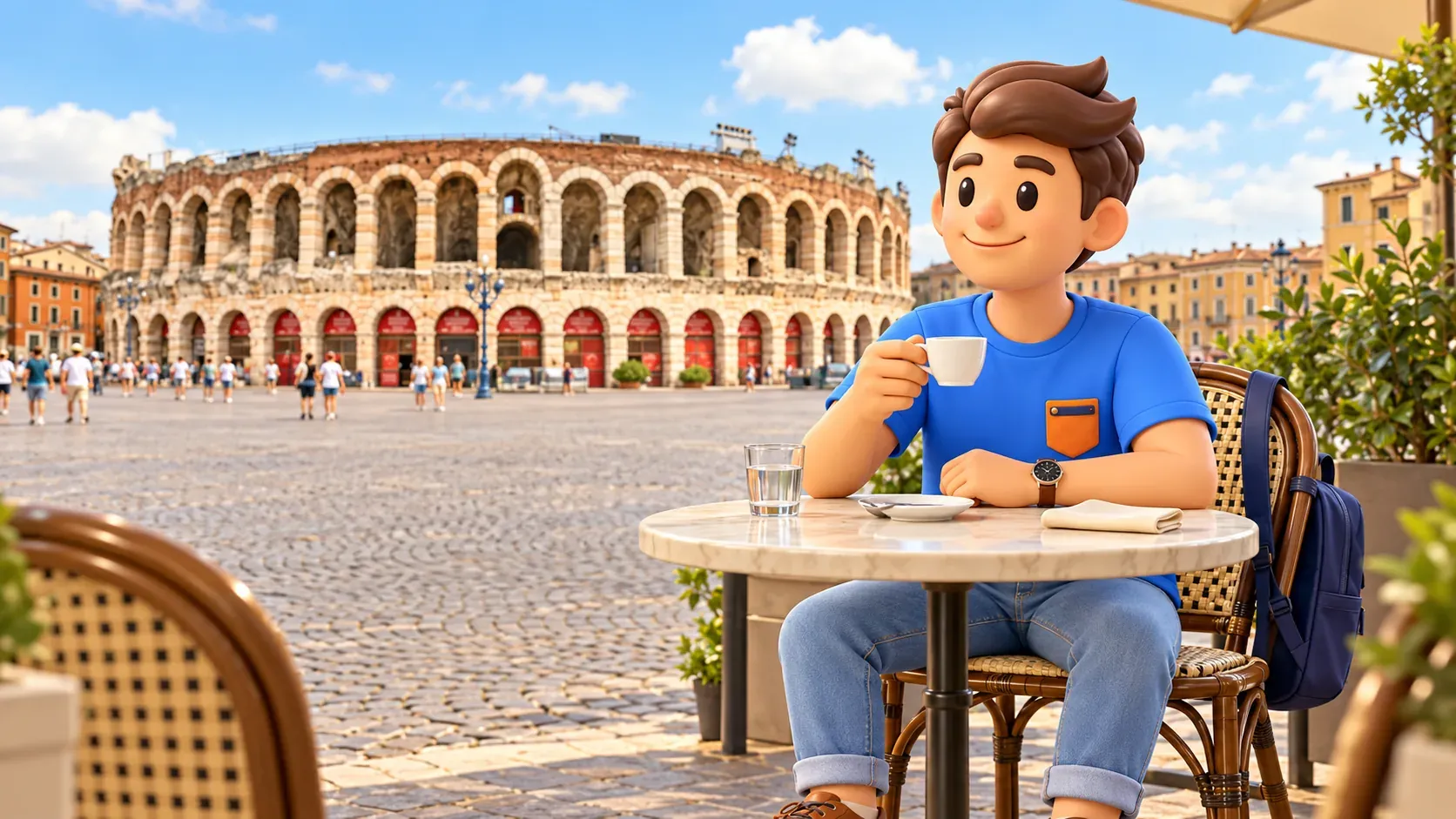
This works well for an initial impression or an arrival day when you want to see Verona without exploring a network of unfamiliar streets. Start and finish around Piazza Bra. The basic outing needs only an exterior view of the Arena and a selected part of the square; walking around the amphitheatre’s entire perimeter is unnecessary.
Spend a few minutes looking at the arches from a position that suits you. Then change position a little and compare the impression. Understanding a large Roman amphitheatre does not depend on accumulating metres around it. Its repeated openings, stonework and relationship with the surrounding open space already provide something absorbing to notice.
Turn towards the buildings framing the square afterwards. Bra developed across later periods as well, while the Liston belongs to Verona’s tradition of strolling. Without adding another destination, you can shift attention from an ancient monument to the way an ordinary city day unfolds around it.
Allow roughly 20–30 minutes for looking, 10–15 for moving between chosen viewpoints, 20–30 for a seated pause and another 10–15 of flexibility. Together that is approximately 60–90 minutes in the area. These are editorial allowances, not a recorded walking track. Waiting for a table and travelling to the square can extend the actual outing.
Arena admission is not included. A daytime interior visit, a performance and looking from outside are different activities. If you decide to enter, check the arrangements and allow separate time. A ticket purchase and queue should not be added to a compact outing as though they change nothing.
Option two: Erbe and Signori, then back again
This option starts and ends in the Erbe area. Choose a suitable part of the square to look at its surroundings, pass through Arco della Costa into Piazza dei Signori, and return through the same short connection. You are visiting a neighbouring urban space, rather than committing yourself to continue north towards the river.
Erbe is interesting because different periods share a small setting. The Roman forum occupied this area, but the present square is not an ancient space preserved unchanged. Painted Mazzanti house fronts and Baroque Palazzo Maffei offer very different kinds of facade within the same view.
You need not approach every detail closely. Pick a painted section and a pattern of windows, for example, and look from somewhere comfortable. Seeing architecture from a useful distance still counts as looking properly, particularly when the day’s purpose is to enjoy the city without continually moving to another position.
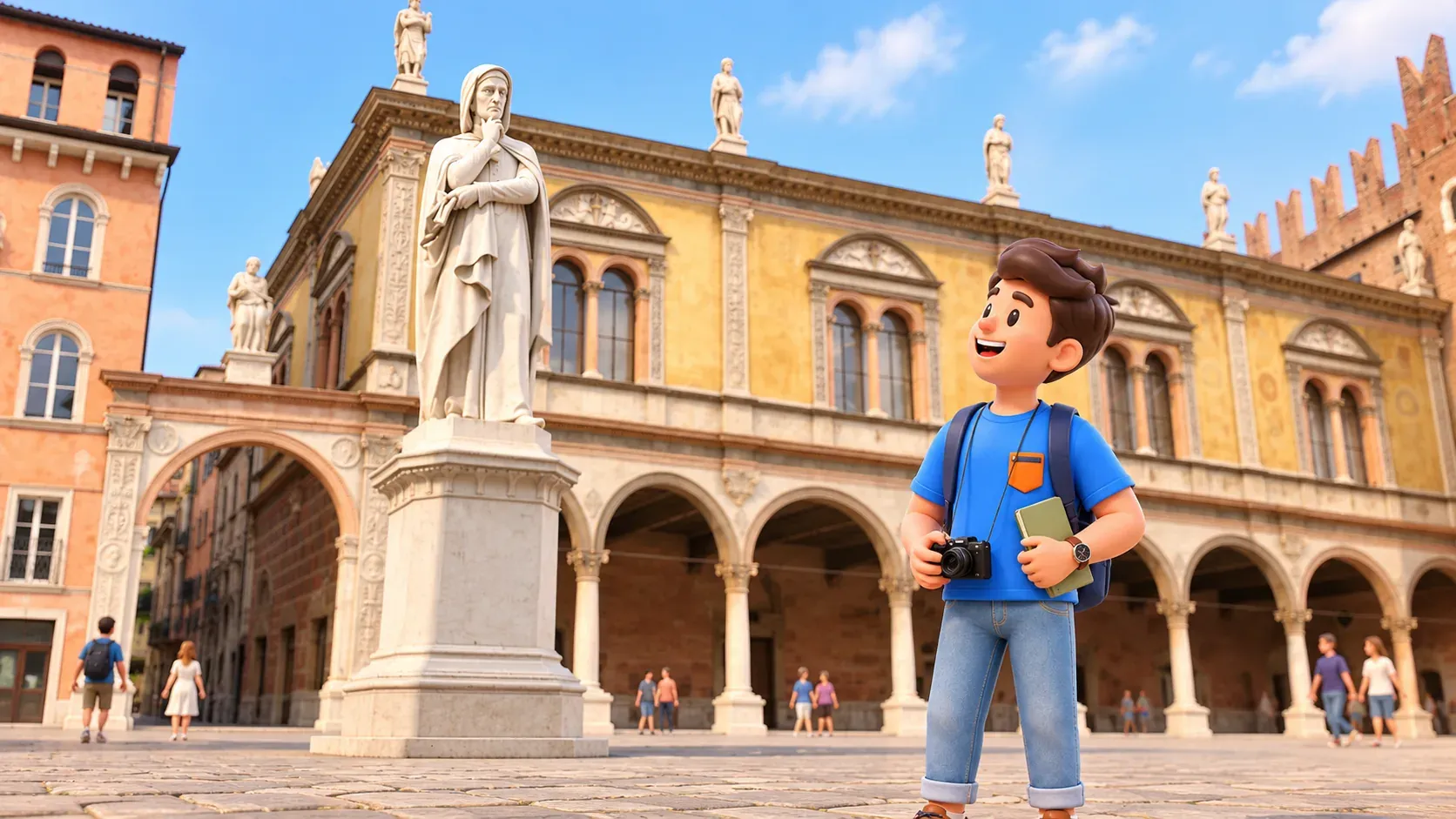
On Signori, turn your attention to Dante’s statue and the surrounding public buildings. This version needs neither a Lamberti Tower ascent nor a courtyard staircase nor an art-gallery visit. The change in the square’s character already supplies a second chapter without requiring an additional interior attraction.
Allow 30–40 minutes of observation across the two squares, 10–15 for short movements, 25–35 for a pause and 10–15 of flexibility. That gives approximately 75–105 minutes. Transfers within this option are included; your approach from accommodation is not. For an even smaller outing, keep Erbe alone and adjust the time to your pace.
The pause need not be at the most famous terrace. A suitable place to sit, the arrangements you need and a clear return matter more. Crossing half the centre in pursuit of a particular table defeats the purpose of choosing a compact area in the first place.
Option three: Castelvecchio and a nearby bridge view
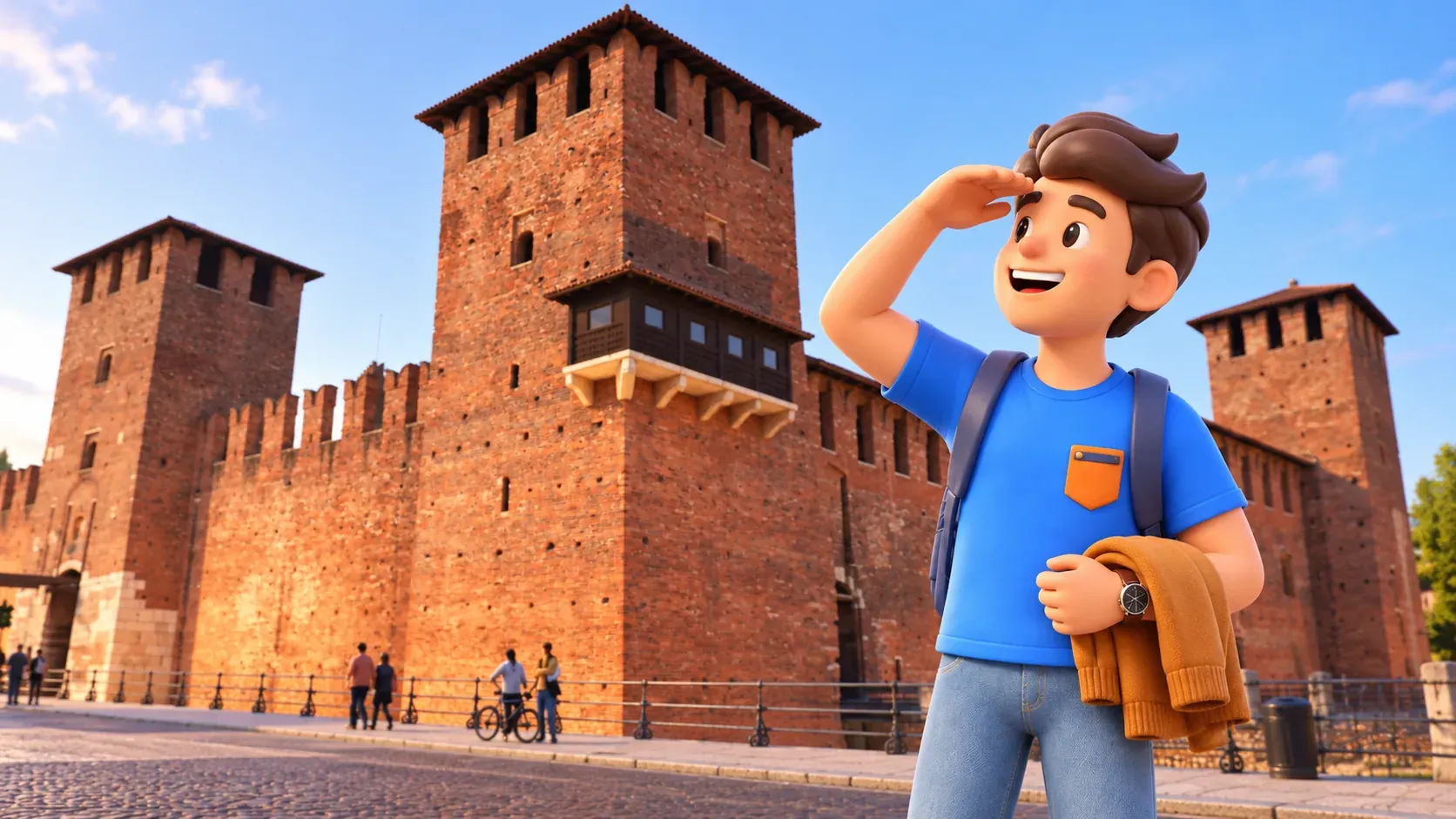
Start near Castelvecchio and finish in the same area. Choose a public street position for looking at the castle, then approach the near, city-side entrance to Ponte Scaligero if passage is available. The basic idea does not require crossing the entire bridge, continuing to the Arsenale or returning along another bank.
Castelvecchio belongs to the fortified world of fourteenth-century Scaliger Verona. Brick walls and towers offer a different city image from the Arena’s stone arches or the palace fronts around Erbe. Choose one architectural feature, such as battlements, wall material or a tower silhouette, and notice how it works within the whole.
The bridge continues that defensive character, although its history also includes destruction during the Second World War and later reconstruction. This is a useful small correction to the impression that everything before you has remained unchanged since the Middle Ages. A first encounter needs only that awareness of the structure’s different lives.
There is no requirement to reach the furthest possible viewpoint. Stopping earlier is a reasonable choice. If the entrance or your needed section is temporarily unavailable, the castle exterior remains a complete subject. Finding a long diversion to the opposite bank is unnecessary merely to satisfy a checklist.
The suggested allowance matches Bra: 20–30 minutes looking, 10–15 moving, 20–30 pausing and 10–15 of flexibility, or about 60–90 minutes altogether. Museum entry, queues, a full bridge crossing and travel from accommodation are not included. Choose the museum as a separate activity, considering movement inside as well as the short distance to its entrance.
Count the journey from your door
A short sightseeing programme can still produce a long day if reaching it involves considerable walking. Compare the actual approach from your accommodation or arrival point to each area. The nearest option that interests you may be more useful than the best-known combination of landmarks.
Consider the return separately. Finishing near the start works well only if the start itself is convenient. Arriving at the station, handling luggage, reaching the centre and returning later do not disappear because the sightseeing description mentions ninety minutes.
If you are considering transport, check the current stop and the walking section after getting off. A short ride does not necessarily deliver you to the door. Traffic restrictions apply in the centre, so avoid building a plan around the assumption that any vehicle can stop immediately beside any monument.
With RoadMe, it is easier to shape the whole trip around the places and pauses that suit you. A personal plan in the app helps distribute experiences across your days while keeping your preferred pace.
Reduce standing as well as steps
Queues, long periods standing and movement through museum rooms affect the day too. When shortening distances, reduce the number of compulsory admissions and leave space for sitting. An indoor attraction is not automatically a rest merely because it has a roof.
If wheelchair, walking-frame or pushchair access matters, check the entire route you need: surfaces, steps, entrance, toilet and resting place. A small square and a brief description do not establish identical conditions along every approach. These options help select an area; they do not replace an individual access check.
With companions, agree on a shared rhythm beforehand. One person might photograph details while another stays in a comfortable position, but settle the meeting point before separating. Waiting on your feet is not a universal way of giving everyone a break.
For arrival day, our short first-evening plan for Verona offers another possibility. Choose it instead of an extra programme if it better matches your accommodation. A satisfying ending is one clear memory and the wish to return, rather than an obligation to reach a final pin.