Okefenokee National Wildlife Refuge: Which Entrance to Choose
For a first visit to Okefenokee National Wildlife Refuge, choose Suwannee Canal Recreation Area near Folkston if you want a guided boat ride and a boardwalk on the same day. Choose Okefenokee State Park near Fargo for wooded waterways, a quieter approach and the option of drive-in camping. Okefenokee Swamp Park near Waycross is a separately ticketed attraction with a train, reptile programs and its own guided boat ride. Set your navigation to the entrance you booked: these are three different road approaches, and a booking at one does not give you a departure at another.
Access and published prices were checked November 5, 2026. The federal refuge's October 27 water-trail update still listed substantial closures following low water. Use the current route list as well as the boat operator's instructions, especially for a self-guided paddle or an overnight trip.
Which Okefenokee entrance should you choose?
RoadMe can build a day plan around your interests and pace. Give your chosen swamp entrance and its boat check-in enough time when fitting the outing into a longer Georgia trip.
| Entrance | Choose it for | What to check |
|---|---|---|
| East: Suwannee Canal Recreation Area, Folkston | Federal visitor center, Chesser Island Boardwalk, Swamp Island Drive and a naturalist-led trip toward open wet prairie | The departure at Okefenokee Adventures and the earlier deadline for getting off the water |
| West: Okefenokee State Park, Fargo | Cypress and blackwater scenery, state-park boat tours, paddling and drive-in camping | The new park name, water access from the west ramp and the gate hours |
| North: Okefenokee Swamp Park, Waycross | Train, walking paths, reptile encounter and an optional package with a guided boat ride | The ticket package and meeting time for the north park |
Folkston still has an outdoor drive and walks when those areas are open. Waycross has things to do on land, but the package you select determines which experiences are included. Fargo is best when the western landscape is the reason for the trip; check available services before committing to the remote approach. For any entrance, a confirmed boat and one walk usually make a more satisfying first visit than trying to get around the whole swamp in a day.
Folkston: Suwannee Canal, the visitor center and boat tours
The east entrance is on Suwannee Canal Road southwest of Folkston. The U.S. Fish and Wildlife Service lists the refuge at 2700 Suwannee Canal Road; the on-site concessionaire lists its meeting location at 4159 Suwannee Canal Road. These refer to stops along the same approach. For a booked trip, use the operator's check-in instructions once inside the recreation area.
Okefenokee Adventures' standard 90-minute boat tour normally follows the canal from enclosed woodland toward Chesser Prairie. The route can change with water levels and weather. The published rate starts with an adult fare of $35 and a $30 fare for children aged 4–11, separate from refuge admission. The operator's public age bands leave age 12 unclear; ask the concessionaire for that ticket rather than assuming the lower rate. Book for the actual party size and confirm availability, the boarding setup and any mobility needs. Leave time for check-in before driving farther down Swamp Island Drive.
The Richard S. Bolt Visitor Center generally opens Tuesday–Saturday, 9 a.m.–4 p.m., closing on federal holidays. It has exhibits, a short film and refuge information. The outdoor east gate follows a different timetable: from 30 minutes before sunrise to 7:30 p.m. March–October or 5:30 p.m. November–February. Boats must be off the water by 6 p.m. or 4 p.m. respectively. A rental return or tour may have an earlier cutoff; use the time staff give you.
Chesser Island and the shortest worthwhile walks
Swamp Island Drive is a 7.2-mile auto tour listed by the refuge. Its stops lead to different experiences, from pine uplands to the historic Chesser Island Homestead and a raised walk over the wetland. The drive takes time even when the road is clear: allow for parking, getting everyone back to the car and driving out before the gate closes. Fill water bottles near the visitor center or concession area; the federal hiking guide notes there is no running water at the more distant trail stops.
The Chesser Island Boardwalk is 0.75 mile each way, or 1.5 miles out and back if you go all the way. There are some covered rest points, but much of the walk beyond the wooded start is exposed. Most of the walkway has low edging rather than a full-height railing. The viewing deck of the 40-foot tower requires stairs; the rest of the outing can be worthwhile without the climb. If a child or adult has had enough, use the first appropriate place to turn around rather than making the tower a requirement.
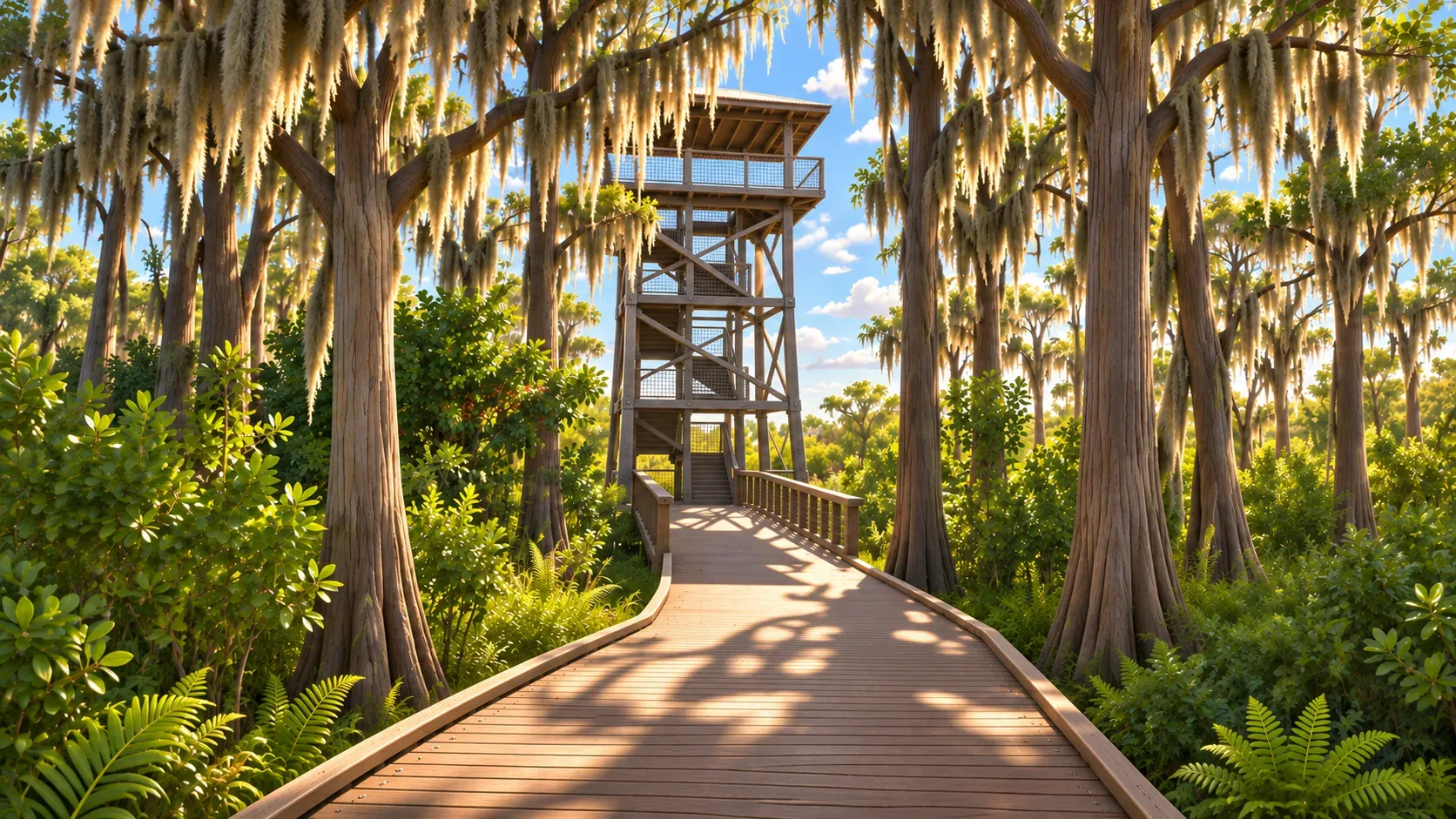
The Cane Pole Trail is a shorter alternative near the canal: roughly 0.7 mile round trip, with a paved approach and a wooden section leading to a covered prairie lookout. The refuge describes both this and the Chesser Island walk as among its most accessible paths. Ask about current surfaces and the available rest stops if mobility equipment matters. A wheelchair is listed as available to borrow at the center on a first-come basis, so its availability depends on the building being open and the chair being free. For a quarter-mile wooded loop instead, Upland Discovery has little elevation but uneven ground and roots.
The federal refuge does not allow pets on Chesser Island or Ridley's Island boardwalks, inside visitor buildings or on boats. Check the relevant rules for other walks and for service animals. As with the different areas in our Everglades entrance guide, an accessible path and a staffed building at one location tell you little about boarding or conditions elsewhere.
Fargo: the west entrance and the former Stephen C. Foster park
Georgia now calls the west entrance Okefenokee State Park. It is the same park older guides and bookings may call Stephen C. Foster State Park, at 17515 Highway 177, Fargo. The road ends at the park side of the refuge, with its own boat ramp and trading post. The state lists limited Wi-Fi around the trading post and eco-lodge facilities, and warns that the park gate locks at 10 p.m.; confirm late-arrival arrangements with staff in advance.
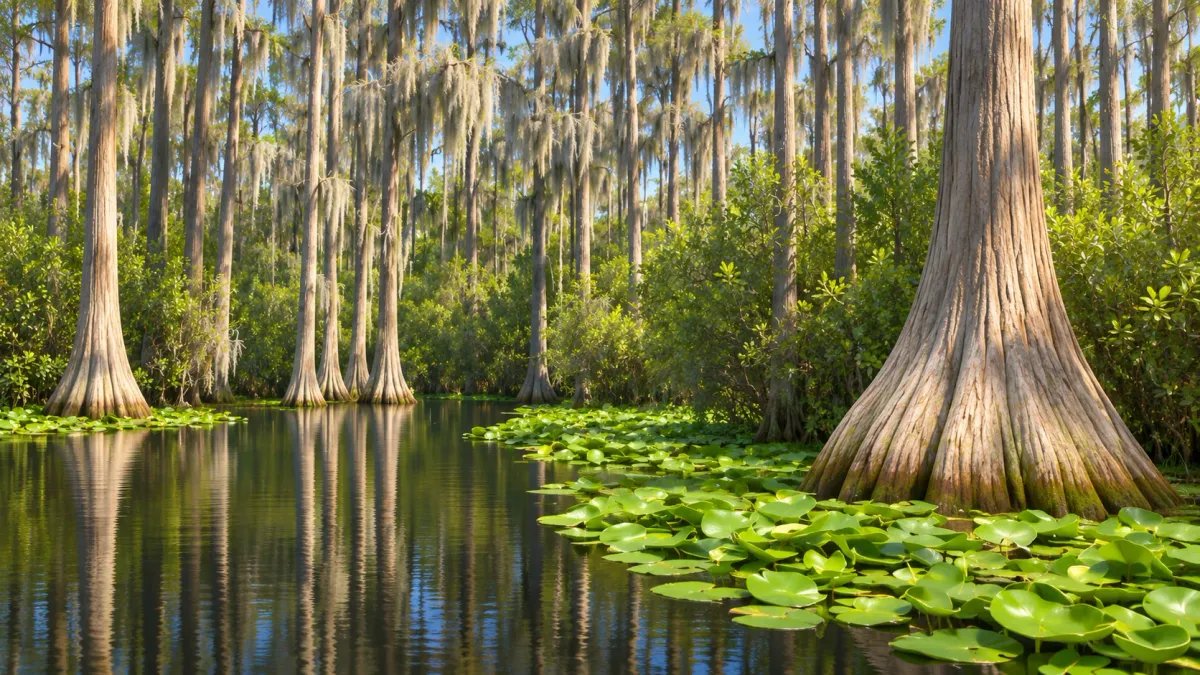
Choose the west for trees close to the water and for a slow look at reflections and cypress knees. Guided trips are offered by the state park; its site says reservations can be made by phone up to seven days ahead. Day-use motorboat, canoe and kayak rentals are first come, first served. For a particular departure, call 912-637-5274 before driving out. Billy's Island is water access only, and the state describes the route from its ramp on its regular boating page. Ask if the particular approach is open, since dated federal notices can close individual connections even when other west-side sections remain usable.
Drive-in tent and RV camping is a state-park booking, different from federal paddle-in camping. The park currently says its on-site cottages are unavailable for reservations while new cottages are built. It identifies the Suwannee River Eco-Lodge cabins, about 18 miles away, as an alternative. The two locations have different approaches and check-in arrangements. Stargazing is another reason to stay in the area, but check where day visitors can be after dark and allow time to leave through the gate. The designation as a dark-sky park does not extend boating hours.
Waycross: what a north entrance ticket actually buys
Okefenokee Swamp Park sits just south of Waycross and runs as a nonprofit attraction. It has its own admissions, activity schedule and visitor paths. The operator currently lists General Admission at $25 for ages 12 and up and $24 for ages 4–11 before tax, with train, reptile encounter, exhibits and paths. The 3-Hour Experience is $35 and $30 for those same age bands before tax and adds a naturalist-led boat ride. The published table lists children three and under as free; confirm how to include them when reserving the boat.
The north park describes the guided boat portion as about 45 minutes. The three hours on the package describe the broader visit, including other activities, not three hours on the water. Ask which events have fixed times, how boarding works and when you should arrive. A family with a short stop can choose the land activities if those are what everyone wants; for someone who mainly wants a longer water outing, the east concession's standard tour is a different choice.
The names are easy to mix up: Okefenokee Swamp Park is the north attraction, Okefenokee Adventures is the east concession at Folkston, and Okefenokee State Park is the west site near Fargo. The north operator presents both Waycross and Folkston on its website. Read the town in the ticket and save the arrival directions with the booking so that anyone driving the group can check the same location.
Refuge passes, paddling and current closures
The federal refuge lists a $5 pass per private vehicle, valid for seven days, and a $15 annual refuge pass. It sells passes through Recreation.gov and lists in-person purchase at Okefenokee Adventures and the state park. The Georgia park also publishes a $5 refuge fee; if you have already paid or carry an eligible interagency pass, show it and confirm coverage before buying another. Save proof where you can open it offline, follow the vehicle-display instructions and keep tour or accommodation charges separate. A federal vehicle pass does not cover Waycross admission or concession tours.
The refuge's October 27, 2026 water update listed the Orange Trail from Folkston to Canal Run, the Red Trail from the west park to Minnies Lake, the Brown Trail to Mixons Hammock and the Yellow Trail to Cedar Hammock as open. It listed the Red Trail from Kingfisher Landing to Minnies Lake, the Orange Trail between Canal Run and Billys Island, a portion of the Purple Trail and all of the Green and Blue trails as closed. These are dated conditions, not a route permit; check the latest post and ask staff what is passable for the boat you are actually taking.
Kingfisher Landing is a secondary east-side launch north of Folkston, with a ramp and limited facilities, rather than the Waycross visitor attraction. The refuge does not ordinarily charge admission there. Its October 13 railroad-crossing closure notice projected roughly 7–10 days but was still displayed when checked; the October 27 water update separately listed closures affecting routes from the landing. Confirm both road access and your intended water segment before making it your destination. Suwannee River Sill, a secondary access area off Highway 177, is another distinct place; its normal sunrise-to-sunset hours do not tell you whether another launch is available.
Self-guided boating and an overnight trip are different plans
Choose a marked day-use route with a clear turnaround point. Check with staff before starting, sign in and out at the launch where required and use the site's off-water deadline. The federal rules require a flotation device for each passenger and require children under 13 to wear theirs; wear yours throughout the trip as well. Outboards are limited to 10 horsepower or less on designated routes. Paddleboards, wading and swimming are prohibited in the refuge. Bring drinking water; standing water or a visible channel is no reason to improvise a passage off the marked route.
Camping on federal wilderness platforms requires an overnight permit and a canoe or kayak with no motor. The current dated refuge notice gives a one-month booking window and requires starting and finishing at the same entrance while conditions recover; the regular camping page describes different terms. Follow the current notice and confirm the assigned route through the federal camping reservation line at 912-496-3331. A day-rental receipt, the drive-in campsite confirmation and a wilderness permit each cover a different thing.
Keep hands and feet inside boats, leave wildlife room and never feed it. An alligator on a bank is not a sighting to move closer to, and neither a guided trip nor a warm day guarantees one. Take binoculars for birds and leave room for a pause when something is already in view. Our Loess Bluffs wildlife drive guide has tips for observing at a patient pace; use Okefenokee's own rules for where to stop, walk or launch.
Put together a short visit without rushing the return
With two to three hours, choose one main activity and a nearby option you can shorten. At Folkston, a reserved boat tour and the Cane Pole Trail can fit when check-in, trail access and the driving time allow; for the full Chesser boardwalk, reserve more of the day. If your first priority is walking, put Chesser Island first and stop near the canal afterwards. At Waycross, use the operator's package schedule rather than expecting the train and boat to leave as soon as you arrive. At Fargo, verify the boat or settle on a land visit before driving to the park.
If a boat trip changes, you can remove or replace an optional stop in RoadMe and keep the rest of the day at a comfortable pace.
Before leaving, check four details together: the town and arrival address, the boat's check-in and return time, the latest access notice for your actual route, and your return drive or lodging. Save the relevant pass and reservation before losing signal. In cooler months bring a layer for the water even if the parking lot feels mild; in warmer weather, make room for shade, drinking water, insect protection and a plan for thunderstorms. If the water route changes, the swamp can still make a rewarding visit from a boardwalk or lookout. Leave before the last available minute, especially when the group is tired and the next stop is another long drive away.