Everglades National Park: Entry, Reservations and Seasonal Access
Everglades National Park is easiest to plan when you separate the entrance pass, the area you will visit and any booked activity or overnight stay. A tram ticket does not replace park admission, a wilderness reservation is not a drive-in campsite, and the three main entrances do not connect by road inside the park. Choosing the wrong starting point can cost much more time than buying the wrong departure hour.
This guide covers access through Homestead, Shark Valley and Everglades City, with the current nonresident entrance charge, seasonal differences and the reservation rules that matter for a first visit. Information was checked on October 31, 2026. Dated closures and operating schedules should be checked again near departure; they are not a promise of conditions on a later holiday.
Choose an entrance before booking an activity
For the supported city destinations around your Florida journey, RoadMe can create a personal plan around your interests, available days and preferred pace. Give the park outing enough room in that wider trip, while arranging its passes and tours with the park and operators.
| Area | Useful starting point | What to keep separate |
|---|---|---|
| Homestead entrance | Ernest F. Coe Visitor Center; access towards Royal Palm and Flamingo | Flamingo is another 38 miles along the main park road |
| Shark Valley | Tram, bicycle loop and observation tower | Your car stays near the entrance; airboats depart elsewhere |
| Everglades City / Gulf Coast | Marjory Stoneman Douglas Visitor Center and access to the Ten Thousand Islands | Boat tour meeting points may differ from the visitor centre |
NPS describes these entrances as at least an hour's drive apart, with no road connection between them inside the park. Treat that as a warning against cramming all areas into one day, not a fixed transfer estimate. Add the approach from your accommodation and your booked activity's check-in time.
Entrance fees and the nonresident charge
The standard private-vehicle entrance pass is USD 35, valid for seven consecutive days at all park entrances. The pedestrian or cyclist rate is USD 20 for visitors aged 16 or older when not arriving in a vehicle or vessel. Entrance fees are separate from camping, concessioner tours and rentals. Do not use the USD 30 car price still printed in the older general FAQ; the dedicated fee page lists USD 35.
Under the 2026 rules, each non-U.S. resident aged 16 or older also pays USD 100 unless covered by an eligible valid annual or America the Beautiful pass. The interagency Non-Resident Annual Pass costs USD 250. Compare the charges for the actual group and check any existing valid pass before purchasing. A two-adult nonresident party in an ordinary private car without an eligible pass would pay USD 235: USD 35 plus two USD 100 charges.
The park-specific annual pass is USD 70 and is currently available to U.S. citizens and residents; the resident interagency annual pass is USD 80. Eligibility and identification matter. NPS states that valid annual passes cover entrance and nonresident charges for the holder and accompanying passengers in a private vehicle, with different coverage at per-person sites. Choose the appropriate product and keep its named holder with the travelling party.
The park accepts digital passes or credit/debit payment at fee collection areas. Save an accepted pass so it is available without a connection and carry the required identification.
There is a useful local exception to watch: the current Gulf Coast visitor-centre page says entrance passes cannot be purchased there at present, although the general fee page still lists that centre as a purchase location. Use the more specific notice and arrange your pass online or at a listed operating entrance. Do not rely on resolving the payment after reaching a remote boat departure.
Shark Valley: a tram reservation is not a parking reservation
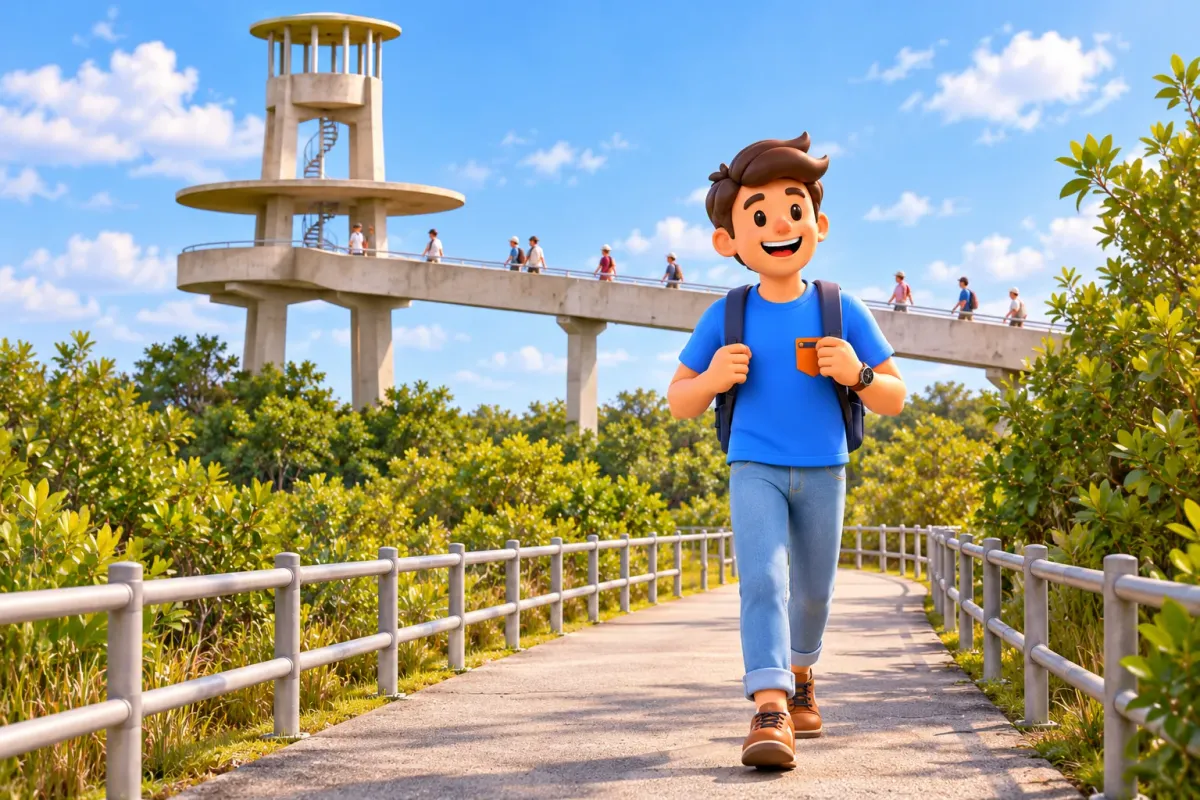
Private vehicles cannot drive the Shark Valley loop or go directly to the observation tower. Beyond the entrance road and parking lot, visitors continue by tram, bicycle or on foot. The loop is 15 miles, and the tower is around halfway; seeing a photograph of its access ramp does not mean the tower stands beside the visitor-centre car park.
The entrance gate is published as open from 8:30 a.m. to 6 p.m. daily. During busy periods the parking lot can operate one car in, one car out. NPS advises arriving 1.5 to 2 hours early for a scheduled tram departure. That is an arrival allowance, not the tram ride's duration, and a prepaid ticket does not remove the gate queue or guarantee immediate parking.
The authorised operator describes a tram tour of approximately two hours. Its current published rates are USD 36 for adults aged 13–61, USD 27 for seniors aged 62 or older and USD 19 for children aged 3–12. These are tour prices, separate from park entrance and any applicable nonresident charges. For a younger child, confirm the booking arrangement directly rather than inferring a free place from an age band that starts at three.
The operator asks reserved passengers to collect tickets at least 30 minutes before departure. Its published online purchase policy says to book at least 48 hours ahead and contact the operator for requests inside that window; it also says no refunds within 24 hours of the scheduled tour. Check the terms presented with your own booking, particularly because the policy page carries an older revision date. No seat availability is assumed here.
For visitors with mobility requirements, the operator describes accessible tram tours and asks for advance notice so staff can prepare. Explain the equipment and assistance you need before booking. There are also short walking choices near the loop, but the full exposed circuit should not become the default family walk just because it is paved.
Royal Palm and Flamingo: plan the distance between them
Royal Palm, reached from the Homestead side, is a useful option for a shorter visit focused on trails and observation. NPS describes the Anhinga and Gumbo Limbo trails as wheelchair accessible, using paved surfaces or boardwalk. Confirm current trail condition for the actual outing; this description does not extend to every route elsewhere in the park.
Flamingo is at the end of the main park road, 38 miles from the Homestead entrance. The Guy Bradley Visitor Center publishes winter hours of 8 a.m.–5 p.m. daily from November 16 through April 30. From May 1 through November 15, it is open Friday–Tuesday, 9 a.m.–5 p.m., and closed Wednesday and Thursday. A park described as open around the clock does not imply that this building or its services are always open.
Boat tours, rentals, the marina and accommodation are separate reasons to make the drive. Confirm the actual check-in point and seasonal service before setting off. For example, the NPS Flamingo page distinguishes a year-round Whitewater Bay tour from a Florida Bay tour described as operating November 1–April 30. Use the operator's current booking calendar to confirm your departure rather than extending that pattern into a guaranteed daily timetable.
Airboats and Gulf Coast tours depart from different places
There are no airboat departures at the Shark Valley visitor area or at Flamingo. NPS lists three authorised airboat businesses along the Tamiami Trail: Coopertown, Gator Park and Everglades Safari Park. Use the chosen business's address and booking conditions. An airboat offer elsewhere in the wider Everglades region is not automatically a tour inside the national park.
At the Gulf Coast entrance in Everglades City, the Marjory Stoneman Douglas Visitor Center opened in 2026. Its published hours are 9 a.m.–5 p.m. daily. The Ten Thousand Islands experience beyond this gateway is water-based; there is no internal scenic road carrying your car through the mangrove islands to Flamingo.
The NPS Gulf Coast page lists the authorised Ten Thousand Islands boat tour as departing from 929 Dupont Street, two miles north of the visitor centre. Verify that meeting point with your tour confirmation before travelling. Reaching 815 Oyster Bar Lane, the visitor-centre address, is not the same as checking in for the boat.
Dry season and wet season change the visit
The park's basic information describes the dry season as typically December–April and the wet season as May–November. Its more recent dry-season page describes November–April as the drier visiting period. Treat November as a transition to check, not a day on the calendar when heat, rain and mosquitoes automatically stop.
During the wet season, heat, humidity, heavy showers and biting insects can make a short outing more demanding. NPS notes reduced ranger programmes and some services during this period. Check the day's forecast and the specific facility, and bring water, appropriate sun protection, insect protection and clothing for the conditions. Have a practical shelter or change of plan for thunderstorms rather than treating rain as the only issue.
The Flamingo operator was displaying a warning of extremely high mosquito levels when checked. That is a dated local notice, not a forecast for every month or every park entrance. It is nevertheless a good reason to read current operator and park notices before choosing an exposed activity or overnight stay. A lower room price does not describe how comfortable the outdoor part of the day will be.
Drive-in camping and the lodge have their own bookings
The park has drive-in camping at Long Pine Key and Flamingo, handled through the Flamingo Adventures operator rather than the wilderness campsite system. The operator recommends reservations and lists Long Pine Key's 2026–2027 season as November 1, 2026 through April 30, 2027. Flamingo camping is described as year-round, with the Bayside campground closed for the 2026 season.
Flamingo Lodge is open, with rooms and accessible room categories offered by the operator; the older FAQ statement that no lodging exists inside the park is out of date. Some suite categories require stairs. If avoiding stairs matters, confirm the exact accessible room and approach with the lodge before paying, rather than booking any room under the same property name.
Use the published guide to national-park permits and reservation checks to keep each confirmation distinct. A campsite or lodge booking resolves the stay it names, not every activity, entrance requirement or local closure. If no suitable overnight option is available, arrange a lawful alternative with a workable journey instead of improvising a night beside a trail.
Wilderness camping: the email confirmation is your permit
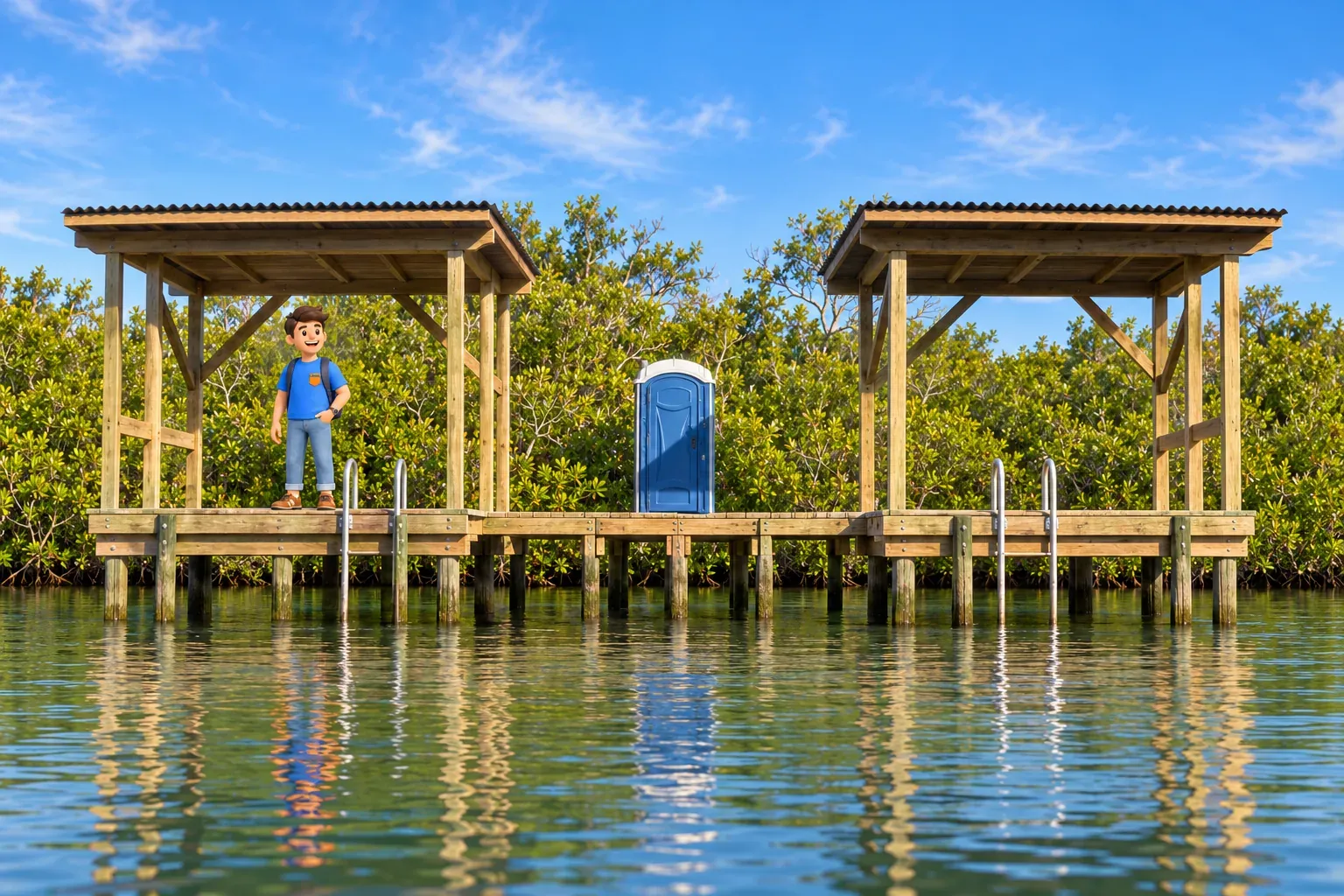
Everglades wilderness camping requires a permit year-round, and most sites are accessible only by water. Sites include chickees, raised platforms above the water; the Sweetwater illustration follows the NPS photograph and does not imply that the platform has a road approach. Choose an overnight route because it matches your preparation and experience, not simply because drive-in campgrounds are busy.
The dedicated wilderness reservation FAQ says sites are released on a rolling basis three months ahead at 10 a.m. Eastern Time. There are no sites held back as a separate walk-up allocation. Rangers can help book an unreserved site on the day, but that does not guarantee a space. Follow the applicable calendar and conditions for the route you actually intend to use.
Your Recreation.gov confirmation email serves as the permit: carry a printed or saved digital copy. A separate physical collection is no longer required. This specific rule differs from instructions still appearing in older general material and from the procedures at other national parks. Keep the full usable confirmation, not merely a bank notification that a payment succeeded.
The published wilderness charges are USD 21 administrative fee plus USD 2 per person per night, year-round. A credit card is needed. Check the reservation's own change and cancellation terms; a permit does not override a closure.
Check closures, wildlife and the return journey
The park's September 9, 2026 notices list Johnson Key Chickee, Shark Point Chickee and Little Rabbit Key Ground Site as closed for maintenance. Other keys have partial closures, and water routes can be obstructed. Check the full current wilderness and trail information for your planned route; a named place appearing on a booking search or an old paddling account does not prove its approach is usable.
Keep your distance from wildlife and do not feed, touch or harass it. NPS tells visitors to stay at least 15 feet from alligators and crocodiles. An animal resting beside a route is still wild, and its lack of movement is no invitation to approach. Keep children close, follow barriers and give the animal space rather than attempting a closer photograph.
With any walk, assess distance, exposure and the group's energy alongside the forecast. The published guide to preparing for a first day hike helps turn a tempting path into a realistic outing. A short accessible route and time to observe can be more satisfying than a long loop chosen only because it looks flat on a map.
In supported cities before or after the park, RoadMe can adapt the day's plan to a quieter pace or your particular interests. Leave enough room around the park visit for the drive, weather changes and rest, while checking the outdoor outing with its own current sources.
Finally, agree the return transport. NPS warns that visitors dropped off by on-demand ride services may be unable to find a return car. A seasonal Homestead trolley is described as an option towards Ernest F. Coe and Royal Palm, but check the current city's schedule rather than assuming a year-round network between entrances. Save passes, confirmations and navigation before leaving reliable connectivity, then recheck your exact entrance and activity address.