
Milan with Less Walking: A Compact Central Plan with Time to Sit

To see Milan with less walking, choose one small area and count the whole journey, including arrival, standing time and the return. A useful central example runs in one direction from Piazza del Duomo through Galleria Vittorio Emanuele II to Piazza della Scala. Allow two hours for a few selected views, a proper seated pause and a generous reserve. The route itself involves approximately 0.5–0.8 kilometres outdoors and in the public passage. It does not include entering the cathedral, visiting a museum or seeing a performance.
Choose one cluster and give it enough time
A short distance becomes a useful plan when you decide what it includes. Here the start is Piazza del Duomo and the finish is near Piazza della Scala. You look at the cathedral exterior, appreciate the Galleria and see the theatre façade from the square. The programme avoids an automatic extension to Brera or the castle. Your trip to the starting square and onward journey from the finish are additional, including any return along the same passage.
Try RoadMe for a personal plan shaped around your interests, dates, preferred pace and budget. Organising the whole stay in the app makes it more convenient and efficient to give a compact outing a clear place among museum days, meals and time to rest.
| Example time | Part of the outing |
|---|---|
| 10:00–10:15 | Piazza del Duomo and the cathedral exterior |
| 10:15–10:20 | Connection to the Galleria |
| 10:20–10:40 | The Galleria’s architecture |
| 10:40–10:45 | Connection to Piazza della Scala |
| 10:45–11:00 | Piazza della Scala and the theatre exterior |
| 11:00–11:05 | Connection to a nearby café |
| 11:05–11:35 | A seated café pause near the finish |
| 11:35–12:00 | Reserve and an unhurried finish |
The allocation totals 120 minutes: 15 at the Duomo, 20 in the Galleria, 15 at Piazza della Scala, 15 for all local connections, 30 seated and 25 in reserve. The distance includes small changes of viewpoint and a nearby pause, not a measured track. Choose a café close to the finish to keep the estimate meaningful. If you need longer for connections, reduce a viewing stop rather than treating the timetable as a speed target.
Start with the journey from your door
Before choosing the outing, work out how you will reach the actual starting point. A hotel described as central may still require a substantial walk to a station, movement through underground corridors and another walk after leaving the platform. Count those sections alongside the main route. A short sightseeing distance can be misleading when it sits between two long journeys that the itinerary quietly leaves out.
Decide how you want to leave Piazza della Scala as well. If you intend to return to Duomo station or your accommodation near the starting square, that is another leg, not a free consequence of finishing nearby. Check a suitable onward connection or allow for retracing the passage. The most useful finishing point is the one that fits your actual return, rather than the furthest landmark you can add to a list.
For public transport, use the operator’s current journey and accessibility information. ATM provides live information about lifts and stairlifts, as well as accessibility details for surface services. Check the particular stations and journey before travelling; a line shown on a map does not prove that every entrance or lift is available. These are the transport operator’s services, separate from a travel-planning app’s general itinerary functions.
At Piazza del Duomo, choose a view instead of a complete circuit
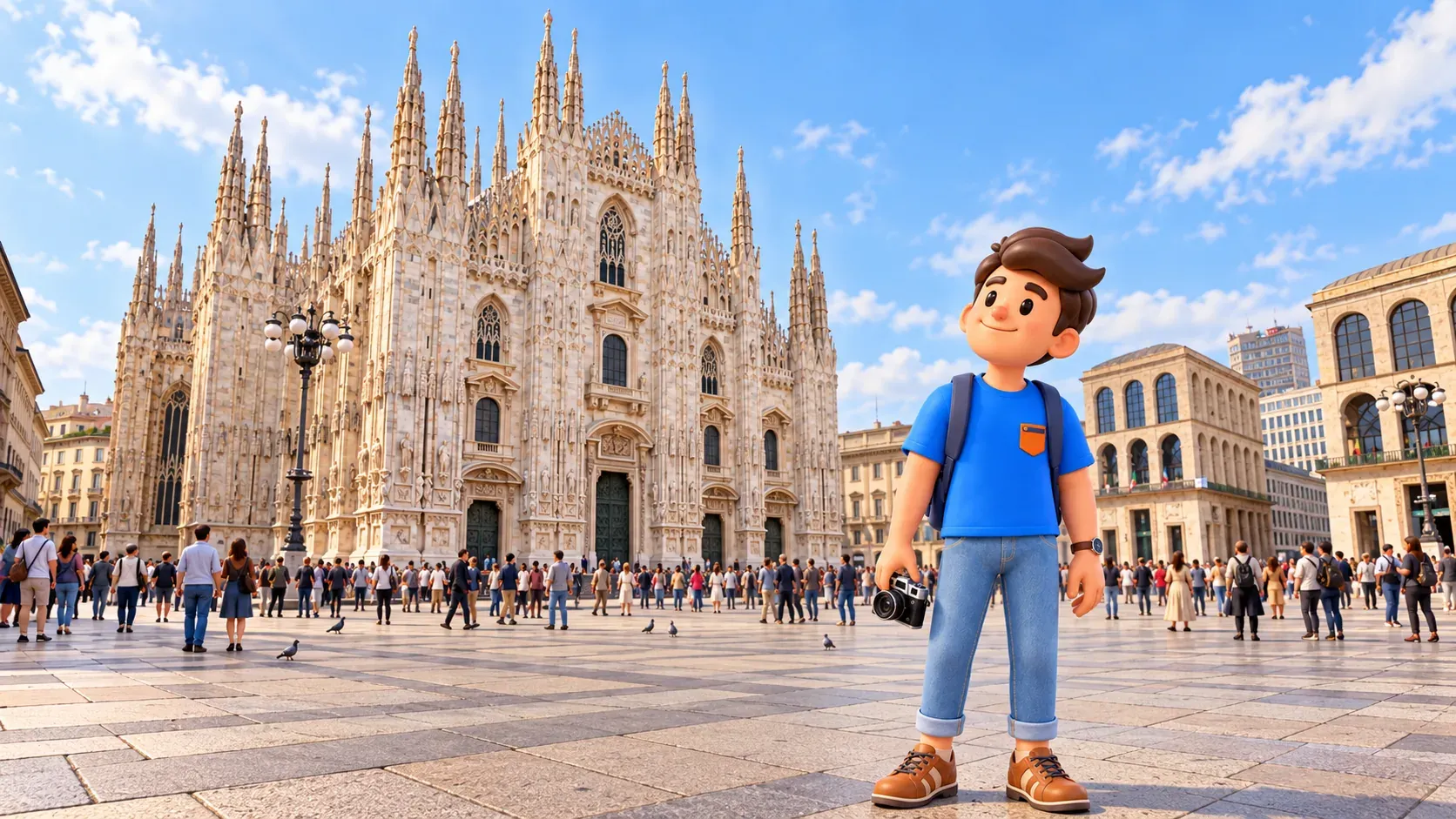
Begin from a comfortable permitted position with a clear view of the cathedral’s front. Look at the overall silhouette, then choose one part of the decoration to notice. There is no requirement to circle the entire building, cross the square repeatedly or approach every door. A single wide photograph and a few minutes looking without a screen can make fifteen minutes feel more substantial than a hurried search for every possible angle.
The Duomo’s construction began in 1386, with Candoglia marble and Gothic design drawing on the skills of workers from across Europe. Its long building history continued through successive periods. The façade is therefore not simply an unchanged surface from the fourteenth century. You can appreciate that accumulated work from the square without treating a short exterior stop as a substitute for all the cathedral’s interiors, terraces and collections.
Keep entry decisions separate. Joining a cathedral queue changes the programme: admission arrangements, checks and the visit itself need time. A terrace ticket is another choice again. If one of those experiences is your main reason for coming, build the day around it and reduce the walk. This outdoor version is complete on its own, with no requirement to add an interior visit to justify being in the square.
The Galleria offers a change of setting within a short connection
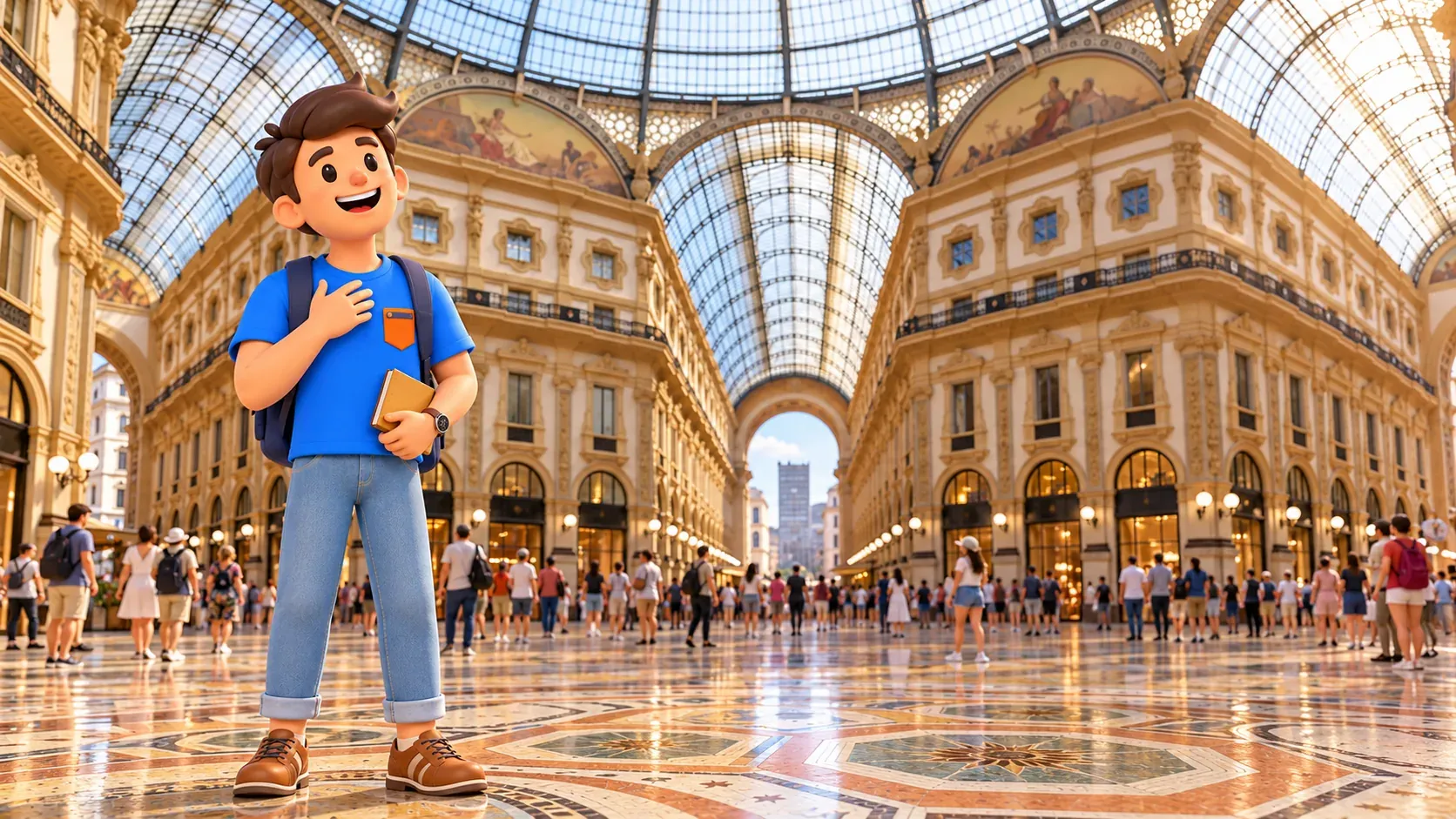
Continue towards Galleria Vittorio Emanuele II and follow its main public passage towards Piazza della Scala. The nineteenth-century project by Giuseppe Mengoni gives the route an architectural transition: from the open cathedral square into a glass-and-iron roofed space with decorated façades and a patterned floor. The covered crossing is worth noticing in its own right. It need not become a shopping expedition simply because shops line the way.
Give the roof and central crossing your attention, then choose a small portion of the floor or a façade detail. Move aside before stopping so you do not block people walking through. You can look closely without moving continuously. If the central area is busy, shorten the stop or choose another position; the plan does not depend on finding the passage empty at a particular hour.
The public passage, a shop visit and a café table are different things. Walking through does not require buying something, but sitting in an establishment follows that business’s menu and conditions. Check the price and service arrangement before ordering, particularly if you want to sit for a while. Do not assume a standing coffee and a seated table have identical conditions, or that every business operates whenever the passage is accessible.
A covered arcade also does not make the entire route sheltered. The squares and local approaches are outdoors, and conditions under a large roof can differ from what you expected. For a hot day, our Milan plan with a museum and a long midday break offers a different structure. Choose it as an alternative rather than adding that whole programme after this one.
Piazza della Scala is the finish, not the start of another district
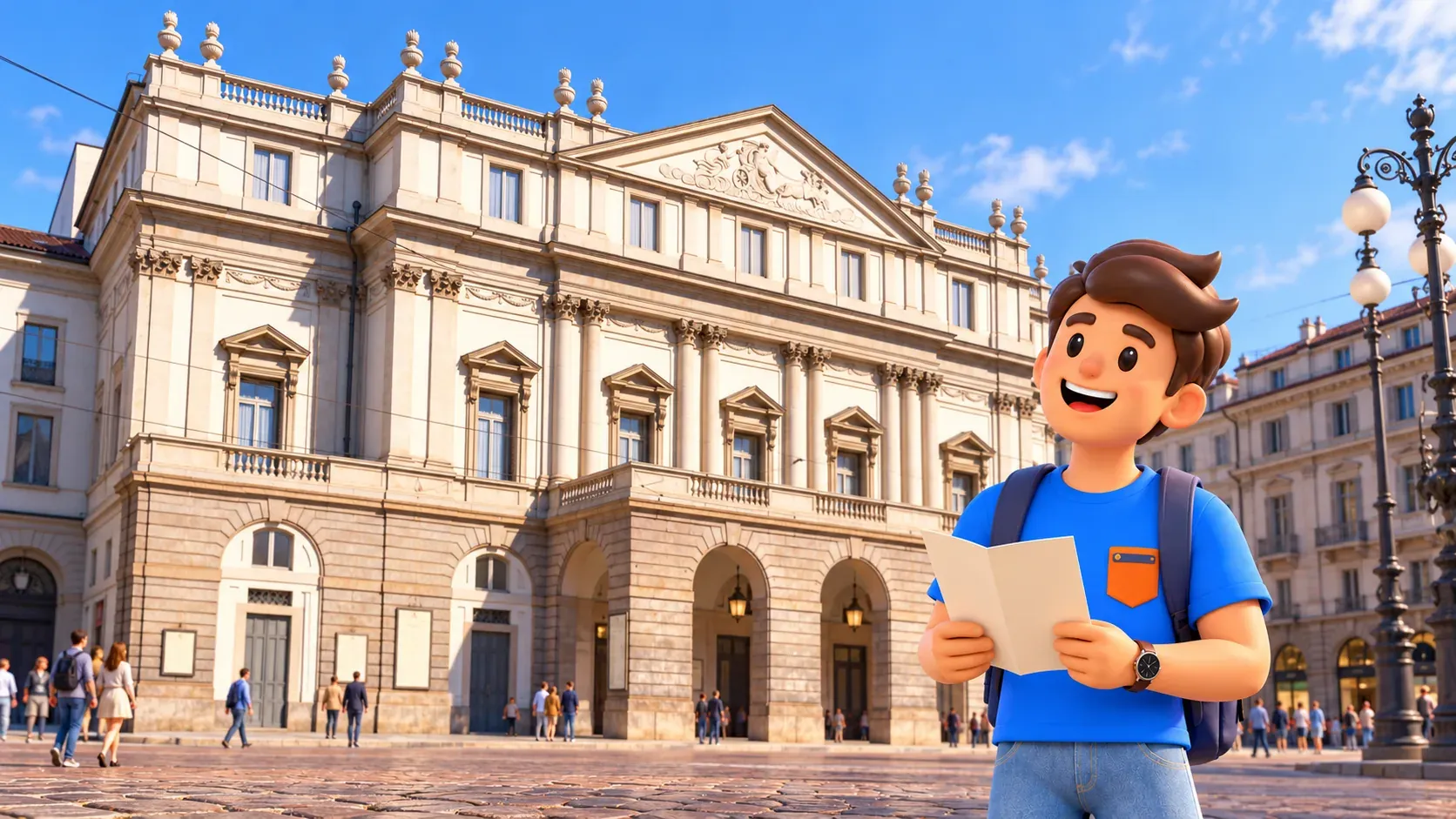
Leave the Galleria towards Piazza della Scala and look at the theatre from a suitable place in the square. Its façade presents a different kind of monument from the Duomo: restrained lines and a central classical pediment rather than a forest of pale spires. The theatre designed by Giuseppe Piermarini opened in 1778. Its place in Milan’s musical life gives the exterior meaning even when you are not attending a performance.
Notice the relationship between the theatre, the square and the surrounding buildings. The Galleria has brought you into another urban room, not merely delivered you to another ticket queue. Keep this stop selective. Looking at the theatre from outside does not include entering the auditorium, seeing backstage spaces or visiting the theatrical museum. Those experiences have separate arrangements, and auditorium access can depend on the theatre’s work.
Resist extending the route simply because Brera appears close on a map. A few additional streets become more distance once you add browsing, another square and the return. You can save a promising area for another day without losing the value of this outing. If you want a wider central introduction with a medieval detour, our first walk through Milan’s historic centre is a different option, with more ground to cover.
Make the seated pause part of the plan
Choose a café near the finish, check that the seating and menu suit you, and allow thirty minutes. This is a planned part of the experience rather than something to squeeze in if every landmark is completed early. A distant restaurant with a famous reputation would change the walking estimate. A nearby place that actually has an appropriate seat can be the better choice for this particular day.
Use the pause to decide what happens next. You may be ready to return, stay longer over a meal or plan another small outing later. The twenty-five-minute reserve can absorb slower connections, waiting for a table or extra attention at a favourite view. It should not become a compulsory fourth attraction. If there is no suitable seat available, change the plan rather than endlessly walking around to preserve the original café idea.
Standing time matters as much as distance. Three short stops can still mean a long period on your feet, especially in crowds or queues. A café pause helps only if you actually sit. Think about your preferred rhythm in advance: you can shorten a viewing stop, take the pause earlier or finish after the Galleria. The route is a framework for choosing, not a test of completing three named places.
A compact route is not a promise of step-free access
A short walk does not establish that paving, crossings, entrances and public transport meet every accessibility need. Crowds, temporary barriers and uneven surfaces can affect a small area too. If specific access is essential, check the actual route, venue information and current transport arrangements in advance. This programme has not been audited as a complete step-free journey. Avoid using a simple distance figure as a substitute for the details that matter to you.
You can also choose one indoor visit instead of the whole exterior circuit. Decide which collection or building interests you, confirm its current access and admission arrangements and place a seated pause nearby. Include walking within the building in your personal allowance. A museum beside a station may still involve a substantial visit on your feet; the short approach alone does not tell you how demanding the experience will feel.
Use RoadMe to develop a personal programme for the whole trip around the subjects you enjoy. Bringing interests, pace and budget together in the app makes it easier to organise satisfying days without filling every interval with another stop.
Information was checked on 17 October 2026. Confirm current conditions for your date, choose an arrival and return that suit you and keep one comfortable pause in the programme. A small part of Milan can give you architecture, a sense of the city and a worthwhile outing when you give it enough attention.


