Brera, Ambrosiana or Novecento: Which Milan Art Museum Fits You?

Choose Brera for a broad encounter with Italian painting, the Ambrosiana for a focused visit linking Leonardo, major paintings and works on paper, or the Museo del Novecento for twentieth-century art and experiments with movement, material and space. There is no single best choice for every Milan visitor. Start with the kind of art you want to spend time with, then check the calendar. Brera and Novecento normally close Monday; the Ambrosiana closes Wednesday. One chosen collection, a meal and a short walk can make a satisfying half-day.
Choose the question you want the museum to answer
Would you like to see how Italian painters constructed stories across different periods? Are you most interested in an original Leonardo work and the relationship between drawing and a finished image? Or would you rather explore how artists moved beyond describing visible objects? Those questions point towards Brera, the Ambrosiana and Novecento respectively. They overlap, but give each visit a different starting point. Your choice does not need to follow a universal ranking or the museum someone else considered essential.
Try RoadMe for a personal trip plan based on your interests, dates, pace and budget. Planning the whole stay in the app makes it more convenient to give your preferred art enough time alongside neighbourhoods, food and rest.
Think about your available attention as well as your available hours. A gallery after a long journey may call for a small selection; a dedicated art morning can support a slower visit. Buying two admissions does not double how much you will notice. If you have one free morning, choose one collection you want to see and leave the next museum for another day. You can enjoy Milan’s range without treating every artistic period as a task to complete.
Brera, Ambrosiana and Novecento at a glance
| Museum | Best starting interest | Selected visit | Main planning condition |
|---|---|---|---|
| Pinacoteca di Brera | Italian painting across periods, including Renaissance masters | About two hours | Date and time required; normally closed Monday |
| Pinacoteca Ambrosiana | Leonardo, major individual works and original drawings | About 90 minutes | Normally closed Wednesday; gallery and crypt are separate choices |
| Museo del Novecento | Twentieth-century Italian art, movement, material and space | About two hours | Normally closed Monday; later opening Thursday |
All three ordinarily charge admission. The durations are planning allowances for a selection and orientation, not promises to complete every room and exhibition. Conditions in this guide were checked on 17 October 2026. Verify the current display and any works on loan if a single masterpiece is the reason for your visit. An online collection catalogue is useful preparation, but a listed work does not automatically mean an unchanged display on every date.
Choose Brera for the wider conversation between paintings
The Pinacoteca di Brera at Via Brera 28 suits a first substantial encounter with Italian painting. Works by Mantegna, Raphael, Giovanni Bellini, Piero della Francesca and Caravaggio give different ways into figures, perspective and storytelling. You do not need to arrive knowing all those names. Choose two or three works, look at what draws your eye and then compare the choices made by another painter. A smaller personal thread helps the collection feel connected without turning it into a checklist.
Raphael’s Marriage of the Virgin offers a way to look at the arrangement of people and architectural space. Mantegna’s Lamentation over the Dead Christ presents a very different relationship between the figure and the viewer. Caravaggio’s Supper at Emmaus invites attention to light and human reaction. These are examples from the museum’s collection, not a guaranteed fixed room sequence. You can stay longer with one and leave another for a future visit if that gives you a more attentive experience.
Brera was officially established as a picture gallery in 1809, building on an earlier collection associated with artistic education. That background helps explain the pleasure of comparing works rather than looking only for a single star. Its range also extends beyond the Renaissance, including later painting such as Francesco Hayez’s The Kiss. Choose Brera when that breadth appeals; you do not have to see the whole historical sequence for the visit to be worthwhile.
Reserve the Pinacoteca’s date and time. Regular opening is Tuesday to Sunday, 08:30–19:15, with last entry at 18:00; Monday is closed. The free first Sunday still requires a reservation. If you choose the Grande Brera ticket, Palazzo Citterio can be visited on the Pinacoteca date or during the following six days under its conditions. Do not force that additional collection into the same two-hour allowance, or assume a ticket covers every institution sharing the Brera name.
Choose the Ambrosiana for originals in different forms
The Pinacoteca Ambrosiana at Piazza Pio XI 2 is especially appealing when you want a visit built around particular works rather than a broad painting survey. Leonardo’s Portrait of a Musician, Caravaggio’s Basket of Fruit and Raphael’s preparatory drawing for The School of Athens offer three different kinds of attention. A face, a still life and a large drawing can give the visit variety without requiring a long journey through different museums.
Raphael’s “cartoon” means a large preparatory drawing, not an animated film. It was made in preparation for the Vatican fresco; the fresco itself has not moved to Milan. Looking at the drawing lets you consider how figures and relationships take shape before the final painted work. With Caravaggio, the Ambrosiana’s fruit basket and Brera’s supper scene are different works by the same painter. Decide which subject interests you instead of choosing only by the presence of a famous name.
The gallery route also includes rotating displays of original sheets from Leonardo’s Codex Atlanticus in the historic Federiciana room. You see selected pages, not the whole manuscript collection open for browsing or handling. The current research reading room follows separate access procedures. Founded in 1618 by Cardinal Federico Borromeo as a complement to the library, the gallery brings visual art and the world of books together. It contains more than Leonardo alone, so leave some room for an unexpected painting to catch your attention.
Regular opening is 10:00–18:00, with Wednesday closed and the ticket office currently closing at 17:15. The institution suggests approximately 90 minutes for a gallery visit. The Crypt of San Sepolcro is a separate addition requiring the appropriate admission and more time. The complete gallery route is only partly accessible for visitors with reduced mobility; check a suitable route with the institution. Choose the visitor ticket you need rather than assuming library access, gallery admission and a crypt visit are one interchangeable arrangement.
Choose Novecento for a change in how art works
The Museo del Novecento in Palazzo dell’Arengario beside Piazza del Duomo offers the clearest contrast with the two older painting collections. Its thematic and chronological route moves through twentieth-century Italian art and into later developments. The museum opened to the public in December 2010 and presents more than 300 selected works from Milan’s much larger civic holdings. Those figures describe a selection, not thousands of works waiting to be completed in a single morning.
Begin with a question such as how an image suggests movement. The Futurism section offers a starting point through rhythm, repeated forms and changes in the direction of your gaze. Later, ask how an artist works with material, surface or the surrounding space. These questions are useful without specialist vocabulary. You do not have to like every experiment equally. Notice what makes you pause and give it time before deciding whether another room is the right next step.
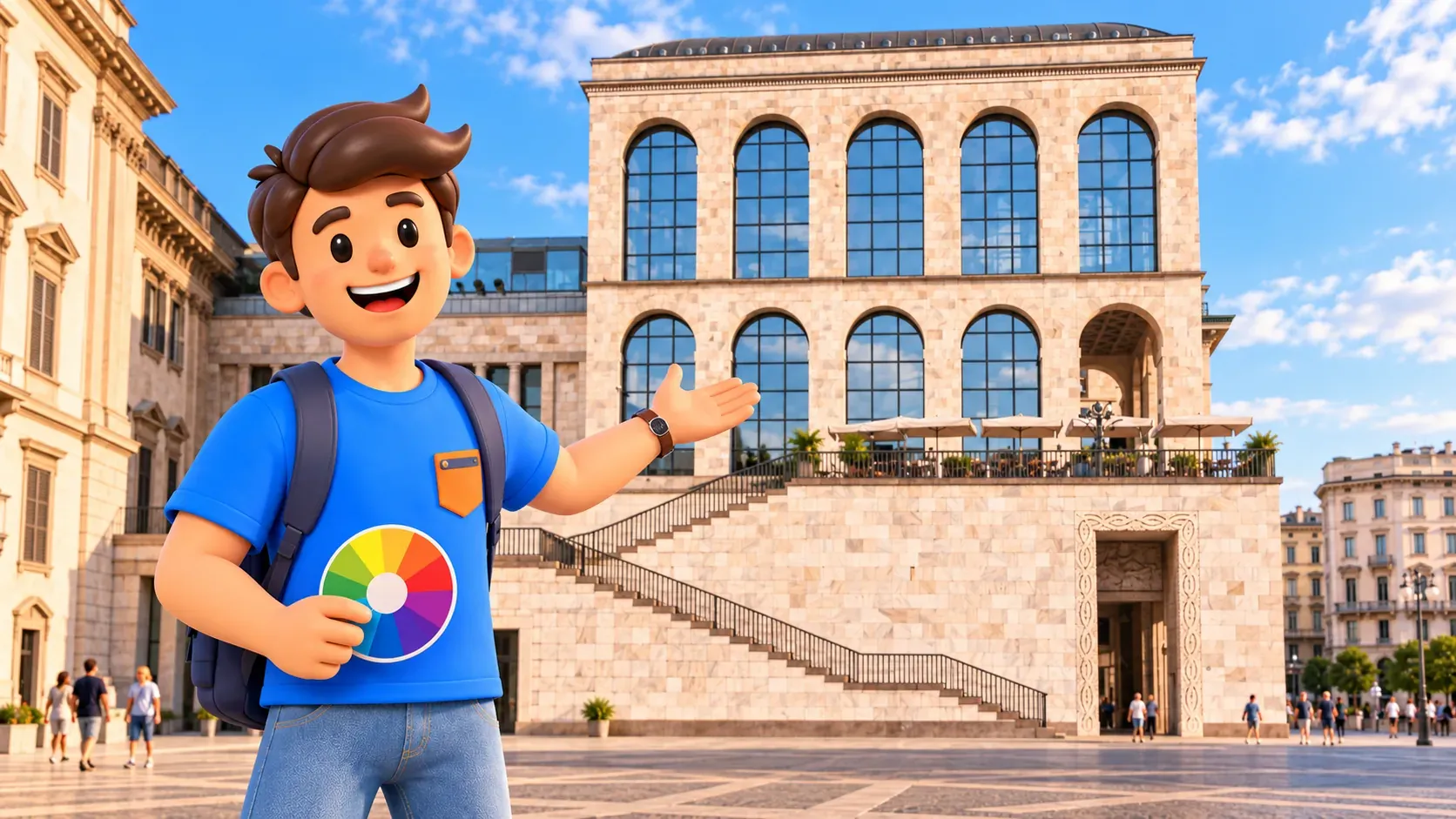
Sala Fontana gives a particularly clear reason to consider space and light as part of an artwork. The museum describes its neon structure and spatial ceiling as distinct installations; they should not be flattened into one generic decorative effect. Enjoy the relationship between art, architecture and the square outside, while checking the actual arrangement on your date. A view of the Duomo can add to the experience, but the collection deserves more than a visit chosen only for a photograph from an upper floor.
Regular opening is Tuesday to Sunday, 10:00–19:30, extended Thursday to 22:30; Monday is closed. Plan last admission at least an hour before closing. Ordinary admission currently includes the permanent collection and temporary exhibitions and can be bought online or at the office. Individual advance reservation is not a universal requirement. If you hold a pass or subscription, follow the museum’s ticket-conversion procedure and capacity conditions. The official address is Piazza Duomo 8; the visitor information describes entrances on Via Marconi and the Palazzo Reale forecourt.
Let the calendar help, without choosing only by convenience
For Monday, the Ambrosiana is the option among these three under its regular calendar. For Wednesday, consider Brera or Novecento. If Thursday evening is your available art time, Novecento’s later opening can help, but leave enough time for the visit rather than treating the last admission as a sensible two-hour start. Special openings, events and closures can override the regular pattern, so confirm the date before planning another appointment immediately afterwards.
Free days have separate rules. Brera and Novecento ordinarily offer free admission on the first Sunday of the month; Brera still requires reservation. Do not extend that rule to the Ambrosiana simply because all three appear in an art guide. Read each ticket’s coverage, reduction conditions and participant requirements. Our advance-booking guide explains the wider city choices. The right comparison is the visit you want under the conditions that actually apply, rather than a list of supposed universal museum advantages.
Give one museum a comfortable half-day
For Brera, a possible morning is 10:00–12:00 in selected galleries, 30 minutes in nearby public streets, 45 minutes for lunch and a 15-minute reserve: 210 minutes, ending around 13:30. A similar Novecento version uses the same two-hour museum block, followed by a short public-square or Galleria walk. For the Ambrosiana, a 90-minute gallery visit plus those same outdoor, meal and reserve allowances totals 180 minutes, ending around 13:00. These are alternative outlines, not three consecutive programmes.
Allow roughly 0.5–1 kilometre outdoors for a modest walk around your chosen area, depending on lunch and crossings. The distance and durations are estimates, not a measured navigation track; indoor walking, arrival and onward travel are additional. No garden, tower, crypt or second collection is automatically included. For access requirements, check the specific entrances and floors: lifts in a museum do not mean every part of every route is independently step-free. At Novecento, the Fontana mezzanine involves a staff-assisted stairlift.
Use RoadMe to build the rest of the trip around your preferred balance of art and city life. A personal itinerary makes it easier to distribute substantial visits across your available days and enjoy each at a pace that suits you.
If ordinary rain changes the outdoor part, our rainy-day Milan guide offers a compact museum-and-arcade approach. Otherwise, finish with the chosen collection still fresh in your mind. Brera, the Ambrosiana and Novecento are worthwhile for different reasons; choosing one thoughtfully is already a good way to spend a Milan morning.