Milan in the Rain: How to Replan a Walk and Keep a Good Day
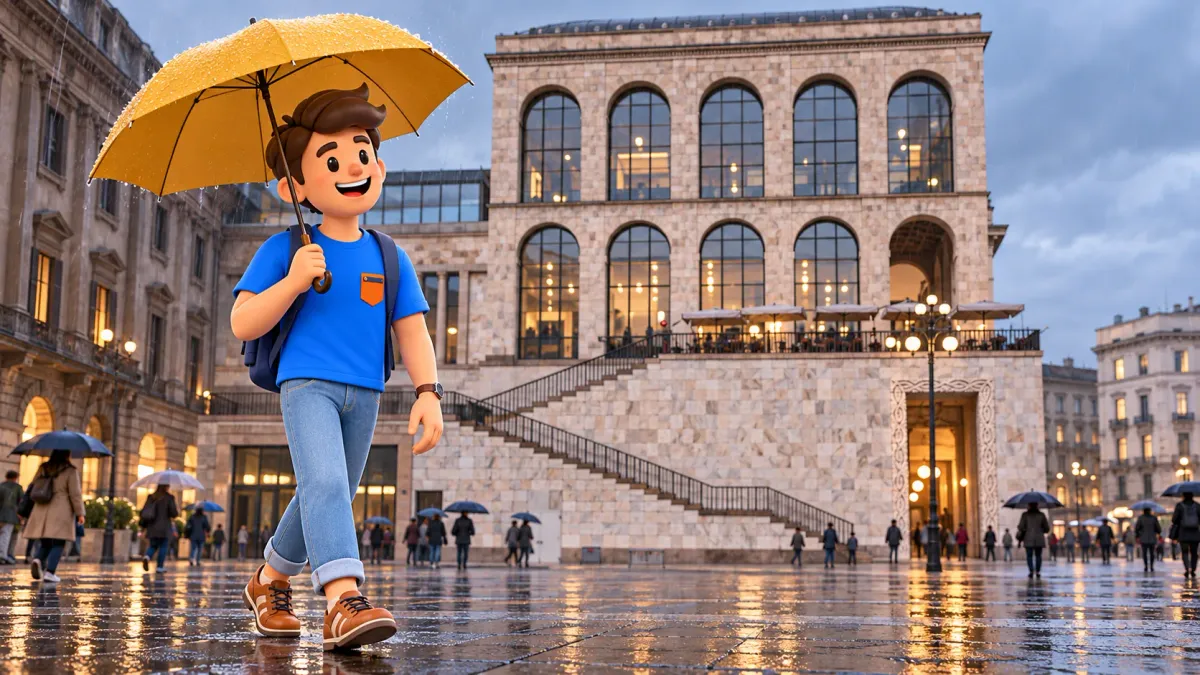
For an ordinary rainy day in Milan, choose one substantial indoor visit and keep the surrounding programme compact. A practical central version is the Museo del Novecento, followed by the covered Galleria Vittorio Emanuele II and lunch nearby. Allow about four hours, with time to enter, walk between the buildings and pause. The museum normally closes on Monday; the Pinacoteca Ambrosiana provides a different Monday option. Neither version is completely sheltered from door to door: the squares and short street connections still require an outdoor walk.
Change the shape of the day before adding more places
On an ordinary Tuesday to Sunday, a useful example runs from 10:00 to 14:00: two hours for a selection at the Museo del Novecento, 15 minutes to leave and reach the Galleria, 30 minutes under its roof, 45 minutes for lunch and a 30-minute reserve. That totals 240 minutes. Allow roughly 0.5–1 kilometre of outdoor and passage walking, depending on your lunch choice and exits, with travel to and from the area additional. These are planning estimates, not measured walking times or a guarantee about admission queues.
If you want to give art more space in the trip, try RoadMe for a personal day-by-day plan based on your dates, interests, pace and budget. Organising the whole stay in the app makes it more convenient to balance substantial museum time with the outdoor places you want to enjoy on another day.
First check what is already fixed: a museum admission, a train departure or an activity you actually reserved. Rain does not automatically cancel a ticket or make it refundable. Then choose one indoor anchor that genuinely interests you. A compact day becomes harder to manage if every shower triggers a move to another district. For an occasional short shower, you may need only a pause; for persistent ordinary rain, giving a collection proper time is more useful than preserving the entire outdoor list with extra transport between stops.
Museo del Novecento: an indoor visit worth choosing for itself
The Museo del Novecento occupies the Palazzo dell’Arengario beside Piazza del Duomo. Its official address is Piazza Duomo 8, with a ground-floor entrance on Via Marconi. M1 and M3 Duomo are useful for reaching the area, followed by an outdoor approach. Regular opening is Tuesday to Sunday, 10:00–19:30, with Thursday extended to 22:30; Monday is closed. The current visitor information gives last admission one hour before closing. A morning start leaves room to look without relying on the final entry window.
The museum opened to the public in December 2010 and presents a selection of more than 300 works from Milan’s larger civic holdings of twentieth- and twenty-first-century Italian art. The collection is not simply a waiting room with a view of the cathedral. Its route combines chronology and themes, from Futurism through later experiments with form, material and space. Choose two questions rather than trying to see everything: how can an image suggest movement, and what happens when an artwork begins to shape the surrounding space?
Those questions provide a way into very different works without requiring specialist vocabulary. In the Futurism section, compare how lines or overlapping forms direct your eye. In the areas concerned with material and space, look at what changes when a surface or light becomes part of the experience. Follow the museum’s actual labels for identification. The route includes Sala Fontana, but an old photograph or artwork list does not guarantee that every associated piece will be available in the same arrangement on your day.
Two hours is a selection allowance, including some orientation, not a promise to complete every permanent section and temporary exhibition. Before moving to another floor, decide whether you want a wider overview or a slower look at fewer works. Leave a little attention for the architecture and its relationship with the square. The pleasure of being indoors here is still connected to Milan outside, even when the weather has made a long city walk unattractive. You do not need to treat the museum as compensation for a supposedly lost day.
Buy the visit you need, without assuming a queue disappears
Ordinary museum admission is paid, and the ticket currently covers the permanent collection and temporary exhibitions. It can be bought online or at the ticket office. Advance purchase is useful when you have chosen this as the day’s main visit, but it does not establish that every individual visitor must reserve or that every entrance procedure will vanish. Organised groups have separate booking rules. Check the exact date and ticket conditions before leaving your accommodation, especially if an event or special closure affects the opening you expected.
Passes and free days also need their actual conditions. The museum says cards and subscriptions must be converted into a ticket at its office, subject to available places. A pass is therefore not an unconditional instruction to walk straight into the collection. The first Sunday of the month has free admission for all visitors; the second Tuesday applies to visitors up to age 25. These are different arrangements, not a general promise that the museum is always free when it rains. A free guided activity can likewise require a separate museum admission.
The Galleria is covered; the connection is not
After the museum, allow about 15 minutes to leave, orient yourself and cross towards the Galleria Vittorio Emanuele II. The distance is modest, but Piazza del Duomo remains open to the weather. Museum and arcade do not form one continuous indoor complex, and a metro arrival does not remove every outdoor step. Keep an umbrella or another suitable means of staying dry available for the connection. If rain intensifies, use the reserve rather than hurrying across a wet square to preserve an arbitrary minute on the plan.
The Galleria’s public passage connects the Duomo square with Piazza della Scala beneath an iron-and-glass roof. Designed by Giuseppe Mengoni, it opened to the public in September 1867; the foundation stone had been laid in 1865. The dates describe different stages, not two interchangeable opening years. Its cross-shaped arrangement meets at the central octagon, where the roof and decorated façades create a reason to stop even without entering a shop. This is architecture you can enjoy without turning the rainy day into a shopping obligation.
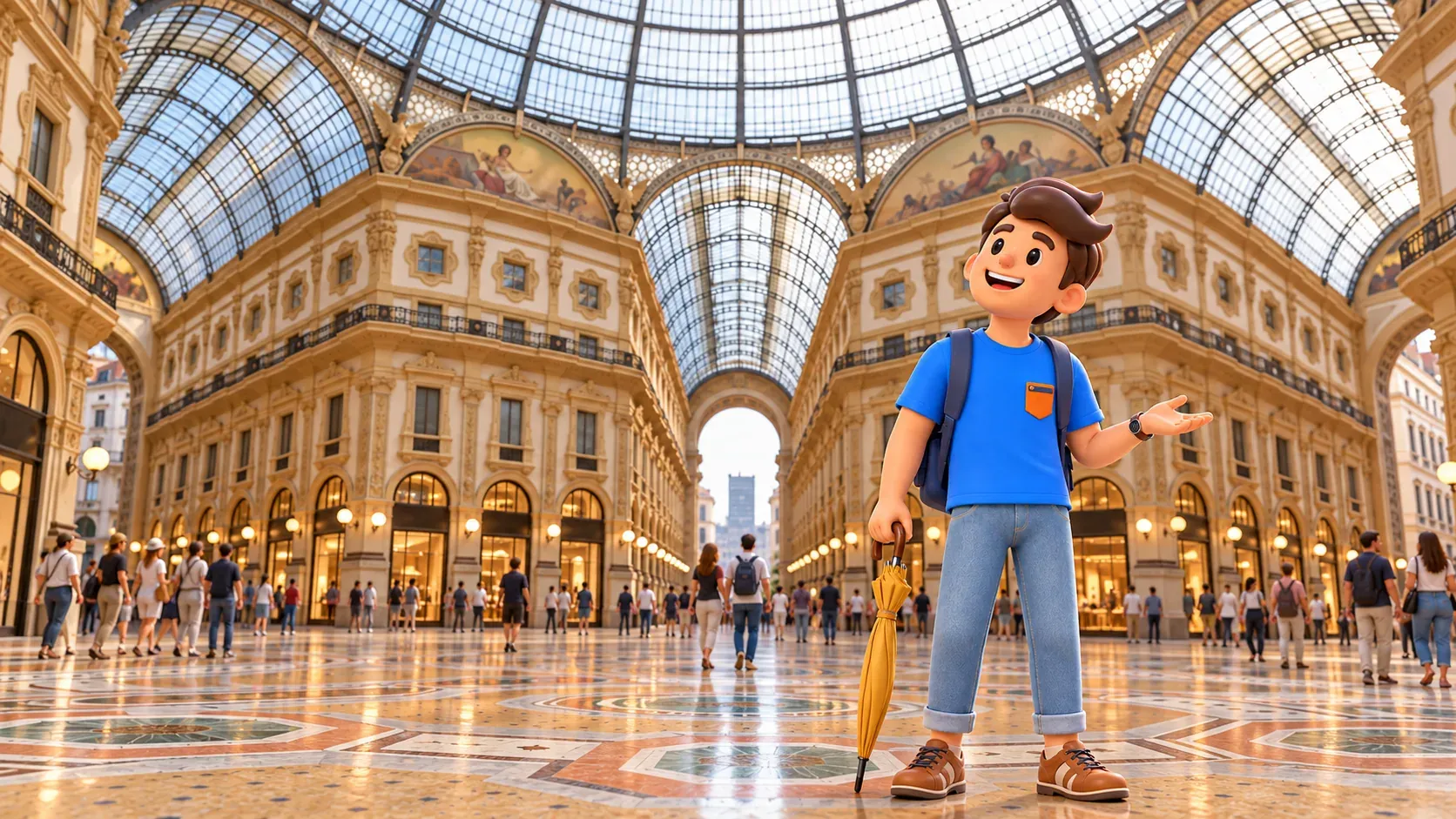
Give the covered passage about 30 minutes. Look up at the structure, then notice how the upper decoration and floor patterns organise the crossing of the arms. Keep clear of entrances and moving crowds while stopping. The cover is a practical benefit, but the space is still a public passage, not a reserved lounge or a promise of an empty interior. Rooftop experiences, shops and restaurants have their own access conditions and opening arrangements. Walking through the arcade does not include admission to every activity in the buildings around it.
Lunch is part of the plan, not unused time
Allow 45 minutes for lunch in the area and choose according to your appetite, budget and the actual availability of a table. Eating inside the Galleria is an option, not a requirement of seeing it. Check a menu before sitting down and keep any short outdoor move to another venue visible in the day’s plan. A café is not guaranteed to have unlimited seating or to accommodate a long wait without an order. One unhurried meal is a more useful pause than repeatedly changing premises whenever the rain becomes noticeable.
Use the break to decide what the afternoon should become. If you have enjoyed the collection, that may be enough culture for the moment. If the weather improves, consider one manageable outdoor activity after checking the conditions, rather than reinstating the whole abandoned morning. Our two-hour walk around the Duomo, Galleria and La Scala provides a separate central outline. It is not an additional two-hour route already included in this four-hour rainy-day example. The reserve is available for a slower lunch, admission delays or the journey onward.
Monday: choose the Ambrosiana instead
When the Museo del Novecento is closed on Monday, consider the Pinacoteca Ambrosiana at Piazza Pio XI 2 as the indoor anchor. Its regular hours are 10:00–18:00, closed Wednesday, with the ticket office closing at 17:15. The institution suggests around 90 minutes for a complete Pinacoteca visit. Treat that as a planning reference, not a timed limit that obliges you to hurry. Ordinary admission is paid; choose the actual ticket and programme for your date rather than assuming a rain-day exception or transferring conditions from the other museum.
The Pinacoteca offers a different emphasis from the twentieth-century collection: paintings and drawings make looking closely at figures, composition and material the centre of the visit. It also gives a way to explore an institution associated with Leonardo’s drawings without promising every page of the Codex Atlanticus on display. Exhibited sheets can change. Our Leonardo-focused Milan day explains that broader choice of places on its own terms. Here, the Ambrosiana replaces the morning museum; it is not a second collection added to the same short plan.
A Monday example is 10:00–11:30 in the Pinacoteca, 20 minutes outdoors towards the Galleria, 30 minutes in the passage, 45 minutes for lunch and a 25-minute reserve. That makes 210 minutes, ending around 13:30. The San Sepolcro Crypt has a different entrance and adds another visit; it is not silently contained in the 90 minutes. The library’s reading room also has its own access arrangements and is not an ordinary tourist shelter included because “Biblioteca” appears in the institution’s name. Wednesday needs a different choice because the Pinacoteca normally closes then.
Make the practical details fit the weather and your needs
Carry only what you are comfortable managing through entrances and galleries. The Museo del Novecento has a staffed cloakroom; ask the staff how to handle a wet umbrella and what can be stored. Do not assume every museum accepts oversized luggage or offers identical storage conditions. Before entering a room, fold and manage wet items as directed rather than letting them drip near exhibits. Shoes suitable for wet paving and a way to keep essential belongings dry matter more than adding a further indoor stop across the city.
If avoiding steps is essential, check the actual museum route and transport approach. The Novecento has accessible lifts between exhibition levels, while the Fontana mezzanine requires a stairlift with staff assistance. Its inclined spiral ramp is not recommended for unaccompanied wheelchair users. Accessible rooms do not certify every crossing and pavement outside. This suggested day concerns ordinary rain; follow local restrictions and transport notices when conditions disrupt movement, and shorten the outing when necessary rather than treating the schedule as an obligation.
Use RoadMe to arrange the remaining days around the balance of art, architecture and neighbourhoods that suits you. A personal trip plan makes the stay easier and more efficient to organise without forcing every interest into the same weather-dependent afternoon.
A rainy day does not need a replacement for every cancelled outdoor stop. One chosen museum, a covered architectural passage and a proper pause can be a complete outing. The useful change is to give those experiences time, keep the short exposed connections honest and leave the rest of Milan for a day when you want to be outside.