Los Angeles Views: Which Panorama Fits Your Trip?
The best Los Angeles view depends on more than height. Griffith Observatory presents the city as a broad landscape; Getty Center connects a panorama with art, architecture and gardens; Vista Hermosa offers a closer relationship with Downtown's skyline. Runyon Canyon and Dante's View suit people who want a hill walk. Jerome C. Daniel Overlook provides a different format: a short roadside stop when access is permitted.
Choose one viewpoint around the area and character of your day. These six places do not form one convenient route and should not compete for the same sunset. This comparison considers the experience, effort and organisation, helping you decide what deserves time on your trip without supplying an exhaustive catalogue of trails, photo positions and interior visits.
Decide what should accompany the view
For an understandable first impression of the city's scale, consider the observatory. For art, architecture and gardens, give Getty Center its own block. For movement on the hills, examine Runyon Canyon or Dante's View with an honest assessment of energy. Vista Hermosa offers a different kind of central-city pause, while a roadside overlook requires its own approach and permitted stopping place.
Let RoadMe develop a personal plan for the whole journey around your interests, dates, budget and pace. The app makes it much more convenient to choose a suitable panorama and connect it with walks, museums and breaks than to squeeze every attractive view into one day yourself.
Then ask how much time the whole visit deserves. Looking at the horizon for ten minutes and reaching the viewpoint are different tasks. The full block includes travel, parking or a transport stop, the approach, the view and the return. Even brief sightseeing becomes an awkward addition if it lies across the city from the rest of your programme.
Do not decide solely from a sunset photograph. Daylight makes the city's arrangement easier to study and the walk easier to finish calmly. Evening provides different light, with opening conditions and the return becoming more important. One appropriate place at a suitable time is more useful than two panoramas connected by constant rushing.
Current conditions affect the choice
At the check date, MRCA announces closures of listed parklands and Mulholland Corridor Overlooks for October 15–17, 2026, during a Red Flag Warning. Jerome C. Daniel Overlook belongs to that corridor's viewpoints. Do not visit during an active closure or treat the following day as an automatically confirmed reopening: the current decision still needs checking.
Vista Hermosa is not named in that published closure list. A shared MRCA website banner does not establish identical closure conditions at every property in its directory. Check the information relevant to your actual destination. This is a comparison of alternatives, not an instruction to immediately visit any hillside regardless of fire or weather restrictions.
Runyon Canyon has a separate notice closing the West Trail until further notice. An older circuit cannot automatically be treated as a permitted route. Red Flag parking restrictions and complete park closure are also different matters. Choosing a panorama does not require attempting to reconstruct an unavailable loop from an older description.
Griffith Observatory: the city as a whole
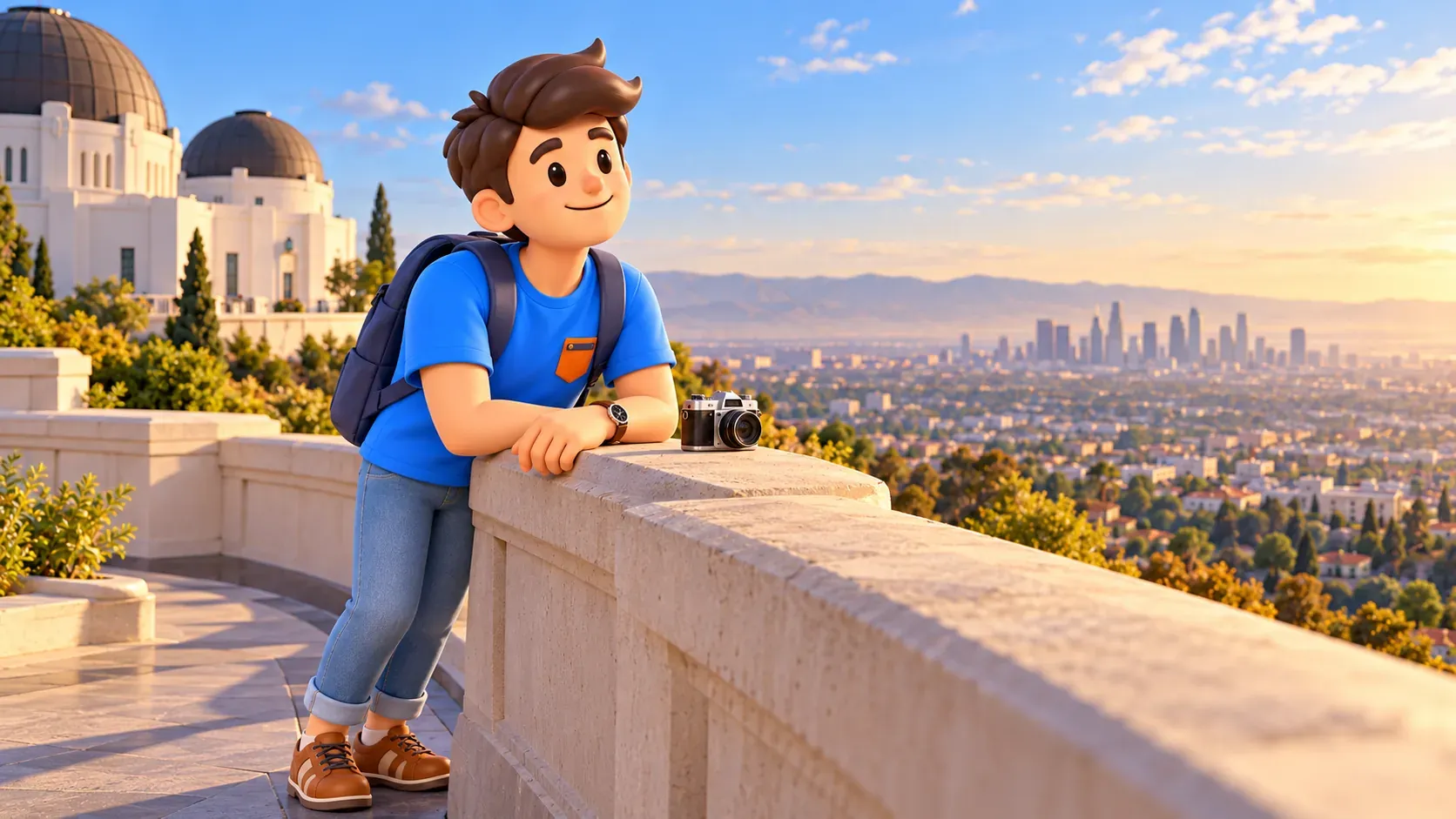
Choose Griffith Observatory when you want to understand the relationship between the urban expanse and the hills while spending time around a recognisable building. Opened in 1935, the observatory connects the panorama with public science. That combination gives this option value: attention can move between the distant city and the public setting immediately around you.
Outdoor viewing and the interior are different programmes. Access to exterior views does not mean the building, a particular show or a chosen exhibition operates at every hour. The building normally closes on Mondays, while the grounds have separate arrangements. If the horizon is your priority, you do not need to promise companions a complete museum evening.
Allow around an hour to an hour and a half locally for an exterior look and a calm pause, with travel and the approach added separately. That is an editorial estimate, not a promise of available parking or visibility. Vehicle parking is limited and can be paid. Public transport requires checking the actual service and suitable return departure.
As a first choice, the observatory combines a clear destination with a broad impression. But if your day is already on the west side, do not add it solely for another photograph. A panorama helps you understand a city when it receives time, rather than becoming the final compulsory task before an exhausted return.
Getty Center: a view with architecture and art
Treat Getty Center as a substantial west-side visit rather than a roadside balcony. Its panoramas belong to a wider experience of buildings, gardens and museum spaces. It suits visitors who want to alternate the open landscape with one artistic interest, without making the entire day depend on a single picture of the horizon.
Admission is free but requires a free timed-entry reservation; parking has separate charges under current conditions. These are different costs and confirmations. The checked regular hours are Tuesday–Friday and Sunday, 10 a.m.–6:30 p.m., and Saturday until 9 p.m.; Monday is closed. Your date's hours and available sections matter more than an older museum schedule.
Some galleries are currently closed for renovation. Do not promise every pavilion or a favourite work without confirming access. Allow several hours if combining views, gardens and a selected museum section. A shorter terrace-focused visit can have its own purpose, but reaching the property and moving from arrival to the upper campus still takes time.
Choose Getty if the place interests you beyond the panorama. Changing visibility then does not remove the visit's meaning: architecture and the available cultural programme remain. Adding the observatory to the same block usually takes attention from both. Giving one complex enough time makes a more satisfying use of this part of the day.
Runyon Canyon: a panorama earned through walking
Runyon Canyon Park suits people who want movement, rather than simply reaching an overlook by vehicle. Its character comes from the urban hills and a walk along available paths. It is not a universally easy outing: terrain, surfaces and individual sections deserve consideration. Popularity does not replace selecting an appropriate level of effort.
Do not plan an obligatory complete circuit with the West Trail closed. Choose a permitted version within your capacity after establishing the current arrangement. The park has no dedicated guaranteed parking space for every visitor, and surrounding streets have their own restrictions. With only a brief gap between appointments, the approach and climbing may dominate the available time.
For an active morning, this format can be more appealing than a museum terrace. Bring water and appropriate footwear, leaving a margin to return in daylight. Do not compare durations only through minutes spent at the view: the outward and return walk belong to the experience. When tired, shorten the outing instead of pursuing somebody else's compulsory endpoint.
Dante's View: a walking destination within Griffith Park
Dante's View is a garden viewpoint in Griffith Park to consider as a hiking destination. That is different from arriving at the observatory for the immediately surrounding exterior spaces. A marker on a map or a short suggested viewing duration does not automatically include the approach. Establish the available trail, ascent and return separately.
If you enjoy a walk followed by a small green pause in the hills, it may suit you. Do not add it casually after the observatory when light or energy is already limited. “Garden” does not promise a vehicle approach directly to a bench or an equally convenient path for every visitor. Without a hiking aim, the observatory's exterior views are easier to frame as a first visit.

Jerome C. Daniel Overlook: a brief stop with an approach
The overlook above the Hollywood Bowl is at 7036 Mulholland Drive. It was built in 1984 in connection with preparations for the Summer Olympics. The relationship between the amphitheatre below and the city beyond is part of its appeal. Ocean and Catalina Island views depend on suitably clear conditions, rather than being guaranteed with every arrival.
Here the relevant format is a short roadside stop after reopening is confirmed, not a new walking connection among all surrounding hills. Arrival, lawful parking and a suitable place to leave the vehicle matter more than a promise of “just a few minutes.” Do not stop arbitrarily on the road for a photograph when the site or parking is unavailable.
During an active Mulholland Corridor closure, remove this option. Once access resumes, it may suit someone already travelling through this area. A separate substantial detour for a short pause needs a particular personal reason. Visiting the overlook does not require adding or promising admission to the Hollywood Bowl itself.
Vista Hermosa: closer to the Downtown skyline
Vista Hermosa Natural Park stands at 100 N. Toluca Street, near Downtown's western gateway. Its paths and vegetation frame a more immediate relationship between greenery and tall buildings, rather than a contest for the farthest horizon. With access confirmed, it can suit a break within a programme already focused on the central city.
You do not need to seek the highest possible point or describe the visit as a major hike. Choose an appropriate public path and time to sit. However, do not promise an entirely level approach from every entrance or a particular available bench. Confirm relevant access and rules, especially when mobility needs influence the choice.
In RoadMe, it is much easier to obtain a personal plan for the entire journey, with views, walks and cultural experiences distributed around your interests and pace. Try organising the days beforehand so the panorama becomes a natural part of the trip while leaving room for rest.

How to make the final decision
For a first broad impression, consider the observatory; for art and gardens, Getty; for active walking, Runyon Canyon or a separate outing toward Dante's View. Vista Hermosa fits a central-city day in character, while Jerome suits an authorised stop on an already appropriate journey. These are distinct roles rather than a universal ranking with one winner.
Compare the chosen role with the calendar, current restrictions and real travel arrangements. Then preserve time simply to look at the city. A useful panorama does not demand the highest ascent, a perfect sunset or every popular photograph. One fitting place where you can stop comfortably is enough to add a sense of scale to your own journey.