Which Dubai viewpoint should you choose: Burj Khalifa, Dubai Frame or The Palm?

The best Dubai viewpoint is the one that shows you what you came to understand. Burj Khalifa gives a high perspective on Downtown, Dubai Frame makes the contrast between different parts of the city its subject, and The View at The Palm reveals the plan of an artificial island. They answer different questions.
For a first visit, choose one main ascent and build the surrounding day around it. Seeing all three is possible across a longer trip, but height alone is a weak reason to repeat the experience. Your interest, the district you already intend to visit and your comfort with elevated spaces are better starting points.
Start with the picture you want to understand
Imagine what would make the visit worthwhile before comparing ticket options. Do you want the scale of Downtown, a clear relationship between older districts and the tower-lined city, or the palm-shaped island seen as a complete piece of engineering? This question narrows the choice more effectively than collecting superlatives.
RoadMe develops a personal Dubai itinerary around your interests, dates and pace, so the viewpoint becomes part of a well-balanced day. The app makes it much more convenient to connect the ascent with the places you actually want to explore.
Next, look at the geography of your existing plan. A Downtown day naturally supports Burj Khalifa, while a Palm Jumeirah day gives The View a clear role. Dubai Frame belongs to the Zabeel side of the city and can provide a different reading of its growth.
The decision is not final until you check the actual product and conditions for your date. A building, its observation experience and an optional attraction are not interchangeable. Compare what is included rather than assuming that a famous name describes a single uniform visit.
Burj Khalifa: choose it for Downtown and the vertical city
Burj Khalifa opened in 2010 and rises to 828 metres as a complete building. That figure describes the tower, not the height of every visitor platform. Observation products use particular levels and arrangements, so read the selected option carefully instead of transferring the building’s full height to your own experience.
The tower’s stepped silhouette is part of its engineering story. Three wings support a central core, and the setbacks change the shape as it rises. The design by SOM brings architecture and structural work together in a form that has become a defining image of modern Dubai.
From above, the useful subject is the organisation of Downtown: the lake near the base, blocks of development and the relationship between large roads and individual buildings. Look for how a landmark is embedded in an urban district rather than trying only to find the most distant object.
Choose Burj Khalifa if the ascent of this particular building matters to you. Its identity is an essential part of the experience. If your main wish is to photograph the tower itself within a skyline, remember that a position inside it answers a different visual question.
Build in time for the arrival process and the route to the correct entrance. A slot is the anchor of the day, not a reason to pack every nearby attraction immediately before and after it. Leave a flexible stretch for looking, resting and returning to ground level.
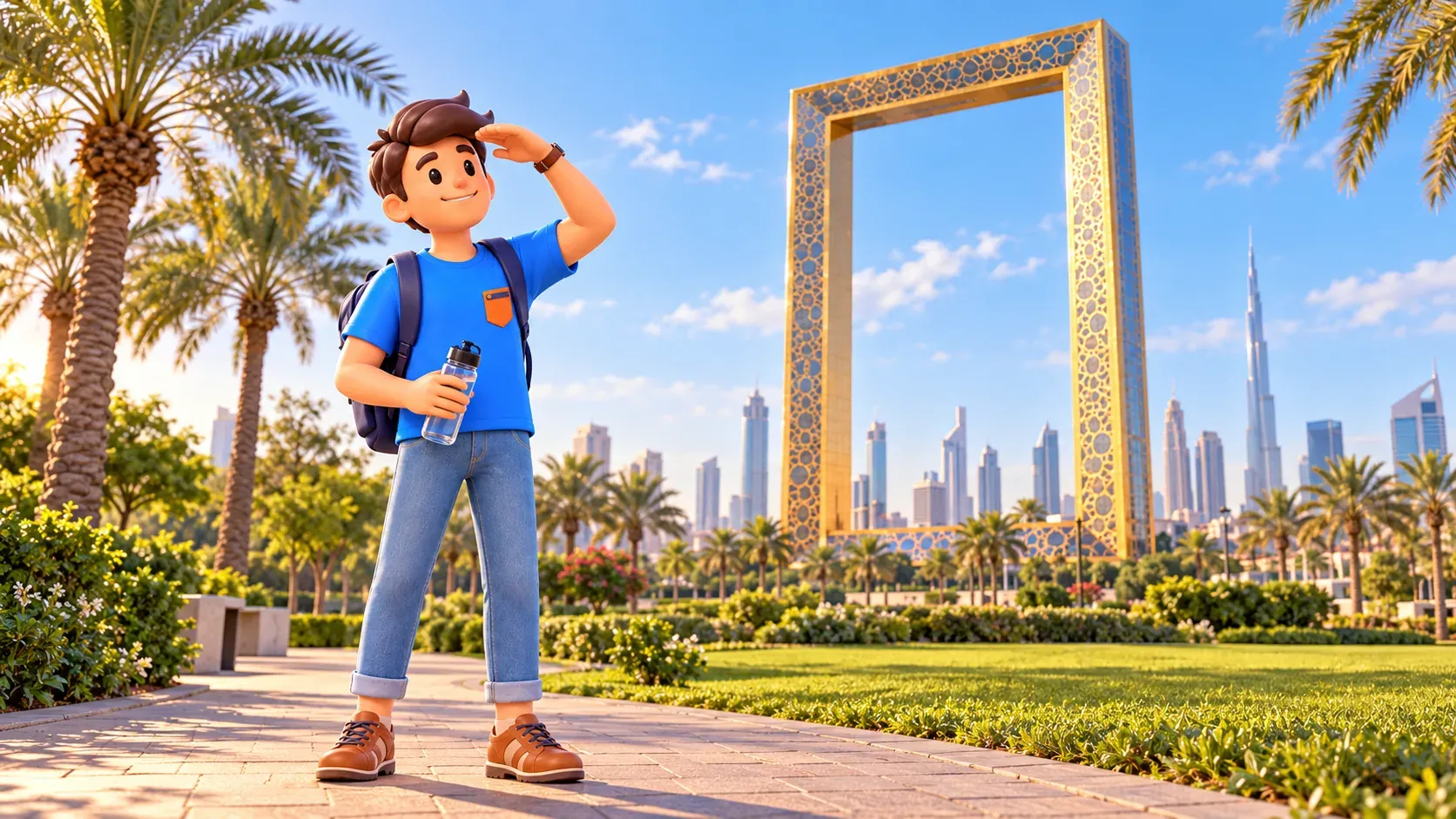
Dubai Frame: choose it to compare different city scales
Dubai Frame opened in Zabeel Park in 2018. Two vertical towers and an upper gallery form a golden rectangular opening. At roughly 150 metres tall, it works with a different relationship to the city than a very high skyscraper viewpoint.
The project’s idea is to frame views of the existing city. The contrast between older, more compact urban areas and the taller modern skyline gives the visit a clear subject. Its value is not simply being another platform at another height.
The gold-toned surface has a circular pattern that becomes more apparent as you approach. From the park, look at the size of the open rectangle and the comparatively narrow supports. The empty space is an important part of the architecture: the city becomes the content of the frame.
Choose it if you enjoy understanding how a place developed or want a viewpoint with a strong architectural concept. It can also suit a visit where a park setting matters to the rhythm of the day. Check the current admission arrangements instead of treating park and landmark access as automatically identical.
On the upper level, allow attention for both directions of the city rather than concentrating entirely on one photograph. If transparent surfaces worry someone in your group, establish the current layout and available route before committing. Different elevated experiences can feel very different even at lower heights.
The View at The Palm: choose it for the island’s geometry
The View at The Palm opened in Palm Tower in 2021. Its main observation level is around 240 metres above the ground. The point is not merely the distance upward: the viewpoint helps reveal a landscape whose overall shape is hard to read while moving between its roads and buildings.
Palm Jumeirah began as a major land-reclamation project announced in 2001. Its central trunk, branching fronds and surrounding crescent create a recognisable outline. From a high position, the connection between that outline and the actual arrangement of land and water becomes easier to understand.
The fronds extend the waterfront, while the outer crescent has a protective role. These are different elements of one engineered landscape. Look for their relationship rather than treating the island only as the background to a hotel photograph.
Choose The View if the shape of the Palm is something you specifically want to see. It also fits a coastal day more naturally than a cross-city detour made only to add another observation deck. Distinguish the basic observation visit from any other level, package or experience currently offered.
Afterwards, give the day a change of scale. A meal or a modest ground-level stop can complement the overview, provided its actual location and access fit your plan. There is no need to cross the whole island simply because you have seen its outline from above.
Use light and visibility as part of the choice
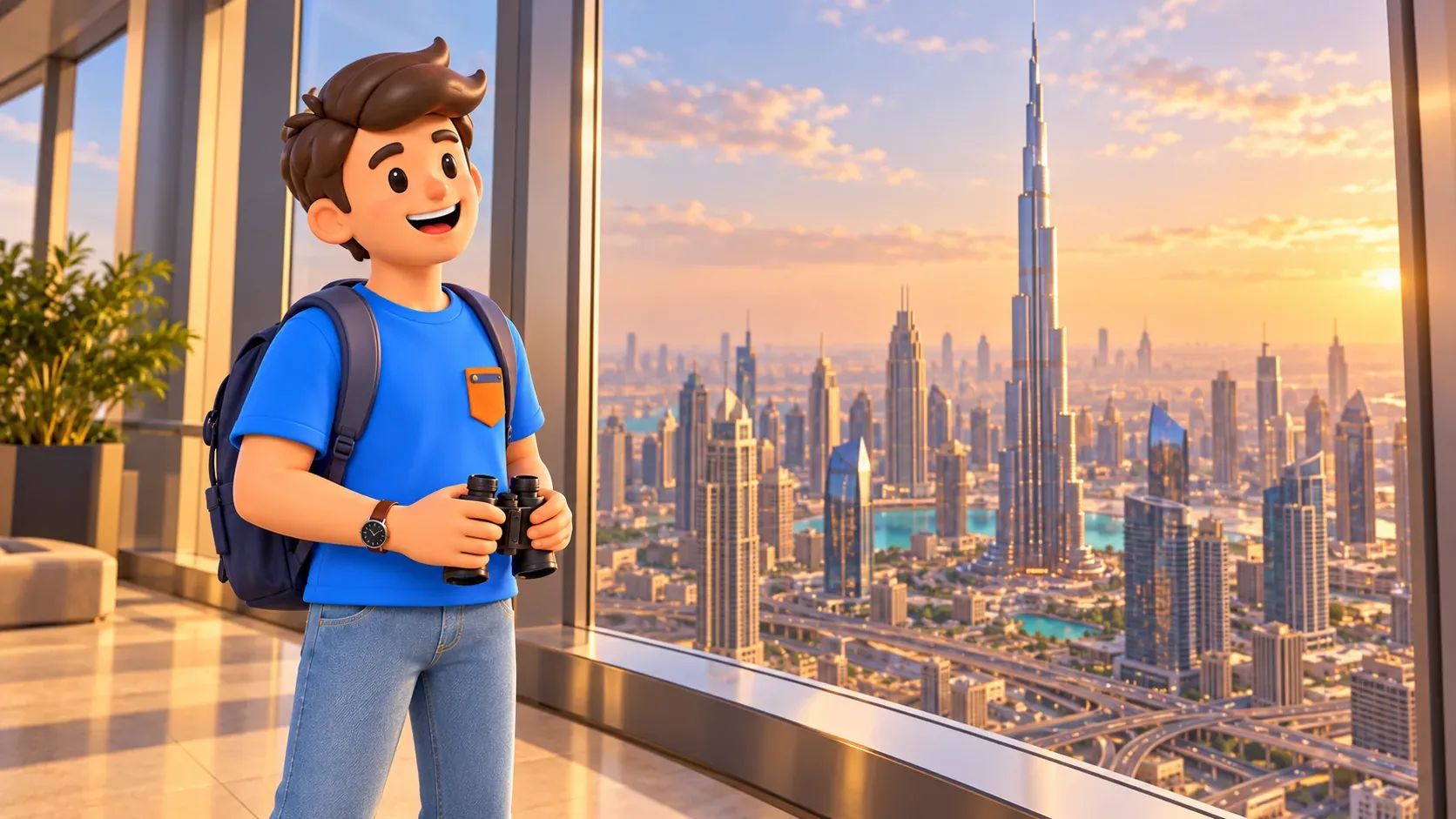
Daylight is useful when your main interest is recognising the structure of the city or island. Twilight offers a transition in atmosphere, while darkness shifts attention towards illuminated roads and buildings. None of these is universally best: choose according to the subject you care about.
A sunset booking does not guarantee a clear sunset or a particular photograph. Haze, cloud and changing light affect what is visible, and the actual experience also depends on the viewing position. Treat a time of day as a preference, with room for conditions to differ.
If you want a photograph of a landmark, ask whether it will actually be in front of you from that position. Being inside the tallest building and seeing that building in a wider skyline are distinct goals. The same applies to seeing the Palm’s plan and being beside one of its waterfronts.
Keep expectations realistic for the equipment you carry. Glass, reflections and other visitors can change a composition. A simple image and a few moments of direct observation can make a better visit than spending the entire session trying to reproduce a promotional panorama.
Compare the whole visit, not only the ticket
Before choosing, check the correct entrance, current booking options, the scope of the product and the travel required from your base. Add the onward connection and a pause. These surrounding decisions often determine whether the viewpoint improves the day or makes it feel overfilled.
For a family or mixed group, discuss comfort with lifts, heights and transparent elements in advance. Do not assume that everyone who enjoys a skyline will enjoy the same physical setting. Choose the shared experience that the group can approach comfortably.
RoadMe can turn your priorities into a personal day-by-day trip plan instead of a list of unrelated attractions. Use the app to give one well-chosen viewpoint its place among neighbourhoods, culture and rest, with a pace that suits you.
A short trip usually benefits from selecting one. On a longer visit, add a second only when it contributes a genuinely different subject, such as moving from Downtown’s vertical scale to the Palm’s engineered coastline. Repeating the same kind of view simply because it is available need not become a goal.
Keep a flexible part of the day outside the timed visit. If arrangements change, use it for a nearby activity you have actually checked rather than rushing across the city to replace one ascent with another. The itinerary should remain useful without a contest to complete all three.

If two people favour different viewpoints, let each explain the subject they want to see rather than arguing over the tallest option. A shared reason for the choice is a useful beginning to the day.
Make a choice you can explain in one sentence
Choose Burj Khalifa because you want to ascend that landmark and understand Downtown from above. Choose Dubai Frame because you want an architectural comparison of different city scales. Choose The View at The Palm because the island’s geometry is the subject that interests you.
Then verify the current product and conditions, reserve the time you need and organise a coherent surrounding day. This final step is more useful than searching for a winner that must suit every visitor. Different viewpoints are valuable precisely because they reveal different things.
A satisfying visit leaves you with a clearer picture of Dubai, not just another height recorded. One perspective, chosen for a reason and given enough room in the day, can be more memorable than several hurried ascents.