Bangkok BTS and MRT: tickets, payment and transfers
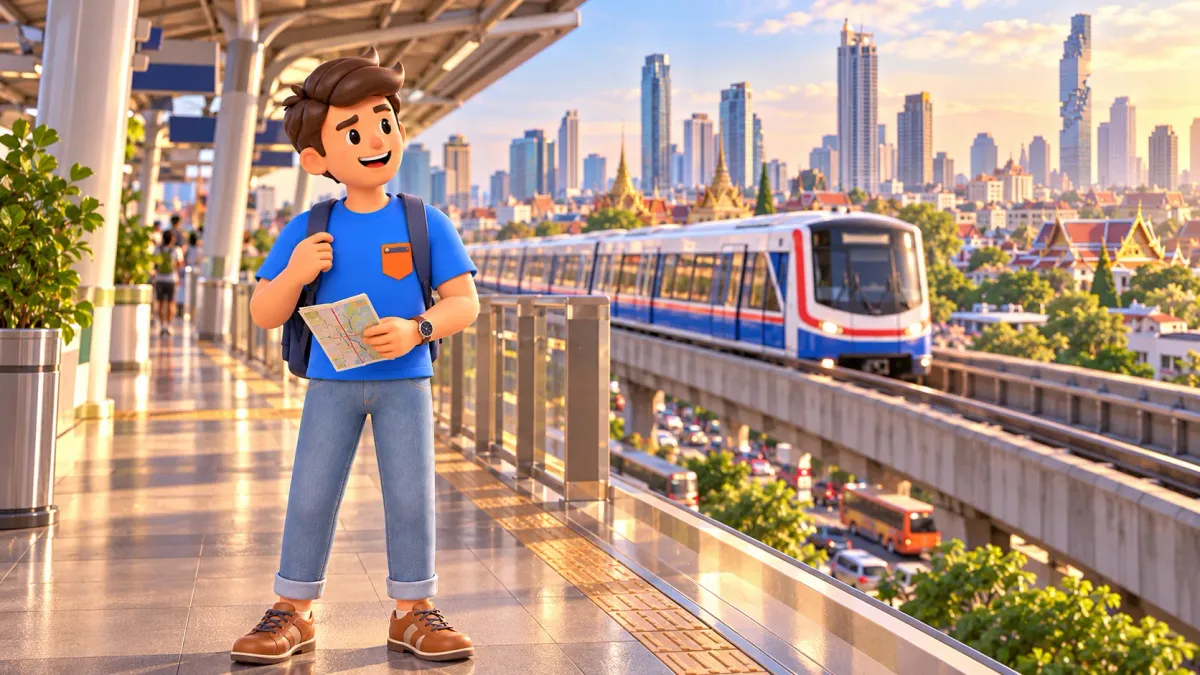
Use Bangkok’s rail network by choosing the line first and the payment method second. The BTS Skytrain and MRT meet at useful interchanges, but they do not form a single ticketing system. A card that opens one set of gates may be unsuitable for the next part of your journey. For a first visit, learn the two main BTS lines, the MRT Blue Line and the interchange names that connect them.
This guide explains how to buy a ticket, enter and leave correctly, choose a platform and change systems. It focuses on ordinary journeys around Bangkok rather than a sightseeing itinerary. Check the current fare and final departure for your actual stations: a general statement about “Bangkok metro prices” cannot describe every line and product.
Start with your destination, not a transport card
The main BTS Skytrain routes are the Sukhumvit and Silom lines. They serve many central shopping, business and accommodation areas, including Siam, Asok and Sala Daeng. MRT is a separate group of lines; the Blue Line is particularly useful for visitors moving between central districts and important interchange stations. Although many MRT stations are underground, not every section is.
Find the place you want to visit before choosing the nearest coloured line. Then look for a suitable station exit and the final walk. A slightly longer train journey can be easier than approaching a building from the wrong side of a major road. Conversely, a sensible walk can remove an unnecessary change and a second ticket purchase.
Planning each visit from scattered notes is less convenient than building a personal trip in RoadMe: the app creates a day-by-day plan around your dates, interests and pace. Try starting with a programme that suits you, then choose the transport that connects its visits.
| Network | Why it matters | Payment approach |
|---|---|---|
| BTS Sukhumvit and Silom | The main Skytrain lines, connected at Siam | Single Journey Card, Rabbit or a suitable BTS pass |
| MRT Blue Line | Central districts and several useful interchanges | Single-journey token, a suitable MRT product or an accepted bank card |
| MRT Purple Line | Connects with the Blue Line at Tao Poon | Check BEM’s conditions for the journey and product |
| Other urban railways | Airport and monorail journeys may involve another operator | Confirm the line’s accepted media and fare separately |
A common map is a navigation aid, not proof of common tickets. Do not apply Blue Line payment rules to every railway called MRT, or assume a BTS product covers the Gold Line and every monorail. At the entrance, read the actual operator and line name. The promise of a card “for all Bangkok trains” needs specific product conditions to be meaningful.

Why the networks feel different
The Skytrain started operating in 1999, adding an elevated railway to a city already shaped by busy roads and dense development. Looking out of a BTS carriage gives a useful sense of Bangkok’s scale: elevated walkways, commercial buildings and road junctions sit at different levels. Later railway projects and extensions helped build the larger network shown on today’s maps.
For visitors, the practical legacy is that infrastructure and fare arrangements have developed through different systems. An interchange symbol can make a connection look as simple as changing platforms at home. In reality, you may need to finish one paid journey, follow signs through a passage or outdoor connection and enter another system.
Think of each connection as a small sequence rather than a single dot. It has an exit from the first network, a walking section, a ticket or payment step and an entrance to the next. Once you expect those stages, the different station names and gates become much less confusing.
Buying a single BTS ticket
A Single Journey Card is a straightforward starting point when you only need a few trips or have not decided how much you will use the Skytrain. Choose your destination before paying. Buying for an arbitrary station and continuing farther can leave you needing a fare adjustment before the exit gates.
- Confirm that the entrance belongs to BTS and locate your destination on its map.
- Select the destination at a ticket machine, or show its name at the ticket office.
- Check the number of passengers and the payment methods displayed on that particular machine.
- Collect the ticket and any change before stepping away.
- Follow the reader’s instructions and pass through individually.
Keep the English station name in your notes. It is generally more useful at a ticket office than an informal description of a neighbourhood. If travelling with someone else, check that you have bought the intended number of tickets rather than assuming one card will admit a group.
Do not expect every machine to accept every banknote, bank card or QR-payment app. Available methods should be shown at the machine. If yours is not available, use the ticket office rather than repeatedly trying the same transaction. A small cash reserve in Thai baht remains useful even if you also carry a suitable payment card.
Keep the ticket until you have left the system. It is evidence of the paid journey, not simply an entrance receipt. Follow the exit-gate instructions for the media you hold: a single-use ticket may be retained, while a reusable card is tapped and kept. Never discard it after boarding because you assume the fare has already been settled.
BTS single-journey tickets are for use on the purchase date during operating hours. They are not a useful way to stock up for future days. If the destination is wrong, the ticket is damaged or a gate rejects it, speak to staff before trying another route through the barriers.
When Rabbit is useful
Rabbit is a rechargeable payment card used on BTS under the conditions of its particular product. Its practical appeal is convenience: you do not have to buy another single-journey ticket for every eligible trip. A Rabbit card is not automatically an unlimited pass, an all-network ticket or the cheapest option for every visit.
Ask what the initial payment contains. A card-issuance charge, money stored for fares and a package of journeys are different things. The entire purchase price should not be treated as travel credit. Equally, comparing the cost of a new card with the price of one ride tells you little about whether it will be useful over your stay.
Have your passport available when arranging a card and ask about the current identification requirements for foreign visitors. Linked electronic wallets and promotional packages can have additional conditions. A travel article describing a package does not establish that every visitor can activate it with any telephone number or document.
Do not assume that your BTS Rabbit balance will open the MRT Blue Line gates. A journey using both networks needs an appropriate payment method for each part. For a short visit, buying several rechargeable cards can add unnecessary administration; a single ticket in one system and a supported card in another may be simpler.
Before leaving Bangkok, check the refund rules for your exact card and balance. Issuance charges, stored money and unused promotional trips are not interchangeable. Avoid loading a large amount just before departure unless you need it for planned journeys. A refund procedure can take longer than a quick stop at a gate.
Deciding whether a day pass makes sense
Consider the BTS One-Day Pass when you expect several eligible journeys within the same day. The useful comparison is your actual list of stations against the current pass price, not a slogan saying that a fixed number of rides always makes a pass worthwhile. Different trip lengths can produce different totals.
List the journeys you would take anyway and obtain their current single fares. Add them together, then compare the result with the product offered at the ticket office. Count MRT and other operators separately unless the pass explicitly includes them. Do not add unnecessary rides just to make a prepaid purchase seem good value.
A day pass should not be interpreted as any rolling twenty-four-hour period from the first tap. BTS conditions tie it to the relevant day. If you buy in the evening, clarify when it expires. Also confirm the eligible lines and sections instead of relying on a nearby BTS logo or the colour of a route on a general map.
A useful decision rule is practical rather than absolute. Start with single tickets for one outward journey and a long visit in one area. Compare a day pass for repeated BTS journeys. Consider a rechargeable card for the convenience of regular use over a longer stay. These are selection scenarios, not guarantees that one product is invariably cheaper.

Paying on MRT: tokens and contactless cards
For an ordinary single journey on the MRT Blue Line, a token provides a useful option without setting up a rechargeable product. Choose the destination, pay the displayed amount and collect the token. At a staffed counter, show the station name and specify the number of passengers. Keep the token until the journey is finished.
To enter, present the token to the gate reader. At the destination, return it through the token slot indicated on the exit gate. A rechargeable card works differently: it is tapped and retained. Looking at the pictogram before using the barrier is easier than trying to retrieve a card from the wrong opening.
BEM also accepts specified contactless bank cards on its Blue and Purple lines. Its published conditions distinguish internationally issued credit cards from debit products: international Visa and Mastercard credit cards are listed, while debit eligibility is limited to named Thai issuers. A familiar logo and a contactless symbol therefore do not, by themselves, establish that every foreign debit card is accepted.
Use the same accepted card or device for entry and exit. Do not casually change between a physical card and a phone during one journey. Remove the card from your wallet so several cards are not presented to the reader together. On a first attempt, keep enough flexibility to buy a token if the card is unsuitable.
A rejection does not necessarily mean the account is empty. The product may be unsupported, restricted by its issuer or affected by an incomplete previous journey. Avoid repeated attempts at different gates and do not hand the card to an unsolicited helper. Ask station staff to clarify the problem and use an ordinary ticket where appropriate.
Four interchange pairs worth recognising
A connection between BTS and MRT often has two names, one for each system. Save both names before travelling, particularly if you will return the same way. Asok on BTS and Sukhumvit on MRT can describe the two ends of one interchange rather than unrelated destinations in different districts.
| BTS station | MRT station | Practical point |
|---|---|---|
| Asok | Sukhumvit | Follow the signs for the next network after completing the first journey |
| Sala Daeng | Silom | Different names; do not assume a shared paid area |
| Mo Chit | Chatuchak Park | Check the correct exit and approach to the next station |
| Bang Wa | Bang Wa | An identical name does not make the tickets interchangeable |
Siam connects the BTS Sukhumvit and Silom lines. That is different from changing operators: your main task is to identify the correct platform and direction. Read the destination shown for the train and locate your stop along that direction. Do not board simply because the line colour looks familiar.
When moving from BTS to MRT, normally expect to end the first paid journey and begin another. Add the walk, gates and possible ticket queue to your travel estimate. An option involving fewer minutes in a carriage can still be less convenient if it introduces an awkward transfer with luggage.
A compact journey note can contain three parts: first network and boarding station; interchange pair; final station and exit. That is enough to show a staff member if mobile reception is poor or your battery fails. It is usually clearer than showing a screenshot containing several unrelated route alternatives.

The station exit can matter as much as the line
The nearest station is not necessarily the easiest approach to your destination. A large road, fence or inconvenient crossing can separate a building from a nearby entrance. Look at the exit diagram before going up to street level. If you need help, show the exact place rather than only a general district name.
With a suitcase, pushchair or reduced mobility, check the complete approach. A station next to your accommodation does not establish a step-free journey: the useful lift may be at another entrance, and an interchange may include another walking section. Do not treat someone else’s estimated walking time as a guarantee for your circumstances.
Heat and heavy rain can make a short-looking walk the least comfortable part of the trip. Compare the number of train changes with the final approach, shelter and opportunities to pause. A different exit or a slightly different journey can be more useful than shaving a station off the rail section.
Once the transport is clear, let RoadMe put the visits into a personal programme built around your interests and preferred pace. Try choosing what you want from Bangkok—art, urban history or new experiences—rather than assembling each day from dozens of disconnected suggestions.
Late journeys, luggage and everyday comfort
Do not plan a late return around a general claim that trains run until midnight. The final train passes individual stations at different times, and a connecting line may have finished before you reach it. Check your boarding station, direction and every necessary connection, leaving a sensible margin for the transfer.
With luggage, locate a suitable entrance and keep the passage clear. Do not assume any size of bag has a guaranteed dedicated space on board. If a bag makes the normal gate awkward, ask staff for the appropriate passage instead of holding the barriers open or lifting possessions over a fence.
Allow passengers to get off before boarding, and step aside when reading a map near gates or platform access. Keep tickets, cards and travel notes easy to reach. These small arrangements make the first trip calmer without requiring you to memorise the entire network or rush through unfamiliar ticket equipment.
If a line is interrupted or an exit is closed, follow station information and staff directions. An alternative railway shown nearby on a phone can still require a substantial walk. Before changing to road transport, establish the pickup point and exact destination rather than accepting an offer solely because someone is standing near the entrance.

A simple check before leaving your accommodation
- Know the first system. BTS and MRT require their own ticketing decisions.
- Save both interchange names. The BTS name may differ from the MRT name.
- Choose payment for every section. A rechargeable balance or contactless logo is not universal acceptance.
- Keep the ticket until the exit. Lost or damaged media should be taken to staff.
- Check the useful exit. Think about the walk to the actual entrance of your destination.
- Confirm a late connection. Check the final departure from the relevant station, not only network-wide hours.
For general background, see our guide to public transport tickets, zones and validation abroad. Bangkok adds a particularly useful local habit: identify the network and journey first, then decide how to pay. Once those pieces are settled, changing systems becomes an ordinary part of exploring the city.